Showing posts with label Women in STEM. Show all posts
Showing posts with label Women in STEM. Show all posts
Saturday, September 03, 2016

Saturday, April 30, 2016
On my evolving thoughts on the #UCDavis saga involving Chancellor Linda Katehi
Still trying to wrap my brain around the controversy at UC Davis involving our Chancellor (the head of the University) Linda Katehi (see some of these news stories if you are not aware of what is going on). In some sense I could just watch this all from the sidelines and see what happens. But that is not in my nature. And, over the last month I have gotten a near endless stream of comments and suggestions (some in private, some in public) about the topic. Some say I need to be more vocal in condemning Chancellor Katehi (e.g., a student in my lab told me the other day that they have talked to faculty who are wondering why I am being so hesitant to condemn Chancellor Katehi). Other people (many) say any negative posts about Katehi are damaging UC Davis. Still others say and and all actions of Katehi must be considered in the context of overwhelming sexism against female leaders. And so on. In total I have probably gotten dozens of private comments and even more public comments about the case with suggestions for what I should be doing here.
For those who know me or know about me, I assume you know I am not exactly shy about expressing my opinions on topics like behavior of academics or academic institutions. For example, just after joining UC Davis I wrote a post that was shared widely, condemning a UC Davis Vice Provost over her misuse of her position in support of Closed Access publishing: Vice Provost of U. C. Davis on the wrong side of Open Access.

I give out all sorts of snarky awards on my blog to friends, colleagues, and other folds in the world for doing things I think are inappropriate (e.g., see this STAT story). Sometimes I go overboard in this, but certainly I am not hesitant at expressing thoughts when I think there has been something untoward going on. I try as much as possible to turn my microscope on myself and UC Davis too. For example, see this post from a few weeks ago: UC Davis Storer Lecture series - since 1963 87% of speakers are male.
But the case of Chancellor Katehi leaves me on the fence and with my fingers unclear what to type somewhat. And so I thought I would try to write up what my thoughts are here, even if they are muddled. I wonder what other people think of the situation and would love feedback (as always) on this post.
So - what is so complex here? What am I trying to wrap my brain around? I think my challenge here comes down to the following: I don't know whether some of the responses (including mine) to Chancellor Katehi's actions are tinged with bias, especially sexism. Or, in other words, are the actions and inactions of Chancellor Katehi "firing offenses" or have they been overblown by biased and sexist points of view.
And honestly, I do not know exactly how to figure this out. On the one hand, I accept that there are massive amounts of sexism in society and certainly in regard to how we judge women in power. On the other hand, I think the actions and inactions of Chancellor Katehi and her administration have been serious (in a bad way). I note - one thing I have done to try and better understand my own feelings and actions in this saga is to compile all my posts and communications as best I can and go through them.
This has helped me sort out my thoughts and also helped show me at least that I was certainly not going easy on the UC Davis administration over these cases. I also re-examined my posts about the Pepper Spray incident and aftermath from 2011 which has many parallels to the current situation and also involved Chancellor Katehi. See here for those: posts about the UC Davis Pepper Spray Incident and Aftermath.

Below is a discussion based in part on going through the news stories and posts of others and posts of mine.
Maybe it is best to start with this. A few weeks ago I was pondering the fate of Chancellor Katehi and I wrote a detailed post about this The #UCDavis Chancellor's Board Positions and the Need for a More Public, Open and Early Disclosure System.

I also included in that discussion some possible conflicts of interest of my own that might be clouding my judgment. Those are relevant to this post too and I encourage people to read them. Anyway, this post was written at the beginning of the latest controversy when all that had been disclosed was her acceptance of a set of outside Board positions that were controversial. I had written many mini posts and Tweets about the situation such as those below:
And I also had started to see some calls for her to be fired and such and made a point to say I did not feel things were that far along and I also linked to some of those posts.
For those who know me or know about me, I assume you know I am not exactly shy about expressing my opinions on topics like behavior of academics or academic institutions. For example, just after joining UC Davis I wrote a post that was shared widely, condemning a UC Davis Vice Provost over her misuse of her position in support of Closed Access publishing: Vice Provost of U. C. Davis on the wrong side of Open Access.

I give out all sorts of snarky awards on my blog to friends, colleagues, and other folds in the world for doing things I think are inappropriate (e.g., see this STAT story). Sometimes I go overboard in this, but certainly I am not hesitant at expressing thoughts when I think there has been something untoward going on. I try as much as possible to turn my microscope on myself and UC Davis too. For example, see this post from a few weeks ago: UC Davis Storer Lecture series - since 1963 87% of speakers are male.
Again, I know I overdo this sometimes but I am certainly not hesitant to make my feelings know.Painful: #UCDavis Storer Lecture series - since 1963 87% of speakers are male https://t.co/uaBbnxPv5T pic.twitter.com/9GuFORRiqu— Jonathan Eisen (@phylogenomics) April 21, 2016
But the case of Chancellor Katehi leaves me on the fence and with my fingers unclear what to type somewhat. And so I thought I would try to write up what my thoughts are here, even if they are muddled. I wonder what other people think of the situation and would love feedback (as always) on this post.
So - what is so complex here? What am I trying to wrap my brain around? I think my challenge here comes down to the following: I don't know whether some of the responses (including mine) to Chancellor Katehi's actions are tinged with bias, especially sexism. Or, in other words, are the actions and inactions of Chancellor Katehi "firing offenses" or have they been overblown by biased and sexist points of view.
And honestly, I do not know exactly how to figure this out. On the one hand, I accept that there are massive amounts of sexism in society and certainly in regard to how we judge women in power. On the other hand, I think the actions and inactions of Chancellor Katehi and her administration have been serious (in a bad way). I note - one thing I have done to try and better understand my own feelings and actions in this saga is to compile all my posts and communications as best I can and go through them.
This has helped me sort out my thoughts and also helped show me at least that I was certainly not going easy on the UC Davis administration over these cases. I also re-examined my posts about the Pepper Spray incident and aftermath from 2011 which has many parallels to the current situation and also involved Chancellor Katehi. See here for those: posts about the UC Davis Pepper Spray Incident and Aftermath.

Below is a discussion based in part on going through the news stories and posts of others and posts of mine.
Maybe it is best to start with this. A few weeks ago I was pondering the fate of Chancellor Katehi and I wrote a detailed post about this The #UCDavis Chancellor's Board Positions and the Need for a More Public, Open and Early Disclosure System.

I also included in that discussion some possible conflicts of interest of my own that might be clouding my judgment. Those are relevant to this post too and I encourage people to read them. Anyway, this post was written at the beginning of the latest controversy when all that had been disclosed was her acceptance of a set of outside Board positions that were controversial. I had written many mini posts and Tweets about the situation such as those below:
This is why I no longer use textbooks for courses. UC Davis chancellor received $420,000 on book publisher’s board https://t.co/q1evG9aTcG— Bruce Rannala (@BruceRannala) March 5, 2016
And I also had started to see some calls for her to be fired and such and made a point to say I did not feel things were that far along and I also linked to some of those posts.
Am very disappointed in board membership choices by #UCDavis Chancellor Katehi but calls for resignation seem woefully reactionary (1/n)— Jonathan Eisen (@phylogenomics) March 5, 2016
Not trying to defend choices - I think she needs to disclose more details and actions (e.g., on Wiley) & how there was no COI (2/n)— Jonathan Eisen (@phylogenomics) March 5, 2016
But at this time, as far as I can tell no laws or policies were violated (actually it seems UC pushes / encourages board membership) 3/n— Jonathan Eisen (@phylogenomics) March 5, 2016
So rather than hanging Katehi out to dry as Janet Napolitano has done, better if UC took some responsibility 4/n pic.twitter.com/ovR7SY4Xet— Jonathan Eisen (@phylogenomics) March 5, 2016
What we need to do is systematically reverse the corporatization of UC from the top to the bottom and not just pick at one scab 5/n— Jonathan Eisen (@phylogenomics) March 5, 2016
#UCDavis Profs Niemeier & Beamish on UC Admins sitting on boards: Let’s focus on the process, not the person https://t.co/PWRY0ilXQd— Jonathan Eisen (@phylogenomics) March 10, 2016
Wednesday, April 01, 2015
Four simple tools to promote gender balance at conferences - guest post from Julie Pfeiffer @jkpfeiff
Guest post from Julie Pfeiffer.
Julie Pfeiffer
Associate Professor of Microbiology
University of Texas Southwestern Medical Center
https://twitter.com/jkpfeiff
http://www4.utsouthwestern.edu/pfeifferlab/Index/Home.html

1. Know that you are biased. Identify your biases.
We all have biases and many of them are unconscious. You can discover your own biases using online social attitude tests developed by Project Implicit, a non-profit organization affiliated with Harvard University. The Gender-Science Implicit Association Test is particularly relevant here. It turns out that I have moderate bias linking science with males, as well as other biases. Knowing this fact has been extremely important. It is very difficult to alter unconscious bias, but it is easy to understand that you are biased and edit your actions accordingly. For example, if I need to make a list of potential speakers or authors quickly, the list will be of senior men from the United States. The key is to spend time EDITING the list to ensure diversity.
2. Keep track of numbers.
Most individuals in leadership positions are not seeking to exclude women or other groups from plenary talks, career opportunities, etc. Instead, they simply forget to count. They forget to keep track of gender ratio and other types of diversity. They forget to edit. When leaders/organizers have diversity in mind, diversity is relatively easy to achieve. Two examples illustrate this point:
1) Vincent Racaniello is President of the American Society for Virology and his goal was to put together an outstanding and diverse group of plenary speakers for the annual meeting in 2015. He asked for speaker suggestions via emails and Twitter (https://twitter.com/profvrr). He made a list and he edited it. The result? The best representation of female scientists at a conference I have ever seen--- 50% of the plenary speakers at ASV this year are female.
Julie Pfeiffer
Associate Professor of Microbiology
University of Texas Southwestern Medical Center
https://twitter.com/jkpfeiff
http://www4.utsouthwestern.edu/pfeifferlab/Index/Home.html
Four simple tools to promote gender balance at conferences
1. Know that you are biased. Identify your biases.
We all have biases and many of them are unconscious. You can discover your own biases using online social attitude tests developed by Project Implicit, a non-profit organization affiliated with Harvard University. The Gender-Science Implicit Association Test is particularly relevant here. It turns out that I have moderate bias linking science with males, as well as other biases. Knowing this fact has been extremely important. It is very difficult to alter unconscious bias, but it is easy to understand that you are biased and edit your actions accordingly. For example, if I need to make a list of potential speakers or authors quickly, the list will be of senior men from the United States. The key is to spend time EDITING the list to ensure diversity.
2. Keep track of numbers.
Most individuals in leadership positions are not seeking to exclude women or other groups from plenary talks, career opportunities, etc. Instead, they simply forget to count. They forget to keep track of gender ratio and other types of diversity. They forget to edit. When leaders/organizers have diversity in mind, diversity is relatively easy to achieve. Two examples illustrate this point:
1) Vincent Racaniello is President of the American Society for Virology and his goal was to put together an outstanding and diverse group of plenary speakers for the annual meeting in 2015. He asked for speaker suggestions via emails and Twitter (https://twitter.com/profvrr). He made a list and he edited it. The result? The best representation of female scientists at a conference I have ever seen--- 50% of the plenary speakers at ASV this year are female.
Wednesday, March 25, 2015
Calling attention to poor speaker gender ratio - even when it hurts
So I saw this Tweet earlier today
And that sounded very interesting. So I clicked on the link to check out the Plant Breeding for Food Security: The Global Impact of Plant Genetics in Rice Production A symposium honoring Dr. Gurdev Khush symposium. And, then I went to the program. And sadly I saw something there that was not to my liking. The speakers were almost all male (men labelled in yellow, women in green)
So I posted to Twitter a response:
But that did not seem sufficient. So I wrote up this post. Underrepresentation of women as speakers is a serious issue in STEM fields. And it is solvable (e.g., see Some suggestions for having diverse speakers at meetings by myself and the wonderful Ten Simple Rules to Achieve Conference Speaker Gender Balance by Jennifer Martin).
Now - do I know who the possible speakers were for this symposium? No - I don't really know the field. Is it possible that there just are no women in the field? Sure. But I would bet anything that is not the case here. Having a meeting where the ratio of speakers is 16:1 male: female sets a bad example. UC Davis and the organizers of this meeting can do better. And though this will possibly hurt me in various ways (I already got grief from one person who I will not name for the Tweet), I think it is critical that we call out examples such as this.
And finally I note - I have taken on the issue of women at STEM conferences and meetings because, well, it is easy to identify cases where the numbers are anomalous and it is relatively easy to solve. But it is also important that we consider other aspects of diversity of speakers (age, ethnicity, career stage, etc). It is important to have diversity of speakers at meetings for many many reasons. Speaking is a career building opportunity. Speakers serve as role models for others. Diverse points of view are important to have represented. Bias - whether simplicity or explicit damages the whole practice of science. And more. Yes, we need to work on many aspects of diversity in STEM fields. Improving the diversity of speakers at meetings is but one part of this. But it is an important part and it is relatively easy to do. So just do it. And call attention to it. Even if it hurts.
Will be an excellent symposium! Register here @UCPlantBreeding http://t.co/Nd86UAr3hJ
— Gena Hoffman (@GenaEHoffman) March 24, 2015
And that sounded very interesting. So I clicked on the link to check out the Plant Breeding for Food Security: The Global Impact of Plant Genetics in Rice Production A symposium honoring Dr. Gurdev Khush symposium. And, then I went to the program. And sadly I saw something there that was not to my liking. The speakers were almost all male (men labelled in yellow, women in green)
- Welcome to the Khush Symposium (Alan Bennett)
- The Plant Breeding Center (Charles Brummer)
- The Confucius Institute (Glenn Young)
- Global food production – challenges and opportunities (Ken Cassman) Food production, technology and climate (David Lobell)
- Panel – Impact of Gurdev Khush on plant genetics and food security Tomato genetics
- (Dani Zamir)
- (Pam Ronald)
- (Gary Toenniessen)
- (Gurdev Khush)
- Lunch; The California Rice Industry (Kent McKenzie)
- The rice theory of culture (Thomas Talhelm)
- Recent advances in rice productivity and the future (David MacKill)
- Hybrid rice technology contributions to global food security (Sant Virmani)
- Super green rice (Qifa Zhang)
- Tackling the wheat yield barrier (Matthew Reynolds)
- African Orphan Crops – inspiration and execution (Howard Shapiro/Allen Van Deynze)
So I posted to Twitter a response:
@GenaEHoffman @UCPlantBreeding sadly the gender ratio of speakers is pretty disappointing - looks like about 14:1 M:F #STEMWomen
— Jonathan Eisen (@phylogenomics) March 25, 2015
But that did not seem sufficient. So I wrote up this post. Underrepresentation of women as speakers is a serious issue in STEM fields. And it is solvable (e.g., see Some suggestions for having diverse speakers at meetings by myself and the wonderful Ten Simple Rules to Achieve Conference Speaker Gender Balance by Jennifer Martin).
Now - do I know who the possible speakers were for this symposium? No - I don't really know the field. Is it possible that there just are no women in the field? Sure. But I would bet anything that is not the case here. Having a meeting where the ratio of speakers is 16:1 male: female sets a bad example. UC Davis and the organizers of this meeting can do better. And though this will possibly hurt me in various ways (I already got grief from one person who I will not name for the Tweet), I think it is critical that we call out examples such as this.
And finally I note - I have taken on the issue of women at STEM conferences and meetings because, well, it is easy to identify cases where the numbers are anomalous and it is relatively easy to solve. But it is also important that we consider other aspects of diversity of speakers (age, ethnicity, career stage, etc). It is important to have diversity of speakers at meetings for many many reasons. Speaking is a career building opportunity. Speakers serve as role models for others. Diverse points of view are important to have represented. Bias - whether simplicity or explicit damages the whole practice of science. And more. Yes, we need to work on many aspects of diversity in STEM fields. Improving the diversity of speakers at meetings is but one part of this. But it is an important part and it is relatively easy to do. So just do it. And call attention to it. Even if it hurts.
Friday, January 23, 2015
Gender and tenure diversity and Github teams (from #UCDavis)
OK this is very interesting: Having higher gender and tenure diversity is associated with higher productivity in GitHub teams. - Computer Science
Thanks to the UC Davis College of Engineering Twitter Feed for pointing me to this
Study: Higher gender + tenure diversity associated with higher productivity in GitHub teams, http://t.co/qHXOvMmGKb @github @phylogenomics
— UC Davis Engineering (@UCDavisCoE) January 23, 2015
The paper behind this is available as a preprint here.
Abstract:
Software development is usually a collaborative venture. Open Source Software (OSS) projects are no exception; in- deed, by design, the OSS approach can accommodate teams that are more open, geographically distributed, and dynamic than commercial teams. This, we find, leads to OSS teams that are quite diverse. Team diversity, predominantly in of- fline groups, is known to correlate with team output, mostly with positive effects. How about in OSS?
Using GITHUB, the largest publicly available collection of OSS projects, we studied how gender and tenure diversity relate to team productivity and turnover. Using regression modeling of GITHUB data and the results of a survey, we show that both gender and tenure diversity are positive and significant predictors of productivity, together explaining a sizable fraction of the data variability. These results can inform decision making on all levels, leading to better out- comes in recruiting and performance.Really, really fascinating.
Monday, October 27, 2014
Some suggestions for having diverse speakers at meetings
Been having a lot of discussions online in response to my post (Apparently, the National Academy of Sciences thinks only one sex is qualified to talk about alternatives to sex #YAMMM) tracking the awful gender ratio for speakers and session chairs at meetings run by the National Academy of Sciences in their Sackler series. Some people were asking what one can do to improve gender diversity at meetings so I thought I would post this which I was meaning to do anyway ...
-------------------------------------------------------
I wrote this in an email to a meeting organizer after I had turned down their invitation due to the imbalance in gender of the speakers (more about this another time --- this is not the same case as the one I wrote about here: Turning down an endowed lectureship because their gender ratio is too skewed towards males #WomenInSTEM).
-------------------------------------------------------
I wrote this in an email to a meeting organizer after I had turned down their invitation due to the imbalance in gender of the speakers (more about this another time --- this is not the same case as the one I wrote about here: Turning down an endowed lectureship because their gender ratio is too skewed towards males #WomenInSTEM).
Anyway, my colleague wrote a long and very helpful email to me after I withdrew from the meeting when I saw the speaker list. In the email she detailed things that her organization was trying to do to increase diversity of speakers at meetings. She ended it with this:
Thus, I take your comment to heart and wanted you to know that I care about this issues as well. I would love to hear how you balance these inequities at your meetings and learn as much as I can. Thank you for taking the time to bring this up I know how busy you are and appreciate your candor. Truly looking forward to more scientific exchanges and perhaps some education around gender issues.And I wrote back, quickly, without digging into the literature or all the posts in the world about this some quick suggestions which I think others might find useful. So here is my response - again - was not meant to cover all the things one can do - just examples:
Thanks so much for the response and I am really glad to see all you are trying to do in this area.
In terms of how we try to balance inequities at meetings I organize I would note a few simple things
Just some ideas off the top of my head.
- Do not try to invite only the famous people or the people doing the "top" work. This usually biases one towards more established researchers (as in, older) and this alas also usually is accompanied by distortion of diversity.
- DO try to invite people across the breadth of career stages. Meetings to me should not be only about getting the PIs whose labs are doing the best work to talk. It should also be about giving opportunities to junior researchers - PhD students, post docs and junior faculty who are doing exciting work - perhaps more focused or smaller scale - but nevertheless exciting. If one opens up a invited speaker list to people at diverse career stages one generally greatly increases the gender and ethnic diversity.
- DO try to invite people from diverse institutions - research universities, research institutes, companies, non profits, NGOs, the press, non research universities, and more.
- DO try to be flexible about times and dates for talks - I have found that women more than men have other commitments (e.g. kids) for which they cannot change dates of activities.
- DO try to provide child care assistance (as you are doing).
- DO try to make sure women are on the organizing committee See http://www.theatlantic.com/
technology/archive/2014/01/ the-easiest-possible-way-to- increase-female-speakers-at- conferences/282858/ - DO make sure to provide travel funds.
- DO try to include some talks on related areas that may not be the main theme of the conference. For example history of science and ELSI related topics increase the pool of women and speakers with diverse backgrounds which can be invited.
- DO ask the women who turn down invitations if they care to say why.
- DO commit to spending a decent amount of time searching for qualified female speakers. Sometimes there are people who fit ALL the goals of a meeting and they are just missed because women on average have lower public profiles than men doing the same type of work.
Jonathan
see also
http://www.stemwomen.net/jonathan-eisen/
and
http://phylogenomics.blogspot.com/p/posts-on-women-in- science.html
Friday, September 19, 2014
Don't forget to positively highlight meetings w/ "good" gender ratio of presenters

See meeting w/ severely bad speaker gender ratio but don't feel comfortable posting?send me details & I will post phylogenomics@me.com
— Jonathan Eisen (@phylogenomics) September 19, 2014
From what I compute - the ratio was 30:22 male: female. I do not know what the ratio of the "pool" of speakers is but regardless, having 42% female speakers is a more even ratio than I have seen for most life sciences meetings. So they deserve some props for this.Female speakers highlighted in yellow. Male in green.
Keynote Lecture: Rebecca Heald
Special Lectures from John Gurdon and Marc Kirschner
Invited Speakers
Enrique Amaya, University of Manchester
Ruchi Bajpai, University of Southern California
A distasteful & disgraceful "Are there limits to evolution?" meeting at the University of Cambridge #YAMMM
Well, I saw this Tweet the other day
This meeting is a complete disgrace and an embarassment for the field of evolutionary biology, for the University of Cambridge which is hosting the meeting, and for the Templeton Foundation which is sponsoring it.
Why do I say this? Well, pretty simple actually. The meeting site lists theInvited Keynote speakers for the meeting. Notice anything? How about I help you by bringing all the pictures together.

Notice anything now? How about I help you some more by masking out the men and not the women.

For more on this and related issues
Posts on Women in STEM
Another for @phylogenomics's list of YAMMMs (Yet Another Mostly Male Mtg). Ratio = 1F speaker to 23M speakers. http://t.co/qgEfwtBS2B
— Hopi Hoekstra (@hopihoekstra) September 16, 2014
And though there was a bit of a discussion on Twitter I felt I had to follow up with a blog post. When I saw the post I was at a conference (Lake Arrowhead Microbial Genomes) where I could get Twitter access but for some reason very little web access. So I could not dig around until now (I am home).
This meeting is a complete disgrace and an embarassment for the field of evolutionary biology, for the University of Cambridge which is hosting the meeting, and for the Templeton Foundation which is sponsoring it.
Why do I say this? Well, pretty simple actually. The meeting site lists the
Notice anything now? How about I help you some more by masking out the men and not the women.
Impressive no? 25 speakers - 23 of them male. I guess that means there are no qualified female speakers who coudl discuss something about evolution right? It would be worth reading "Fewer invited talks bu women in evolutionary biology symposia" to get some context. What an incredible, disgusting, distasteful and disgraceful meeting.
I recommend to everyone who was considering going to this meeting - skip it. Also consider writing to the University of Cambirdge and the Templeton Foundation to express your thoughts about the meeting. This certainly is a fine example of Yet Another Mostly Male Meeting (YAMMM). Well, maybe I should word that differently - this is a disgusting example of a YAMMM.
For more on this and related issues
Also see
See meeting w/ severely bad speaker gender ratio but don't feel comfortable posting?send me details & I will post phylogenomics@me.com
— Jonathan Eisen (@phylogenomics) September 19, 2014
Tuesday, September 09, 2014
International Symposium on Subsurface Microbiology - where men tell us about deep things
Just saw this Tweet:
The plenary speakers for this meeting are all men
ISSM, a conference with no female plenary speakers. http://t.co/r3zUX8lEpt #fail cc @phylogenomics @pgirguis
— Jen Biddle (@subsurface_life) September 9, 2014
This refers to this meeting: Call for Abstracts for 2014 Ninth International Symposium on Subsurface Microbiology, Pacific Grove CaliforniaThe plenary speakers for this meeting are all men
- Peter Girguis
- Terry Hazen
- Rainer Meckenstock
- Lars Nielsen
- Aaron Packman
- Karsten Pedersen
- Timothy Scheibe
- Jack Schijven
- Andreas Kappler
- Karsten Pedersen
- Christian Griebler
- Ian Head
- Frank Löffler
- Babara Sherwood-Lollar
- Bo Barker Jørgensen
- Ken Takai
- Kai-Uwe Hinrichs
- Tori Hoehler
Saturday, August 30, 2014
A tale of salt and gender: participation of women in halophile research
Interesting paper on women in science of direct relevance to my work: Frontiers | Salty sisters: The women of halophiles | Extreme Microbiology. I have been working on halophilic archaea for many years (since introduced to them in graduate school) and published papers on this topic (e.g., see The Complete Genome Sequence of Haloferax volcanii DS2, a Model Archaeon and Sequencing of seven haloarchaeal genomes reveals patterns of genomic flux and more coming). However, I have never been to a meeting dedicated to the topic and confess I have not thought specifically about the gender of scientists in this field and at meetings in the field and such. Thus I was pleasantly surprised to see this analysis from Bonnie Baxter, Nina Gunde-Cimerman and Ahoren Oren. Their abstract is below:


A history of halophile research reveals the commitment of scientists to uncovering the secrets of the limits of life, in particular life in high salt concentration and under extreme osmotic pressure. During the last 40 years, halophile scientists have indeed made important contributions to extremophile research, and prior international halophiles congresses have documented both the historical and the current work. During this period of salty discoveries, female scientists, in general, have grown in number worldwide. But those who worked in the field when there were small numbers of women sometimes saw their important contributions overshadowed by their male counterparts. Recent studies suggest that modern female scientists experience gender bias in matters such as conference invitations and even representation among full professors. In the field of halophilic microbiology, what is the impact of gender bias? How has the participation of women changed over time? What do women uniquely contribute to this field? What are factors that impact current female scientists to a greater degree? This essay emphasizes the “her story” (not “history”) of halophile discovery.As part of their paper they analyze participation of women at conference on halophiles:
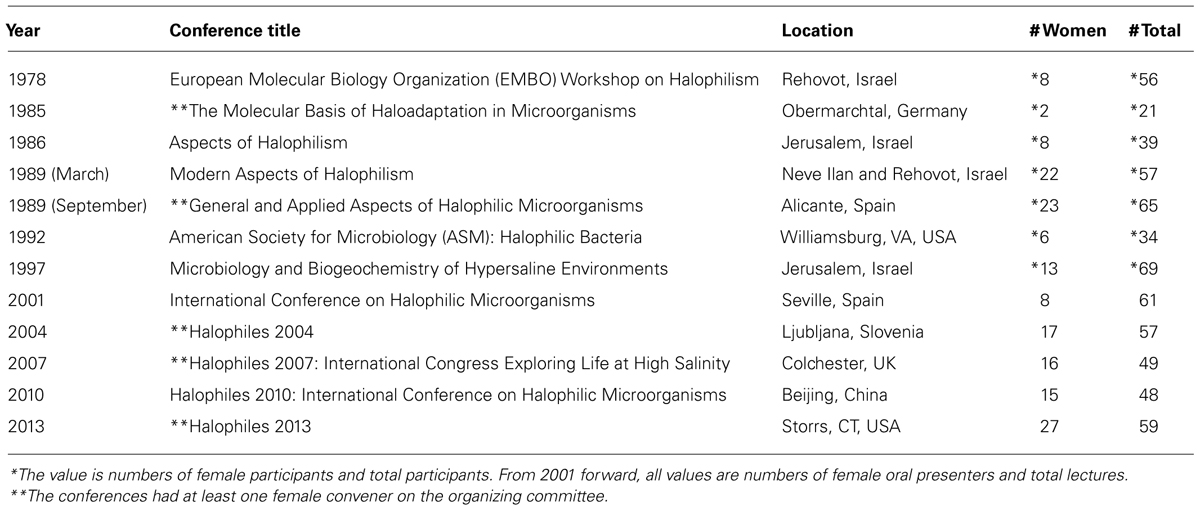
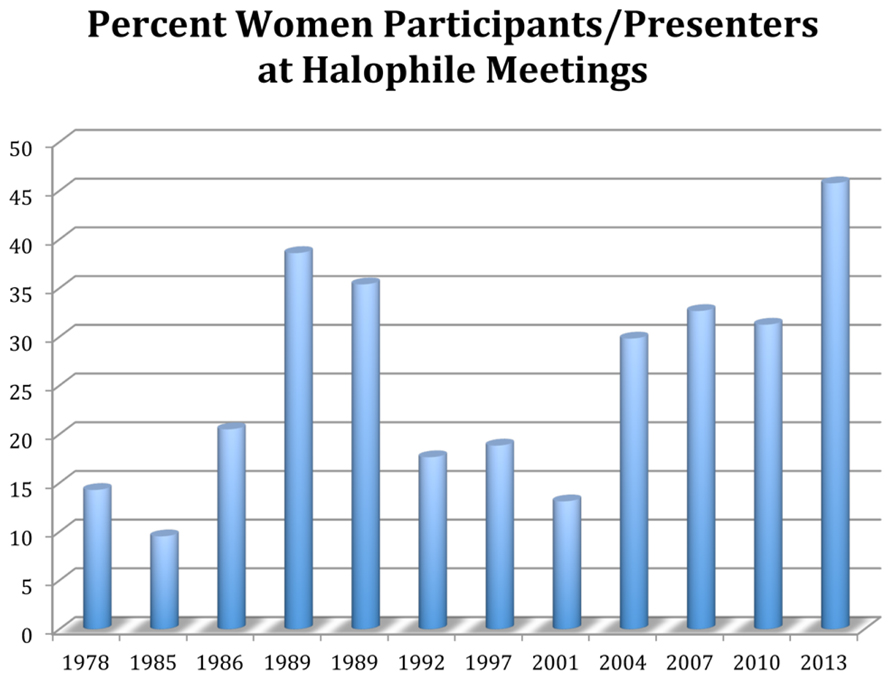
This is a useful analysis and compendium and it would be great to see this done for as many fields as possible.
Thursday, August 21, 2014
No Ovaries? Well this Ovarian Club Conference is For You (YAMMMs for everyone)
Well, I just got an email invitation to attend CME - OVARIAN CLUB 4. And alas, rather than just dumping it into SPAM (which I did do) I clicked on one of the links. I had to know - what was the gender balance at this meeting. Was there any chance that the organizers would see that it would be ironic to not have a decent number of female speakers? Alas, nope.
The organizing committee is 17:1 males to females.

And the speaker balance is not much better something like 25:6.


 I guess maybe they should rename this "Meeting brought to you by people who mostly do not have ovaries." Sad. Another YAMMM (Yet another mostly male meeting).

Related posts and pages
The organizing committee is 17:1 males to females.
And the speaker balance is not much better something like 25:6.
Related posts and pages
Monday, July 21, 2014
Turning down an endowed lectureship because their gender ratio is too skewed towards males #WomenInSTEM
Just got this invitation. I have edited it to remove some of the identifying factors since I think the specific details do not matter.
Dear Dr. Eisen:
I am writing to invite you to present a lecture in the endowed XXXX Lecture Series at XXXX Univsersity. The XXXX Lecture is a platform to allow leaders in the areas of XXXX to communicate research advances to a general audience. Recent speakers include XXXX and XXXX and XXXX. For your talk, we were hoping you could discuss advances in understanding human microbiomes and their significance to health. I think this is an enormously important area that the general public is still largely unaware of, and also an area with incredible promise that will see exponential progress going forward. I know this is relatively short notice, but we are hoping that the lecture would be sometime in October or November of 2014.
The lectureship includes an honorarium of $2,000 in addition to covering your travel, lodging, and meal expenses. Because XXXX we generally hold duplicate lectures XXXX on consecutive evenings (typical Tues-Wed or Wed-Thurs). Speakers generally arrive early in the afternoon of the day of the first lecture, and depart after the second lecture the following day. Between the two lectures there will be a dinner and meetings with research or medical groups and an outreach activity in which, if you are willing, you would XXXX.
We would be honored to have you speak in the XXXX series and hope you will be able to fit us into your busy schedule.
Sincerely,
XXXXWell, wow. That would be really nice. I do not think I have ever given a named lecture before. Then I made one fateful decision - I decided to look up who had spoken at the lecture series previously. And, well, it was not what I wanted to see. And another lecture series from the same institute had the same problem. Bad gender ratio of speakers. So, after some thought and a brief discussion with a post doc in my lab Sarah Hird whose opinions I trust on such issues. I wrote this to the people who invited me:
XXX
Thank you so much for the invitation and the respect it shows to me that I would be considered for this. However, when I looked into past lectures in this series I saw something that was disappointing. From the site XXXX where past lectures are listed I see that the ratio of male to female speakers is 14:3. I note - the XXXX lecture series - also from XXXX - also has a skewed ratio (11:2). As someone who is working actively on multiple issues relating to gender bias in science, I find this very disappointing. I realize there are many issues that contribute to who comes to give a talk in a meeting or seminar series or such. But I simply cannot personally contribute to a series which has such an imbalance and I would suggest that you consider whether anything in your process is biased in some way.
Sincerely,
Jonathan Eisen
UPDATE 7/22/2014
The person who invited me responded to my email. Here is what this person wrote:
UPDATE 2: Storify of responses
The person who invited me responded to my email. Here is what this person wrote:
Jonathan:
Thanks for response and your concern. I noted this uneven representation also when I took over the series a couple years ago and have worked (not as successfully as I would have liked) to get more balance. For example, in trying to book the XXXX lecture this year I have been turned down by XXXX, but did manage to book XXXX. For the XXXX lecture series, a related but separate series aimed at professional rather than the lay public audiences that I also run, I was turned down by XXXX, but I’ve booked XXXX. You have been the sole male invite to either series this year. But I will agree that in previous years the ratio has not been as good as I would like. In part this is because it seems even harder to book top female speakers than males speakers - presumably because they are in such demand and are always asked to be representative on a million committees etc, but in past XXXX I did bring in XXXX and XXXX. For the XXXX lecture I brought in XXXX last year. So numbers are getting better, and this year the ratio will be at least 2:1 (max) in favor of females.
But you point is well taken, and perhaps I can even things out a little with your help. Although I think microbiomes are an incredibly important and under appreciated area, this is not my area of research, so I don’t know the players. If you can recommend female researchers in this area who are dynamic speakers that would be able to give a very publicly accessible talks (TED talk level) on the topic, and ideally are also doing great research too, I would be happy to invite them.
Best,
XXXXSo then I wrote back
Ruth Ley at Cornell is great - works on evolution of microbiomes and
has done some fantastic stuff in humans and plants. See
https://micro.cornell.edu/people/ruth-ley. And gives very good talks.
Katie Pollard at UCSF is completely brilliant and awesome and gives
amazing talks
http://www.docpollard.com. She works on many things including microbiomes
Jessica Green http://pages.uoregon.edu/green/ at Oregon does not work
on human microbimes per se but does work on microbiomes in buildings
and connects that to human microbiomes. She is also a TED fellow and
has given two great TED talks and is one of the best speakers I know.
Julie Segre at NHGRI is great too. Hard core medical microbiome work:
http://www.genome.gov/Staff/Segre/.
UPDATE 3: Some links writing about this
- PZ Myers at Pharyngula: Commitment
- Feminist Philosophers: A great model from STEM
- Vous n'invitez pas assez de femmes, ce sera sans moi
- A scientist sets an example for the church
For related posts by me see my collection on Diversity in STEM. Some key posts of possible interest include:
- What to do when you realize the meeting you are speaking at is a YAMMM (yet another mostly male meeting)?
- Another Mostly Male Meeting from UCSD- should be called "Food and Fuel for the 19th Century"
- Kudos to the DOE-JGI for organizing a genomics meeting w/ a good gender ratio - no kudos to BGI - yet again.
- YAMMGM - yet another mostly male genomics meeting (series): Plant Genomic Congresses by Global Engage
- Q-Bio conference in Hawaii, bring your surfboard & your Y chromosome b/c they don't take a XX
- A scientific study of gender bias in scientific conferences: new #PLoS One paper from #UCDavis
- Diversity (of speakers, participants) at meetings: do something about it
- A conference where the speakers are all women?
- Not protesting this commencement address: Nancy Hopkins at BU on Gender Bias in STEM
- is Sexxing up your scientific journal OK? The Journal of Proteomics seems to think so
- STEM Women: How Men Can Help, w/ Professor Jonathan Eisen (hey, that's me)
- Crosspost from PLOS Biologue: Working to increase diversity of PLOS Biology Academic Editors and Advisory Board members
Thursday, May 22, 2014
Quick Post - Interview of me is up on the Story Exchange re: #WomenInSTEM especially at conferences
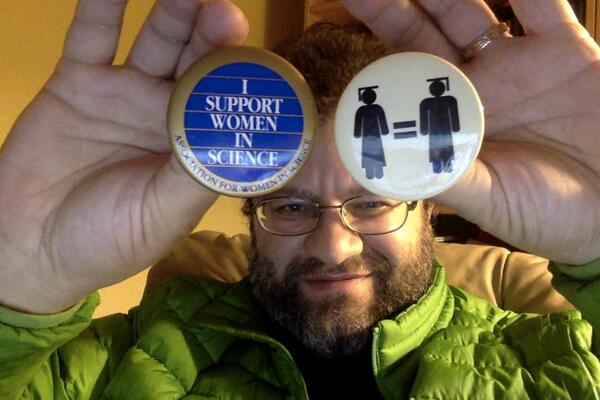
For some other background on my work and posts in this area see this page with a compilation of my Posts on diversity (gender, etc) in science.
Some selected ones are below:
- Pete Seeger, RIP, on women in engineering - The Tree of Life
- Important new paper on impact of having women as conveners on gender ratio of speakers
- Diversity (of speakers, participants) at meetings: do something about it
- Storified tweets from the #UCDavisADVANCE Symposium on Increasing Diversity of STEM Faculty
- Perhaps this meeting should be renamed "Of Microbiomes and Men" ....
- Another genomics meeting featuring men men men and men: International Forum on "Genomics, Innovation and economic growth"
- Important read for those interested in gender, family & academia: Do Babies Matter
- Q-Bio conference in Hawaii, bring your surfboard & your Y chromosome b/c they don't take a XX
- YAMMGM - yet another mostly male genomics meeting (series): Plant Genomic Congresses by Global Engage
- ICG Europe starts w/ "Omics & the future of man" & sticks to men the rest of the time
Friday, May 02, 2014
What to do when you realize the meeting you are speaking at is a YAMMM (yet another mostly male meeting)?

In looking at the agenda for the meeting I am pretty bummed about the gender ratio of speakers. Looks like 18:5 Men to Women.
- Jeff Welser IBM
- David Haussler UCSC
- Daniel Huson Tubingen U
- Joe DeRisi UCSF
- Jane Carlton NYU
- Ajay Royyuru IBM
- Paula Olsiewski Sloan Foundation
- Christopher Mentzel Moore Foundation
- Anne Marie Kimball Gates Foundation
- Jonathan Eisen UC Davis
- Jessica Green U Oregon
- Mark Adams JCVI
- Eric Alm MIT
- Raul Andino UCSF
- Scott Kahn Illumina
- Mike Lelivelt Ion Torrent
- Radoje (Rade) Drmanac Complete Genomics
- Brett Bowman Pacific Biosciences
- Chris Mason Cornell
- Bart Weimer UC Davis
- David Crean Mars
- Astri Wayadande Oklahoma State U
- Christopher Elkins FDA
UPDATE 5/5 -
Friday, April 25, 2014
Today's wondering - why are so few of the speakers at "UC Drought Summit" women?
Got pointed to YAMWASGR (yet another meeting with a skewed gender ratio) this AM via Twitter.
This was in reference to a meeting in Sacramento: Apr. 25: UC Drought Summit, free and open to public | Center for Watershed Sciences and alas the gender ratio is definitely skewed on the speaker list. Men in Blue, Women in Yellow.
That comes out to 26:6 in my count or 18.8% female, 81.2% male. Now, I note - I have no idea what the "pool" looks like in this area, but such a % certainly does not look good from an outside (to the field, even though I am an insider in that this was organized by some people at UC Davis). Once again, I would like to point out to meeting organizers, that having a diverse pool of speakers for a meeting is important for many reasons and sometimes it takes extra work to pull it off, but in my experience it is definitely worth it.
@phylogenomics I've read your blogs about lack of diversity on conference panels, thoughts on UC drought summit's? https://t.co/PsH1dOikc9
— Elizabeth Case (@elizabeth_case) April 25, 2014
This was in reference to a meeting in Sacramento: Apr. 25: UC Drought Summit, free and open to public | Center for Watershed Sciences and alas the gender ratio is definitely skewed on the speaker list. Men in Blue, Women in Yellow.
- UC activities to reduce water use on and off campus
- • Barbara Allen-Diaz, UC Division of Agriculture and Natural Resources
- • Matthew St.Clair, University Office of the President
- Current drought: causes, how bad is it, and will we see more like it?
- • Amir AghaKouchak, UC Irvine
- • Michael Anderson, State Climatologist
- • Daniel Cayan, UC San Diego
- • William Collins, UC Berkeley; Intergovernmental Panel on Climate Change
- • Glen MacDonald, UCLA
- • Daniel Swain, Stanford University
- Drought-proofing California?
- • Michael Stenstrom, UCLA
- • Jay Lund, UC Davis
- Kenneth Baerenklau, UC Riverside
- • Roger Bales, UC Merced
- • Charles Burt, Cal Poly San Luis Obispo
- • Frank Loge, UC Davis
- • Stephanie Pincetl,UCLA
- • Scott Stephens, UC Berkeley
- Remarks by Chancellor Linda P.B. Katehi, UC Davis
- Economic consequences of the drought: agriculture, energy, forests, industry and water
- • Katrina Jessoe, UC Davis
- • Anthony Madrigal, Twenty-Nine Palms Band of Mission Indians
- • Josué Medellín-Azuara, UC Davis
- • Daniel Sumner, UC Agricultural Issues Center
- • David Sunding, UC Berkeley
- Endangered species and drought: science, management and policies
- • Richard Frank, UC Davis
- • Ellen Hanak, Public Policy Institute of California
- • David Hayes, Stanford University; former deputy Interior secretary
- • Peter Moyle, UC Davis
- • David Sedlak, UC Berkeley
- • Joshua Viers, UC Merced
- State policy for future droughts: groundwater, storage, marketing and conservation
- • Jay Famiglietti, UC Irvine
- • Thomas Harter, UC Davis
- • Ruth Langridge, UC Santa Cruz
- • Steve Macaulay, consultant
- • Samuel Sandoval Solis, UC Davis
- • Kurt Schwabe, UC Riverside
Thursday, March 20, 2014
is Sexxing up your scientific journal OK? The Journal of Proteomics seems to think so
I saw a Tweet from a college classmate of mine - Jillian Buriak - that pointed me to this article from the Journal of Proteomics in January 2012.
Harry Belafonte and the secret proteome of coconut milk
And this is what one sees when one goes there:
 A "Graphical Abstract" with the text "Here is your coconut woman, as perhaps envisioned by Harry Belafonte. For its proteome, though, have a look at the report inside!". I guess this is an attempt at a joke about breasts and coconuts? And how is it appropriate for a scientific paper?
Want to guess about the gender balance of the people who run the journal? Here are the pics from the web site of the main executive editors and officials


Harry Belafonte and the secret proteome of coconut milk
And this is what one sees when one goes there:
Want to guess about the gender balance of the people who run the journal? Here are the pics from the web site of the main executive editors and officials
Monday, March 03, 2014
Another Mostly Male Meeting from UCSD- should be called "Food and Fuel for the 19th Century"
Well, just when I thought meeting organizers from UCSD had learned their lesson regarding mostly male meetings - this comes along. Check out "Food and Fuel for the 21st Century" (I was pointed to this by a comment on a blog post of mine). The speakers are
Reminds me a bit of the QBio meeting from 2013 organized by many from UCSD which I wrote about last year: Q-Bio conference in Hawaii, bring your surfboard & your Y chromosome because they don't take a XX. I note - this years Q-Bio meeting is much better. But one can ask - does nobody at UCSD think about these issues when planning conferences and Advisory / Executive Committees. I personally don't think one should choose women to just choose women. But as with the Q-Bio meeting from last year, I think there are an enormous number of highly qualified women working on topics directly related to "Food and Fuel for the 21st Century" and thus I am both surprised and disturbed by the gender ratio of this meeting and this organization.
UPDATE 3/4 7:21 AM
It took me a bit but I found details on the 2013 symposium from the same group. The web site for the 2013 meeting is not active as far as I can tell. However it is available in the Internet Archive. For example, here is a snapshot from June 1, 2013. From that snapshot here are the listed speakers
For a ratio of 20:3.
- Eric Allen, Ph.D.
- Shota Atsumi, Ph.D.
- Roger Beachy, Ph.D.
- Bianca Brahamsha, Ph.D.
- Geoffrey Chang, Ph.D.
- Joseph Ecker, Ph.D.
- James W. Golden, Ph.D.
- Farzad Haerizadeh, Ph.D.
- Jeff Hasty, Ph.D.
- Sara Iverson, M.S.
- Martin Jonikas, Ph.D.
- Stephen Mayfield, Ph.D.
- Greg Mitchell, Ph.D.
- George Oyler, M.D., Ph.D.
- Bernhard Palsson, Ph.D.
- Jason Pyle, M.D., Ph.D.
- Ben Saydah, Ph.D.
- Hamilton Smith, M.D.
- Brian Staskawicz, Ph.D.
- Martin Yanofksy, Ph.D.
That a ratio of 18:2 or 10% female.
Not that I know the cause of this but here are some other pieces of information to consider.
The Food and Fuel for the 21st Century Program lists 5 people on their Executive Committee. Any guesses on the # of these that are men? Well it is 5.
Fortunately they have an Advisory Committee too and that must have some women on it right? Nope.
- Josh Graff-Zivin
- George Tynan
- Byron Washom
- Bob Schmidt, Ph.D.
- Tim Zenk
UPDATE 3/4 7:21 AM
It took me a bit but I found details on the 2013 symposium from the same group. The web site for the 2013 meeting is not active as far as I can tell. However it is available in the Internet Archive. For example, here is a snapshot from June 1, 2013. From that snapshot here are the listed speakers
- David Kramer, Michigan State University
- Susan Golden, University of California, San Diego
- Julian Schroeder, University of California, San Diego
- Stephen Mayfield, University of California, San Diego
- Steven Briggs, University of California, San Diego
- Matteo Pellegrini, University of California, Los Angeles
- Donald Weeks, University of Nebraska--Lincoln
- Michael Burkart, University of California, San Diego
- Chancellor Pradeep Khosla, University of California, San Diego
- Farzad Haerizadeh, Life Technologies
- Ben Hueso, California State Assembly
- Bill Gerwick, Scripps Institution of Oceanography
- Eric Mathur, SG Biofuels
- James Van Etten, University of Nebraska--Lincoln
- Fred Tennant, Heliae
- David Dunigan, University of Nebraska--Lincoln
- Xuemei Bai, Cellana
- George Oyler, University of Nebraska--Lincoln
- Gerry Mackie, University of California, San Diego
- Mark Hildebrand, Scripps Institution of Oceanography
- Lawrence Johnson, Salim Group
- Craig Behnke, Sapphire Energy
- Rebecca White, Sapphire Energy
For a ratio of 20:3.
Sunday, February 16, 2014
STEM Women: How Men Can Help, w/ Professor Jonathan Eisen (hey, that's me)
Just got done with an interview "STEM Women: How Men Can Help, with Professor Jonathan Eisen" done via Google Hangout with Buddhini Samarasinghe and Zuleyka Zavallos.
Video of the chat has been posted to Youtube.
And there is a Google Plus Event Page here.
Video of the chat has been posted to Youtube.
And there is a Google Plus Event Page here.
Wednesday, January 29, 2014
Pete Seeger, RIP, on women in engineering ...
When I was growing up, we went to Pete Seeger and Arlo Guthrie concerts every year at Wolf Trap. I have loved Seeger since then and thus was very sad to hear he died a few days ago. My mom is visiting right now and she and I have been talking about "Women in Science" issues (and for example she brought me some nice presents which I posted about Monday).
Just picked up my mom from airport & she brought me some presents - I think she knows me #ISupportWomenInScience pic.twitter.com/JbmF65197P
— Jonathan Eisen (@phylogenomics) January 28, 2014
And in talking to my mom today she reminded me of this song Seeger used to sing every year when we saw the show. It is by his sister. And it is a good rallying cry for "Women in STEM" fields, I think. Here it is:Thursday, August 22, 2013
YAMMGM - yet another mostly male genomics meeting (series): Plant Genomic Congresses by Global Engage
- John Manners, Chief, CSIRO Plant Industry, Australia
- Dave Edwards, Principal Research Fellow, School of Agriculture and Food Sciences, University of Queensland, Australia
- Nagendra Singh National Professor-BP Pal Chair, National Research Centre on Plant Biotechnology, Indian Council of Agricultural Research, India
- Han Zhao, Professor of Biology and Biotechnology, Institute of Biotechnology Jiangsu, Academy of Agricultural Sciences, China
- Huaan Yang, Department of Agriculture and Food (DAFWA), Australia
- Rajeev K. Varshney, Principal Scientist (Applied Genomics) & Director, Centre of Excellence in Genomics, ICRISAT, India
- Apichart Vanavichit, Professor, The Rice Gene Discovery Unit, Kasetsart University, Thailand
- Norman Warthmann, Senior Post Doc, Borevitz Laboratory, ANU College of Medicine, Biology and Environment, Australian National University, Australia
- Chungui Lu Lecturer in Post-Genomics, Faculty of Science, Nottingham University, UK
- Beng Kah (Bk) Song, Lecturer, Monash University, Sunway Campus, Australia/ Malaysia
- Kenneth Olsen, Associate Professor Department of Biology, Washington St Louis University, USA
- Yue-Ie Hsing, Distinguished Research Fellow, Institute of Plant and Microbial Biology, Academica Sinica, Taiwan
- Meilina Ong Abdullah, Breeding and Tissue Culture Unit, The Advanced Biotechnology and Breeding Centre, Malaysian Palm Oil Board (MPOB) Malaysia
- Yijun Ruan, Professor and Director, Systems Biology Center, HuaZhong Agricultural University, Wuhan, China
- Sachiko Isobe, Head Applied Plant Genomics, Kaduza DNA Research Institute (KDRI), Japan
- Yuan-Ming Zhang, Professor of Statistical Genomics, State Key Lab. of Crop Genetics and Germplasm Enhancement, Nanjing Agricultural University, China
- Parveen Chhuneja, Geneticist, Bioinformatics Centre School of Agricultural Biotechnology, Punjab Agricultural University, India
- Shengyi Liu, Professor and Head, The Key Lab of Oil Crops Biology, the Ministry of Agriculture, PRC Department of Genomics, Oil Crops Research Institute, Chinese Academy of Agricultural Sciences, China
- Wen-Hsiung Li, Director and Distinguished Research Fellow, Biodiversity Research Center, Institute of Plant and Microbial Biology, Academica Sinica, Taiwan
- Graham King, Director, Southern Cross Plant Science Professor of Plant Genomics and Epigenetics, Southern Cross University, Australia
- Ryan Lister, Professor/ARC Future Fellow, Plant Energy Biology ARC CoE, School of Chemistry and Biochemistry, The University of Western Australia
- Amitabh Mohanty, Lead Trait Discovery, E.I. DuPont India Pvt Ltd.
Subscribe to:
Posts (Atom)
Most recent post
A ton to be thankful for -- here is one part of that - all the acknowledgement sections from my scholarly papers
So - it is another Thanksgiving Day and in addition to thinking about family, and football, and Alice's Restaurant, I also think a lot a...

-
Wow. Just wow. And not in a good way. Just got an email invitation to a meeting. The meeting is " THE FIRST ANNUAL WINTER Q-BIO ...
-
 I have a new friend in Google Scholar Updates I have written about the Updates system before and if you want more information please see...
 -
See Isolation and sequence-based characterization of a koala symbiont: Lonepinella koalarum Paper based on PhD thesis work of Katie Dahlha...
