See the whole story here.
Showing posts with label Jonathan Eisen. Show all posts
Showing posts with label Jonathan Eisen. Show all posts
Saturday, January 30, 2016
Tony Rodriguez Illustration of Me for WiredUK
OK so I have not worn a tie in a very long time and I pretty much don't wear a lab coat too often either but I totally love this:
See the whole story here.
See the whole story here.

Saturday, November 22, 2014
Post-doc w/ me, Jessica Green, Jay Stachowicz, and Jenna Lang on seagrass microbiomes
Postdoctoral Position in Microbial Ecology and Evolution
Jessica Green at the University of Oregon Green (http://pages.uoregon.edu/green/) is currently seeking a postdoctoral researcher to explore fundamental questions in microbial ecology and evolution. Applicants should have a PhD in a biological, computational, mathematical, or statistical field with extensive training using theory and/or modeling to understand the ecology and evolution of complex biological communities, and strong writing skills. Experience developing and applying quantitative phylogenetic ecological methods is highly desirable, but not explicitly required for candidates who have otherwise demonstrated strong quantitative skills.
The successful candidate will play a key role in the Seagrass Microbiome Project (http://seagrassmicrobiome.org) in collaboration among Jonathan Eisen https://phylogenomics.wordpress.com), Jay Stachowicz http://www-eve.ucdavis.edu/stachowicz/stachowicz.shtml, and Jenna Lang (http://jennomics.com/) at the University of California, Davis. The Seagrass Microbiome Project aims to integrate the long interest in seagrass ecology and ecosystem science with more recent work on microbiomes to produce a deeper, more mechanistic understanding of the ecology and evolution of seagrasses and the ecosystems on which they depend. Our studies of the community of microorganisms that live in and on seagrasses – the seagrass “microbiome” – will contribute to a broader understanding of host-microbe systems biology, and will benefit from ongoing University of Oregon research programs including the Microbial Ecology and Theory of Animals Center for Systems Biology (http://meta.uoregon.edu/) and the Biology and Built Environment Center (http://biobe.uoregon.edu/).
The position is available for 1 year with the possibility for renewal depending on performance. The start date is flexible. Please email questions regarding the position to Jessica Green (jlgreen).
To apply
A complete application will consist of the following materials:
(1) a brief cover letter explaining your background and career interests
(2) CV (including publications)
(3) names and contact information for three references
Submit materials to ie2jobs. Subject: Posting 14431
To ensure consideration, please submit applications by November 1, 2014, but the position will remain open until filled.
Women and minorities encouraged to apply. We invite applications from qualified candidates who share our commitment to diversity.
The University of Oregon is an equal opportunity, affirmative action institution committed to cultural diversity and compliance with the ADA. The University encourages all qualified individuals to apply, and does not discriminate on the basis of any protected status, including veteran and disability status.
Monday, July 21, 2014
Turning down an endowed lectureship because their gender ratio is too skewed towards males #WomenInSTEM
Just got this invitation. I have edited it to remove some of the identifying factors since I think the specific details do not matter.
Dear Dr. Eisen:
I am writing to invite you to present a lecture in the endowed XXXX Lecture Series at XXXX Univsersity. The XXXX Lecture is a platform to allow leaders in the areas of XXXX to communicate research advances to a general audience. Recent speakers include XXXX and XXXX and XXXX. For your talk, we were hoping you could discuss advances in understanding human microbiomes and their significance to health. I think this is an enormously important area that the general public is still largely unaware of, and also an area with incredible promise that will see exponential progress going forward. I know this is relatively short notice, but we are hoping that the lecture would be sometime in October or November of 2014.
The lectureship includes an honorarium of $2,000 in addition to covering your travel, lodging, and meal expenses. Because XXXX we generally hold duplicate lectures XXXX on consecutive evenings (typical Tues-Wed or Wed-Thurs). Speakers generally arrive early in the afternoon of the day of the first lecture, and depart after the second lecture the following day. Between the two lectures there will be a dinner and meetings with research or medical groups and an outreach activity in which, if you are willing, you would XXXX.
We would be honored to have you speak in the XXXX series and hope you will be able to fit us into your busy schedule.
Sincerely,
XXXXWell, wow. That would be really nice. I do not think I have ever given a named lecture before. Then I made one fateful decision - I decided to look up who had spoken at the lecture series previously. And, well, it was not what I wanted to see. And another lecture series from the same institute had the same problem. Bad gender ratio of speakers. So, after some thought and a brief discussion with a post doc in my lab Sarah Hird whose opinions I trust on such issues. I wrote this to the people who invited me:
XXX
Thank you so much for the invitation and the respect it shows to me that I would be considered for this. However, when I looked into past lectures in this series I saw something that was disappointing. From the site XXXX where past lectures are listed I see that the ratio of male to female speakers is 14:3. I note - the XXXX lecture series - also from XXXX - also has a skewed ratio (11:2). As someone who is working actively on multiple issues relating to gender bias in science, I find this very disappointing. I realize there are many issues that contribute to who comes to give a talk in a meeting or seminar series or such. But I simply cannot personally contribute to a series which has such an imbalance and I would suggest that you consider whether anything in your process is biased in some way.
Sincerely,
Jonathan Eisen
UPDATE 7/22/2014
The person who invited me responded to my email. Here is what this person wrote:
UPDATE 2: Storify of responses
The person who invited me responded to my email. Here is what this person wrote:
Jonathan:
Thanks for response and your concern. I noted this uneven representation also when I took over the series a couple years ago and have worked (not as successfully as I would have liked) to get more balance. For example, in trying to book the XXXX lecture this year I have been turned down by XXXX, but did manage to book XXXX. For the XXXX lecture series, a related but separate series aimed at professional rather than the lay public audiences that I also run, I was turned down by XXXX, but I’ve booked XXXX. You have been the sole male invite to either series this year. But I will agree that in previous years the ratio has not been as good as I would like. In part this is because it seems even harder to book top female speakers than males speakers - presumably because they are in such demand and are always asked to be representative on a million committees etc, but in past XXXX I did bring in XXXX and XXXX. For the XXXX lecture I brought in XXXX last year. So numbers are getting better, and this year the ratio will be at least 2:1 (max) in favor of females.
But you point is well taken, and perhaps I can even things out a little with your help. Although I think microbiomes are an incredibly important and under appreciated area, this is not my area of research, so I don’t know the players. If you can recommend female researchers in this area who are dynamic speakers that would be able to give a very publicly accessible talks (TED talk level) on the topic, and ideally are also doing great research too, I would be happy to invite them.
Best,
XXXXSo then I wrote back
Ruth Ley at Cornell is great - works on evolution of microbiomes and
has done some fantastic stuff in humans and plants. See
https://micro.cornell.edu/people/ruth-ley. And gives very good talks.
Katie Pollard at UCSF is completely brilliant and awesome and gives
amazing talks
http://www.docpollard.com. She works on many things including microbiomes
Jessica Green http://pages.uoregon.edu/green/ at Oregon does not work
on human microbimes per se but does work on microbiomes in buildings
and connects that to human microbiomes. She is also a TED fellow and
has given two great TED talks and is one of the best speakers I know.
Julie Segre at NHGRI is great too. Hard core medical microbiome work:
http://www.genome.gov/Staff/Segre/.
UPDATE 3: Some links writing about this
- PZ Myers at Pharyngula: Commitment
- Feminist Philosophers: A great model from STEM
- Vous n'invitez pas assez de femmes, ce sera sans moi
- A scientist sets an example for the church
For related posts by me see my collection on Diversity in STEM. Some key posts of possible interest include:
- What to do when you realize the meeting you are speaking at is a YAMMM (yet another mostly male meeting)?
- Another Mostly Male Meeting from UCSD- should be called "Food and Fuel for the 19th Century"
- Kudos to the DOE-JGI for organizing a genomics meeting w/ a good gender ratio - no kudos to BGI - yet again.
- YAMMGM - yet another mostly male genomics meeting (series): Plant Genomic Congresses by Global Engage
- Q-Bio conference in Hawaii, bring your surfboard & your Y chromosome b/c they don't take a XX
- A scientific study of gender bias in scientific conferences: new #PLoS One paper from #UCDavis
- Diversity (of speakers, participants) at meetings: do something about it
- A conference where the speakers are all women?
- Not protesting this commencement address: Nancy Hopkins at BU on Gender Bias in STEM
- is Sexxing up your scientific journal OK? The Journal of Proteomics seems to think so
- STEM Women: How Men Can Help, w/ Professor Jonathan Eisen (hey, that's me)
- Crosspost from PLOS Biologue: Working to increase diversity of PLOS Biology Academic Editors and Advisory Board members
Wednesday, June 04, 2014
ASUCD (Associated Students, #UCDavis) Excellence in Education Awards
Very proud of this. I was a finalist in the "Excellence in Education" awards given out by the UC Davis Undergraduate group ASUCD Associated Students, University of California, Davis. And David Coil, Project Scientist in my lba was another finalist. The award for my college (College of Biological Sciences) went to Jay Rosenheim, who is a great teacher, so no shame in losing to him.
Anyway - here are some pics.


Just got back from @ASUCDofficial Excellence in Education awards - check out @davidacoil - one of the finalists pic.twitter.com/AMOztcwApx
— Jonathan Eisen (@phylogenomics) June 3, 2014
Oh and here is another finalist for the @ASUCDofficial Excellence in Education awards - me - pic.twitter.com/OKwBEdRUWH
— Jonathan Eisen (@phylogenomics) June 3, 2014
Some more pics from the @ASUCDofficial Excellence in Education awards https://t.co/aQaLv18u7p #ucdavis
— Jonathan Eisen (@phylogenomics) June 3, 2014
Anyway - here are some pics.
 |
| One of the ASUCD members doing introductions |
 |
| Another ASUCD |
 |
| David Coil getting is certificate |
 |
| Hey, that's me |
 |
| Jay Rosenheim getting his certificate |
Thursday, May 22, 2014
Quick Post - Interview of me is up on the Story Exchange re: #WomenInSTEM especially at conferences
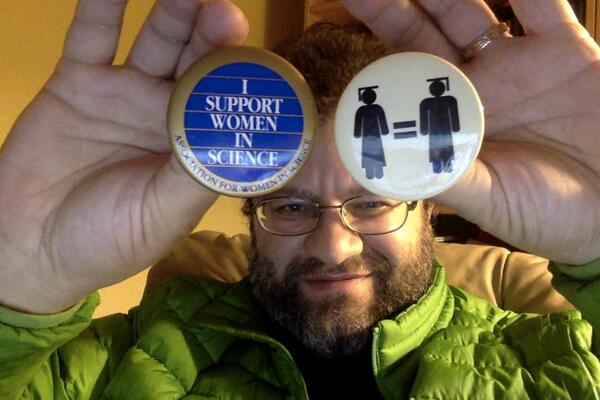
For some other background on my work and posts in this area see this page with a compilation of my Posts on diversity (gender, etc) in science.
Some selected ones are below:
- Pete Seeger, RIP, on women in engineering - The Tree of Life
- Important new paper on impact of having women as conveners on gender ratio of speakers
- Diversity (of speakers, participants) at meetings: do something about it
- Storified tweets from the #UCDavisADVANCE Symposium on Increasing Diversity of STEM Faculty
- Perhaps this meeting should be renamed "Of Microbiomes and Men" ....
- Another genomics meeting featuring men men men and men: International Forum on "Genomics, Innovation and economic growth"
- Important read for those interested in gender, family & academia: Do Babies Matter
- Q-Bio conference in Hawaii, bring your surfboard & your Y chromosome b/c they don't take a XX
- YAMMGM - yet another mostly male genomics meeting (series): Plant Genomic Congresses by Global Engage
- ICG Europe starts w/ "Omics & the future of man" & sticks to men the rest of the time
Sunday, February 16, 2014
STEM Women: How Men Can Help, w/ Professor Jonathan Eisen (hey, that's me)
Just got done with an interview "STEM Women: How Men Can Help, with Professor Jonathan Eisen" done via Google Hangout with Buddhini Samarasinghe and Zuleyka Zavallos.
Video of the chat has been posted to Youtube.
And there is a Google Plus Event Page here.
Video of the chat has been posted to Youtube.
And there is a Google Plus Event Page here.
Thursday, October 10, 2013
Victoria Schlesinger in Al Jazeera America on Open Data Pros and Cons
Got interviewed last week by Victoria Schlesinger about open science and open data issues and she has now posted her article: Scientists threatened by demands to share data | Al Jazeera America. The article includes a discussion primarily about the push for more open release of data (and also a bit about papers) and some of the challenges associated with this push. There are some good quotes in the article both from Schlesinger's text and from some key players in the field of data access including:
- Christopher Lortie: “There will be fantastic discoveries, and that’s all that really matters,” says Lortie.
- From Schlesigner (a quote I do not agree with all of but some may like the metaphor): Sharing the results of scientific research is a bit like unveiling a newly built house, and scientists generally want it widely viewed, so the growth in open access publishing is a boon for most. Sharing data, on the other hand, is comparable to handing over the architectural plans and building materials used to construct the house. Others can scrutinize the quality of work and reuse the basic components to build their own house. That raises fears about discovery of errors and theft of future research ideas.
- Heather Piwowar: “I think the public thinks that we’re all learning from everyone else’s work. That’s not true, and furthermore, it’s not true in ways that are even worse than you might think,” says Piwowar=
- Me: “People are busy,” says Jonathan Eisen, a genetics professor at the University of California, Davis. “Everyone is overwhelmed with life and email and, in academia, trying to get funding and write papers. Whether something is open or not open is not highest on the priority list. There’s still need for making people aware of open science issues and making it easy for them to participate if they want to.”
- Titus Brown: “My general attitude about open science is that I’d much rather be relevant. In science, that’s harder than anything else,” says Titus Brown, an assistant professor at Michigan State University who runs a genomics, evolution and development lab and practices open science. “If I make my work available, I have a higher chance of being relevant.”
- It has transformed the way we do science across biological scales, from the molecular all the way up to studying whole ecosystems,” says Carl Boettiger, a postdoctoral student at UC Santa Cruz. “The value is in enabling science to progress faster.”
The article is worth a look ...
Thursday, June 06, 2013
Better late than never - video interview of me from #AAAS2012 - Evolvability, the Built Environment and Open Science
Well, better late than never. An interview of me by Stan Malloy at the AAAS Meeting
from February 2012 has been posted at MWV Episode 72 - Jonathan Eisen - Evolvability, the Built Environment and Open Science. From their site
See the interview via Youtube below:
On this episode, Jonathan talks about "evolvability," the probability that organisms can invent new functions. To do this, he has been using genome data in conjunction with experimental information to try and understand the mechanisms by which new functions have originated.
Another area of interest for Eisen is the "built environment." We live and work in buildings or structures which are non-natural environments, new to microbes. These "new" environments represent a controlled system in which to study the rules by which microbial communities form.
Jonathan is interested in these environments as basic science vehicle and he shares the importance of studying the built environment for science and human health.
Finally Jonathan explains his interest in "open science," the ways in which science is shared. At it's core, Eisen wants to leverage cheaper technologies to accelerate the progress of science in a positive way.
This episode was recorded at the American Association for the Advancement of Science Meeting in Vancouver, British Columbia on February 18, 2012.
See the interview via Youtube below:
Sunday, February 17, 2013
Psyched: have rescued old MobileMe and other websites after Apple annoyingly cancelled them by posting to Dropbox
A few years ago I used to post many things for the Web through Apple's Mobile Me service. Annoyingly, Apple ended up treating this like they treat connectors and plugs for their phones and Macs. They just decided to move their online system to iCloud and deleted all the old websites through Mobile Me. Which left me in a lurch. And then I forgot about it. But I have been rediscovering how annoying this is since I had a lot of information out there on old papers and projects and now it is gone from the interwebs. So I have ben trying to re-share all of this stuff.
One way has ben to post data from old papers to Figshare. See for example:
See for example my re-releasing of some of my April 1 and other joke websites:
One way has ben to post data from old papers to Figshare. See for example:
- Eisen et al. 1995. SNF2 Evolution datasets.
- Eisen 1995 RecA Evolution
- Sequence alignment for GEBA paper
- Proteomes of genomes used in GEBA paper
See for example my re-releasing of some of my April 1 and other joke websites:
- Scientist Reveals Secret of the Ocean: It's Him- New York Times
- Collins responds
- World Anti Brain Doping Authority
- Thymineless Death Society
I have always been into sharing scientific information on the web since, well, the web came out. And I am going to dig around for other old websites to post them via Dropbox. If anyone knows an easy way to upload / convert an old website into Wordpress, I suppose I could load in all the old pages into my current wordpress site, but this was a much easier temporary solution. Still annoyed with Apple but glad Dropbox allows a simple solution.
Thursday, May 03, 2012
Social Networks and Scientists: Chronicle for Higher Education Article
Quick post here.
There is a new article in the Chronicle for Higher Education in which I am quoted: Social Networks for Academics Proliferate, Despite Some Scholars' Doubts
The article discusses many connected topics relating to the use of social media by scientists - though it does not make clear how everything is connected perhaps. Anyway the author talked to me about Mendeley and various uses of Mendeley and I told her about an effort to create a Mendeley collection of my father's papers. The article also discussed LinkedIn, Academia.Edu, Twitter and other social media systems.
Some quotes
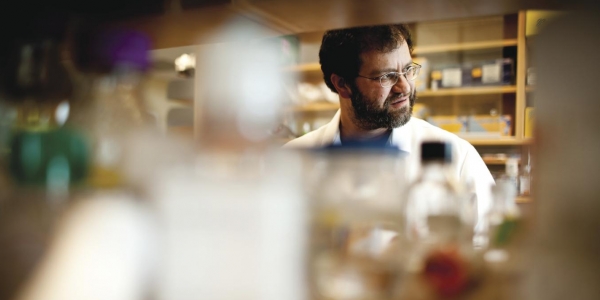
Perhaps most important from my point of view - I love the picture of me taken by Max Whittaker.

There is a new article in the Chronicle for Higher Education in which I am quoted: Social Networks for Academics Proliferate, Despite Some Scholars' Doubts
The article discusses many connected topics relating to the use of social media by scientists - though it does not make clear how everything is connected perhaps. Anyway the author talked to me about Mendeley and various uses of Mendeley and I told her about an effort to create a Mendeley collection of my father's papers. The article also discussed LinkedIn, Academia.Edu, Twitter and other social media systems.
Some quotes
Jonathan A. Eisen, a professor of medical microbiology and immunology at the University of California at Davis, used Mendeley to distribute the research papers that his father, Howard J. Eisen, a researcher at the National Institutes of Health, published before he died, in 1987. After struggling to free papers locked behind pay walls, Jonathan Eisen compiled the articles and posted nearly all of them on a Mendeley page he had created for his father.
Mr. Eisen, a self-described "obsessed open-access advocate," described the impact in a blog post last year: "Thanks to the social features of Mendeley, more and more people will see and have access to those papers, thus ensuring that they do not wallow in never-never land but continue to have some potential impact on science and society."
Perhaps most important from my point of view - I love the picture of me taken by Max Whittaker.
Thursday, September 01, 2011
Mendelspod interview with, well, me, discussing science, pranks, evolution and more
Here is an interview with me produced by Mendelspod. It was filmed in my office at UC Davis on Mendel's birthday.
Stalking the Fourth Domain with Jonathan Eisen, Ph D from mendelspod on Vimeo.
Some links of relevance to this interview:
Stalking the Fourth Domain with Jonathan Eisen, Ph D from mendelspod on Vimeo.
Some links of relevance to this interview:
- Freeing my father's publications part 5: near completion of PDF collection at Mendeley (h/t @David_Dobbs)
- The story behind the story of my new #PLoSOne paper on "Stalking the fourth domain of life" #metagenomics #fb
- Scientist Reveals Secret of the Ocean: It's Him- New York Times
- The Tree of Life: What kid would want to study bacterial evolution ...
- Confessions of an April Fool and the Dope on Brain Doping
Subscribe to:
Posts (Atom)
Most recent post
A ton to be thankful for -- here is one part of that - all the acknowledgement sections from my scholarly papers
So - it is another Thanksgiving Day and in addition to thinking about family, and football, and Alice's Restaurant, I also think a lot a...

-
Wow. Just wow. And not in a good way. Just got an email invitation to a meeting. The meeting is " THE FIRST ANNUAL WINTER Q-BIO ...
-
 I have a new friend in Google Scholar Updates I have written about the Updates system before and if you want more information please see...
 -
See Isolation and sequence-based characterization of a koala symbiont: Lonepinella koalarum Paper based on PhD thesis work of Katie Dahlha...
