See the whole story here.
Showing posts with label press. Show all posts
Showing posts with label press. Show all posts
Saturday, January 30, 2016
Tony Rodriguez Illustration of Me for WiredUK
OK so I have not worn a tie in a very long time and I pretty much don't wear a lab coat too often either but I totally love this:
See the whole story here.
See the whole story here.

Monday, May 13, 2013
Twisted tree of life award #15: NBC News on "Junk DNA mystery"

Brought to us by NBC News and LiveScience (which actually can have some pretty good science coverage). This article has some complete and utter crap:
Some parts that I have issues with:
- The headline: "'Junk' DNA mystery solved: It's not needed." The headline is silly but alas it is consistent with what is in the article.
- "So-called junk DNA, the vast majority of the genome that doesn't code for proteins". So - they have redefined junk DNA as all non coding DNA?
- "For decades, scientists have known that the vast majority of the genome is made up of DNA that doesn't seem to contain genes or turn genes on or off." Apparently there is an entity out there known as "The Genome".
And then we get into the quoting of author and researcher Victor Albert with no comments or responses from anyone is painful too.
- "At least for a plant, junk DNA really is just junk — it's not required." Except that they did not show this - they just showed that one plant can have a small genome and not have a lot of "junk" as they call it, which of course does not really say anything about what "junk" does or does not do in other organisms.
- "Nobody's really known what junk DNA does or doesn't do" apparently calling into question the some 10,000 plus papers on the topic.
"The findings suggest junk DNA really isn't needed for healthy plants — and that may also hold for other organisms, such as humans."
And this leads us to 'Junk' DNA mystery solved: It's not needed.
So - basically - if ONE FUCKING ORGANISM DELETES SOME OF IT'S NON PROTEIN CODING PORTIONS OF ITS GENOME THEN THIS MEANS THAT ALL NON CODING DNA IS USELESS.
Aaaaaaaaaaaaaaaaaaargh.
And for this evolutionary logic, I am awarding NBC News, Tia Ghose (the author of the piece) and Victor Albert, the 15th coveted Twisted Tree of Life Award.
Past winners:
- Twisted tree of life award #14: @nytimes and Nathaniel Rich on Immortal Jellyfish
- Twisted tree of Life Award #13: Press release from U. Oslo on new protozoan
- Twisted Tree of Life Award #12: Billion Year Old Smart Bacteria That Perfectly Treat Cancer
- Twisted tree of life award #11: National Geographic for emphasizing Five Kingdoms & no Bacteria/Archaea
- Twisted tree of life award #10: @Discovermag for article on Lynne Margulis
- Twisted Tree of Life Award #9: Nature News on the "Marsupial" platypus
- Twisted Tree of Life Award #8: Alroy on "Changing the rules of evolution"
- Twisted Tree of Life Award #7: NPR on the Evolution of Crying
- Twisted tree of life award #6: Scientific American Origins piece for dissing microbes
- Twisted tree of life award #5: Nicholas Wade & use of higher, lower, ladders, etc
- Twisted Tree of Life Award #4: Hoxful Monsters Blog on "Primitive" Animals
- Twisted Tree of Life Award #3: The Columbus Dispatch on Ancient Bacteria
- Twisted Tree of Life Award #2: Science Friday on the Five Kingdoms
- Twisted Tree of Life Award #1: Salk Institute Press Release on Kinases
UPDATE 5/17/13
Some other discussions of this paper and related to my critique (though not always agreeing with me)
- Knight School of Journalism: A Weird Little Plant is Nearly Free of Junk DNA. Big Contentions Underlie Seemingly Cute Story
- From T. Ryan Gregory Genome reduction in bladderworts vs. leg loss in snakes ...
- Deconstructing Nature's “plant without junk DNA” story | Genetic ...
- From Dan Graur: The Logical Fallacy of Jonathan Eisen (a.k.a. @phylogenomics) and the Theological Implications of the Bladderwort Genome
Thursday, August 30, 2012
Rosacea - What Causes It? News story overplays suggested connection to skin mites

"Bacteria carried by tiny mites on the skin might be responsible for the common dermatological condition known as rosacea, researchers say."This caught my attention because I have been reading up on skin microbes recently and though many have suggested connections between microbes and rosacea as far as I know nobody has shown any causal relationship. And causation vs. correlation has been on my mind a lot recently.
Sunday, July 22, 2012
Thursday, May 03, 2012
Social Networks and Scientists: Chronicle for Higher Education Article
Quick post here.
There is a new article in the Chronicle for Higher Education in which I am quoted: Social Networks for Academics Proliferate, Despite Some Scholars' Doubts
The article discusses many connected topics relating to the use of social media by scientists - though it does not make clear how everything is connected perhaps. Anyway the author talked to me about Mendeley and various uses of Mendeley and I told her about an effort to create a Mendeley collection of my father's papers. The article also discussed LinkedIn, Academia.Edu, Twitter and other social media systems.
Some quotes
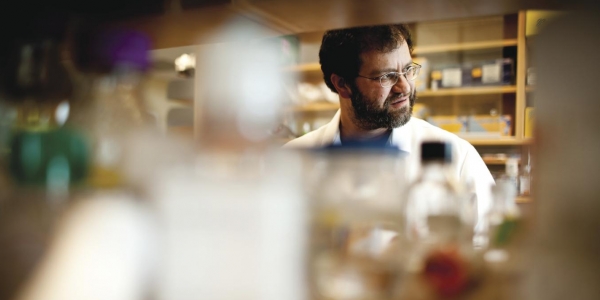
Perhaps most important from my point of view - I love the picture of me taken by Max Whittaker.

There is a new article in the Chronicle for Higher Education in which I am quoted: Social Networks for Academics Proliferate, Despite Some Scholars' Doubts
The article discusses many connected topics relating to the use of social media by scientists - though it does not make clear how everything is connected perhaps. Anyway the author talked to me about Mendeley and various uses of Mendeley and I told her about an effort to create a Mendeley collection of my father's papers. The article also discussed LinkedIn, Academia.Edu, Twitter and other social media systems.
Some quotes
Jonathan A. Eisen, a professor of medical microbiology and immunology at the University of California at Davis, used Mendeley to distribute the research papers that his father, Howard J. Eisen, a researcher at the National Institutes of Health, published before he died, in 1987. After struggling to free papers locked behind pay walls, Jonathan Eisen compiled the articles and posted nearly all of them on a Mendeley page he had created for his father.
Mr. Eisen, a self-described "obsessed open-access advocate," described the impact in a blog post last year: "Thanks to the social features of Mendeley, more and more people will see and have access to those papers, thus ensuring that they do not wallow in never-never land but continue to have some potential impact on science and society."
Perhaps most important from my point of view - I love the picture of me taken by Max Whittaker.
Monday, February 20, 2012
Jack Gilbert @gilbertjacka clarifies comments at #AAASMtg re: opening windows, cleanliness & microbes
Just got this to post from my college colleague Jack Gilbert in regard to some comments he made to the press at the AAAS Meeting a few days ago. He sent this in part in response to some news stories that came out of the press conference we had at the meeting (e.g., see Florence Nightingale approach 'could help fight infection in ..., Open hospital windows to stem spread of infections, says ... and others). And I encouraged him to consider whether or not he needed to clarify some of his comments - and here is his response.
A confession, lesson and retraction
By Jack A. Gilbert
At the AAAS 2012 annual meeting on Friday, I was involved in a press conference to announce the initial results and ideology for the Earth Microbiome Project (http://www.earthmicrobiome.org). Following the press conference we went to another room, where we were openly discussing these concepts with the reporters. Several reporters asked me to comment on the potential impact of this research in the medical sphere. At which point I started to discuss some excellent research by Jessica Green (http://biology.uoregon.edu/people/green) regarding her recent evidence that improved ventilation in hospital wards reduced the airborne abundance of organisms that were related to pathogens. I showed these reporters the paper
(http://www.nature.com/ismej/journal/vaop/ncurrent/full/ismej2011211a.html) and asked them to discuss this with Jessica Green.
A confession, lesson and retraction
By Jack A. Gilbert
At the AAAS 2012 annual meeting on Friday, I was involved in a press conference to announce the initial results and ideology for the Earth Microbiome Project (http://www.earthmicrobiome.org). Following the press conference we went to another room, where we were openly discussing these concepts with the reporters. Several reporters asked me to comment on the potential impact of this research in the medical sphere. At which point I started to discuss some excellent research by Jessica Green (http://biology.uoregon.edu/people/green) regarding her recent evidence that improved ventilation in hospital wards reduced the airborne abundance of organisms that were related to pathogens. I showed these reporters the paper
(http://www.nature.com/ismej/journal/vaop/ncurrent/full/ismej2011211a.html) and asked them to discuss this with Jessica Green.
Wednesday, September 07, 2011
My science communication hero/heroine of the month - Dr. Kiki @drkiki
Been working on revising my lab's web site and was looking for some videos of talks I have given online to post there. And I discovered/rediscovered this video of an interview I did for Dr. Kiki's Science Hour. Here it is:
NOTE - AT LEAST TEMPORARILY REMOVING THE VIDEO DUE TO MALWARE INFECTION OF TWIT.TV SITE
Now I know - this is over a year old. But I just watched the full video. Not so bad I think.
As many of you know, I like to talk. And talk. And talk. But I would like to say that as an interviewer, Dr. Kiki is pretty frigging awesome. Don't know how she does it. But I am going to post this video on the new lab page and point people to it if they want to know what my lab does and what I am interested in.
But enough about me. I want to thank Dr. Kiki for this great interview by saying a little bit about her. Or, well, her work in science communication.
NOTE - AT LEAST TEMPORARILY REMOVING THE VIDEO DUE TO MALWARE INFECTION OF TWIT.TV SITE
Now I know - this is over a year old. But I just watched the full video. Not so bad I think.
As many of you know, I like to talk. And talk. And talk. But I would like to say that as an interviewer, Dr. Kiki is pretty frigging awesome. Don't know how she does it. But I am going to post this video on the new lab page and point people to it if they want to know what my lab does and what I am interested in.
But enough about me. I want to thank Dr. Kiki for this great interview by saying a little bit about her. Or, well, her work in science communication.
Tuesday, May 10, 2011
Compiling a list of reporters who cover #microbiology stories well; suggestions wanted
Well, I got asked recently for examples of reporters who cover microbiology related stories well. A few examples came to mind.
But before I biased anyone with those I thought I would snoop around the web and see if anyone else had written about this. And in googling around I discovered something I probably should have known about - the American Society for Microbiology gives out a Microbiology Public Communication Award. The list of past winners is very helpful. However, the ASM site does not have a lot of detail so I have tried to compile it here:
Obviously there are many other great journalists dealing with microbial topics out there. But this is a pretty interest list. Most of the others I know about I know through their blogs. Examples of reporters who's microbiology writing I tend to like include:
But before I biased anyone with those I thought I would snoop around the web and see if anyone else had written about this. And in googling around I discovered something I probably should have known about - the American Society for Microbiology gives out a Microbiology Public Communication Award. The list of past winners is very helpful. However, the ASM site does not have a lot of detail so I have tried to compile it here:
| Year | Recipient | Highlighted story | Publisher |
|---|---|---|---|
| 2010 | Debora MacKenzie | An End to Flu? | New Scientist |
| 2009 | Ken Armstrong, Michael Berens | Culture of Resistance | Seattle Times |
| 2008 | Martin Enserink, Leslie Roberts | Combating Malaria | Science Magazine |
| 2007 | Kenneth Weiss, Usha McFarling | Altered Oceans | Los Angeles Times |
| 2006 | David Baron, Clark Boyd, Katy Clark, Orlando de Guzman | The Forgotten Plague: Malaria | Public Radio International’s “The World” |
| 2005 | Leslie Roberts | Polio: The Final Assault? | Science Magazine |
| 2004 | Martin Enserink, Dennis Normile | SARS In China | Science Magazine |
| 2003 | John Fauber, Mark Johnson | “A New Kind of Killer” and “The Hand of Man” | Milwaukee Journal Sentinel |
| 2002 | Jonathon Knight | Meet the Herod Bug | Nature |
| 2001 | Janet Ginsburg | Bio Invasion | Business Week |
| 2000 | Susan Okie | Science Races to Stem TB’s Threat | The Washington Post |
| 1999 | Richard Monastersky | The Rise of Life on Earth | National Geographic |
| 1998 | Rachel Nowak, Ian Anderson | Australia’s Giant Lab | New Scientist |
| 1997 | Andy Coghlan | Slime City: Where Bugs Build Skyscrapers | New Scientist |
| 1996 | David Baro | Living on Earth: Microbial Diversity | National Public Radio |
Obviously there are many other great journalists dealing with microbial topics out there. But this is a pretty interest list. Most of the others I know about I know through their blogs. Examples of reporters who's microbiology writing I tend to like include:
- Carl Zimmer (seconded by John Logsdon)
- Ed Yong
- Maryn McKenna
- Hannah Waters
- Rita Rubin
- Brandon Keim
- Laurie Garrett
There are also many microbiology bloggers out there who are great. For now I am focusing on those who do more traditional reporting (e.g., writing for newspapers or magazines).
So - I am now asking - do people have any other reporters who have done good work on microbiology related topics to recommend out there? I am certain I am missing a few.
-----------------------
Some additional names coming from out there in the internets (with some links to example articles):
-----------------------
Some additional names coming from out there in the internets (with some links to example articles):
- David Biello (self-recommended)
- Lizzie Buchen (recommended by Brendan Maher and endorsed by David Dobbs)
- Ewen Calloway (recommended by Brendan Maher)
- Paul Voosen (self-recommended)
- Gina Kolatta (suggested by Theresa Britschgi)
- Luke Timmerman (suggested by Mark Minie)
Sunday, February 27, 2011
Arsenic revisited: discussing arsenic story with a #UCDavis biology writing class next week
Well, this could be fun. Next week I am making a guest appearance in a Writing class at UC Davis. The class focuses on writing in Biology and the instructor invited me to come in as a guest to coordinate a discussion of the arsenic paper and the coverage of it.
When the instructor asked for reading assignments I said they should read:
- The paper: A Bacterium That Can Grow by Using Arsenic Instead of Phosphorus
- Any one (or more) of the following
Any other pointers to good write ups of what has happened since the first week after the paper would be appreciated.
-------------
Some suggestions coming in from twitter:
- BoraZ Bora Zivkovic@phylogenomics I like this meta-post http://bit.ly/gUW0R8 also more to choose from here: http://bit.ly/dNlorL
Subscribe to:
Posts (Atom)
Most recent post
A ton to be thankful for -- here is one part of that - all the acknowledgement sections from my scholarly papers
So - it is another Thanksgiving Day and in addition to thinking about family, and football, and Alice's Restaurant, I also think a lot a...

-
Wow. Just wow. And not in a good way. Just got an email invitation to a meeting. The meeting is " THE FIRST ANNUAL WINTER Q-BIO ...
-
 I have a new friend in Google Scholar Updates I have written about the Updates system before and if you want more information please see...
 -
See Isolation and sequence-based characterization of a koala symbiont: Lonepinella koalarum Paper based on PhD thesis work of Katie Dahlha...
