Showing posts with label Jack Gilbert. Show all posts

Friday, March 04, 2016

Would you try to vaginally "seed" your baby's microbiome after a C-section

Well, sadly I just accidentally deleted a whole post about this and cannot find it. So this is going to be way shorter than I would have liked.

I found this opinion piece to be very interesting and a really good case study for discussing the microbiome: Opinion: A Mother’s Microbes | The Scientist Magazine

About the piece
  • Authors: Jack Gilbert and Rob Knight
  • Topic: VMS. Vaginal Microbiome Seeding. Attempting to "seed" the microbiome of an infant born by C-section by collecting microbes from the mother's vagina and applying them to the baby. 
  • Subtopic: A response to a BMJ editorial that seems to have said they do not at this time recommend VMS (I say seems to have said because the people at BMJ decided this was something to put behind a paywall). 
Why do I find it interesting?  Because I think the authors do a good job of showing how hard it is to make some decisions when the evidence is inconclusive.

Quibbles? Sure.  I like much of the approach of Gilbert and Knight but still find parts unconvincing and incomplete.  Some specifics are below:

The paragraph on the conditions associated with C-sections does not in my mind, go into enough detail on how such associations can be spurious and that those conditions could have no causal connection to C-sections.  Instead they simply say we do not know if these associations are due to lack of exposure to the vaginal microbiome of the mother.  That just is not sufficient in my mind.  For example, they mention the association between autism and C-sections.  However, they do not mention that some recent studies suggest that there may not be a causal association (e.g., see this). I think it is imperative when discussing such associations that one also mentions how such associations may have no causal relationship. 

It is unclear what the part near the end is that appears to be a quote from Rob Knight.  Not sure if this is a online formatting issue or what.  But in that section Knight writes "I seeded my newborn child with the vaginal microbes the baby would have received naturally had everything gone according to plan."  I have some quibbles with this as it seems possible that just doing an attempted seeding would not necessarily get the microbes that would have been received naturally

Finally, I have some more major quibbles with the last section.  On the one hand it it is good that they do discuss a risk that could come from VMS (exposure of the baby to pathogens from the mother).  However I think it would have been good in this discussion to also discuss other possible risks.  For example, it seems plausible that exposure to non pathogens from the mother could in fact do some harm (e.g., if one exposure the baby to the wrong non pathogenic organisms perhaps things could go wrong in terms of colonization).  In addition, it seems also plausible that by doing the sending, some parents and medical caregivers and others might be less vigilant at watching the infant for health issues assuming that the seeding made them healthy.  And I am sure there are others.  

It would in fact be good to lay out the possible risks somewhere in more detail.  Why?  Because I think Gilbert and Knight are actually spot on with their final recommendation:
But based on the evidence to date that your child’s microbiome at birth is important and modifiable, we think that parents should make up their own minds how much evidence is enough given the evolutionarily sound logic and clear health advantages of vaginal birth over C-section. 
And I am not just per se talking in the hypothetical.  If I could go back in time to when my daughter was born by a last minute C-section, I think I would have wanted to have done VMS.  And if I could go back in time to when our second child was born by a planned C-section, I definitely would have wanted to have been more aware of this issue and I think we would have seriously considered it.  I probably would have looked in more detail at the possible risks if I had the time but regardless, from what I know now, I think VMS is definitely worth considering in cases of C-sections if the mother's vaginal microbiome does not contain any known dangerous pathogens and if other risks can be considered and balanced.  


Bonus: BMJ did make available an audio commentary about their Editorial. See below:

Made a Storify of some of the discussion around the topic


Some other questions of interest and or papers to look at

Tuesday, December 11, 2012

Guest post on "The phone microbiome" from Georgia Barguil in Jack Gilbert's lab

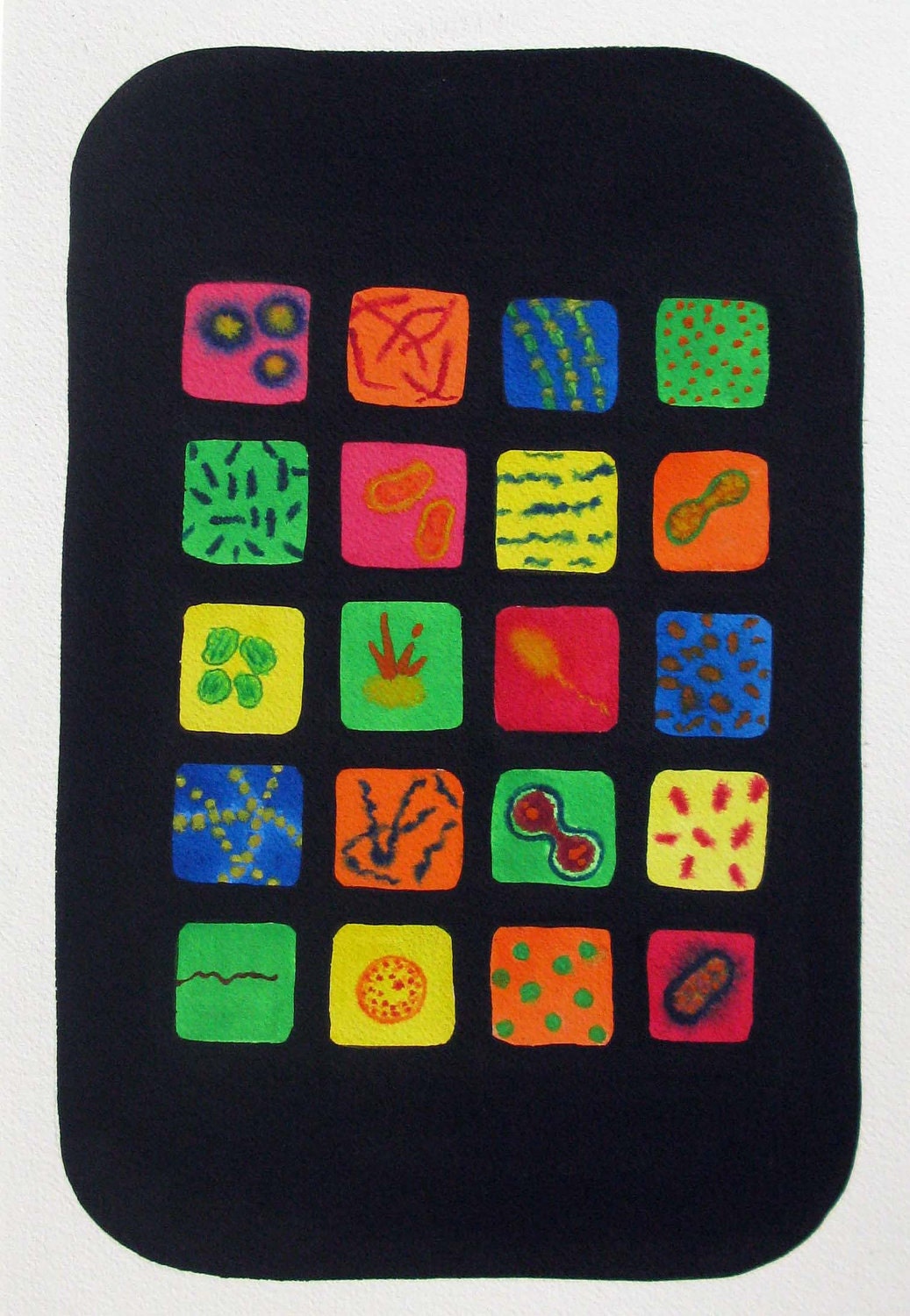
From @Artologica on Etsy.  The Phonome. 
Today we have a very special guest post from Georgia Barguil in Jack Gilbert's group at University of Chicago / Argonne National Lab.  Georgia has been coordinating analyses of microbial surveys that have been a collaboration between me and Jack (although really driven by Jack and his lab in most ways).  The study subject: cell phones and shoes.  The study locations: conferences and meetings in order to have participation in microbial surveys by "citizen" scientists of one kind or another.  We did this together at the AAAS meeting.  And then Gilbert's lab did this at ThirstDC.  And then I did this at SciFoo at Google HQ.  We are working on a paper on this and wanted to get some results out to the community so Georgia wrote up this post.


Ever wanted to know what bacteria are on your shoes and phones? Of course you have! Here we explored the bacteria that call shoes and phones home; the shoes and phones belonged to employees at Google’s Headquarters, and to participants at the Thirst DC and AAAS annual meeting conferences over 2012 (Fig. 1). Altogether, 84 phones (34 from GoogleHQ, 23 from ThirstDC and 27 from AAAS) and 68 shoes (15 from SciFoo, 24 from ThirstDC and 29 from AAAS) were sampled. The DNA of these samples was extracted and the bacteria were identified by sequencing and subsequent computational analysis of a key gene (16SrRNA) found in all bacteria. Here we show some of the results.

Fig. 1: Map showing the 3 sampling locations: AAAS in Vancouver, SciFoo in California and ThirstDC in Washington

There are quite a lot of microorganisms found in these environments, as you can see in the graph below (Fig. 2), where each bar represents a sample and each color represents a group of bacteria. Also by looking at the chart you can see that the bacteria that live on phones and shoes are different, and found in different proportions. Actually, by comparing the bacterial profile from an unidentified sample with this collection, we could tell you whether that sample was from a phone or a shoe!

Fig. 2: Genus-level diversity and abundance of bacteria associated to phone and shoe samples.

In the shoe samples you can see a lot more colors, which implies that the shoes are home to more bacterial groups than the phones. Out of 560 groups of bacteria found, there were 90 that favored either shoes or phones; 70 of these groups favored the shoe environment while the other 20 favored the phone. Some of the groups that preferred the phones were:

Monday, February 20, 2012

Jack Gilbert @gilbertjacka clarifies comments at #AAASMtg re: opening windows, cleanliness & microbes

Just got this to post from my college colleague Jack Gilbert in regard to some comments he made to the press at the AAAS Meeting a few days ago.  He sent this in part in response to some news stories that came out of the press conference we had at the meeting (e.g., see Florence Nightingale approach 'could help fight infection in ...Open hospital windows to stem spread of infections, says ... and others).  And I encouraged him to consider whether or not he needed to clarify some of his comments - and here is his response.

A confession, lesson and retraction
By Jack A. Gilbert

At the AAAS 2012 annual meeting on Friday, I was involved in a press conference to announce the initial results and ideology for the Earth Microbiome Project (http://www.earthmicrobiome.org). Following the press conference we went to another room, where we were openly discussing these concepts with the reporters. Several reporters asked me to comment on the potential impact of this research in the medical sphere. At which point I started to discuss some excellent research by Jessica Green (http://biology.uoregon.edu/people/green) regarding her recent evidence that improved ventilation in hospital wards reduced the airborne abundance of organisms that were related to pathogens. I showed these reporters the paper
(http://www.nature.com/ismej/journal/vaop/ncurrent/full/ismej2011211a.html) and asked them to discuss this with Jessica Green.

Friday, August 19, 2011

Get to know Jack & the story behind the paper by @gilbertjacka "Defining seasonal marine microbial community dynamics"

ResearchBlogging.org A few days ago I became aware of the publication of a cool new paper: "Defining seasonal marine microbial community dynamics" by Jack A. Gilbert, Joshua A Steele, J Gregory Caporaso, Lars Steinbrück, Jens Reeder, Ben Temperton, Susan Huse, Alice C McHardy, Rob Knight, Ian Joint, Paul Somerfield, Jed A Fuhrman and Dawn Field.  The paper was published in the ISME Journal and is freely available using the ISME Open option. If you want to know more about Jack (in case you don't know Jack, or don't know jack about Jack) check out some of his rantings material on the web like his Google Scholar page, and his twitter feed, his LinkedIn page, his U. Chicago page. But rather than tell you about Jack or the paper, I thought I would send some questions to the first author, Jack Gilbert and see if I could get some of the "story behind the paper" out of him.  Since Jack likes to talk (and email and do things on the web), I figured it was highly likely I could get some good answers.  And indeed I was right. Here are his answers to my quickly written up questions (been out of the office due to family illness)

Most recent post

A ton to be thankful for -- here is one part of that - all the acknowledgement sections from my scholarly papers

So - it is another Thanksgiving Day and in addition to thinking about family, and football, and Alice's Restaurant, I also think a lot a...