Showing posts with label Jenna Lang. Show all posts

Saturday, March 28, 2015

How to keep up with microbial ecology and the built environment: microBEnet is your place

Just posting a wrap up of posts on microBEnet (where I blog frequently as do many other folks that work on something related to microbial ecology, the built environment, or the intersection of the two).  microBEnet is really becoming a central place to find out what is going on in the world of microbial ecology and the built environment.  And I love that we are getting more and more posts from outsiders about their work, their meetings, their ideas and more.  Anyway - here is a wrap up of the posts for the last month.  If you are interesting in joining microBEnet and writing posts about relevant topics, let me know.

Jenna Lang (staff scientist in my lab) -- meeting reports from a Planetary Protection meeting
My posts:
Alexander Sczyrba on the Critical Assessment of Metagenome Interpretation (CAMI)

Tuesday, February 17, 2015

Two Eisen lab papers selected for the PeerJ 2015 Collection

Cool.  Two paper from my lab were selected as highlights of 2014 papers in the Peer J: PeerJ Collection: PeerJ Picks 2015 Collection

The papers were


,  ,  

Wednesday, December 10, 2014

New lab paper: The microbes we eat: abundance and taxonomy of microbes consumed in a day’s worth of meals for three diet types

A new paper out from my lab (with Jenna Lang as the 1st author and in collaboration with Angela Zivcovic from the UC Davis Food For Health Initiative and the Department of Nutrition):  The microbes we eat: abundance and taxonomy of microbes consumed in a day’s worth of meals for three diet types.  The work in the paper focuses on characterizing the abundance and taxonomy of microbes in food from three model diets.

Basically, Angela prepared meals for these three diets
Food was purchased and prepared in a standard American home kitchen by the same individual using typical kitchen cleaning practices including hand washing with non-antibacterial soap between food preparation steps, washing of dishes and cooking instruments with non-antibacterial dish washing detergent, and kitchen clean-up with a combination of anti-bacterial and non-antibacterial cleaning products. Anti-bacterial products had specific anti-bacterial molecules added to them whereas “non-antibacterial” products were simple surfactant-based formulations. The goal was to simulate a typical home kitchen rather than to artificially introduce sterile practices that would be atypical of how the average American prepares their meals at home. All meals were prepared according to specific recipes (from raw ingredient preparation such as washing and chopping, to cooking and mixing).
And then she blended them and we characterzied the microbial communities in the blended samples:
After food preparation, meals were plated on a clean plate, weighed on a digital scale (model 157W; Escali, Minneapolis, MN), and then transferred to a blender (model 5,200; Vita-Mix Corporation, Cleveland, OH) and processed until completely blended (approximately 1–3 min). Prepared, ready to eat foods that were purchased outside the home were simply weighed in their original packaging and then transferred to the blender. 4 mL aliquots of the blended meal composite were extracted from the blender, transported on dry ice and then stored at −80 °C until analysis. The following analyses were completed using these meal composite samples: (1) total aerobic bacterial plate counts, (2) total anaerobic bacterial plate counts, (3) yeast plate counts, (4) fungal plate counts, and (5) 16S rDNA analysis for microbial ecology.
And Jenna Lang coordainted the sequence analysis and then Angela and Jenna (with some help here and there from me) coordianted the analysis of the different microbial data and the writing of the paper.
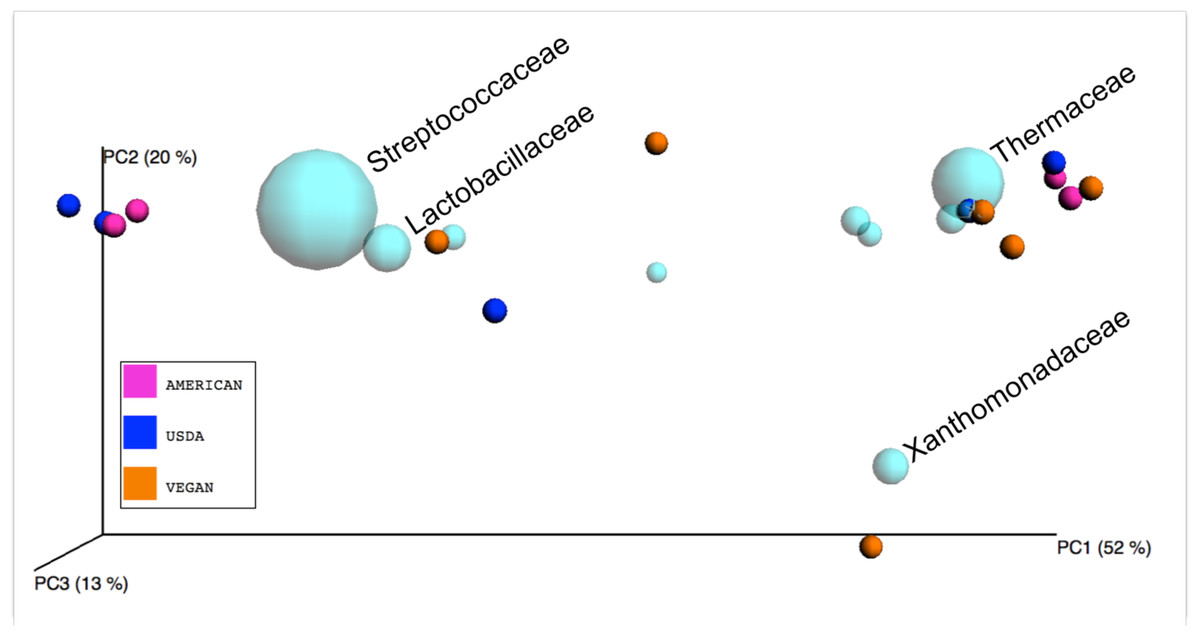
Figure 5: Biplot of taxa in sample PCoA space.

Lots of interesting things reported in the paper (read it, I insist).  I note - this is a demonstration project in a way - trying to get the community and others to think about the source pools of microbes that come into our system from our food.  It is by no means comprehensive or conclusive (read the caveats section of the paper).  Congrats to Jenna and Angela for all their hard work. Anyway - the paper is Open Access in PeerJ.  Eat it up.

UPDATE: Some press and blog coverage

Saturday, November 22, 2014

Post-doc w/ me, Jessica Green, Jay Stachowicz, and Jenna Lang on seagrass microbiomes

Postdoctoral Position in Microbial Ecology and Evolution
Jessica Green at the University of Oregon Green (http://pages.uoregon.edu/green/) is currently seeking a postdoctoral researcher to explore fundamental questions in microbial ecology and evolution. Applicants should have a PhD in a biological, computational, mathematical, or statistical field with extensive training using theory and/or modeling to understand the ecology and evolution of complex biological communities, and strong writing skills. Experience developing and applying quantitative phylogenetic ecological methods is highly desirable, but not explicitly required for candidates who have otherwise demonstrated strong quantitative skills.
The successful candidate will play a key role in the Seagrass Microbiome Project (http://seagrassmicrobiome.org) in collaboration among Jonathan Eisen https://phylogenomics.wordpress.com), Jay Stachowicz http://www-eve.ucdavis.edu/stachowicz/stachowicz.shtml, and Jenna Lang (http://jennomics.com/) at the University of California, Davis. The Seagrass Microbiome Project aims to integrate the long interest in seagrass ecology and ecosystem science with more recent work on microbiomes to produce a deeper, more mechanistic understanding of the ecology and evolution of seagrasses and the ecosystems on which they depend. Our studies of the community of microorganisms that live in and on seagrasses – the seagrass “microbiome” – will contribute to a broader understanding of host-microbe systems biology, and will benefit from ongoing University of Oregon research programs including the Microbial Ecology and Theory of Animals Center for Systems Biology (http://meta.uoregon.edu/) and the Biology and Built Environment Center (http://biobe.uoregon.edu/).
The position is available for 1 year with the possibility for renewal depending on performance. The start date is flexible. Please email questions regarding the position to Jessica Green (jlgreen).
To apply
A complete application will consist of the following materials:
(1) a brief cover letter explaining your background and career interests
(2) CV (including publications)
(3) names and contact information for three references
Submit materials to ie2jobs. Subject: Posting 14431
To ensure consideration, please submit applications by November 1, 2014, but the position will remain open until filled.
Women and minorities encouraged to apply. We invite applications from qualified candidates who share our commitment to diversity.
The University of Oregon is an equal opportunity, affirmative action institution committed to cultural diversity and compliance with the ADA. The University encourages all qualified individuals to apply, and does not discriminate on the basis of any protected status, including veteran and disability status.

Friday, May 02, 2014

What to do when you realize the meeting you are speaking at is a YAMMM (yet another mostly male meeting)?

I am supposed to be talking at a meeting Tuesday: Almaden Institute 2014: Sequence the City -Metagenomics in the Era of Big Data.

In looking at the agenda for the meeting I am pretty bummed about the gender ratio of speakers. Looks like 18:5 Men to Women. 
  • Jeff Welser IBM 
  • David Haussler UCSC 
  • Daniel Huson Tubingen U 
  • Joe DeRisi UCSF 
  • Jane Carlton NYU 
  • Ajay Royyuru IBM 
  • Paula Olsiewski Sloan Foundation 
  • Christopher Mentzel Moore Foundation 
  • Anne Marie Kimball Gates Foundation 
  • Jonathan Eisen UC Davis 
  • Jessica Green U Oregon 
  • Mark Adams JCVI 
  • Eric Alm MIT 
  • Raul Andino UCSF 
  • Scott Kahn Illumina 
  • Mike Lelivelt Ion Torrent 
  • Radoje (Rade) Drmanac Complete Genomics 
  • Brett Bowman Pacific Biosciences 
  • Chris Mason Cornell 
  • Bart Weimer UC Davis 
  • David Crean Mars 
  • Astri Wayadande Oklahoma State U 
  • Christopher Elkins FDA
Not sure what to do about this. I am certainly (in a few minutes) going to be writing to the organizers. I am also pondering cancelling talking. I try very hard to be vigilant about gender ratios at meetings and it drives me crazy to see such skews. I know it is not always possible to have meetings have equal representation and I know some people try very hard and do not succeed. But this seems unpleasantly extreme. So - any thoughts or recommendations as to what to do would be appreciated.


UPDATE 5/5 -

Saturday, May 18, 2013

Thanks to Software Carpentry (@swcarpentry) for coming to #UCDavis

Quick post here.  Jenna Lang in my lab has a post at microBEnet about the recent workshop that the Software Carpentry folks ran at UC Davis: Software Carpentry comes to UC Davis! | microBEnet: The microbiology of the Built Environment network.  It was a major success.  For those who don't know Software Carpentry's mission is is to build basic computing skills among researchers.  From their web site:
Software Carpentry helps researchers be more productive by teaching them basic computing skills. We run boot camps at dozens of sites around the world, and also provide open access material online for self-paced instruction. The benefits are more reliable results and higher productivity: a day a week is common, and a ten-fold improvement isn't rare.
A great idea and done really well.  Others out there should consider hosting or attending one of their Boot Camps and checking out their materials on their web site.  See for example their videos and their reading list and their lessons.  They really do great things ...

Friday, May 10, 2013

Crosspost: Woohoo – two more genome announcement papers from our undergraduate project on built environment reference genomes


Crossposting this from the microBEnet blog.
Two new papers out from the microBEnet Undergraduate Research: Built Environment Reference Genomes  project:
These go with two previously published ones:
And two more coming. So proud of the undergrads in my lab who did this work and David Coil for coordinating it with help from Jenna Lang and Aaron Darling.  Undergrads at UC Davis sequencing genomes of organisms they isolated. So cool.

Saturday, April 27, 2013

Yes, the human microbiome has truly arrived: on Wait Wait Don't Tell Me

So cool.  Yesterday on "wait wait ... don't tell me" Kai Penn (actor) was enticed to play the game "Ahhh! Get It Off Me!" in regard to microbes: Not My Job: Kal Penn Takes A Quiz On The Microbiome : NPR

Hat tip to Jenna Lang for pointing me to this.

Most recent post

A ton to be thankful for -- here is one part of that - all the acknowledgement sections from my scholarly papers

So - it is another Thanksgiving Day and in addition to thinking about family, and football, and Alice's Restaurant, I also think a lot a...