Cool. Two paper from my lab were selected as highlights of 2014 papers in the Peer J: PeerJ Collection: PeerJ Picks 2015 Collection
The papers were
The microbes we eat: abundance and taxonomy of microbes consumed in a day’s worth of meals for three diet types
Showing posts with label PeerJ. Show all posts
Showing posts with label PeerJ. Show all posts
Tuesday, February 17, 2015

Wednesday, December 24, 2014
Do preprints count for anything? Not according to Elife & G3 & some authors ..
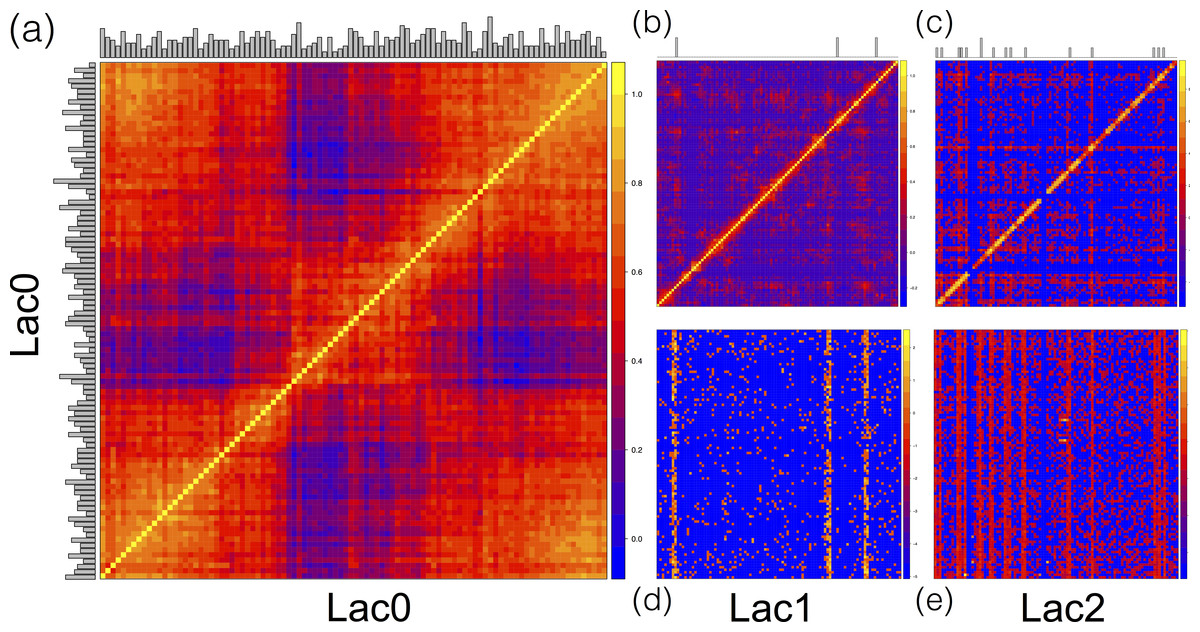
Well, just got pointed to this paper: Metagenomic chromosome conformation capture (meta3C) unveils the diversity of chromosome organization in microorganisms | eLife by Martial Marbouty, Axel Cournac, Jean-François Flot, Hervé Marie-Nelly, Julien Mozziconacci, Romain Koszul. Seems potentially really interesting.
It is similar in concept and in many aspects to a paper we published in PeerJ earlier in the year (see Beitel et al., 2014 Beitel CW, Froenicke L, Lang JM, Korf IF, Michelmore RW, Eisen JA, Darling AE. (2014) Strain- and plasmid-level deconvolution of a synthetic metagenome by sequencing proximity ligation products. PeerJ 2:e415 http://dx.doi.org/10.7717/peerj.415.
Yet despite the similarities to our paper and to another paper that was formally published around the time of ours, this new paper does not mention these other pieces of work any where in the introduction as having any type of "prior work" relevance. Instead, they wait until late in their discussion:
Taking advantage of chromatin conformation capture data to address genomic questions is a dynamic field: while this paper was under review, two studies were released that also aimed at exploiting the physical contacts between DNA molecules to deconvolve genomes from controlled mixes of microorganisms (Beitel et al., 2014; Burton et al., 2014).Clearly, what they are trying to do here is to claim that since they paper was submitted before these other two (including ours) was published, that they should get some sort of "priority" for their work. Let's look at that in more detail. Their paper was received May 9, 2014. Our paper was published online May 27 and the other related paper by Burton et al. was published online May 22. In general, if a paper on what your paper is about comes out just after you submit your paper, while your paper is still in review, the common, normal thing to be asked to do is to rewrite your paper to deal with the fact that you were, in essence, scooped. But that does not really appear to be the case here. They are treating this in a way as "oh look, some new papers came out at the last minute and we have commented on them." The last minute would be in this case, 6 months before this new paper was accepted. Seems like a long time to treat this as "ooh - a new paper came up that we will add a few comments about".
But - one could quibble about the ethics and policies of dealing with papers that were published after one submitted one's own paper. From my experience, I have always had to do major rewrites to deal with such papers. But maybe E-Life has different policies. Who knows. But that is where things get really annoying here. This is because it was May 27 when our FINAL paper came out online at PeerJ. However, the preprint of the paper was published on February 27, more than two months before their paper was even submitted. So does this mean that the authors of this new paper do not believe that preprints exist? It is pretty clear on the web site for our paper that there is a preprint that was published earlier. Given what they were working on - something directly related to what our preprint/paper was about, one would assume they would have seen it with a few simple Google searches. Or a reviewer might have pointed them to it. Maybe not. I do not know. But either way, our preprint was published long before their paper was submitted and therefore I believe they should have discussed it in more detail.
Is this a sign that some people believe preprints are nothing more than rumors? I hope not. Preprints are a great way to share research prior to the delays that can happen in peer review. And in my opinion, preprints should count as prior research and be cited as such. I note - the Burton group in their paper in G3 also did not reference our preprint in what I consider to be a reasonable manner. They add some comments in their acknowledgements
While this manuscript was in preparation, a preprint describing a related method appeared in PeerJ PrePrints (Beitel et al. 2014a). Note added in proof: this preprint was subsequently published (Beitel et al. 2014b).Given that our preprint was published before their paper was submitted too, I believe that they also should have made more reference to it in their paper. But again, I can only guess that both the Burton and the Marbouty group just do not see preprints as being respectable scientific objects. That is a bad precedent to set and I think the wrong one too. And it is a shame. A preprint is a publication. No - it is not peer reviewed. But that does not mean it should not be considered part of the scientific literature in some way. I note - this new paper from the Marbouty group seems really interesting. Not sure I want to dig into it any deeper if they are going to play games with the timing of submission vs. published "papers" as part of how they are positioning themselves to be viewed as doing something novel.
Thursday, June 06, 2013
Some new preprints of interest and comments on "The case for preprints in biology"
Getting more and more into preprints (see for example these posts Guest post from Jake Scott: Building trust: a sine qua non for successful acceptance of preprints in the biological sciences and More bio preprint discussion sites ...). So am starting to browse preprint servers a bit more and I have found some recently posted preprints of interest:
http://arxiv.org/abs/1306.1206
From arVix:
http://arxiv.org/abs/1306.1206
From arVix:
- [1305.7256] tRNA signatures reveal polyphyletic origins of streamlined SAR11 genomes among the alphaproteobacteria
- Coalescence, genetic diversity and adaptation in sexual populations from Neher et al.
- Reducing assembly complexity of microbial genomes with single-molecule sequencing from Koren et al.
- Antibiotic resistance landscapes: a quantification of theory-data incompatibility for fitness landscapes from Crona et al.
- Supertrees based on the subtree prune-and-regraft distance from Whidden et al.
- Microenvironmental variables need to effect intrinsic phenotypic parameters of cancer stem cells to affect tumourigenicity from Jake Scott et al.
- GenGIS 2: Geospatial analysis of traditional and genetic biodiversity, with new gradient algorithms and an extensible plugin framework from Rob Beiko et al.
I wondered - where else might one find Biology themed preprints. And a little google searching let me to this new PLOS Biology paper which somehow I had missed a few weeks ago: The Case for Open Preprints in Biology
(Full citation: Desjardins-Proulx P, White EP, Adamson JJ, Ram K, Poisot T, et al. (2013) The Case for Open Preprints in Biology. PLoS Biol 11(5): e1001563. doi:10.1371/journal.pbio.1001563)
Wow - how perfect. In their paper they not only lay out the case for why preprints would be a good thing in biology but discuss some of the options. And in addition to PeerJ and arXiv they point to Figshare, Github, and ResearchGate.
Below is Figure 1 from their paper:
 | |||
| Figure 1. It can take several months before a submitted paper is officially published and citable.. Meanwhile, few people are aware of the research that has been done since, typically, only close colleagues are given access to the preprints. With public preprint servers, the science is immediately available and can be openly discussed, analyzed, and integrated into current research. doi:10.1371/journal.pbio.1001563.g001 |
They also show that in arXiv submissions in the qBio section are going up but not nearly as much as submissions in other fields
 |
| Figure 2. Submissions to the quantitative biology section lag behind physics, mathematics, and computer science. Data from [19]. doi:10.1371/journal.pbio.1001563.g002. The reference to 19 is to Warner S (2012) Data for arXiv submissions by subject and year. Available: http://dx.doi.org/10.6084/m9.figshare.96966. Accessed 14 April 2013. |
I think this paper is worth a look for anyone interest in scientific publishing. I like their last line and will end my post with it:
Preprints are simply bypassing this model for what we believe is the progress of science: they speed up the dissemination of scientific discoveries and put on readers' shoulders the responsibility to judge originality and pertinence.
Monday, June 03, 2013
Guest post from Jake Scott: Building trust: a sine qua non for successful acceptance of preprints in the biological sciences
Today I am happy to have a guest post from my friend and colleague Jake Scott. The topic of the day is preprints in biology and medicine.
Hi - I'm Jake Scott. I met Jonathan last year when he and I spoke at TEDMED 2012. Both Jonathan and I have posted recently about the need for, and (slowly) growing movement in the biological sciences to post #preprints of manuscripts in openly accessible fora to circumvent some problems associated with standard academic publishing. Most worrisome are the issues surrounding #openaccess and the length of time it takes to get information from one's brain to the literature - drastically slowing down the pace of science.
This has worked GREAT in the physics community, where this trend really began quite some time ago when the high energy physicists started the arXiv. Now, the precedent is set, and no one in physics bats an eye about sticking their paper on the arXiv, and cite other works presented there as standard publications.
The climate in biology, sadly, is much different. Whether this is because of a more competitive climate for funding, or just a field diluted by more talented scientists, I don't know. But there is a pervasive attitude of fear and mistrust around the idea of preprints.
Before you read on (and become biased by my opinions) take a few second (really, probably 1.5 minutes) and take this quick survey:
Tuesday, March 12, 2013
Guest post from Ashley Bateman on "Full contact microbes" - Roller Derby
A special guest post from Ashley Bateman.


Roller derby players share their skin microbes during play
Single-celled organisms are intimately associated with multicellular organisms across the tree of life, and human beings are no exception. Making up 90% of our cellular composition, these invisible passengers (our microbiome) contribute to our health and well-being in crucial ways, including aiding our digestion, the education of our immune system, and resistance to pathogens. Despite this importance, we still lack a fundamental understanding of where our host-associated microbes actually come from. We know that infants are born practically sterile; early-life events such as birth mode can contribute to the types of microbial species found on an individual, but these events cannot adequately explain the majority of spatiotemporal variation observed over a host’s lifetime. To be able to accurately describe the processes that drive host-associated microbial community dynamics, we must have an informed understanding of the role of dispersal in structuring host-associated microbial communities.
Where do they come from? How do they get there? Do these changes (if any) last?
The Green Lab at the University of Oregon-Eugene attempted to answer some of these questions in our latest publication “Significant changes in the skin microbiome mediated by the sport of Roller Derby”, released today by PeerJ. We decided to use Roller Derby as a model system to investigate the role of contact in dispersing skin microbial communities between hosts. We have known for a long time that pathogens can be transmitted via direct contact; could not our commensal microbial communities be shared in this way?
We swabbed the upper arms (a frequent contact point between players during a bout) of players belonging to 3 geographically distinct derby teams and characterized the skin microbiome of each player using 16s rRNA gene Illumina sequencing. We found that each team’s upper arm microbiome was significantly different from one another before play, and that this difference decreased after bouts were played. Not only did teams’ skin microbiomes become less different from one another after play, but the differences were driven in part “by the presence of unique indicator taxa that are commonly associated with human skin, gut, mouth, and respiratory tract.” There were also environmental bacteria associated with soil and plants found in the skin samples.
Although we weren’t able to show a direct link between contact and transfer of specific microbial taxa, the best explanation of the data seems to be that contact between these players during a one-hour bout effectively resulted in homogenization of their upper arm skin microbiomes.
So much yet to explore! As a 2nd year graduate student in the Green Lab I hope to address some of the questions that the Roller Derby paper has brought to our attention. My dissertation research is gearing up to understand the role of dispersal on our skin microbiome. Are some skin sites more amenable to changes than others? Can we pick up host-associated microbes not just from other individuals, but from objects that other individuals have touched? Can we pick up non-host-associated microbes? If we can pick them up, how long do they stick around? How do they participate in the functions attributed to the skin microbiome?
Hope to keep up the fantastic momentum that has been launched by this latest publication – if you have any thoughts or comments, feel free to contact me at abateman@uoregon.edu, or via Twitter: @microbesrock
And you can check out a stop-motion video I made on the skin microbiome here:
Subscribe to:
Posts (Atom)
Most recent post
A ton to be thankful for -- here is one part of that - all the acknowledgement sections from my scholarly papers
So - it is another Thanksgiving Day and in addition to thinking about family, and football, and Alice's Restaurant, I also think a lot a...

-
Wow. Just wow. And not in a good way. Just got an email invitation to a meeting. The meeting is " THE FIRST ANNUAL WINTER Q-BIO ...
-
 I have a new friend in Google Scholar Updates I have written about the Updates system before and if you want more information please see...
-
See Isolation and sequence-based characterization of a koala symbiont: Lonepinella koalarum Paper based on PhD thesis work of Katie Dahlha...
