Showing posts with label eLife. Show all posts

Wednesday, December 24, 2014

Do preprints count for anything? Not according to Elife & G3 & some authors ..


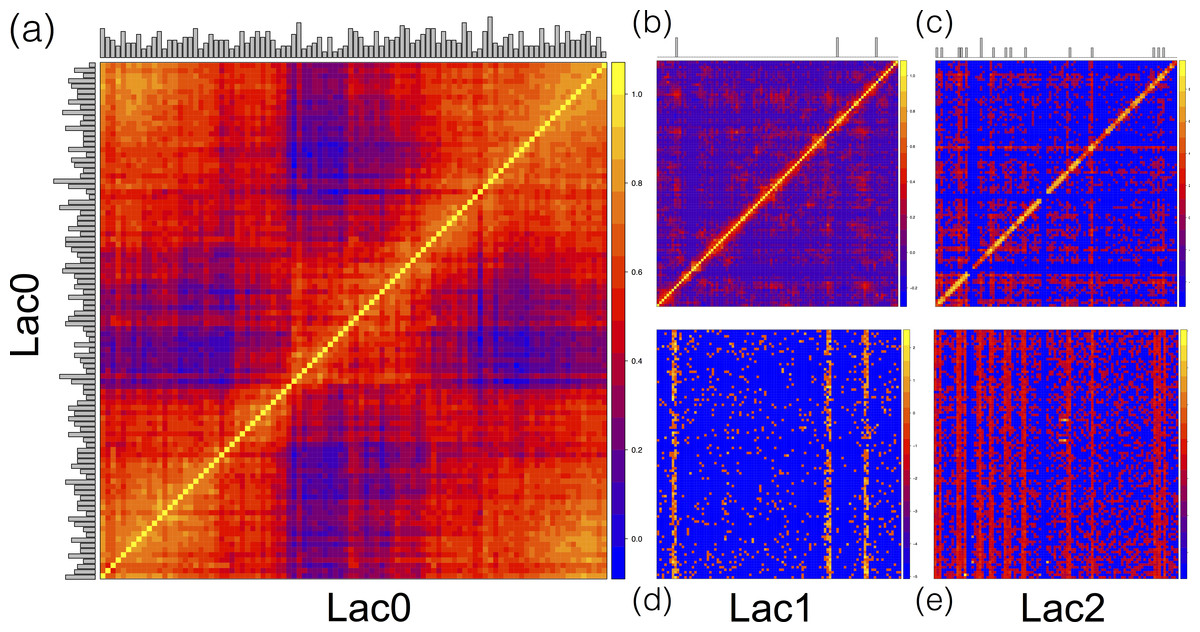
Well, just got pointed to this paper: Metagenomic chromosome conformation capture (meta3C) unveils the diversity of chromosome organization in microorganisms | eLife by Martial Marbouty, Axel Cournac, Jean-François Flot, Hervé Marie-Nelly, Julien Mozziconacci, Romain Koszul.  Seems potentially really interesting.

It is similar in concept and in many aspects to a paper we published in PeerJ earlier in the year (see Beitel et al., 2014 Beitel CW, Froenicke L, Lang JM, Korf IF, Michelmore RW, Eisen JA, Darling AE. (2014) Strain- and plasmid-level deconvolution of a synthetic metagenome by sequencing proximity ligation products. PeerJ 2:e415 http://dx.doi.org/10.7717/peerj.415.

Yet despite the similarities to our paper and to another paper that was formally published around the time of ours, this new paper does not mention these other pieces of work any where in the introduction as having any type of "prior work" relevance.  Instead, they wait until late in their discussion:
Taking advantage of chromatin conformation capture data to address genomic questions is a dynamic field: while this paper was under review, two studies were released that also aimed at exploiting the physical contacts between DNA molecules to deconvolve genomes from controlled mixes of microorganisms (Beitel et al., 2014; Burton et al., 2014).
Clearly, what they are trying to do here is to claim that since they paper was submitted before these other two (including ours) was published, that they should get some sort of "priority" for their work.  Let's look at that in more detail.  Their paper was received May 9, 2014.  Our paper was published online May 27 and the other related paper by Burton et al. was published online May 22.  In general, if a paper on what your paper is about comes out just after you submit your paper, while your paper is still in review, the common, normal thing to be asked to do is to rewrite your paper to deal with the fact that you were, in essence, scooped.  But that does not really appear to be the case here.  They are treating this in a way as "oh look, some new papers came out at the last minute and we have commented on them."  The last minute would be in this case, 6 months before this new paper was accepted.  Seems like a long time to treat this as "ooh - a new paper came up that we will add a few comments about".

But - one could quibble about the ethics and policies of dealing with papers that were published after one submitted one's own paper.  From my experience, I have always had to do major rewrites to deal with such papers.  But maybe E-Life has different policies.  Who knows.  But that is where things get really annoying here.  This is because it was May 27 when our FINAL paper came out online at PeerJ. However, the preprint of the paper was published on February 27, more than two months before their paper was even submitted.  So does this mean that the authors of this new paper do not believe that preprints exist?  It is pretty clear on the web site for our paper that there is a preprint that was published earlier.  Given what they were working on - something directly related to what our preprint/paper was about, one would assume they would have seen it with a few simple Google searches.  Or a reviewer might have pointed them to it.  Maybe not.  I do not know.  But either way, our preprint was published long before their paper was submitted and therefore I believe they should have discussed it in more detail.

Is this a sign that some people believe preprints are nothing more than rumors?  I hope not.  Preprints are a great way to share research prior to the delays that can happen in peer review.  And in my opinion, preprints should count as prior research and be cited as such.  I note - the Burton group in their paper in G3 also did not reference our preprint in what I consider to be a reasonable manner.  They add some comments in their acknowledgements
While this manuscript was in preparation, a preprint describing a related method appeared in PeerJ PrePrints (Beitel et al. 2014a). Note added in proof: this preprint was subsequently published (Beitel et al. 2014b). 
Given that our preprint was published before their paper was submitted too, I believe that they also should have made more reference to it in their paper.   But again, I can only guess that both the Burton and the Marbouty group just do not see preprints as being respectable scientific objects.  That is a bad precedent to set and I think the wrong one too.  And it is a shame.  A preprint is a publication.  No - it is not peer reviewed.  But that does not mean it should not be considered part of the scientific literature in some way.  I note - this new paper from the Marbouty group seems really interesting.  Not sure I want to dig into it any deeper if they are going to play games with the timing of submission vs. published "papers" as part of how they are positioning themselves to be viewed as doing something novel.

Wednesday, December 12, 2012

Story behind the paper: Corey Nislow on Haloferax Chromatin and eLife

This is fun.  Today I am posting this guest post from Corey Nislow in my continuing "Story behind the paper" series.  The history of this post is what is most fun for me.  A few weeks ago I received this email from Corey:
Hi Jonathan, I hope this mail finds you well.
I wanted to alert you to a study from our lab that will be coming out in the inaugural issue of eLIFE.
After reading your PLoS ONE paper on the Haloferax volcanii genome (inspiration #1) I ordered the critter, prepared nucleosomes and RNA and we went mapping. Without a student to burden, I actually had to do some work...
Anyhow, we found that the genome-wide pattern of nucleosome occupancy and its relation to gene expression was remarkably yeast like. Unsure of where to send the story, we rolled the dice with the new open access journal eLIFE (inspiration #2) and the experience was awesome. I'm quite keen to pursue generating a barcoded deletion set for Hfx.
here's the paper (coming out Dec. 10) if you're curious.

And a PDF of the paper was attached.

And I wrote back quickly in my typically elegant manner:
completely awesome
But then I thought better of it and wrote again
So - can I con you into writing a guest post for my blog about the story behind this paper?  Or if you are writing a description somewhere else I would love to share it
And he said, well, yes.  And with a little back and forth, he wrote up the post that it below.  Go halophiles.  Go Haloferax.  Go open access.  Go science.


Chromatin is an ancient innovation conserved between Archaea and Eukarya  - The story behind the story

By Corey Nislow

My group first became interested in understanding the global organization of chromatin in early 2005 when Lars Steinmetz (now program leader at the EMBL) led a team effort at the Stanford Genome Center to design a state-of-the-art whole genome tiling microarray for Saccharomyces cerevisiae. These were heady times at Ron Davis’ Genome Technology shop and the array was another triumph of technology and teamwork. The array has over 7 million exceedingly small (5 µm²). The history of how this microarray transformed our understanding of the transcriptome began in 2006. As Lars’ group dug deeper, the extent of antisense transcription and its role in the regulation of expression became clear.

The availability of this array and its potential for asking interesting questions inspired me to convince William Lee, a new graduate student in my group (now at Memorial Sloan-Kettering) to embark on a seemingly simple experiment. The idea was to ask if we could use the classic micrococcal nuclease assay to define nucleosome positioning on a DNA template. But rather than using a short stretch of DNA that could be assessed by radioactive end-labeling and slab gel analysis, we decided the time was right to go “full-genome”. Accordingly, the template was all ~12.5mB of the yeast genome. Will systematically worked out conditions appropriate for hybridization, wrote the software to extract signal off the array (we were flying blind as the array did not come with an instruction manual) and producing an output that was compatible with the genome browsers of the time. Will’s computational background proved critical here (and at several later stages of the project). The result of this experiment was a map of the yeast genome with each of its approximately 70,000 nucleosome's charted with respect to their occupancy (the length of time that the nucleosomes spend in contact with the DNA) and positioning (the location of a particular nucleosome relative to specific sequence coordinates) in a logarithmically growing population of cells (the paper). Both occupancy and positioning regulate access of most trans-acting factors for all DNA transactions. Working with my new colleague Tim Hughes at the University of Toronto, we began to mine this data focusing first on how the diverse occupancy patterns correlated with aspects of transcription, e.g. the presence of transcription factor binding sites, the level of expression of particular genes, and the like. With this data for the entire genome, we could systematically correlate nucleosome positioning/occupancy with functional elements, sequence logos and structural features. Des Tillo, a graduate student in Tim’s lab and now a research fellow with Eran Segal, was able to build a model that could predict nucleosome occupancy. The correlation (R=0.45) was not great but it was miles better than anything that existed at the time. Tim and Eran’s labs, work with Jason Lieb and Jonathan Widom, refined the model to greater accuracy 2009 model.

Our original study (essentially a control experiment to define the benchmark nucleosome map in yeast) has been widely cited- many of these cites have come from what were two opposing camps, the sequence advocates and the trans-acting proponents. The sequence folks posed that nucleosome position is directed by the underlying sequence information while the trans-acting folks see chromatin remodelers as having the primary role. Having last worked on chromatin in 1995 as a postdoc in Lorraine Pillus’ lab (cloning yeast SET1), it has been a scientific treat to be both a participant and observer in this most recent renaissance of chromatin glory.

The protocol

As a reminder, the micrococcal nuclease (MNase) assay relies on the preference of this nuclease to digest linker DNA. By chemically crosslinking histones to DNA with formaldehyde, digesting with MNase, then reversing the crosslinks and deproteinizing the DNA, you obtain 2 populations of DNAs, those protected by digestion (and presumably wrapped around nucleosomes in vivo) and a control sample that is crosslinked but not digested (genomic DNA). The former sample becomes the numerator and the latter the denominator and you take the ration between the two. Initially we compared the microarray signal intensities, now next generation sequence counts are used to define nucleosomal DNA. This cartoon depicts the array based assay, but simply swap in an NGS library step for the arrays to upgrade to the current state-of-the-art.  


In 2007 we were restricted to array-based assays (as were most genomic studies) and frankly, the 4bp resolution of the arrays was pretty amazing. But the introduction of Next-generation sequencing opened up the possibility of charting nucleosomes in worms or wildebeest or almonds, there was nothing to stop you other than the short read lengths at the time. The read length issue has since disappeared as the “short-read” platforms can easily cover the length of a nucleosome protected DNA fragment of ~150bases.

Most recent post

A ton to be thankful for -- here is one part of that - all the acknowledgement sections from my scholarly papers

So - it is another Thanksgiving Day and in addition to thinking about family, and football, and Alice's Restaurant, I also think a lot a...