Showing posts with label open access. Show all posts

Monday, October 13, 2014

Talk for UC Davis Pre-Health Meeting (#UCDPHSA): Opening up to Diversity

Sunday I gave a talk at the "12th National UC Davis Pre-Health Student Alliance Pre-Medical and Pre-Health Professions Conference".  I normally try to not give talks on weekends (to spend time with my family) but I made an exception here since this meeting has a strong commitment to issues relating to diversity in health and STEM fields.  This mission statement for the meeting reads:
The UC Davis Pre-Health Student Alliance’s objective is to introduce and support academic, admission, and preparatory opportunities for all students interested in health professions with a focus on those underrepresented in healthcare (with regard to gender, economic, social, educational, linguistic, cultural, racial, and ethnic background). We target universities, community colleges and high schools throughout the United States. The UC Davis Pre-Health Student Alliance aims to impact health education, increase diversity amongst the healthcare workforce, and inspire future leaders of healthcare through hosting the largest national pre-health professions conference.
It was that mission statement that got me to ditch my wife and kids Sunday AM (and also much of Saturday PM for a dinner and to work on my talk).  I went to a dinner Saturday for some of the speakers with the new Dean of the UC Davis School of Medicine Julie Freischlag.  The dinner had about 20 or so people and I met some quite interesting folks there working on various aspects of human and animal health.

And then Sunday AM I got up early, decided to use slides (was not sure) and finished off the slide set I had worked on the night before.  I decided that, in the spirit of the meeting, I would talk about two main things - diversity and access.  And I planned to tell three stories about my work in this area.  I wove in some personal stories since, at the dinner the night before Barbara Ross-Lee (who I sat next to) helped remind me of the importance of making talks personal.  So in the end I talked about myself, diabetes, diversity of microbes, antibiotics, diversity in STEM, and open science.  I came up with a title I was OK with: Opening up to Diversity.

My talk went well, I think.  I am pretty sure it was vbideotaped but not sure where that recording will end up. I did however post my slides to slideshare.  See below:


Opening up to Diversity talk by @phylogenomics at #UCDPHSA from Jonathan Eisen

And I also recorded the talk using Camtasia (basically, it allows recording of the screen, the video camera on my computer, and the audio).  I posted the recording (without the video feed which shows mostly my neck) to Youtube.  See below:


Saturday, August 30, 2014

NIH Announces Revised Genome Data Release Policies

Just got notified of this by the UC Davis Med. School grants administration: NOT-OD-14-124: NIH Genomic Data Sharing Policy.  Lots of interesting things in here including a summary of the comments that they received on the draft policy.

I have copied some of the more interesting and relevant bits below:
  • Sharing research data supports the NIH mission and is essential to facilitate the translation of research results into knowledge, products, and procedures that improve human health.  NIH has longstanding policies to make a broad range of research data, in addition to genomic data, publicly available in a timely manner from the research activities that it funds. 
  • The public comments have been posted on the NIH GDS website. http://gds.nih.gov/pdf/GDS_Policy_Public_Comments.PDF
  • The statement of scope remains intentionally general enough to accommodate the evolving nature of genomic technologies and the broad range of research that generates genomic data.
  • Several comments were submitted by representatives or members of tribal organizations about data access.  Tribal groups expressed concerns about the ability of DACs to represent tribal preferences in the review of requests for tribal data.
  • The GDS Policy expects that basic sequence and certain related data made available through NIH-designated data repositories and all conclusions derived from them will be freely available.  It discourages patenting of “upstream” discoveries, which are considered pre-competitive, while it encourages the patenting of “downstream” applications appropriate for intellectual property.  
  • NIH expects investigators and their institutions to provide basic plans for following this Policy in the “Genomic Data Sharing Plan” located in the Resource Sharing Plan section of funding applications and proposals.  Any resources that may be needed to support a proposed genomic data sharing plan (e.g., preparation of data for submission) should be included in the project's budget. 
  • Large-scale non-human genomic data, including data from microbes, microbiomes, and model organisms, as well as relevant associated data (e.g., phenotype and exposure data), are to be shared in a timely manner. 

Sunday, October 06, 2013

It may have been a flawed #OpenAccess "Sting" but WE ROCKED IT so submit to our journal ...

I suppose I knew this was coming ... but did not expect it so soon ... see the email I received below.  Focus in particular on the part highlighted in yellow .... 

Dear Colleague, 
British Biotechnology Journal (BBJ) is an OPEN peer-reviewed, OPEN access, INTERNATIONAL journal, inspired from the great OPEN Access Movement. We offer both Online publication as well as Reprints (Hard copy) options. Article Processing Charge is only 50 US$ as per present offer. This journal is at present publishing Volume 4 (i.e. Fourth year of operation). 
2. Transparent and High standard Peer review:
In order to maintain highest level of transparency and high standard of review, this journal presently follows highly respected and toughest Advanced OPEN peer-review system(Example Link1, Link2, Link3, Link4, Link5, Link6, Link7, Link8, Link9, Link10,Link11, etc). We hope that you will appreciate this Advanced OPEN peer-review system, which is expected to give doubtless scholarly benefit and impact to the authors in long run. Additionally we strongly encourage and promote “Post-publication Peer review” by ourcomment section. 
As per a recent report (Link) of Science journal (present Impact factor 31), one of our journal passed a stringent test of quality of Peer review by rejecting a fake article (Link1,Link2, Link3). We applaud the dedication and hard-work of our peer reviewers and editors to maintain the high standard of our journals. It was reported that only few journals (20), out of total 304 journals tested, rejected the fake article after substantial peer review. We are happy that our journal was among these few successful journals along with industry leaders like PLoS One, Hindawi, etc. We believe that the result of this experiment also proved the efficacy of our Advanced OPEN peer review and ‘post publication’ peer review system. Though the report is debated, as it did not include subscription journals, we normally support any effort to improve the quality and transparency of peer review. 
3. Proposed Time Schedule:
Submission to first editorial decision with review comments: 3 weeks
Submission to publication: 6 weeks
State-of-the-art ‘running issue’ concept gives authors the benefit of 'Zero Waiting Time' for the officially accepted manuscripts to be published.
4. Abstracting/indexing:
Many respected abstracting/indexing services covered our journals.

Wednesday, August 21, 2013

Institutional repository success story: Master's on "War Eagles" contributes to amazing ring recovery story

Image from NPR.
So I just heard this amazing story on NPR. "Journey Of The Ring: Lost In WWII, Now Back With POW's Son."  In summary - a US Military member David Cox was taken as a POW in World War II in Germany.  While a captive he ended up trading a treasured ring for some chocolate. He returned home and made a replica of the ring but always felt bad about having had to trade the ring for food.  He passed away a few years ago.  Three or so weeks ago, two Americans - Mark and Mindy Turner - were invited to a dinner at the house of Martin and Regina Kiss and it turns out the Kiss's had the ring.  But they did not know who the original owner was.  So the Turners did some searching based on the inscription on the ring and the figured out who the original owner was and it has now been returned to David Cox's son.

So - how on earth is this a story connected to institutional archives.  Well, it turns out that the Turners figured out who the original owner of the ring was because their Google searches based on the ring's inscriptions took them within a few minutes to this Master's Thesis posted in 2006 at the NC State Digital Repository: War Eagles: A Bird's Eye View of 305th Bomb Group and the Eighth Air Force from the experiences of David C. Cox and Joseph B. Boyle - NCSU Digital Repository.  The thesis was written by Norwood McDowell, who happens to be the younger Cox's son in law.  And his thesis was about the elder Cox and had a brief discussion of the ring.

Kudos to all involved, including NC State and Norwood McDowell for making his Masters thesis available.

Friday, July 26, 2013

Postdoc position in innovating scholarly communication at #UCDavis w/ me, Mario Biagioli & Mackenzie Smith


7/26/13

Postdoc Position in Innovating Scholarly Communication

A new UC Davis initiative on "Innovating the Communication of Scholarship" is hiring a 3-year postdoctoral fellow, starting September 1, 2013. This is a cross-disciplinary project to study the future of academic publishing, involving faculty from the Center for Science and Innovation Studies, the Library, the Genome Center, and the School of Law (with additional collaborators in Computer Science, English, Philosophy, and the Graduate School of Management). Research topics include open access models, peer review, new forms of quality metrics, data publication, use of social media, and new forms of misconduct.
The successful candidate will conduct research, collaborate on or lead organization of conferences, workshops, pedagogical activities, and grant writing. A Ph.D. is required in a relevant field such as Science and Technology Studies, Library and Information Sciences, Communication, Law, Science, or English. Other disciplines will be considered depending on the specific focus of the candidate?s research and other experience. Qualified applicants will have experience working successfully in teams and managing multi-year projects. He or she will possess excellent written and oral communication and administrative skills.
Salary is based on experience and qualifications according to UC Davis guidelines.
To apply: E-mail a PDF file containing your CV, short description of your research experience relevant to this position, and contact details for three references to Mario Biagioli, MacKenzie Smith, Jonathan Eisen.

Tuesday, June 04, 2013

I am highly skeptical of the CHORUS system proposed by scientific publishers as an end run around PubMed Central

Just read this news story ... Scientific Publishers Offer Solution to White House's Public Access Mandate - ScienceInsider

It reports on an effort by various scientific publishers to create something they call "CHORUS" which stands for "Clearinghouse for the Open Research of the United States." They claim this will be used to meet the guidelines issued by the White House OSTP for making papers for which the work was supported by federal grants available for free within 12 months of being published.

This appears to be an attempt to kill databases like Pubmed Central which is where such freely available publications now are archived.  I am very skeptical of the claims made by publishers that papers that are supposed to be freely available will in fact be made freely available on their own websites.  Why you may ask am I skeptical of this?  I suggest you read my prior posts on how Nature Publishing Group continuously failed to fulfill their promises to make genome papers freely available on their website.

See for example:
We need to make sure such papers are freely available permanently and the only way to do this is via making them available outside of the publishers own sites.  Pubmed Central seems to be a good solution for this.  I would be happy to hear other possible solutions - but leaving "free" papers under the control of the publishers is a bad idea.

UPDATE 6/27/2013


Saw this Tweet Seemed potentially really interesting. Read the story and got pointed to a new Nature paper on the ancient horse genome. I guess not so surprisingly, despite the fact that they report a new genome sequence, it is not openly available. We really cannot trust Nature on this can we? They could say "Well, this is a draft genome, and we did not mean to apply our policy to draft genomes." Well, that would be weird since, well, they have applied this to draft genomes before. And then I decided to search for other examples ... and in about ten minutes I found a few. See

Saturday, March 02, 2013

Quick post - Nature Publishing Group buys into #OpenAccess publisher Frontiers

In case you have not hear - Nature Publishing Group continues to play around with open publishing and other open science initiatives (when they switch some of their big journals to fully OpenAccess I will stop referring to it as playing around ...).  The latest is that Nature has bought into the Frontiers publishing group which publishes a series of Open Access journals.  For more on this see:
Hat tip to many people who have sent this info to me.  Not 100% sure what to make of it, but it is interesting ...

Tuesday, January 22, 2013

From iSEEM project: Phylogenetic Diversity Theory Sheds Light on the Structure of Microbial Communities

Quick post.  Another paper is out based on the Gordon and Betty Moore Foundation funded iSEEM project I co-ran with Jessica Green and Katie Pollard.

PLOS Computational Biology: Phylogenetic Diversity Theory Sheds Light on the Structure of Microbial Communities.

O'Dwyer JP, Kembel SW, Green JL (2012) Phylogenetic Diversity Theory Sheds Light on the Structure of Microbial Communities. PLoS Comput Biol 8(12): e1002832. doi:10.1371/journal.pcbi.1002832.

It has one of my favorite paper figures ever.

Figure 1. The local community and metacommunity framework casts local biodiversity of coexisting species in terms of a sampling process from a larger reference pool, or metacommunity. 
And the paper is definitely worth checking out.


Monday, January 14, 2013

10 things you can do to REALLY support #OpenAccess #PDFTribute

I wrote a post earlier today in relation to the #PDFTribute movement: Ten simple ways to share PDFs of your papers #PDFtribute.  I wrote it largely to give people an outlet and information and ideas about how to better share PDFs of their academic work.  I think the more people share the better.

However, I also got shit from my brother Michael - co founder of PLoS on Twitter about how this is partly a "feel good" action.  I do think he underestimates the surge of anger over the death of Aaron Swartz and the momentum right now in the semi-civil disobedience being seen in the #PDFTribute movement.  But I also think he is right in part. So, I thought I would follow up with suggestions for what people should do in the future to really support full and open access to the academic literature.
  1. Only publish in fully open access journals.  See DOAJ -- Directory of Open Access Journals.
  2. Do not do ANY work for non open access journals. That includes reviewing, suggesting reviewers, etc. 
  3. Cancel all subscriptions to closed access journals. The subscription model is part of the problem. 
  4. Work for open access journals. 
  5. Embrace openness in other aspects of your academic work. See for example Open science - Wikipedia, the free encyclopedia and Open Humanities Alliance
  6. Learn the difference between "open" and "freely available." See Peter Suber, Open Access Overview (definition, introduction) and Open Access | PLOS
  7. Reward people in job hiring, merits and promotions for their level of openness.  Do not reward them for closed activities.
  8. Lobby for more open access requirements at the Federal, State, and Institutional level.  Make sure they are not mealy mouthed or mediocre. See What the UC “open access” policy should say for example.
  9. Embrace other changes in scientific publishing such as post-publication review that enable more rapid sharing of publications (see The Glacial Pace of Change in Scientific Publishing). 
  10. Read up on what else you can do (e.g., Peter Suber, What you can do to promote open access) and come up with your own ideas.  Oh and share them.  Openly.

Related posts from The Tree of Life


Other ideas? Please post in comments.


Wednesday, December 12, 2012

Story behind the paper: Corey Nislow on Haloferax Chromatin and eLife

This is fun.  Today I am posting this guest post from Corey Nislow in my continuing "Story behind the paper" series.  The history of this post is what is most fun for me.  A few weeks ago I received this email from Corey:
Hi Jonathan, I hope this mail finds you well.
I wanted to alert you to a study from our lab that will be coming out in the inaugural issue of eLIFE.
After reading your PLoS ONE paper on the Haloferax volcanii genome (inspiration #1) I ordered the critter, prepared nucleosomes and RNA and we went mapping. Without a student to burden, I actually had to do some work...
Anyhow, we found that the genome-wide pattern of nucleosome occupancy and its relation to gene expression was remarkably yeast like. Unsure of where to send the story, we rolled the dice with the new open access journal eLIFE (inspiration #2) and the experience was awesome. I'm quite keen to pursue generating a barcoded deletion set for Hfx.
here's the paper (coming out Dec. 10) if you're curious.

And a PDF of the paper was attached.

And I wrote back quickly in my typically elegant manner:
completely awesome
But then I thought better of it and wrote again
So - can I con you into writing a guest post for my blog about the story behind this paper?  Or if you are writing a description somewhere else I would love to share it
And he said, well, yes.  And with a little back and forth, he wrote up the post that it below.  Go halophiles.  Go Haloferax.  Go open access.  Go science.


Chromatin is an ancient innovation conserved between Archaea and Eukarya  - The story behind the story

By Corey Nislow

My group first became interested in understanding the global organization of chromatin in early 2005 when Lars Steinmetz (now program leader at the EMBL) led a team effort at the Stanford Genome Center to design a state-of-the-art whole genome tiling microarray for Saccharomyces cerevisiae. These were heady times at Ron Davis’ Genome Technology shop and the array was another triumph of technology and teamwork. The array has over 7 million exceedingly small (5 µm²). The history of how this microarray transformed our understanding of the transcriptome began in 2006. As Lars’ group dug deeper, the extent of antisense transcription and its role in the regulation of expression became clear.

The availability of this array and its potential for asking interesting questions inspired me to convince William Lee, a new graduate student in my group (now at Memorial Sloan-Kettering) to embark on a seemingly simple experiment. The idea was to ask if we could use the classic micrococcal nuclease assay to define nucleosome positioning on a DNA template. But rather than using a short stretch of DNA that could be assessed by radioactive end-labeling and slab gel analysis, we decided the time was right to go “full-genome”. Accordingly, the template was all ~12.5mB of the yeast genome. Will systematically worked out conditions appropriate for hybridization, wrote the software to extract signal off the array (we were flying blind as the array did not come with an instruction manual) and producing an output that was compatible with the genome browsers of the time. Will’s computational background proved critical here (and at several later stages of the project). The result of this experiment was a map of the yeast genome with each of its approximately 70,000 nucleosome's charted with respect to their occupancy (the length of time that the nucleosomes spend in contact with the DNA) and positioning (the location of a particular nucleosome relative to specific sequence coordinates) in a logarithmically growing population of cells (the paper). Both occupancy and positioning regulate access of most trans-acting factors for all DNA transactions. Working with my new colleague Tim Hughes at the University of Toronto, we began to mine this data focusing first on how the diverse occupancy patterns correlated with aspects of transcription, e.g. the presence of transcription factor binding sites, the level of expression of particular genes, and the like. With this data for the entire genome, we could systematically correlate nucleosome positioning/occupancy with functional elements, sequence logos and structural features. Des Tillo, a graduate student in Tim’s lab and now a research fellow with Eran Segal, was able to build a model that could predict nucleosome occupancy. The correlation (R=0.45) was not great but it was miles better than anything that existed at the time. Tim and Eran’s labs, work with Jason Lieb and Jonathan Widom, refined the model to greater accuracy 2009 model.

Our original study (essentially a control experiment to define the benchmark nucleosome map in yeast) has been widely cited- many of these cites have come from what were two opposing camps, the sequence advocates and the trans-acting proponents. The sequence folks posed that nucleosome position is directed by the underlying sequence information while the trans-acting folks see chromatin remodelers as having the primary role. Having last worked on chromatin in 1995 as a postdoc in Lorraine Pillus’ lab (cloning yeast SET1), it has been a scientific treat to be both a participant and observer in this most recent renaissance of chromatin glory.

The protocol

As a reminder, the micrococcal nuclease (MNase) assay relies on the preference of this nuclease to digest linker DNA. By chemically crosslinking histones to DNA with formaldehyde, digesting with MNase, then reversing the crosslinks and deproteinizing the DNA, you obtain 2 populations of DNAs, those protected by digestion (and presumably wrapped around nucleosomes in vivo) and a control sample that is crosslinked but not digested (genomic DNA). The former sample becomes the numerator and the latter the denominator and you take the ration between the two. Initially we compared the microarray signal intensities, now next generation sequence counts are used to define nucleosomal DNA. This cartoon depicts the array based assay, but simply swap in an NGS library step for the arrays to upgrade to the current state-of-the-art.  


In 2007 we were restricted to array-based assays (as were most genomic studies) and frankly, the 4bp resolution of the arrays was pretty amazing. But the introduction of Next-generation sequencing opened up the possibility of charting nucleosomes in worms or wildebeest or almonds, there was nothing to stop you other than the short read lengths at the time. The read length issue has since disappeared as the “short-read” platforms can easily cover the length of a nucleosome protected DNA fragment of ~150bases.

Wednesday, September 07, 2011

Fun with Pubmed central - first paper describing #HeLa cells - Note @rebeccaskloot


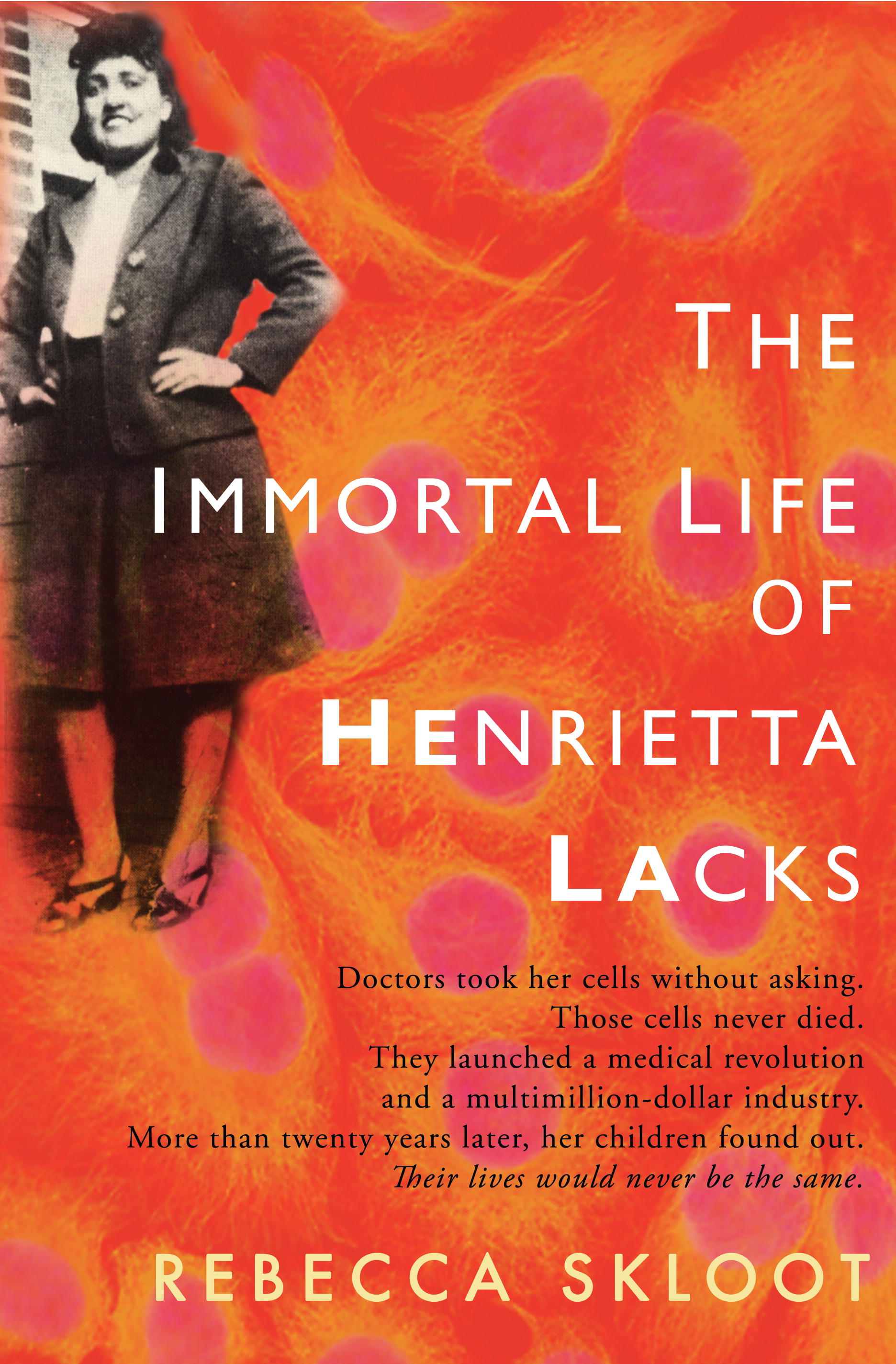
Last year, Rebecca Skloot came to Davis to talk about her book "The Immortal Life of Henrietta Lacks".  Note - if you have not read the book - what f*$ing rock have you been hiding under?  It is in my opinion the best non fiction book I have ever read.  Seriously.  Not the best science book. The best non fiction book of any kind.  And I am not alone in this feeling as it has won a bazillion positive reviews and awards.   In summary - it tells three stories - the story of the isolation of HeLa cells, the story of the woman from whom those cells came, and the story of Skloot learning the other two stories.

Anyway - I somehow managed to get her to come to UC Davis to give a talk last year just as the book was going viral.  In preparation for Skloot's visit I decided to do some sort of "open access" schtick and looked into how many papers about HeLa cells were in Pubmed Central.  Pubmed Central is a database of papers for which the full text is available at no charge.  After this mini-research and after interacting with Rebecca over the last year and seeing the well deserved recognition of her book, I have been a bit fascinated about how much of the literature surrounding studies of HeLa cells is openly and/or freely available.

So today I decided to see what was the earliest HeLa paper that was freely available on PubMed Central.  And I managed to find a good one: Studies on the propagation in vitro of poliomyelitis viruses. IV. viral multiplication in a stable strain of human malignant epithelial cells (strain hela) derived from an epidermoid carcinoma of the cervix. William F. Scherer, Jerome T. Syverton, and George O. Gey.  J Exp Med. 1953 May 1; 97(5): 695–710.

I believe this was the first full paper published discussing HeLa cells.  Nice short title by the way. Anyway - good to see it in Pubmed Central.

Thursday, August 18, 2011

Open Parkinson's - Parkinson's UK pushing (and funding) openness #brilliant

Just a quick post here on my new theme of Openness in Parkinson's research in honor of my father in law Carlos Benito who is, unfortunately, dying from this disease.  I did a google search for open access and Parkinson's to see whether any organizations out there were pushing for more openness.  And the good news is that there are a few.  One I highlight today Parkinson's UK.  I highlight them because of their position on Open Access publishing: Parkinson's UK - Open access publishing - (formerly Parkinson's Disease Society)

From their site:
"We expect authors of research papers to maximise the opportunities to make their results available for free."
But that is not all - they do offer to help support OA publishing fees on top of the research money they dole out.  Truly putting one's money where one's mouth is.

Monday, July 11, 2011

Ahh ... Pubmed Central. I love you. In many ways. But alas, not today. #openaccess

Been having some challenges with Pubmed Central recently.  What is Pubmed Central?  If you don't know, and you have anything to do with the life sciences in any way, you should learn.  A good place to learn is on their info page here.   Here is the summary:
PubMed Central (PMC) is a free archive of biomedical and life sciences journal literature at the U.S. National Institutes of Health's National Library of Medicine (NIH/NLM). In keeping with NLM’s legislative mandate to collect and preserve the biomedical literature, PMC serves as a digital counterpart to NLM’s extensive print journal collection. Launched in February 2000, PMC was developed and is managed by NLM’s National Center for Biotechnology Information (NCBI).
It is a fantastic resource.  Alas, there is one major limitation.  Mostly it is an archive of papers submitted by publishers.  Some publishers do not submit their material there.  Fortunately, there is now a way around this.  Author's can submit their own papers to PMC.  However, there is some caveats to this -- there are severe restrictions on what one can submit.  In the past I was aware of one of these caveats - the work in the manuscript has to have been at least partially supported by NIH funds (well, there is a way to submit if supported by the Wellcome Trust to).  To submit NIH supported work, you have to use the NIH manuscript submission system.  Why they won't take papers supported by other funding agencies I do not know.  Imagine if Genbank only took sequences inferred with NIH funds?  Imagine if libraries only took books supported by rich Europeans.  I am sure Pubmed does this because other agencies don't pay for the archive but still --- I think this is shortsighted.

And today I discovered a new caveat.  A few days ago I used the NIH manuscript submission form to submit author versions of a few of my past papers supported by NIH funds.  And one of them was rejected today because

Your submission to the NIHMS system cannot be processed because the NIH Public Access Policy does not apply to this material. The NIH Public Access Policy does not apply to book chapters, editorials, letters, or conference proceedings. As such, we are sorry that we cannot process your submission.
And though my paper was not one of these things, it is marked in such a way that it seems to be an editorial.  And thus apparently they won't take it.  I find this a bit surprising since PMC is actually filled with things like editorials including ones by me like PLoS Biology 2.0 and Genomics of Emerging Infectious Disease: A PLoS Collection and meeting reports like Meeting Report: The Terabase Metagenomics Workshop and the Vision of an Earth Microbiome Project. 
and letters (none of mine but I found many of others including even responses to letters to the editor). I have run this through my brain over and over and I cannot figure out why (or in fact how) they would exclude these types of materials.   I am going to ask around and see if anyone knows more detail about this but I am not convinced there will be a simple explanation.  Most likely it will have something to do with trying to cover "research" but not opinion.  But in my opinion, research and opinion are not always distinct.

Anyway - I am a bit annoyed by all of this because really, all I want to do is find these best way to share all of my past publications and this seemed like a useful addition to posting them on my website and/or in Mendeley as well as in UC sponsored archives.  And it would be great to have all my papers in PMC.  I note - the vast vast majority of my recent work is in PMC because I basically only publish in Open Access journals that deposit their material there.  But a lot of my old work is not in PMC.  And that is too bad.  Someone, somewhere might find it useful ...

Monday, June 27, 2011

New #openaccess journals welcome; competition good; not sure how they know it is "top tier" though

Great news from HHMI, The Wellcome Trust and the Max Planck: http://www.hhmi.org/news/20110627.html

Leading Research Organizations Announce Top-Tier, Open Access Journal for Biomedical and Life Sciences


The Howard Hughes Medical Institute, the Max Planck Society and the Wellcome Trust announced today that they are to support a new, top-tier, open access journal for biomedical and life sciences research.

The three organizations aim to establish a new journal that will attract and define the very best research publications from across these fields. All research published in the journal will make highly significant contributions that will extend the boundaries of scientific knowledge.

A team of highly regarded, experienced and actively practicing scientists will ensure fair, swift and transparent editorial decisions followed by rapid online publication. The first issue of the journal, whose name has yet to be decided, is expected to be published in the summer of 2012.

The three research organizations developed their plans following a workshop in 2010 at HHMI's Janelia Farm Research Campus attended by a number of leading scientists. The participants concluded that there was a need for a model of academic publishing that better suits the needs of the research community.

Dr. Robert Tjian, President of the Howard Hughes Medical Institute, says: "The message from the research community was clear: we are fortunate to have many excellent journals, but there is need for a different, more appropriate and efficient publishing model."

Professor Herbert Jäckle, Vice President of the Max Planck Society, says: "A journal which aims to represent and publish the very best research outcomes needs an editorial team of experienced – and, crucially, actively practicing – scientists. It must also be editorially independent of those who provide the financial support."

Sir Mark Walport, Director of the Wellcome Trust, says: "We will attract the most outstanding science for publication by establishing a journal in which researchers have confidence in robust editorial decisions taken by their scientific peers. This will be a journal for scientists edited by scientists. The ethos of the journal will be to avoid asking authors to make extensive modifications or perform endless additional experiments before a paper can be published."

Recruitment is under way for an Editor-in-Chief who – together with the journal's editorial team – will be an experienced, active scientist. The editorial team will be editorially independent of the funders. They will rely on their scientific expertise and active research experience to identify the best papers, make scientifically-based judgments and exercise leadership in steering these papers through peer review.

The journal will employ an open and transparent peer review process in which papers will be accepted or rejected as rapidly as possible, generally with only one round of revisions, and with limited need for modifications or additional experiments. For transparency, reviewers' comments will be published anonymously.

As the journal will only exist online, it offers an opportunity to create a journal and article format that will exploit the potential of new technologies to allow for improved data presentation. The journal will be an open access journal, i.e. the entire content will be freely available for all to read, to reproduce and for unrestricted use. This open access system will also enhance opportunities to share content and to more directly engage the reader.

The three organizations have made a commitment to cover costs of launching the journal to ensure its success. The long-term business model will be developed by the incoming Editor-in-Chief and the team they build.

This is great news.  The more #openaccess journals we have the better.  Clearly some of the text here is a dig at existing journals, including PLoS Biology.  PLoS Biology definitely needs to work on some things - like transparency (e.g., if your article is rejected, the Academic Editor who advised the professional editors is not names).  PLoS Biology is also run by professional editors.  Thus it is not run by "active scientists" which is another one of the comments in this press release.  Personally I think it would be better if PLoS Biology was run by active scientists.  But that is not the system there.  I have a strange role at PLoS Biology - "Academic Editor in Chief" for a journal not run by academics.  In essence I am a senior advisor to the professionals who run the journal.  I personally would prefer it if academics ran the journal, probably for the same reasons that HHMI, Wellcome, and Max Planck make such a big deal out of it here.  But the professionals do run PLoS Biology.  And overall, they do a good job.  I think the journal could certainly be better - and thus this new competition should be good.  We will have to wait and see just how much competition it is.  It seems a bit weird for them to call this a "top tier" journal before it exists.  Maybe they should have said "aiming to be a top tier journal" or something like that.  But I think it probably will become one if HHMI and Wellcome and MaxPlanck scientists start publishing their good papers there.  I hope this helps catalyze some beneficial changes at PLoS Biology, but we will have to wait and see.

It is a good time for #OpenAccess when major organizations start to compete to create the best "top tier" open access journal.  In the end, this can only be good for science and scientists. 

Thursday, May 19, 2011

Freeing my father's publications part 5: near completion of PDF collection at Mendeley (h/t @David_Dobbs)


Well, the story continues.  Yesterday marked a major achievement in my goal to free up the scientific publications of my father Howard J. Eisen, who passed away in 1987 when I was in college.  I have been working for the last 3+ years or so on collecting and sharing as much of his scientific work as possible.  I have documented this effort on a page on this blog: Freeing dads pubs.  That page contains links to various details about my effort here.

I have been doing this for many reasons.  And I could detail them all here.  But instead I point you to the amazing story written by David Dobbs that relates to this effort: Free Science, One Paper at a Time | Wired Science | Wired.com.  David is a science writer/blogger/scientist/journalist and about a year ago he was interviewing me for a story that he was working on about Mendeley.  It was good timing as right around then I was trying all sorts of different tools for sharing his publications, from Academia.Edu to web pages and so on.  And I had been looking at Mendeley too.  When Academia.Edu did not pan out, Mr. Gunn suggested in a comment on one of my posts that this might work in Mendeley.  So I set up a Mendeley page for my father which I diddled around with for a bit.  But inspired by the discussions with David I tried to beef up the Mendeley page and try to learn how to use the system.  And I managed to post many of my dad's papers there and on my blog.  And I ended up telling David about the whole saga of trying to free up my dad's papers.  David, being an insightful journalist, realized that this saga was a good story and he asked a lot of questions about it.

But then I got caught up in life and the effort to free my dad's publications slowed down.  That was, until David's blog post came out: Free Science, One Paper at a Time | Wired Science | Wired.com.  The piece moved me.  It scared me a bit at first, since there are some really personal details in there, but I realized when reading it why he had focused in on this story.  So, with his post out there - for all to read.  I realized, I had to get my shit together and redouble my efforts to free up my father's publications.  So over the last week or so I have been scavenging around (with some help from people around the web) trying to dig up PDFs of as many of my father's papers as possible.  Note - I generally would like to obtain these papers without having to pay for them but I am trying to not break any laws either.

I am writing today because I have nearly completed the task of getting PDFs of all of his papers.  And I have discovered that Mendeley is really a great way to share them.  So now on the Howard Eisen Mendeley page almost all of his papers are there for anyone to obtain.  And thanks to the social features of Mendeley, more and more people will see and have access to those papers, thus ensuring that they do not wallow in never never land but continue to have some potential impact on science and society.  Anyway - thanks David, for a wonderful article and for inspiring me to get moving on the "Freeing My Father's Publications" effort.  And thanks to all the people who have supported me along the way including Linda Avey, Mr. Gunn, David Williams, and more.  It has been a slog but we are getting there.

Afterthought: some additional discussions of David's story include:

Friday, May 13, 2011

Wanted - OpenAccess figures on introductory molecular and cellular biology topics

Quick post here.  I am looking for OpenAccess figures on introductory topics in molecular and cellular biology like DNA, RNA, proteins, transcription, translation, etc.  I want these for multiple purposes including teaching, blog posts, etc.  Anyone out there know of a database of such things?

UPDATE
Some suggestions from Twitter

Friday, March 04, 2011

Calling for Nature Publishing Group to return all money charged for articles that were supposed to be free #OpenAccess

Well, in case you did not see, yesterday I got really pissed off at Nature Publishing Group.  Short summary - many articles of mine that were supposed to be freely available on their journal sites were not.  For more information see
People from Nature Publishing Group have responded quite quickly saying they will look into this and try to fix it and indeed they have fixed many if not all of the mistakes in accessibility I found yesterday.  Glad they responded so quickly.  However, their response raises quite a few questions.  Like "what happened?" - as in - why did access get closed off?  And why were they charging to for article use when they should not have been?

It would be good for Nature to publish / post a full description of what went wrong.  And perhaps they will.  Apparently, it was just a glitch in the system.  Whatever the cause however, almost certainly some people paid for access for articles that were supposed to be freely available.  I am calling on Nature here to audit their systems and return all money that was paid for such access.

Thursday, March 03, 2011

Today is a day to be annoyed with Nature (Publishing Group that is) #NatureFail

Yuck.  Am getting really pissed off right now.  It is 1:30 AM.  I am tired.  And I am now angry.  I was writing a post about a recent trip, and wanted to link to an article I was a coauthor on.  The article was the paper on sequencing and analysis of the genome of Arabidopsis thaliana.  So I googled "Arabidopsis Genome Initiative" and found the link to the paper at Nature.  And much to my surprise I found this waiting for me:


Why is that a surprise?  Because the genome paper is supposed to be freely available to all forever, under a policy Nature developed for papers reporting new genome sequence data.  I am tired or I would write more about the history of this.  But another time.

So then I looked for other genome papers I have published in Nature.  And so I looked for the Plasmodium genome paper.  And I got this:


Grand.  That one was supposed to be free forever too.

And so I looked at many others.  And for most, I got the same thing.  Not freely available.  If I were not at home, I would not have noticed this because I have access at work.  And I could get access at home by setting up the UC Davis library VPN system.  But fortunately I do not do that or I would not have discovered that Nature, not for the first time mind you, has turned articles that were supposed to be freely available forever into charge for access articles.  I know.  I know.  This is probably just some glitch in their system.  They really do seem committed to trying to make these available.  But clearly, the system either does not work well.  Or they are not committed to it.  Either way this is really annoying.  In some cases, the papers were sold to communities of scientists in part with the "These will be freely available to all forever" line as part of the sell.  I am deeply worried about my recent Genomic Encyclopedia paper which is also supposed to be freely available forever.  Right now it still is, which is good.  But how long will that last?  And I note, though Nature people have said they would try and fix it, Nature still incorrectly claims Copyright to that article on the PDF.  Personally, I like most of the people I know at Nature Publishing Group and like many of the things NPG does.  But this is getting really annoying.  And it just goes to show - the ONLY way to go it seems is full, complete Open Access which the journals cannot magically then take away.

Tuesday, February 15, 2011

Open Access Pioneer Award: George Garrity for his work on Standards in Genomic Sciences journal

A few days ago I got a message that made a big impact on my publication record in PubMed Central.  My number of publications there went up by 85 in one fell swoop (see below for the list ...).  Did I publish 85 new papers yesterday?  No.  But a journal in which I have been a co-author on many papers recently finally showed up in Pubmed Central.  The journal is called Standards in Genomic Sciences.  The journal's scope is:
The goal of SIGS is to serve as an open-access, standards-supportive publication for rapid dissemination of concise genome and metagenome reports that comply with the emerging MIGS/MIMS standards, detailed standard operating procedures, meeting reports, reviews and commentaries, data policies, white papers and other gray literature that is relevant to genome sciences but currently absent from the scholarly literature.
Lots of jargon, I know.  But you can ignore that.  The reason I am writing here is that this journal is a place to publish what could be called "genome sequencing data reports."  These reports are a way for data producers to describe, in a formal manner, their sequencing project - and to share - in a formal manner - not only the data but also metadata about the organism(s) sequenced and the methods used.  As sequencing gets cheaper and easier, we need places for people to publish these types of "data papers" to both produce a citable unit with a DOI relating to the data, and to also share the details of the data production in a way that a simple Genbank entry does not.

One aspect of the papers in this "SIGS" journal is that they are being done in a way that is compliant with sets of standards for sharing metadata about the organism and the project.  I confess, when I first heard about these standards developments, I was bored almost to tears.  But now I realize that this is a very important aspect of getting the most out of genome data.  If people who sequence a genome not only release the sequence data, but also a table of information about the project, such as information about the organism (e.g., aerobic vs anaerobic, location of isolation) and about the data production (e.g., sequencing methods used) then people will be able to do high throughput analyses of these features.  Then we will not just be looking at sequence but also connecting these sequences to organismal features.  Right now that is very hard to do since genome data is rarely accompanied by machine usable information about the organism that has been sequenced.

Anyway - long story short - there will be a paper published in this journal for each genome being produced as part of the "Genomic Encyclopedia of Bacteria and Archaea" project that I have been coordinating at the DOE Joint Genome Institute in collaboration with the DSMZ.

Today I am writing to recognize the people connected to this movement - the people who created the standards, the people who created and run the journal, and the people writing papers for this journal.  All of them are to be commended for their vision and their dedication to openness.  Thus I am giving George Garrity the EIC of SIGS  my "Open Access Pioneer Award" for creating SIGS, making it an open access journal,  for keeping it running and for getting its papers into Pubmed Central and soon Pubmed.   Many others should be recognized too for their contribution to SIGS (see the whole list of founding members here).  I also should recognize Nikos Kyrpides from the DOE JGI who helped coordinate the writing and submission of these papers along with Hans Peter Klenk from the DSMZ.  Without them, these papers would never have gotten out there.  Plus I think some credit goes to Michigan State University and the Department of Energy which apparently are sponsors of SIGS


------------------------------------

Most recent post

A ton to be thankful for -- here is one part of that - all the acknowledgement sections from my scholarly papers

So - it is another Thanksgiving Day and in addition to thinking about family, and football, and Alice's Restaurant, I also think a lot a...