Showing posts with label microbiomes. Show all posts
Showing posts with label microbiomes. Show all posts
Tuesday, November 26, 2019
Slides for talk: Marine Host-Microbiome Interactions: Challenges and Opportunities
Posted slides for a talk I gave at Scripps Institute for Oceanography last week.

Thursday, March 07, 2019
Kisaco Research - sponsoring YAMMMM - yet another mostly male microbiome meeting - again - not their first biased rodeo
Well, sadly, I am not shocked by this. Disappointed, yes. But not shocked. Just got an announcement sent to me for this meeting: Animal Microbiome USA 2019 | Kisaco Research
Happening next week in Kansas City. Run by Kisaco Research. I have written about their propensity to have meetings where most of the speakers were white men previously. See

Happening next week in Kansas City. Run by Kisaco Research. I have written about their propensity to have meetings where most of the speakers were white men previously. See
- Another white men's microbiome meeting from Kisaco #YAMMM #manel #STEMDiversity
- The White Men's Microbiome Congress #YAMMM #Manel #Boycott
People from the company claimed they were going to do better in the future. And maybe they have for some meetings. But alas not for this one. By my estimate the speakers are ~ 85% male. 15% female. Grrr. Not good. Not representative of the field. Most likely some sort of implicit or explicit bias going on.

Friday, March 09, 2018
Frustrated by YAMMMMs: Yet another mostly male microbiome meeting
UPDATE 3/9/2018 - See Comments. Carly Rosewarne coined the term last year ...
-------------------------------------------------------
A while back I coined the term "YAMMM" - yet another mostly male meeting - to reflect my frustration in seeing meetings where most of the presenters were male:
What to do when you realize the meeting you are speaking at is a YAMMM (yet another mostly male meeting)?

I have since written dozens of posts about such meetings. Sadly this is not an unusual thing. Fortunately there has been a growing movement in many communities, including in science, to critique and not support such "MANELs". Progress is definitely being made. But it is piecemeal and in my opinion we must still keep up the fight for meetings and conferences to better reflect the diversity of people doing interesting and important work that should be heard. I am sure many fields still are seeing slow progress in this area but one that frustrates me personally is the microbiome arena. So today I am coining a new term - YAMMMM (note the extra M). Yet Another Mostly Male Microbiome Meeting.
I decided to update my mini image about this so I went to world and entered some common male names and some numbers for them.
Charles: 10
Robert: 20
Joseph: 20
David: 5
John:10
Doug: 20
Michael: 5
James: 20
William: 10
Jake: 5
Sam: 5
Richard: 10
Chris: 20
Anthony:5
Paul: 5
Mark: 5
Donald: 10
Brian: 5
Kevin: 10
Edward: 10
Timothy: 15
And Voila:

I then added a little header

So if you see a YAMMMM - please feel free to use this image.
-------------------------------------------------------
A while back I coined the term "YAMMM" - yet another mostly male meeting - to reflect my frustration in seeing meetings where most of the presenters were male:
What to do when you realize the meeting you are speaking at is a YAMMM (yet another mostly male meeting)?
I have since written dozens of posts about such meetings. Sadly this is not an unusual thing. Fortunately there has been a growing movement in many communities, including in science, to critique and not support such "MANELs". Progress is definitely being made. But it is piecemeal and in my opinion we must still keep up the fight for meetings and conferences to better reflect the diversity of people doing interesting and important work that should be heard. I am sure many fields still are seeing slow progress in this area but one that frustrates me personally is the microbiome arena. So today I am coining a new term - YAMMMM (note the extra M). Yet Another Mostly Male Microbiome Meeting.
I decided to update my mini image about this so I went to world and entered some common male names and some numbers for them.
Charles: 10
Robert: 20
Joseph: 20
David: 5
John:10
Doug: 20
Michael: 5
James: 20
William: 10
Jake: 5
Sam: 5
Richard: 10
Chris: 20
Anthony:5
Paul: 5
Mark: 5
Donald: 10
Brian: 5
Kevin: 10
Edward: 10
Timothy: 15
And Voila:

I then added a little header

So if you see a YAMMMM - please feel free to use this image.
Monday, October 30, 2017
Monday, April 11, 2016
Microbiomes of the Built Environment NAS Meeting Webcast 4/11 10:30-5 EST
This may be of interest:
Microbiomes of the Built Environment: From Research to Application
The National Academies of Sciences, Engineering, and Medicine are conducting a consensus study that will examine the formation and function of microbial communities in built environments, the impacts of such microbial communities on human health, and how human occupants shape complex indoor microbiomes. This study is intended to provide an independent, objective examination of the current state of science regarding built environment microbiomes and their impacts on human health, and then attempt to bridge gaps in moving this research to an application stage, in which building materials and architecture will be designed with microbiomes in mind. The study is being conducted by a committee of experts and the consensus report is expected to be released in 2017.
The study’s first public meeting will be held on April 11, 2016 in Washington, DC. You may view the webcast of the public sessions, to be held from 10:30am – 5:00pm EDT by clicking here.
Please direct any questions or comments to builtmicrobiome@nas.edu
This study is sponsored by the Alfred P. Sloan Foundation, U.S. Environmental Protection Agency (EPA), National Aeronautics and Space Administration (NASA) and the National Institutes of Health (NIH).
AGENDA
Monday, April 11
10:30am Welcome Public Observers and Study Sponsors Committee Member Introductions
What are microbiomes of built environments and why is the study topic a compelling one to address?
Joan Bennett, Committee Chair
10:45 Discussion of Statement of Task with Study Sponsors
Sponsoring organizations will provide perspectives on the context for the study, how the study relates to their missions, and what they see as key needs and challenges for understanding microbiomes in built environments. Invited speakers will each provide 10 minutes of opening remarks.
Paula Olsiewski, Alfred P. Sloan Foundation
Tina Bahadori and Laura Kolb, Environmental Protection Agency David Tomko, National Aeronautics and Space Administration Lisa Chadwick, NIEHS, National Institutes of Health (remotely)
Committee Discussion with Sponsors
12:15 Lunch
1:30 Setting the Stage for the Study
Presentations will highlight developments and challenges in several background areas. Invited speakers will each give 15 minute presentations.
1:40 Built environment microbiome interfaces: Why is improving our understanding of these interactions an exciting topic and perspective on the eld?
Gary Andersen, Lawrence Berkeley National Laboratory and University of California, Berkeley
2:00 Understanding and modeling building systems: What’s known and how might these parameters impact indoor microbiomes?
Jelena Srebric, University of Maryland
2:20 Example of built environment microbiome studies and their potential human health links
10:30am Welcome Public Observers and Study Sponsors Committee Member Introductions
What are microbiomes of built environments and why is the study topic a compelling one to address?
Joan Bennett, Committee Chair
10:45 Discussion of Statement of Task with Study Sponsors
Sponsoring organizations will provide perspectives on the context for the study, how the study relates to their missions, and what they see as key needs and challenges for understanding microbiomes in built environments. Invited speakers will each provide 10 minutes of opening remarks.
Paula Olsiewski, Alfred P. Sloan Foundation
Tina Bahadori and Laura Kolb, Environmental Protection Agency David Tomko, National Aeronautics and Space Administration Lisa Chadwick, NIEHS, National Institutes of Health (remotely)
Committee Discussion with Sponsors
12:15 Lunch
1:30 Setting the Stage for the Study
Presentations will highlight developments and challenges in several background areas. Invited speakers will each give 15 minute presentations.
1:40 Built environment microbiome interfaces: Why is improving our understanding of these interactions an exciting topic and perspective on the eld?
Gary Andersen, Lawrence Berkeley National Laboratory and University of California, Berkeley
2:00 Understanding and modeling building systems: What’s known and how might these parameters impact indoor microbiomes?
Jelena Srebric, University of Maryland
2:20 Example of built environment microbiome studies and their potential human health links
Benjamin Kirkup, Naval Research Laboratory
2:40 Understanding microbes in water systems
Amy Pruden, Virginia Polytechnic Institute and State University
3:00 Committee Discussion with Speakers 3:30 Break
Light snack will be provided
3:50 Further Discussion: Major Issues Relevant to the Study
Opportunity for committee members, sponsors, speakers, and meeting participants to further
discuss points raised during the presentations and to identify additional topical areas, gaps, or needs that may be relevant to the study’s statement of task.
4:30 Public Comment Period
Opportunity for meeting participants to share additional information or ideas they would like the committee to consider.
5:00 Meeting Adjourns
Amy Pruden, Virginia Polytechnic Institute and State University
3:00 Committee Discussion with Speakers 3:30 Break
Light snack will be provided
3:50 Further Discussion: Major Issues Relevant to the Study
Opportunity for committee members, sponsors, speakers, and meeting participants to further
discuss points raised during the presentations and to identify additional topical areas, gaps, or needs that may be relevant to the study’s statement of task.
4:30 Public Comment Period
Opportunity for meeting participants to share additional information or ideas they would like the committee to consider.
5:00 Meeting Adjourns
Wednesday, March 09, 2016
Time for #DegreeMadness - where we rank people's statements by what degrees they have not by science
 Powered by
 Thursday, October 29, 2015
Storify of the IFAL Roundtable on Microbiomes in Food and Agriculture
Here is a quick roundup of the Roundtable discussion I was involved in on Microbiomes in Food and Agriculture run by the IFAL at UC Davis.
Monday, June 08, 2015
Guest post by Katie Dahlhausen on her project on "The effect of antibiotics for chlamydia on koalas and their microbiomes"
This is a guest post by Katie Dahlhausen, a PhD Student in my lab.

Koala populations across Australia are on a rapid decline due to many culprits including habitat loss, being hit by cars, attacks by dogs, and the Chlamydia infection. Yes, that’s right, Chlamydia. And when koalas are brought into wildlife hospitals, they are treated with antibiotics to cure their Chlamydia infection. Although ridding koalas of Chlamydia, the antibiotics also kill off important gut microbes that are essential to the koala’s life biology. Koalas eat a diet solely of eucalyptus leaves, which would be poisonous to the koalas if it wasn’t for the tannin-protein-complex-degrading enterobacteria that break down the toxic components of the koala’s diet. Brace yourself, because the koala’s biology gets even more interesting! Mother koalas feed their young joeys a substance called pap, a fecal matter more concentrated in nutrients and microbes than normal feces. This form of a natural fecal transplant allows the joeys to colonize the critical gut microbes necessary for them to eat noxious eucaplytus leaves. But what does this mean for joeys whose mothers have been administered antibiotics?
My name is Katie Dahlhausen and I am A PhD student in Jonathan’s lab. I am crowd-funding a project to study this fascinating koala biology, as well as investigate alternative infectious disease treatment where antibiotics are not a viable option. Want to help out these adorable critters? You can support the Indiegogo campaign here, which is live until June 16, 2015. More information about the project is available on the crowdfunding page, and in these recent articles published in Scientific American and the Washington Post.
So how did I get into this project? Well, When I was at the Australia Wildlife Zoo in Australia last September, there was a sign next to the koala exhibit with picture of a joey whose mouth was covered in a brown substance. The sign read something like "It's not chocolate!" and explained the pap part of the koala's biology.

The moment I read this I knew there was some fascinating microbiology questions that were begging to be answered. While researching the microbiology behind this behavior, I found a study the recorded the detrimental effects antibiotics had on a koala's eating habit and inability to maintain weight, but the question of how antibiotics were effecting the microbial composition of koala's guts remained unsolved. That is how this whole project started. Like most people, I think koalas are cute and appreciate how iconic they are to Australia. Otherwise, I'm not very attached to koalas - they are actually quite mean and antisocial! But koalas are a fantastic model system - one food source, plenty of sampling opportunities (in Australia at least), frequently given antibiotics, and clear mechanism of the transfer of microbes from mother to offspring. The implications of the study are vast, but are aimed at the care for animals in captivity and foster changes in how/when we administer antibiotics.

Koala populations across Australia are on a rapid decline due to many culprits including habitat loss, being hit by cars, attacks by dogs, and the Chlamydia infection. Yes, that’s right, Chlamydia. And when koalas are brought into wildlife hospitals, they are treated with antibiotics to cure their Chlamydia infection. Although ridding koalas of Chlamydia, the antibiotics also kill off important gut microbes that are essential to the koala’s life biology. Koalas eat a diet solely of eucalyptus leaves, which would be poisonous to the koalas if it wasn’t for the tannin-protein-complex-degrading enterobacteria that break down the toxic components of the koala’s diet. Brace yourself, because the koala’s biology gets even more interesting! Mother koalas feed their young joeys a substance called pap, a fecal matter more concentrated in nutrients and microbes than normal feces. This form of a natural fecal transplant allows the joeys to colonize the critical gut microbes necessary for them to eat noxious eucaplytus leaves. But what does this mean for joeys whose mothers have been administered antibiotics?
My name is Katie Dahlhausen and I am A PhD student in Jonathan’s lab. I am crowd-funding a project to study this fascinating koala biology, as well as investigate alternative infectious disease treatment where antibiotics are not a viable option. Want to help out these adorable critters? You can support the Indiegogo campaign here, which is live until June 16, 2015. More information about the project is available on the crowdfunding page, and in these recent articles published in Scientific American and the Washington Post.
So how did I get into this project? Well, When I was at the Australia Wildlife Zoo in Australia last September, there was a sign next to the koala exhibit with picture of a joey whose mouth was covered in a brown substance. The sign read something like "It's not chocolate!" and explained the pap part of the koala's biology.

The moment I read this I knew there was some fascinating microbiology questions that were begging to be answered. While researching the microbiology behind this behavior, I found a study the recorded the detrimental effects antibiotics had on a koala's eating habit and inability to maintain weight, but the question of how antibiotics were effecting the microbial composition of koala's guts remained unsolved. That is how this whole project started. Like most people, I think koalas are cute and appreciate how iconic they are to Australia. Otherwise, I'm not very attached to koalas - they are actually quite mean and antisocial! But koalas are a fantastic model system - one food source, plenty of sampling opportunities (in Australia at least), frequently given antibiotics, and clear mechanism of the transfer of microbes from mother to offspring. The implications of the study are vast, but are aimed at the care for animals in captivity and foster changes in how/when we administer antibiotics.
Sunday, June 07, 2015
Guest post from Student Alex Martin on Kittybiome & Animal Shelters
We are nearing the end of our Kitty Kickstarter to fund research on the
microbiome of cats (only three days left). We have received some requests to learn
more about our work with animal shelters. Here is a blog post by Alex Martin, a
UC Berkeley junior who is working with us to study shelter cats in Berkeley.


The Berkeley Animal Shelter takes in all cats from within Berkeley city limits. Thus, cats who once varied markedly with regards to diet and home environment come to live under a fairly uniform set of conditions. It typically houses between fifteen and forty cats, but has held as many as seventy during the peak of breeding season. Recently we have begun collecting samples from cats at the Berkeley shelter in order to better understand their gut microbiomes.
A major dichotomy in the shelter cat population is the one
separating house cats from feral cats. Both are considered domestic cats, members of the
species Felis catus. If a kitten
during its first few months of life is not exposed to humans, it develops
behaviors to facilitate surviving in the wild, and grows up to become a feral
cat. Some see feral cats as a nuisance, but the animals also tend to live
difficult lives, enduring food shortages and a lack of medical care. Thus, a relatively
new effort referred to as “trap-neuter-return”
(TNR) aims to spay and neuter feral cats to slowly and humanely diminish the
size and number of feral cat colonies. Differences in the gut microbiomes of
feral cats versus their tamer counterparts is perhaps expected, as the two
groups have vastly different diets and levels of environmental exposure.
However, these differences have yet to be characterized.
In addition to the differences between feral and house cats,
a small but important FIV
(Feline Immunodeficiency Virus) population can potentially serve as an
interesting point of comparison. Much like Human Immunodeficiency Virus, FIV
attacks the immune system of infected individuals, making them markedly more
susceptible to other infections. We think that this virus will affect the
microbiome of FIV-positive cats in measurable ways. By identifying any
differences, we will gain a better understanding of FIV as a whole and will hopefully
be better positioned to one day develop more effective methods of treatment.


Geronimo is one Berkeley shelter cat whose gut microbiome
will be analyzed. He was picked up as a stray just a few blocks from the
shelter, and is three years old. Geronimo is exceptionally friendly, and loves
playing with his wand toy and hiding in his cat tree to nap. He gets along well
with other cats and was even introduced to a rabbit without incident. After
spending about two weeks in the shelter, Geronimo was adopted into a loving
home.
Wednesday, May 13, 2015
Koalas, Chlamydia, Antibiotics and Microbiomes - what else do you need?
Katie Dahlhausen, a PhD student in my lab, has become really really interested (perhaps a bit obsessed) with a really interesting case study regarding koalas, Chlamydia, antibiotics, and microbiomes. Since we do not have funds to work on this in the lab, she has started an Indiegogo campaign to raise funds to work on this. For more information on this project and how Koalas, Chlamydia, antibiotics and microbiomes are connected see "The Koala Project" page.
Monday, May 11, 2015
9 things PBS Newshour famously gets horrible wrong in story on fast food and microbiomes
Well, this is one of the worst microbiome news stories in a long time: Fast food kills gut bacteria that can keep you slim, book claims. So many things wrong with it I don't even know where to go. Here are nine:
1. The original headline: "Fast food kills gut bacteria that can keep you slim, study finds"
 Here is the Tweet
2. The correction:

is just completely lame and they should, as the New York Times does when it makes a correction, say what it used to say before they changed it
3. The sentence with the reference to Rob Knight is just bad reporting #1
Here is the quote:
4 . The sentence with the reference to Rob Knight is just bad reporting #2
What the *$*$# does "famously showed" mean? Really. What does it mean?
5 . The sentence with the reference to Rob Knight is just bad reporting #3
The statement "Previous studies made similar findings" is just so incredibly misleading. It seems to be referring back to the previous sentences:
6 . The sentence with the reference to Rob Knight is just bad reporting #4
Why exactly tell us he is collaborating with Rob Knight? So some of Rob's good work rubs off? I mean, Spector may do some fine work (and he has done some really good stuff). But casually mentioning he collaborates with Knight who famously showed something (when actually it was more Jeff Gordon's work) which did not actually show what the article implies it showed. Aaaaaaaaaaarg.
7. Good news.
8. This sentence
9. This sentence
UPDATE 1: May 11, 2015. 8:00 PM
Thanks to a Tweet from Jennifer Gunter I changed the title of my post from " 9 things horribly wrong with Newshour story on fast food and microbiomes" to "9 things PBS Newshour famously gets horrible wrong in story on fast food and microbiomes"
1. The original headline: "Fast food kills gut bacteria that can keep you slim, study finds"

Fast food kills gut bacteria that can keep you slim, study finds http://t.co/3fPIhJTuAB | @newshour
— PBS (@PBS) May 11, 2015
2. The correction:

is just completely lame and they should, as the New York Times does when it makes a correction, say what it used to say before they changed it
3. The sentence with the reference to Rob Knight is just bad reporting #1
Here is the quote:
Previous studies made similar findings: Professor Rob Knight of the University of Colorado Boulder, who collaborates with Spector, famously showed that transferring gut bacteria from obese humans to mice could make the rodents gain weight.First of all - the paper they link to does include Rob Knight as a co-author, but the corresponding and senior author is Jeffrey Gordon and Rob is fourth to last (mind you I love Rob and his work, but in this case, saying this is something Rob showed without mentioning Gordon is just not right).
4 . The sentence with the reference to Rob Knight is just bad reporting #2
What the *$*$# does "famously showed" mean? Really. What does it mean?
5 . The sentence with the reference to Rob Knight is just bad reporting #3
The statement "Previous studies made similar findings" is just so incredibly misleading. It seems to be referring back to the previous sentences:
“What is emerging is that changes in our gut microbe community , or microbiome, are likely to be responsible for much of our obesity epidemic, and consequences like diabetes, cancer and heart disease,” he said. “It is clear that the more diverse your diet, the more diverse your microbes and the better your health at any age.”This is just completely overblown. The more diverse your diet the better your health at any age? Oh #FFS that is just not based on any science. And the "likely responsible for" is silly too.
6 . The sentence with the reference to Rob Knight is just bad reporting #4
Why exactly tell us he is collaborating with Rob Knight? So some of Rob's good work rubs off? I mean, Spector may do some fine work (and he has done some really good stuff). But casually mentioning he collaborates with Knight who famously showed something (when actually it was more Jeff Gordon's work) which did not actually show what the article implies it showed. Aaaaaaaaaaarg.
7. Good news.
Spector’s book claims that the diversity of microbes in the human body has decreased almost a third over the last century. But there’s also good news: Foods like dark chocolate, garlic, coffee and Belgian beer may help increase gut microbes.Really? Thinking about microbes MAY also increase gut microbes. And so might listening to NPR. Not something worth reporting here.
8. This sentence
This discovery suggested to his father that many cases of obesity may not simply be due to overeating.That is right. Looking at his son's poop and the microbes in it is the key to knowing that obesity might actually be fuc$*@#@ complex and not only caused by overeating. Oh, that and 100 years of epidemiology and research.
9. This sentence
“Once on the diet I rapidly lost 1,300 species of bacteria and my gut was dominated by a different group called bacteroidetes. The implication is that the McDonald’s diet killed 1,300 of my gut species,” he said.Sorry but that is NOT the implication.
UPDATE 1: May 11, 2015. 8:00 PM
Thanks to a Tweet from Jennifer Gunter I changed the title of my post from " 9 things horribly wrong with Newshour story on fast food and microbiomes" to "9 things PBS Newshour famously gets horrible wrong in story on fast food and microbiomes"
@PBS famously showed bad science reporting https://t.co/8VuGq5njWU
— Jennifer Gunter (@DrJenGunter) May 12, 2015
Saturday, March 07, 2015
My microbiome talk at #FOGM15 - the perils (and fun I guess) of redoing one's talk at the last minute
Just got back from the Future of Genomic Medicine 2015 meeting where I gave a talk about microbiomes. My original plan was to talk about the need for evolutionary and ecological approaches to microbiome studies but I changed my mind a few days before the meeting and decided to switch to talking more about citizen microbiology. I did this because the meeting has a lot of people who think about digital and wearable technology and public engagement in the audience and it just seemed like a good chance to introduce them to the growing personal/citizen microbiology movement.
To help prep for my talk I emailed some colleagues who work on Citizen Microbiology (including a few in my lab like Jenna Lang and David Coil) and asked them if they had any slides I could pilfer. And then I started drafting an outline of my talk (I draft all my talks by hand with pen and paper). Here are my handwritten notes


I realized I would not likely be able to focus enough at home to work on the talk so I kind of waited until heading down to San Diego on Wednesday (talk was on Friday).
I got in pretty late and worked a little on my talk before going to bed. I also emailed the organizers of the meeting to say I was changing the topic of my talk a bit and asked if they could change the online program which they did. Eric Topol in response to my saying I wanted to talk about citizen microbiology and personal microbiomes very wisely suggested that I talk about my vision for the future of microbiome research. I (lamely) had been so focused on Citizen Microbiology that I had not been thinking much about the bigger picture. But once he suggested this notion my talk really congealed (in my head and on paper at least). It is interesting to me how one simple suggestion from someone with vision and perspective can transform one's thought process so much ...
Anyway, the next day I headed over to the meeting venue (by the beach - life is rough in San Diego). I got there in time to hear Francis Collins' talk. I spent the day sitting outside in the outdoor tent viewing area, pondering my talk and listening to the talks of others. Lots and lots of interesting things presented there. More about this later I hope. Anyway - that evening I worked on my talk some more, headed down to the hotel bar for a bit and then worked on my talk some more. And eventually went to sleep. Friday I spent much of the AM working on my talk in the outdoor tent (while listening to the talks though this time not watching them on the screen since I was a bit too far away from it). And voila - only 30 minutes before the PM session was to begin I finished the prep. I do not like to do this normally but I just felt like my talk would be much better if I re-conceived it and I had to make all new slides pretty much for the whole talk (other than the few I pilfered from colleagues).
I note - I was talking after Marty Blaser and figured I would not have to introduce the human microbiome at all and also that he would give an overview of the risks that come from disturbing the microbiome. Anyway, I gave my talk, and recorded the slideshow with Camtasia. Below are my slides, the video slideshow, and a Storify of the Tweets others posted during my talk.
As is frequently the case, afterwards I felt I was too rushed and that it was not the best talk I have ever given. But that being said, I like the general outline and some of the concepts and figured I should share, warts and all. My biggest regret after talks which I have rushed a bit in preparing is that I usually do not do a great job in mentioning who did all the work I refer to. I try to put people's pictures and names on all slides and references but I don't always get this done in time and I worry I screwed this up for a few topics here. Oh well, life goes on ...
Here is a slideshow with Audio (which I recorded via Camtasia)
Here is the Slideshare posting of my slides
To help prep for my talk I emailed some colleagues who work on Citizen Microbiology (including a few in my lab like Jenna Lang and David Coil) and asked them if they had any slides I could pilfer. And then I started drafting an outline of my talk (I draft all my talks by hand with pen and paper). Here are my handwritten notes
I realized I would not likely be able to focus enough at home to work on the talk so I kind of waited until heading down to San Diego on Wednesday (talk was on Friday).
I got in pretty late and worked a little on my talk before going to bed. I also emailed the organizers of the meeting to say I was changing the topic of my talk a bit and asked if they could change the online program which they did. Eric Topol in response to my saying I wanted to talk about citizen microbiology and personal microbiomes very wisely suggested that I talk about my vision for the future of microbiome research. I (lamely) had been so focused on Citizen Microbiology that I had not been thinking much about the bigger picture. But once he suggested this notion my talk really congealed (in my head and on paper at least). It is interesting to me how one simple suggestion from someone with vision and perspective can transform one's thought process so much ...
Anyway, the next day I headed over to the meeting venue (by the beach - life is rough in San Diego). I got there in time to hear Francis Collins' talk. I spent the day sitting outside in the outdoor tent viewing area, pondering my talk and listening to the talks of others. Lots and lots of interesting things presented there. More about this later I hope. Anyway - that evening I worked on my talk some more, headed down to the hotel bar for a bit and then worked on my talk some more. And eventually went to sleep. Friday I spent much of the AM working on my talk in the outdoor tent (while listening to the talks though this time not watching them on the screen since I was a bit too far away from it). And voila - only 30 minutes before the PM session was to begin I finished the prep. I do not like to do this normally but I just felt like my talk would be much better if I re-conceived it and I had to make all new slides pretty much for the whole talk (other than the few I pilfered from colleagues).
I note - I was talking after Marty Blaser and figured I would not have to introduce the human microbiome at all and also that he would give an overview of the risks that come from disturbing the microbiome. Anyway, I gave my talk, and recorded the slideshow with Camtasia. Below are my slides, the video slideshow, and a Storify of the Tweets others posted during my talk.
As is frequently the case, afterwards I felt I was too rushed and that it was not the best talk I have ever given. But that being said, I like the general outline and some of the concepts and figured I should share, warts and all. My biggest regret after talks which I have rushed a bit in preparing is that I usually do not do a great job in mentioning who did all the work I refer to. I try to put people's pictures and names on all slides and references but I don't always get this done in time and I worry I screwed this up for a few topics here. Oh well, life goes on ...
Here is a slideshow with Audio (which I recorded via Camtasia)
Here is the Slideshare posting of my slides
Talk for #FOGM15: Challenges and Opportunities in Microbiome Studies and the Rise of Citizen Microbiology from Jonathan Eisen
Tuesday, March 03, 2015
Another day, another microbiome journal ... alas not as "open access" as claimed
Just got this email

Dear Doctor Jonathan Eisen,Seemed right up my alley - an open access microbiome journal. Alas, when I clicked on the journal link and then browsed around I found out that articles will be published using some pretty restrictive conditions. Some key parts of the text from this page is below:
I would like to invite you to consider submitting a paper to our recently launched Open Access journal Microbiome Science and Medicine (http://www.degruyter.com/view/j/micsm).
As can be seen from the titles of articles published in our first volume, MICSM reflects the full breadth of research in the diverse areas of microbiome-related science, from molecules to ecosystems:
Newton ILG, Sheehan KB, Lee FJ, Horton MA, Hicks RD "Invertebrate systems for hypothesis-driven microbiome research"
Amato KR "Co-evolution in context: The importance of studying gut microbiomes in wild animals"
Nelson DR, Tu ZJ, Lefebvre PA "Heterococcus sp. DN1 draft genome: focus on cold tolerance and lipid production"
Rudlaff RM, Waters CM "What is the role of cyclic di-GMP signaling within the human gut microbiome?"
Fang Y, Chia N, Mazur M, Pettigrew J, Schook LB, White BA "Genetically identical co-housed pigs as models for dietary studies of gut microbiomes"
MICSM is a broad-spectrum platform for the rapid publication of works of broad significance, originality and relevance in all areas related to the study of microbiomes, their components, and their roles in health and disease. We solicit research and review articles, as well as communications and vision papers. The manuscripts submitted in response to this invitation will be processed with the highest priority and all accepted papers will be immediately available on-line.
Authors are offered a variety of benefits:
– transparent, comprehensive and fast peer review;
– language assistance for authors from non-English speaking regions;
– convenient, web-based manuscript submission and tracking system;
– efficient route to fast-track publication and full advantage of De Gruyter Open's e-technology;
– no publication charge in the first two annual volumes.
I look forward to your manuscript!
Please forward this invitation to any interested colleagues and associates.
1. LicenseOther than being, well, painfully legalesy, this is just too restrictive for me and does not really seem like "open access". The no derivatives part drives me batty. Also they write:
The non-commercial use of the article will be governed by the Creative Commons Attribution-NonCommercial-NoDerivs license as currently displayed on http://creativecommons.org/licenses/by-nc-nd/3.0/., except that sections 2 through 8 below will apply in this respect and prevail over all conflicting provisions of such license model. Without prejudice to the foregoing, the author hereby grants the Journal Owner the exclusive license for commercial use of the article (for U.S. government employees: to the extent transferable) according to section 2 below, and sections 4 through 9 below, throughout the world, in any form, in any language, for the full term of copyright, effective upon acceptance for publication.
9. Scope of the Commercial LicenseWell, no thanks. Too many restrictions and not open access in my view. If I had to choose a "microbiome" journal to publish in, I would choose "Microbiome" an actually open access journal, where papers have the following info on them:
The exclusive right and license granted under this agreement to the Journal Owner for commercial use is as follows:
to prepare, reproduce, manufacture, publish, distribute, exhibit, advertise, promote, license and sub-license printed and electronic copies of the article, through the Internet and other means of data transmission now known or later to be developed; the foregoing will include abstracts, bibliographic information, illustrations, pictures, indexes and subject headings and other proprietary materials contained in the article,
to exercise, license, and sub-license others to exercise subsidiary and other rights in the article, including the right to photocopy, scan or reproduce copies thereof, to reproduce excerpts from the article in other works, and to reproduce copies of the article as part of compilations with other works, including collections of materials made for use in classes for instructional purposes, customized works, electronic databases, document delivery, and other information services, and publish, distribute, exhibit and license the same.
Where this agreement refers to a license granted to Journal Owner in this agreement as exclusive, the author commits not only to refrain from granting such license to a third party but also to refrain from exercising the right that is the subject of such license otherwise than by performing this agreement.
This is an Open Access article distributed under the terms of the Creative Commons Attribution License (http://creativecommons.org/licenses/by/4.0), which permits unrestricted use, distribution, and reproduction in any medium, provided the original work is properly credited. The Creative Commons Public Domain Dedication waiver (http://creativecommons.org/publicdomain/zero/1.0/) applies to the data made available in this article, unless otherwise stated.Go Microbiome ...
Tuesday, December 23, 2014
Buzzfeed includes microbiomes in "77 facts" but alas, gets the facts (and the math) wrong
Well, I admit it - I clicked on this Buzzfeed link someone posted on Facebook - 77 Facts That Sound Like Huge Lies But Are Actually Completely True. There are some pretty funny and interesting things on the list. However, I note - I did not click on the link per se for entertainment. I clicked on it to see if there was anything about microbes on the list. And happily, there was. Alas, what there was, was, well, a bit wrong:

Let's start with #67. "There is 10 times more bacteria in your body than actual body cells". Well, alas, this is a nice bit of information. But it is not based on facts. See Peter Andrey Smiths wonderful article in the Boston Globe about this issue. The Buzzfeed article links to a 2010 Discover Magazine bit about this topic. So they were trying to use facts. But alas, that was not based on facts itself.
Then, let's go to #68. "And 90% of the cells that make us up of aren’t human but mostly fungi and bacteria.". So - I am at a bit of a loss on this. First, isn't this really just rehashing #67 with the addition of fungi to the story? Also - I note the math here is weird. #67 would lead one to conclude that 90.9% of the cells in your body are bacterial (10:1 = 10/11 = 90.9%). So then if one adds fungi to the picture the percent of cells in our bodies that are not human goes DOWN to 90%. How does that work exactly?
So not only do they get the 10x as many cells fact wrong, they do something really weird by basically repeating #67 and then doing some weird math.
Oh well, glad they have something on microbiomes. Too bad it came out a bit wrong.
Let's start with #67. "There is 10 times more bacteria in your body than actual body cells". Well, alas, this is a nice bit of information. But it is not based on facts. See Peter Andrey Smiths wonderful article in the Boston Globe about this issue. The Buzzfeed article links to a 2010 Discover Magazine bit about this topic. So they were trying to use facts. But alas, that was not based on facts itself.
Then, let's go to #68. "And 90% of the cells that make us up of aren’t human but mostly fungi and bacteria.". So - I am at a bit of a loss on this. First, isn't this really just rehashing #67 with the addition of fungi to the story? Also - I note the math here is weird. #67 would lead one to conclude that 90.9% of the cells in your body are bacterial (10:1 = 10/11 = 90.9%). So then if one adds fungi to the picture the percent of cells in our bodies that are not human goes DOWN to 90%. How does that work exactly?
So not only do they get the 10x as many cells fact wrong, they do something really weird by basically repeating #67 and then doing some weird math.
Oh well, glad they have something on microbiomes. Too bad it came out a bit wrong.
Wednesday, December 10, 2014
New lab paper: The microbes we eat: abundance and taxonomy of microbes consumed in a day’s worth of meals for three diet types
A new paper out from my lab (with Jenna Lang as the 1st author and in collaboration with Angela Zivcovic from the UC Davis Food For Health Initiative and the Department of Nutrition): The microbes we eat: abundance and taxonomy of microbes consumed in a day’s worth of meals for three diet types. The work in the paper focuses on characterizing the abundance and taxonomy of microbes in food from three model diets.
Basically, Angela prepared meals for these three diets
Lots of interesting things reported in the paper (read it, I insist). I note - this is a demonstration project in a way - trying to get the community and others to think about the source pools of microbes that come into our system from our food. It is by no means comprehensive or conclusive (read the caveats section of the paper). Congrats to Jenna and Angela for all their hard work. Anyway - the paper is Open Access in PeerJ. Eat it up.
UPDATE: Some press and blog coverage
Basically, Angela prepared meals for these three diets
Food was purchased and prepared in a standard American home kitchen by the same individual using typical kitchen cleaning practices including hand washing with non-antibacterial soap between food preparation steps, washing of dishes and cooking instruments with non-antibacterial dish washing detergent, and kitchen clean-up with a combination of anti-bacterial and non-antibacterial cleaning products. Anti-bacterial products had specific anti-bacterial molecules added to them whereas “non-antibacterial” products were simple surfactant-based formulations. The goal was to simulate a typical home kitchen rather than to artificially introduce sterile practices that would be atypical of how the average American prepares their meals at home. All meals were prepared according to specific recipes (from raw ingredient preparation such as washing and chopping, to cooking and mixing).And then she blended them and we characterzied the microbial communities in the blended samples:
After food preparation, meals were plated on a clean plate, weighed on a digital scale (model 157W; Escali, Minneapolis, MN), and then transferred to a blender (model 5,200; Vita-Mix Corporation, Cleveland, OH) and processed until completely blended (approximately 1–3 min). Prepared, ready to eat foods that were purchased outside the home were simply weighed in their original packaging and then transferred to the blender. 4 mL aliquots of the blended meal composite were extracted from the blender, transported on dry ice and then stored at −80 °C until analysis. The following analyses were completed using these meal composite samples: (1) total aerobic bacterial plate counts, (2) total anaerobic bacterial plate counts, (3) yeast plate counts, (4) fungal plate counts, and (5) 16S rDNA analysis for microbial ecology.And Jenna Lang coordainted the sequence analysis and then Angela and Jenna (with some help here and there from me) coordianted the analysis of the different microbial data and the writing of the paper.
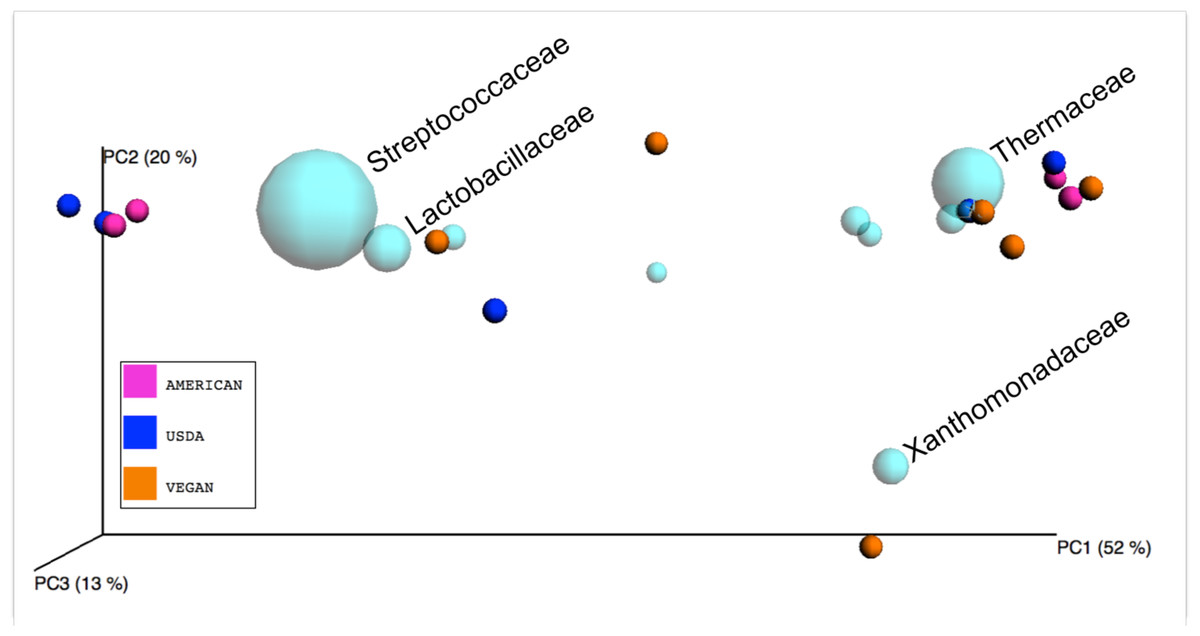 | ||
| Figure 5: Biplot of taxa in sample PCoA space. |
Lots of interesting things reported in the paper (read it, I insist). I note - this is a demonstration project in a way - trying to get the community and others to think about the source pools of microbes that come into our system from our food. It is by no means comprehensive or conclusive (read the caveats section of the paper). Congrats to Jenna and Angela for all their hard work. Anyway - the paper is Open Access in PeerJ. Eat it up.
UPDATE: Some press and blog coverage
- Kevin Bonham on SciAM Blogs: The Microbes in Your Kitchen (Or in your Starbucks mocha)
- Maddie Stone on Motherboard: Here’s How Many Microbes You Eat in a Single Day
- “This paper will hopefully convince the powers that be that the next study, actually looking at how different foods or diets with differing microbes affect people, should be funded soon,” Zivkovic told me.
- Nathan Gray: The microbes we eat: Study investigates bacteria in different diets
- Ross Pomeroy on Real Clear Science: This Is How Many Microbes You'll Eat Today
- Improbable Research: What’s Eating You, and/or Vice Versa: Microbes
- Marissa Fessenden at Smithsonian: You Eat Millions...Even Billions!...of Microbes Every Day
Monday, October 13, 2014
Talk for UC Davis Pre-Health Meeting (#UCDPHSA): Opening up to Diversity
Sunday I gave a talk at the "12th National UC Davis Pre-Health Student Alliance Pre-Medical and Pre-Health Professions Conference". I normally try to not give talks on weekends (to spend time with my family) but I made an exception here since this meeting has a strong commitment to issues relating to diversity in health and STEM fields. This mission statement for the meeting reads:
And then Sunday AM I got up early, decided to use slides (was not sure) and finished off the slide set I had worked on the night before. I decided that, in the spirit of the meeting, I would talk about two main things - diversity and access. And I planned to tell three stories about my work in this area. I wove in some personal stories since, at the dinner the night before Barbara Ross-Lee (who I sat next to) helped remind me of the importance of making talks personal. So in the end I talked about myself, diabetes, diversity of microbes, antibiotics, diversity in STEM, and open science. I came up with a title I was OK with: Opening up to Diversity.
My talk went well, I think. I am pretty sure it was vbideotaped but not sure where that recording will end up. I did however post my slides to slideshare. See below:
The UC Davis Pre-Health Student Alliance’s objective is to introduce and support academic, admission, and preparatory opportunities for all students interested in health professions with a focus on those underrepresented in healthcare (with regard to gender, economic, social, educational, linguistic, cultural, racial, and ethnic background). We target universities, community colleges and high schools throughout the United States. The UC Davis Pre-Health Student Alliance aims to impact health education, increase diversity amongst the healthcare workforce, and inspire future leaders of healthcare through hosting the largest national pre-health professions conference.It was that mission statement that got me to ditch my wife and kids Sunday AM (and also much of Saturday PM for a dinner and to work on my talk). I went to a dinner Saturday for some of the speakers with the new Dean of the UC Davis School of Medicine Julie Freischlag. The dinner had about 20 or so people and I met some quite interesting folks there working on various aspects of human and animal health.
And then Sunday AM I got up early, decided to use slides (was not sure) and finished off the slide set I had worked on the night before. I decided that, in the spirit of the meeting, I would talk about two main things - diversity and access. And I planned to tell three stories about my work in this area. I wove in some personal stories since, at the dinner the night before Barbara Ross-Lee (who I sat next to) helped remind me of the importance of making talks personal. So in the end I talked about myself, diabetes, diversity of microbes, antibiotics, diversity in STEM, and open science. I came up with a title I was OK with: Opening up to Diversity.
My talk went well, I think. I am pretty sure it was vbideotaped but not sure where that recording will end up. I did however post my slides to slideshare. See below:
Opening up to Diversity talk by @phylogenomics at #UCDPHSA from Jonathan Eisen
And I also recorded the talk using Camtasia (basically, it allows recording of the screen, the video camera on my computer, and the audio). I posted the recording (without the video feed which shows mostly my neck) to Youtube. See below:
And I also recorded the talk using Camtasia (basically, it allows recording of the screen, the video camera on my computer, and the audio). I posted the recording (without the video feed which shows mostly my neck) to Youtube. See below:
Friday, July 26, 2013
Another quick post - condoms and probiotics
Another quick post. Just read this article in LiveScience about a new PLOS One paper: Condoms May Boost Beneficial Vaginal Bacteria | LiveScience. Am wondering - when will condoms start coming with probiotics in them? Anyone out there know if this has been done yet? I mean, I do not want to oversell the microbiome but hey it seems like there could be something to do here ...
Saturday, November 10, 2012
Overselling the microbiome award of the month: Integrative medical group of Irvine

Yes that is right. We (the royal We of course) are on the verge of showing that the microbiota does EVERYTHING and therefore, if anything ails you, just wash your troubles away with some shit from a relative. There is no reason to wait. Come in to our clinic now.As our understanding of the enormous importance of bowel micro-biota (bacteria) grows, the indications for fecal transplant will expand greatly and public acceptance will follow. But there is no reason for you to wait. Dr. Lee, our naturopathic doctor, is one of only a tiny handful of specialists certified in the use of fecal transplant. She can expertly manage your case.
And for the misleading nature of this site, I am giving this Integrative Medical Group of Irvine my coveted "Overselling the microbiome award." Previous winners and discussions of this issue are listed below:
- Overselling the microbiome award: MedicalDaily on Effects of Sugary Drink
- The microbiome in the news: risk of overselling but not always bad coverage
- Overselling the microbiome award: Scientists look to mummies for obesity cure
- Probiotics are the new viagra & the risks of overselling of probiotics
- Overselling the microbiome award #2: The Marshall Protocol
- Overselling the microbiome award: Stephen Barrie on pre and probiotics at the Huffington Post
------
UPDATE September 2017
Was just looking back at this post. Alas the link to the Irvine web site was dead. But thankfully the Internet Archive indexed this page. See https://web.archive.org/web/20130405021335/http://integrativemgi.com/fecal-transplantation/. It is from 2013 but may be the same as what I was seeing.
I am copying the text below
Fecal Transplantation
The gastrointestinal (GI) system is largely responsible for the well-being of every other cell and system in the body. It absorbs the nutrients which all cells require, expels toxic wastes, nurtures the complex bacterial bio-matrix which produces essential enzymes and vitamins, protects the body from invading organisms, and participates in critical “cross-talk” with the brain and the immune system.
When the bacterial communities of the intestinal tract become altered or damaged, their essential processes malfunction and the health of the individual declines – sometimes slowly, but at other times with devastating speed. When this happens, we attempt to “heal the gut,” a process that involves elimination diets, healing supplementation and probiotics. This can take many weeks or longer.
Recently, however, a new treatment has been developed that is proving highly beneficial, amazing fast, and in many cases lifesaving. Though fecal transplantation sounds unappealing, this amazingly simple procedure rejuvenates the gastrointestinal (GI) system literally overnight by taking fecal material from a healthy donor (preferably a relative), carefully processing it, and then inserting it into the colon of the patient. This is a simple and safe procedure, and, of course, the donor is thoroughly screened for communicable diseases.
The most common application of fecal transplant is in patients suffering from a serious intestinal infection caused by Clostridium difficile bacteria. Usually infections with C. diff occur following oral administration of antibiotics, and with increasing frequency the resulting infection is resistant to all antibiotic therapies. Lives have been saved and transformed in a matter of days following a fecal transplant treatment.
Exciting novel applications are evolving for fecal transplant. One is for the treatment of ulcerative colitis (UC). Patients on the verge of having their colons removed or patients living in misery with UC have experienced dramatic remissions following fecal transplants.
Another novel application involves the use of fecal transplants in obese patients. It has been discovered that in these individuals, the GI bacteria differ from those found in thin, healthy people. These so-called “fat bacteria” can extract a significantly greater quantity of calories from the same amount of food as do normal bowel bacteria. There is great hope that doing a fecal transplant on an obese individual will stimulate more appropriate bacterial behavior, and weight loss will become much easier.
Data now exists that the bacteria in the gut impacts virtually all aspects of health. Cardiovascular well-being, emotional status, bone strength, as well as immune health are all dependent on a healthy bowel flora.
As our understanding of the enormous importance of bowel micro-biota (bacteria) grows, the indications for fecal transplant will expand greatly and public acceptance will follow. But there is no reason for you to wait. Dr. Lee, our naturopathic doctor, is one of only a tiny handful of specialists certified in the use of fecal transplant. She can expertly manage your case.
If you are interested in learning more about how fecal transplants can improve your health, we encourage you to call our office to schedule an appointment with Dr. Lee.
Tuesday, September 13, 2011
Storification of my notes/tweets from #UCDavis CLIMB Symposium "The infant gut microbiome: prebiotics, probiotics and establishment"
I made a Storify posting for the CLIMB Symposium I participated in yesterday. First I am reposting my summary of what the symposium was about which I posted the day before the meeting:
There is a symposium tomorrow at UC Davis organized by a undergraduates in the CLIMB program. CLIMB stands for "Collaborative Learning at the Interface of Mathematics and Biology (CLIMB)" and is a program that emphasizes hands-on training using mathematics and computation to answer state-of-the-art questions in biology. A select group of undergraduates participate in the program and this summer the students had to do some sort of modelling project. Somehow I managed to convince them to do work on human gut microbes. And they have done a remarkable job.
As part of their summer work, they organized a symposium on the topic and their symposium takes place tomorrow. Details are below.
The Infant Gut Microbiome: Prebiotics, Probiotics, & Establishment
- Jonathan Eisen, UC Davis “DNA and the hidden world of microbes”
- Mark Underwood, UC Davis “Dysbiosis and necrotizing enterocolitis”
- Ruth Ley, Cornell University “Host-microbial interactions and metabolic syndrome”
- CLIMB 2010 cohort “Breast milk metabolism and bacterial coexistence in the infant microbiome”
- David Relman, Stanford University “Early days: assembly of the human gut microbiome during childhood"
- Bruce German, UC Davis
The only major issue for me is I am losing my voice. So we will see how this goes. Though I note I have gotten some very sage advice on how to treat my voice problem via the magic of twitter. If I do not collapse I will also be tweeting/posting about the other talks during the day.
Subscribe to:
Posts (Atom)
Most recent post
A ton to be thankful for -- here is one part of that - all the acknowledgement sections from my scholarly papers
So - it is another Thanksgiving Day and in addition to thinking about family, and football, and Alice's Restaurant, I also think a lot a...

-
Wow. Just wow. And not in a good way. Just got an email invitation to a meeting. The meeting is " THE FIRST ANNUAL WINTER Q-BIO ...
-
 I have a new friend in Google Scholar Updates I have written about the Updates system before and if you want more information please see...
 -
See Isolation and sequence-based characterization of a koala symbiont: Lonepinella koalarum Paper based on PhD thesis work of Katie Dahlha...
