Showing posts with label food. Show all posts
Showing posts with label food. Show all posts
Thursday, October 29, 2015
Storify of the IFAL Roundtable on Microbiomes in Food and Agriculture
Here is a quick roundup of the Roundtable discussion I was involved in on Microbiomes in Food and Agriculture run by the IFAL at UC Davis.

Wednesday, December 10, 2014
New lab paper: The microbes we eat: abundance and taxonomy of microbes consumed in a day’s worth of meals for three diet types
A new paper out from my lab (with Jenna Lang as the 1st author and in collaboration with Angela Zivcovic from the UC Davis Food For Health Initiative and the Department of Nutrition): The microbes we eat: abundance and taxonomy of microbes consumed in a day’s worth of meals for three diet types. The work in the paper focuses on characterizing the abundance and taxonomy of microbes in food from three model diets.
Basically, Angela prepared meals for these three diets
Lots of interesting things reported in the paper (read it, I insist). I note - this is a demonstration project in a way - trying to get the community and others to think about the source pools of microbes that come into our system from our food. It is by no means comprehensive or conclusive (read the caveats section of the paper). Congrats to Jenna and Angela for all their hard work. Anyway - the paper is Open Access in PeerJ. Eat it up.
UPDATE: Some press and blog coverage
Basically, Angela prepared meals for these three diets
Food was purchased and prepared in a standard American home kitchen by the same individual using typical kitchen cleaning practices including hand washing with non-antibacterial soap between food preparation steps, washing of dishes and cooking instruments with non-antibacterial dish washing detergent, and kitchen clean-up with a combination of anti-bacterial and non-antibacterial cleaning products. Anti-bacterial products had specific anti-bacterial molecules added to them whereas “non-antibacterial” products were simple surfactant-based formulations. The goal was to simulate a typical home kitchen rather than to artificially introduce sterile practices that would be atypical of how the average American prepares their meals at home. All meals were prepared according to specific recipes (from raw ingredient preparation such as washing and chopping, to cooking and mixing).And then she blended them and we characterzied the microbial communities in the blended samples:
After food preparation, meals were plated on a clean plate, weighed on a digital scale (model 157W; Escali, Minneapolis, MN), and then transferred to a blender (model 5,200; Vita-Mix Corporation, Cleveland, OH) and processed until completely blended (approximately 1–3 min). Prepared, ready to eat foods that were purchased outside the home were simply weighed in their original packaging and then transferred to the blender. 4 mL aliquots of the blended meal composite were extracted from the blender, transported on dry ice and then stored at −80 °C until analysis. The following analyses were completed using these meal composite samples: (1) total aerobic bacterial plate counts, (2) total anaerobic bacterial plate counts, (3) yeast plate counts, (4) fungal plate counts, and (5) 16S rDNA analysis for microbial ecology.And Jenna Lang coordainted the sequence analysis and then Angela and Jenna (with some help here and there from me) coordianted the analysis of the different microbial data and the writing of the paper.
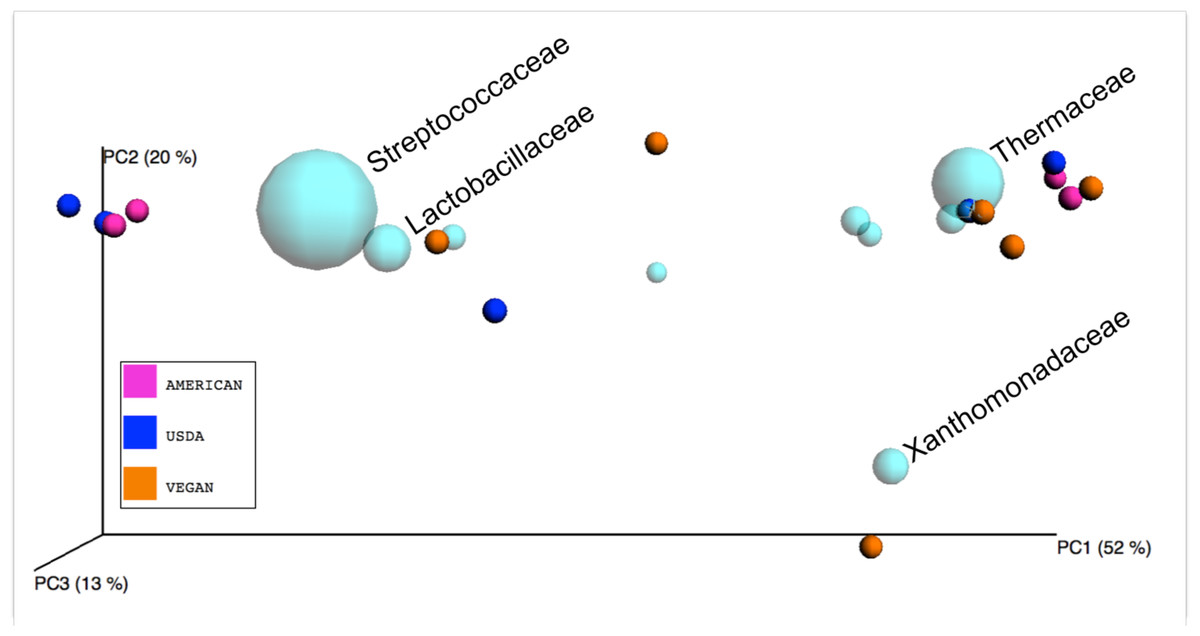 | ||
| Figure 5: Biplot of taxa in sample PCoA space. |
Lots of interesting things reported in the paper (read it, I insist). I note - this is a demonstration project in a way - trying to get the community and others to think about the source pools of microbes that come into our system from our food. It is by no means comprehensive or conclusive (read the caveats section of the paper). Congrats to Jenna and Angela for all their hard work. Anyway - the paper is Open Access in PeerJ. Eat it up.
UPDATE: Some press and blog coverage
- Kevin Bonham on SciAM Blogs: The Microbes in Your Kitchen (Or in your Starbucks mocha)
- Maddie Stone on Motherboard: Here’s How Many Microbes You Eat in a Single Day
- “This paper will hopefully convince the powers that be that the next study, actually looking at how different foods or diets with differing microbes affect people, should be funded soon,” Zivkovic told me.
- Nathan Gray: The microbes we eat: Study investigates bacteria in different diets
- Ross Pomeroy on Real Clear Science: This Is How Many Microbes You'll Eat Today
- Improbable Research: What’s Eating You, and/or Vice Versa: Microbes
- Marissa Fessenden at Smithsonian: You Eat Millions...Even Billions!...of Microbes Every Day
Monday, November 13, 2006
Hidden Gem in Davis - Farmer's Kitchen Cafe
The Farmer's Kitchen Cafe, which is part of the Natural FoodWorks Store, is possibly the biggest hidden gem of a restaurant in Davis. They specialize in :
This is one of my favorite places in Davis and definitely worth a visit, especially if you are into sustainable, organic or local foods. Check it out at 624 4th Street or at their website.
delicious, homemade bioregional foods, free of gluten and casein. Your food is made with locally grown and organic fruits and vegetables, free range meats and wild fish. No aluminum pans, no hydrogenated fats, no microwaved foods, no unnatural additives.Although the service there can be a little slow, that is part of the point. This is not a fast food restaurant. It is fresh, in season, homemade, and usually organic or at least local. Last time I went I had the chicken noodle soup, which was, I have to say, even better than mom used to make. It has a nice simple clear broth, a smattering of flavorful veggies and chicken, and a good helping of clearly top of the line noodles. I also had an organic eggplant sandwich with pesto and feta cheese that was nearly perfect. The eggplant was creamy and intermixed with the pesto into a spread with no hint of the bad eggplant flavors one can get sometime. Plus, there is a great basket of miscellaneous crayons and toys that our daughter spent much of the time playing with.
This is one of my favorite places in Davis and definitely worth a visit, especially if you are into sustainable, organic or local foods. Check it out at 624 4th Street or at their website.
Friday, August 18, 2006
Viruses as food additives
I find it sad that the world has come to this. The FDA announced that it has approved the use of viruses as a food additive. The particular viruses (known as phage in this case) target and kill common bacterial pathogens found in meat. It is entirely possible that this treatment will lead to reduction in deaths and illnesses. However, it is also possible that there will be unexpected consequences of this treatment and thus anything like this should be done with caution. What saddens me about this whole thing is that it is the wrong way to go about solving the problem. Most of the problem comes from the fact that our meat today in this country does not come to us in reasonable condition. The animals are usually kept in unsanitary conditions where diseases and nasty pathogens are prevalent.
The best way to think about this in my opinion is what I read in The Omnivore's Dilemma, the new book by Michael Pollan. In this book he talks about how animals now frequently live in what can be considered the equivalent of the slums of the industrial revolution. Cities of animals, frequently wallowing in excrement, is not the best way to prevent bad microbes from getting in our food.
So in recent years all sorts of practices have been developed to kill these microbes in food products. Irradiation, for example. And now, viruses, sprinkled on your meat, to keep the bacteria from growing too much. Give me meat from animals that have not been swimming in their own shit and piss and I will be happy to take my risks without dumping viruses on top.
The best way to think about this in my opinion is what I read in The Omnivore's Dilemma, the new book by Michael Pollan. In this book he talks about how animals now frequently live in what can be considered the equivalent of the slums of the industrial revolution. Cities of animals, frequently wallowing in excrement, is not the best way to prevent bad microbes from getting in our food.
So in recent years all sorts of practices have been developed to kill these microbes in food products. Irradiation, for example. And now, viruses, sprinkled on your meat, to keep the bacteria from growing too much. Give me meat from animals that have not been swimming in their own shit and piss and I will be happy to take my risks without dumping viruses on top.
Subscribe to:
Posts (Atom)
Most recent post
A ton to be thankful for -- here is one part of that - all the acknowledgement sections from my scholarly papers
So - it is another Thanksgiving Day and in addition to thinking about family, and football, and Alice's Restaurant, I also think a lot a...

-
Wow. Just wow. And not in a good way. Just got an email invitation to a meeting. The meeting is " THE FIRST ANNUAL WINTER Q-BIO ...
-
 I have a new friend in Google Scholar Updates I have written about the Updates system before and if you want more information please see...
 -
See Isolation and sequence-based characterization of a koala symbiont: Lonepinella koalarum Paper based on PhD thesis work of Katie Dahlha...
