Friday, September 12, 2014

Fun read of the day: On whimsy, jokes, and beauty: can scientific writing be enjoyed?

This is such a fun paper: On whimsy, jokes, and beauty: can scientific writing be enjoyed? by Stephen Heard in Ideas in Ecology and Evolution 7: 64–72, 2014  I found out about it in an email from Heard, who sent it to me because he had earlier commented on a blog post I had written: The best writing in science papers part 1: Vladimir Nabokov in Notes on Neotropical Plebejinae (Lycaenidae, Lepidoptera).

Anyway - enough about me - what about this paper?  It has so many nuggets of interest I am not sure which to highlight so I will just go through some of it.  Oh - and it is published with a Creative Commons Attribution license (yay).
Abstract: While scientists are often exhorted to write better, it isn’t entirely obvious what “better” means. It’s uncontroversial that good scientific writing is clear, with the reader’s understanding as effortless as possible. Unsettled, and largely undiscussed, is the question of whether our goal of clarity precludes us from making our writing enjoyable by incorporating touches of whimsy, humanity, humour, and beauty. I offer examples of scientific writing that offers pleasure, drawing from ecology and evolution and from other natural sciences, and I argue that enjoyable writing can help recruit readers to a paper and retain them as they read. I document resistance to this idea in the scientific community, and consider the objections (well grounded and not) that may lie behind this resistance. I close by recommending that we include touches of whimsy and beauty in our own writing, and also that we work to encourage such touches in the writing of others.
OK - the title would have drawn me in anyway but the abstract definitely had me.
If scientific writers aren’t sure how to write better, it isn’t for lack of advice. Dozens of guidebooks discuss form, style, and goals in scientific writing (e.g., Montgomery 2003, Davis 2005, Day and Gastel 2006, Katz 2006, Matthews and Matthews 2007, Rogers 2007, Harmon and Gross 2010, Hofmann 2010, Pechenik 2010, Greene 2013, Heard unpubl.).
OK - I am going to have to look at some of these.

Heard documents a bit of a spat between Sprat and Boyle from the 1660s regarding scientific writing.  I especially like the Boyle quote:
To affect needless rhetorical ornaments in setting down an experiment...were little less improper than...to paint the eyeglasses of a telescope...in which even the most delightful colours cannot so much please the eye as they would hinder the sight...And yet I approve not that dull and insipid way of writing, which is practiced by many...for though a philosopher need not be solicitous that his style should delight his reader with his floridness, yet I think he may very well be allowed to take a care that it disgust not his reader by its flatness...Though it were foolish to colour...the glasses of telescopes, yet to gild...the tubes of them may render them most acceptable to the users (Boyle 1661:11-12, spelling and punctuation modern- ized).
Heard then goes through some different aspects of good scientific writing
  • Sightings (1): Playfulness in the scientific literature
  • Sightings (2): Beauty
Also - he then doscusses pushback against the "notion that whimsy, jokes, and beauty can have a place in our scientific literature." which I have also seen in many contexts.

He ends with suggestions and I quote the whole section with some highlights:
If you write papers that are crystal clear and thus effortless to read, you’ll have achieved the primary goal of scientific writing and your work will be among the best of our literature. But if you want to reach for even more, if you agree with me that we can also offer our readers some pleasure in reading, what can you do? To begin, you can try to write with small touches of whimsy, humanity, humour, and beauty—without, of course, compromising clarity; and even knowing that sometimes, reviewers will make you take them out. I am not suggesting writing in which art shares the stage equally with content (as can be true in the lay literature). Rather, the goal that’s within our reach is clear, functional writing punctuated with occasional nuggets of playfulness or glints of beauty—to extend Boyle’s metaphor, not a telescope of solid gold but one lightly gilded. 
You can also work to encourage pleasure in what your colleagues write, in two complementary ways. First, when you review manuscripts, you can suppress the reflex telling you to question any touches of whimsy, humour, or beauty that you find; you can even (gently) suggest some be put in. Second, you can announce your admiration of writing that has given you pleasure. Announce your admiration to the writers who crafted the passage, to editors who might be considering its fate, and to students or colleagues who might read it. If we choose to, we can change our culture to deliver, and value, pleasure along with function in our writing.
This is a must read paper.  And I really wish more people would endorse the idea that scientific writing can include more than just science.  Of course, there are many who already endorse this notion but for those who do not - give it a try.


Thursday, September 11, 2014

Kudos to Tedmed for the gender ratio of speakers for this year's event

Well done Tedmed.

Here are the speaker pages below.  Notice anything?


The gender ratio of speakers is actually well balanced.  Well done Tedmed.  Well done.

Tuesday, September 09, 2014

International Symposium on Subsurface Microbiology - where men tell us about deep things

Just saw this Tweet:
This refers to this meeting: Call for Abstracts for 2014 Ninth International Symposium on Subsurface Microbiology, Pacific Grove California

The plenary speakers for this meeting are all men
  • Peter Girguis
  • Terry Hazen
  • Rainer Meckenstock
  • Lars Nielsen
  • Aaron Packman
  • Karsten Pedersen
  • Timothy Scheibe
  • Jack Schijven
The last meeting was in 2011 and it was not much better - with one female keynote speaker.
  • Andreas Kappler
  • Karsten Pedersen
  • Christian Griebler
  • Ian Head
  • Frank Löffler
  • Babara Sherwood-Lollar
  • Bo Barker Jørgensen
  • Ken Takai
  • Kai-Uwe Hinrichs
  • Tori Hoehler
Apparently, only men can talk about deep things.  Fun times.


Sunday, September 07, 2014

Story behind the paper: Bonnie Baxter on "A tale of salt and gender" #STEMWomen #Halophiles

After posting A tale of salt and gender: participation of women in halophile research I sent the post to Bonnie Baxter, one of the authors of the article I discussed and I asked if she would be interested in writing a guest post about the "Story Behind the Paper" (for which I have a whole series).  I am so so pleased that she said yes.  I have followed Bonnie's work for many years but this is her first guest post here.  I hope there will be more.  She is a wonderful and brilliant scientist and educator.


Guest Post by Bonnie Baxter
Salty Sisters: The Women of Halophiles


Bonnie Baxter and Nina Gunde-Cimerman at the north arm of Great Salt Lake (2008)

I was drawn to the western US, the extreme landscapes, and ended up at the only liberal arts college in Utah. I had wanted a career doing science with undergraduates, and I set about exploring the microbiota of Great Salt Lake. Since few had studied this incredible spot, I quickly became the go-to person for studies on the lake, and these collaborations and grant projects eventually evolved into an organization I direct called Great Salt Lake Institute. We are dedicated to research, scholarship and education efforts on Great Salt Lake.

There had been no microbiology done on Great Salt Lake since 1979. This is why there was much excitement concerning our emerging data, and in 2004, I was invited to speak at the triennial International Halophiles conference in Slovenia. Halophiles are microbes that thrive at high-salt, and the people who study them maintain an interesting balance of field-work and lab work. I had been to large meeting on DNA repair, DNA replication, nucleases and the like, but I had never met a group who were centered on a theme that connected them around the planet. 

From my first Halophiles meeting (I’ve since attended 2007 in Colchester UK, 2010 in Beijing and 2013 at University of Connecticut), I felt an unusual level of support from the elders of this group. And I noticed that, unlike the NASA meetings or biochemistry meetings I attended, there seemed to be a nice balance of men and women. There were a group of folks who had participated for a long time, without a membership organization, and these people maintained the notion of mentoring in the field. It is this spirit that drew all of us younger folk to participate. 

Friday, September 05, 2014

Paperwork, paper pushing policies push people past pressure points

So I am going to make this simple here.  Paperwork at UC Davis is driving me batty these days.  One thing in particular does not make much sense to me. When I or anyone who works in my lab go on trips associated with work, we have to collect all the receipts for the trip and then these need to be submitted in an intemized way for reimbursement.  With a lot of people going on a lot of trips, this amounts to a lot of work for us, for my administrative assistant, for the UC Davis Genome Center administration, and for the UC administration.  At other places I have worked, and in other situations, people can get reimbursed using a per diem calculation.  Such calculations save an absurd amount of work for people even if they come with some "risks" such as people getting reimbursed for more than they actually spent.  Personally, I would take a 50% per diem to save everyone the trouble associated with all the reciepts and submitting them and checking them and such.

So - the reason I am writing is to ask - what happens at other institutions?  Does everyone have to submit all the receipts?  Or does anyone out there do per diems?


Thursday, September 04, 2014

Nice letter to the editor in the Davis Enterprise taking on school district's anti-science tone

I assume many people heard about the recently released report from the American Academy of Pediatrics where they recommended high school classes start later in the morning than most do right now.  See for example: Let Them Sleep: AAP Recommends Delaying Start Times of Middle and High Schools to Combat Teen Sleep Deprivation.  And this report was covered in all sorts of newsy and bloggy places.   See for example, Amy Graff's article in SFGate and Deborah Netburn in the LA Times.  Overall, the argument presented by the AAP makes sense and seems supported by scientific fundings.  And they go through a lot of scientific reasons for their recommendations.

Alas, Winfred Roberson, superintendant of the Davis, CA schools (also known as the DJUSD) told the Davis Enterprise that the schools here would not be making any changes in response to this report:
“While DJUSD won’t be modifying start times, our role as an educational institution can be to find ways to support our students by giving them the tools that will help them to think through, make adjustments and prioritize their competing forces that may be cutting into the recommended sleep time,” Roberson said. “These are life skills we are helping to build that will help students to function even after graduation.”
And I had missed out on this quote, thankfully, but became aware of it when my wife showed me this letter by Steve Carlip in the Davis Enterprise today:  Don’t ignore the science Davis Enterprise.   I quote from it below:
The superintendent’s response, as reported in Tuesday’s Enterprise, was to simply ignore the science. Instead, he said, the schools will help student “build life skills” to “prioritize their competing forces that may be cutting into the recommended sleep time.” 
Really? The high school is going to teach students to control their circadian rhythms? It’s going to give them the “life skills” to regulate the timing of their bodies’ secretion of melatonin? It will educate them to overcome biological sleep-wake phase delay by sheer force of will?
He completely nailed it here.  I hope Winfred Roberson and the Davis School district rethink their attitude towards scientific studies.

Tuesday, September 02, 2014

The US Postal Service Cares (actually this was kind of a nice gesture)

Well, this is a new one for me and my family.  We got some mail today.  My wife called me over this evening to tell me and said "it might make something good for my blog".  But it was very strange. From the US Postal Service.  In a plastic bag and the bag read "We care ..." see below:


And inside of this was half of a piece of mail.  A card.  It felt very weird.  Like someone was censoring us but most likely some machine just ate the other half.

Front
Back

Add caption
They easily could have just tossed this once it got damaged.  Glad they did this.  Now, mind you, I still detest all their junk mail / bulk mail policies, but this was nice ..

Science Journal SPAM of the Week: the Journal of HIV/AIDS from Sci Forschen

Well, got this email this AM.  It is yet another spammy journal (I don't work on HIV/AIDS).  I particularly like the part where I am called an "eminent personality".

Dear Dr. Jonathan Eisen,
Greetings from the Journal of HIV/AIDS,
We take great delight in inviting you to join the Editorial Board for the Journal of HIV/AIDS , which is an open access, peer reviewed journal managed by Sci Forschen.  Ensuring quality and accuracy for every submitted article is the top most priority for Sci Forschen, and we genuinely believe that someone with the knowledge and experience, such as yourself, can really make a huge difference for us.
Journal of HIV/AIDS , publishes cutting edge research work submitted by scholars from all over the world, and we believe that your presence will polished up with the help of illustrious experts in research field.
We are always striving to involve eminent personalities like you and your standing in the global community makes us confident.
Kindly let us know your valuable response and acceptance if possible with in 48 hours.
Please kindly submit your following particulars to update in our journal website

1. Updated CV
2. Passport Size Photo
3. Short Biography
4. Research Interest
Looking forward for your valuable and soon response.

Regards,

Editorial Office
Sci Forschen Incorporation
913 Catkin Ct.
San Jose, CA 95128, USA.

Saturday, August 30, 2014

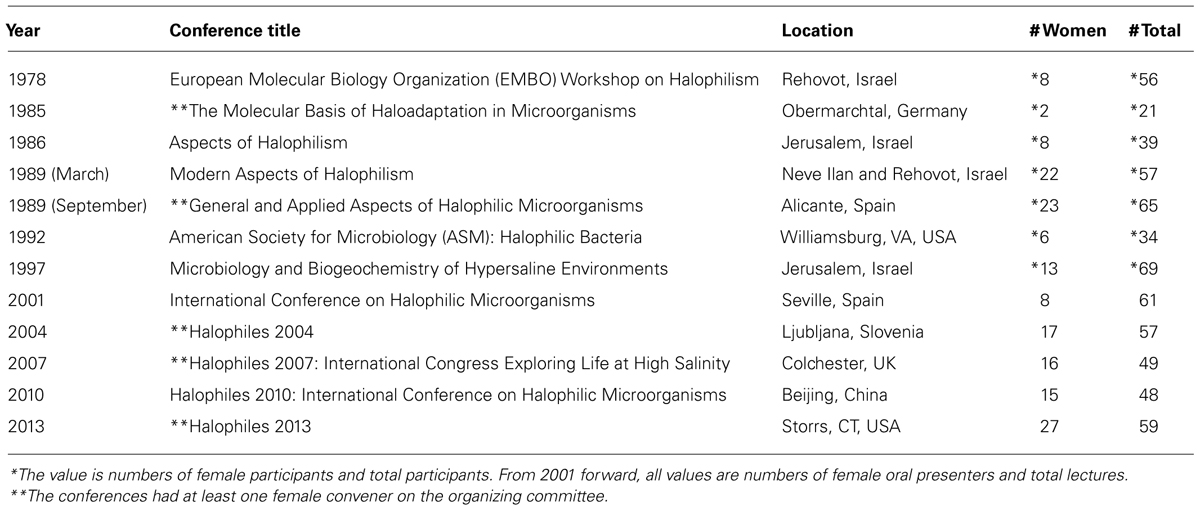
A tale of salt and gender: participation of women in halophile research

Interesting paper on women in science of direct relevance to my work: Frontiers | Salty sisters: The women of halophiles | Extreme Microbiology.  I have been working on halophilic archaea for many years (since introduced to them in graduate school) and published papers on this topic (e.g., see The Complete Genome Sequence of Haloferax volcanii DS2, a Model Archaeon and Sequencing of seven haloarchaeal genomes reveals patterns of genomic flux and more coming).  However, I have never been to a meeting dedicated to the topic and confess I have not thought specifically about the gender of scientists in this field and at meetings in the field and such.  Thus I was pleasantly surprised to see this analysis from Bonnie Baxter, Nina Gunde-Cimerman and Ahoren Oren.  Their abstract is below:
A history of halophile research reveals the commitment of scientists to uncovering the secrets of the limits of life, in particular life in high salt concentration and under extreme osmotic pressure. During the last 40 years, halophile scientists have indeed made important contributions to extremophile research, and prior international halophiles congresses have documented both the historical and the current work. During this period of salty discoveries, female scientists, in general, have grown in number worldwide. But those who worked in the field when there were small numbers of women sometimes saw their important contributions overshadowed by their male counterparts. Recent studies suggest that modern female scientists experience gender bias in matters such as conference invitations and even representation among full professors. In the field of halophilic microbiology, what is the impact of gender bias? How has the participation of women changed over time? What do women uniquely contribute to this field? What are factors that impact current female scientists to a greater degree? This essay emphasizes the “her story” (not “history”) of halophile discovery.
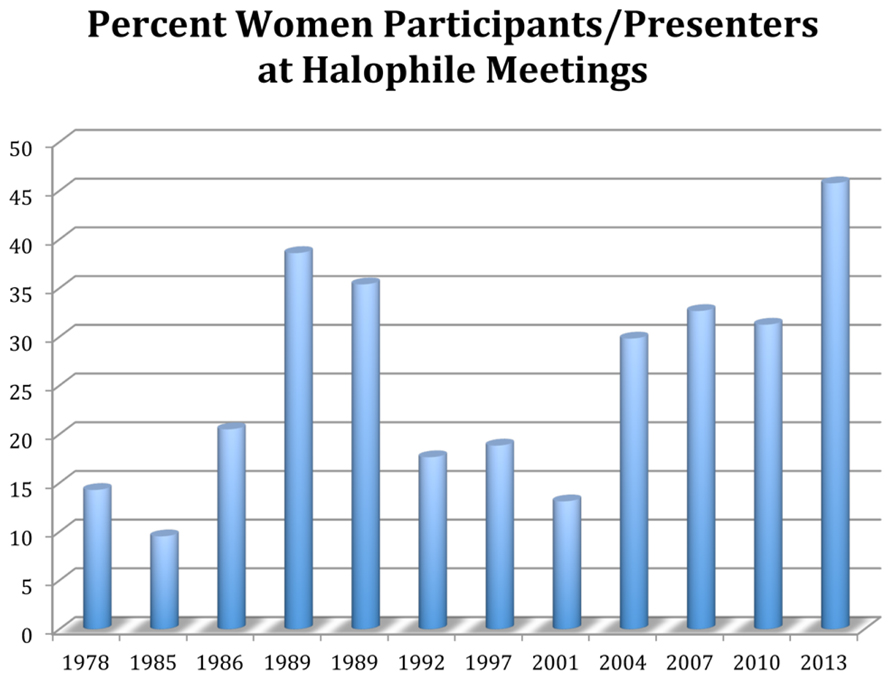
As part of their paper they analyze participation of women at conference on halophiles:


This is a useful analysis and compendium and it would be great to see this done for as many fields as possible. 

Mesquite "A modular system for evolutionary analysis" v3.0 released from Team Maddison

Just found out about this on Facebook via Rod Page: Mesquite V3.0  has been released.  Mesquite is from Team Maddison (Wayne and David).  I have been using their software since 1987 when I took Stephen Jay Gould's course at Harvard and they were TAs for the course demoing an early version of MacClade.   Lots of nice features and it is available in Mac, Unix/Linux, and Windows versions.   They describe "What Mesquite Does" on their Wikispaces site in the following way:

Mesquite is software for evolutionary biology, designed to help biologists manage and analyze comparative data about organisms. Its emphasis is on phylogenetic analysis, but some of its modules concern population genetics, while others do non-phylogenetic multivariate analysis. Because it is modular, the analyses and management features available depend on the modules installed. Here is a brief overview of some of Mesquite's features. See also a more complete outline of features, and the Mesquite Project Youtube channel, with instructional videos helping you learn Mesquite.

Despite Mesquite's broad analytical capabilities, the developers of Mesquite find that we use Mesquite most often to provide a workflow of data editing, management, and processing. We will therefore begin there.
Definitely worth a look.

NIH Announces Revised Genome Data Release Policies

Just got notified of this by the UC Davis Med. School grants administration: NOT-OD-14-124: NIH Genomic Data Sharing Policy.  Lots of interesting things in here including a summary of the comments that they received on the draft policy.

I have copied some of the more interesting and relevant bits below:
  • Sharing research data supports the NIH mission and is essential to facilitate the translation of research results into knowledge, products, and procedures that improve human health.  NIH has longstanding policies to make a broad range of research data, in addition to genomic data, publicly available in a timely manner from the research activities that it funds. 
  • The public comments have been posted on the NIH GDS website. http://gds.nih.gov/pdf/GDS_Policy_Public_Comments.PDF
  • The statement of scope remains intentionally general enough to accommodate the evolving nature of genomic technologies and the broad range of research that generates genomic data.
  • Several comments were submitted by representatives or members of tribal organizations about data access.  Tribal groups expressed concerns about the ability of DACs to represent tribal preferences in the review of requests for tribal data.
  • The GDS Policy expects that basic sequence and certain related data made available through NIH-designated data repositories and all conclusions derived from them will be freely available.  It discourages patenting of “upstream” discoveries, which are considered pre-competitive, while it encourages the patenting of “downstream” applications appropriate for intellectual property.  
  • NIH expects investigators and their institutions to provide basic plans for following this Policy in the “Genomic Data Sharing Plan” located in the Resource Sharing Plan section of funding applications and proposals.  Any resources that may be needed to support a proposed genomic data sharing plan (e.g., preparation of data for submission) should be included in the project's budget. 
  • Large-scale non-human genomic data, including data from microbes, microbiomes, and model organisms, as well as relevant associated data (e.g., phenotype and exposure data), are to be shared in a timely manner. 

Friday, August 29, 2014

Kudos to Dr. Roizen's Personalized, Preventive, & Integrative Medicine "Focus on Women's Health" Conference #NoMoreYAMMMs

Quick post here as I have a bit of a cold.  I post a lot of critiques here about meetings that have bad gender ratios for the speakers.  But I do focus on the negative and am trying to also call attention to the good cases.  Well here is one: the 12th Annual Dr. Roizen’s Personalized, Preventive, and Integrative Medicine Conference with a focus on Women's Health.  And unlike the recent Ovarian Club meeting (see No Ovaries? Well this Ovarian Club Conference is For You (YAMMMs for everyone)) which had few female speakers despite the topic, Dr. Roizen and the other organizers (including one of my favorite colleagues Rosane Oliveira) did a great job.  The gender ratio of organizers, moderators and speakers all looks good (see images below).  Kudos to all involved.


Tuesday, August 26, 2014

Overselling the Microbiome Award: The Microbiome Diet Book

Well, umm, I do not know what to say: The Microbiome Diet: The Scientifically Proven Way to Restore Your Gut Health and Achieve Permanent Weight Loss: Raphael Kellman MD: 9780738217659: Amazon.com: Books.  I got pointed to this book by Dorothy Timmermans and she wondered if this was a case of "overselling the microbiome" or not.  I guess I don't know because I have not read the book.  Nor will I most likely.  But I think almost certainly it is a case of "Overselling the Microbiome" based just on reading the blurb on Amazon from the Publisher which I paste below.  It contains a litany of over the top statements:

Cutting-edge science has shown that the microbiome is the secret to healthy weight loss and to feeling healthy, energized, optimistic, and at the top of your game. The microbiome is a whole inner world that lives within your intestines—trillions of tiny microbes that help you extract the nutrients from your food, balance your mood, and sharpen your clarity and focus.


These beneficial bacteria make up a separate ecology within the body and have an enormous influence on your metabolism, your hormones, your cravings—even your genes. The microbiome's health is intimately involved with yours: when it flourishes, you flourish. When it craves sugar, so do you. When it operates at peak efficiency, so does your metabolism. And when your microbiome is out of balance, you might find yourself gaining weight or unable to lose weight, no matter how much you exercise or how carefully you eat. To achieve your ideal weight, you need the help of your microbiome.


Now, drawing from nearly two decades of experience as a specialist in functional medicine and intestinal health, Raphael Kellman, MD, has developed the first diet based upon on these scientific breakthroughs. The Microbiome Diet offers an effective three-phase plan to heal your gut, reset your metabolism, and achieve dramatic, sustainable weight loss. The Microbiome Diet will help you...

Reset your metabolism

Free yourself from food cravings and uncontrollable appetite

Incorporate prebiotics, probiotics, and healing foods into every meal

Lose weight—and keep it off—with a nonrestrictive life plan


With delicious recipes, convenient meal plans, and helpful information on Microbiome Superfoods and Supersupplements—including prebiotics and probiotics—The Microbiome Diet gives you the tools to achieve your healthy weight, boost your mood, regain your mental focus, and be in your best shape for life.


Sound too good to be true?  Well, that is because it is.

Monday, August 25, 2014

The Agricultural Bioscience International Conference #ABIC2014 run by @ABICFoundation: where you can hear lots of talks by men #YAMMM

Well, here is this week's YAMMM (yet another mostly male meeting) alert: The Agricultural Bioscience International Conference in Saskatchewan.

Male Speakers: 40
Female speakers 4

  1. Marc Albertsen
  2. Robert Carberry
  3. David Fischhoff
  4. Maurice Moloney
  5. Frédéric Seppey
  6. Juliana Alexandre
  7. Tom Carrato
  8. Michael Frodyma
  9. Carlo Montemagno
  10. Tim Sharbel
  11. Simon Barber
  12. David Chalack
  13. Richard Gray
  14. Giuseppe Natale
  15. Roman Szumski
  16. Roger Beachy
  17. Raju Datla
  18. Wayne Hunter
  19. Matthew O'Mara
  20. Albert Vandenberg
  21. Suzanne Bertrand
  22. Swapan Datta
  23. David Irvin
  24. Peter Phillips
  25. Victor Villalobos
  26. Julie Borlaug
  27. Maurice Delage
  28. Lawrence Kent
  29. Ingo Potrykus
  30. Simon Warner
  31. Jim Brandle
  32. David Dent
  33. Ganesh Kishore
  34. Andrew Potter
  35. Howard Wheater
  36. John Buchanan
  37. Claude Fauquet
  38. Robert Lamb
  39. Thomas Redick
  40. Hong-Wei Xue
  41. Derek Byerlee
  42. Nina Fedoroff
  43. Greg Meredith
  44. Andrew Reed

Who gets the credit/blame for this wonderful arrangment? 
  1. Chair, Wilf Keller, Ag-WestBio Inc.
  2. Jerome Konecsni, Innovation Saskatchewan
  3. Muriel Adams, ABIC Foundation
  4. Art Froehlich, Ad Farm
  5. Pierre Fobert, National Research Council
  6. Graham Scoles, University of Saskatchewan
  7. Peter Phillips, Johnson-Shoyama Graduate School of Public Policy
  8. Paul McCaughey, Agriculture and Agri-Food Canada
  9. Dr.Abdul Jalil, Saskatchewan Ministry of Agriculture (originally colored green)
  10. Janice Tranberg, Saskatchewan Ministry of Agriculture

This goes with another YAMMM from Canada recently: Today's YAMMM (Yet Another Mostly Male Meeting) Brought to You by CIFAR & NAS.  I have not done any analysis of meetings organized by country but I am thinking it might be worth looking into.  I would really suggest if anyone is considering going to this meeting for you to skip it.  There should be consequences for such a skewed ratio.  And while you are at it consider writing to the organizers and sponsors.  I will ...

Friday, August 22, 2014

Want to prevent someone from taking copyright on something- have it be made by a monkey

Well, this is both strange and surreal and fascinating: Who Owns A Monkey's Selfie? No One Can, U.S. Says : The Two-Way : NPR.  Turns out the UC Copyright office says a photo taken by a monkey cannot by copyrighted because apparently copyright is reserved for humans (and I guess human corporations).  NPR implies that an Ars Technica article by David Kravets is what caught their attention as well as that of others.

I wonder - if one could teach a monkey to type maybe one could get them to type up some papers and then nobody could have copyright on them?  What if one wrote a paper where a monkey was a co-author but did not do all the work?  Would that mean one could not transfer copyright to anyone else?  Seems like I should / could include monkeys on all my work.


Thursday, August 21, 2014

No Ovaries? Well this Ovarian Club Conference is For You (YAMMMs for everyone)

Well, I just got an email invitation to attend CME - OVARIAN CLUB 4.  And alas, rather than just dumping it into SPAM (which I did do) I clicked on one of the links.  I had to know - what was the gender balance at this meeting.  Was there any chance that the organizers would see that it would be ironic to not have a decent number of female speakers?  Alas, nope.

The organizing committee is 17:1 males to females.

And the speaker balance is not much better something like 25:6.


I guess maybe they should rename this "Meeting brought to you by people who mostly do not have ovaries."  Sad.  Another YAMMM (Yet another mostly male meeting).


Related posts and pages

Wednesday, August 20, 2014

No #AAAS and ASM you do not deserve good PR for freeing up a few papers on Ebola

Saw a PR from AAAS about how they were freeing up all of ~ 20 papers on Ebola
In light of what has become the largest Ebola outbreak on record, Science and Science Translational Medicine have compiled over a decade's worth of their published news and research. Researchers and the general public can now view this special collection for free.
OK. More access is good. But alas, they did not even free up all papers in #AAAS journals with Ebola in the Title or Abstract.

And then I started thinking. What about HIV? TB? Malaria? And as I started Tweeting about this, I saw that ASM also was hopping on the "free Ebola" bandwagon (actually I do not know who did it first).

Today's YAMMM (Yet another mostly male meeting): pharma-nutrition #PN2015

Just got pointed to (by Elisabeth Bik) an announcement for a meeting: Home : Pharma-Nutrition 2015 with a focus on "Linking the Microbiome with Nutrition and Pharma".  And alas, the list of confirmed speakers is as follows:
  • Keynote Speaker
    • Martin J. Blaser, NY University Medical Center, New York, NY, USA
  • Speakers
    • Gregor Reid, University of Western Ontario, London, ON, Canada 
    • Alain van Gool, Radboud University, Nijmegen, The Netherlands 
    • David Hafler, Yale, New Haven, CT, USA 
    • John F. Cryan, University College Cork, Cork, Ireland 
    • André Marette, Laval University, Montreal, QC, Canada 
    • Charles R. Mackay, Monash University, Clayton, Victoria, Australia
    • Alan L. Landay, Rush University Medical Center, Chicago, IL, USA
Yay.  All men.  How wonderful.  Because, you know, there are no women working on the microbiome and nutrition right?  Ugg.

Seems like they are still working on getting more speakers.  I will send this blog post to the organizers and see what they say.  But suffice it to say I am very disappointed in them.  Oh, and shockingly, the two organizers are men: Johan Garssen and Alan Landay.

These YAMMMs (Yet Another Mostly Male Meeting) really have got to be killed.  People should not got to them.  People should not speak at them.  And the organizers should not be allowed to run other meetings unless they can explain themselves and provide evidence that they will work to not have this happen again.


UPDATE A FEW MINUTES AFTER POSTING.

I found the program committee for the meeting.  Alas the gender ratio there is lame too.
  • John F Cryan, University College Cork, Cork, Ireland
  • Alain van Gool, Radboud University Medical Centre, Nijmegen, The Netherlands
  • David Hafler, Yale School of Medicine, New Haven, CT, USA
  • Charles R Mackay, Monash University, Melbourne, Australia
  • André Marette, Laval University, Sainte-Foy, QC, Canada
  • Gregor Reid, Lawson Health Research Institute, London, ON, Canada
And a bit strangely - all of the people on the program committee are speakers.  No bias there.

Nice Art and Science example - UC Davis Medical School molecule sculpture

Quikc post here.  A month or so ago I went to the UC Davis Medical School in Sacramento for a meeting and got to see this amazing new sculpture for the first time.


For more about this and the Artist Roger Berry see this article.  It is always inspiring and uplifting to see nice architecture and nice art in a science building. 


Monday, August 18, 2014

AAAS - Blocking Access to the Scientific Literature Even When They Say It Is "Free"

Today, I wanted to show someone a PDF of a paper of mine that I co-authored in 1999.  The paper was, I think, kind of cool.  It reported the sequencing and analysis of the genome of Deinococcus radiodurans, an incredibly radiation resistant bacterium.  Alas, I did not have a copy on me, and the only electornic device I had with me was my phone.  The person I wanted to show the paper to had their computer, a device with a strange little red trackball and running some sort of Windows operating system, so I looked at it and panicked and said "Maybe you should drive" (as in, maybe they should be the one controlling the computer).

So this person, who shall remain anonymous mostly because of the ancientness of their computer, did the kind of obvious thing, and opened a web browser (don't even ask which one) and typed in "Pubmed.Com".  OK - that would work.  I might have preferred going to Google Scholar, but I use Pubmed about as frequently.  And though I do not have a Windows machine or the weird web broswser they used, I have recreated what happened next.


A nice Pubmed window.  And I said, type in "Deinococcus Eisen." and seven papers showed up.


Friday, August 15, 2014

AAAS and SnapChat collaborate to develop SnapScience to publish scientific papers transiently

Just got this in an email and thought it should be shared.

Washington, DC. August 15, 2014.

Kent Anderson, the newly appointed Publisher of AAAS (see http://www.aaas.org/news/aaas-names-new-science-publisher) has announced his first action as Publisher - a partnership between AAAS and Snapchat (https://www.snapchat.com).

Anderson said "Although I will not officially assume the role of Science publisher until 3 November, this was too important a task to not carry out immediately. AAAS has always been looking for new ways to reduce the public availability of scientific publications. AAAS approached Snapchat a few months ago and in secret developed a new App "SnapScience" which allows the transient publication of scientific articles. Article longevity can be set to 1 minute, 5 minutes or 15 minutes."

Anderson followed this with "This kind of thing I had always hoped to do in my role as president of the Society for Scholarly Publishing but the technology was just not available. Snapchat has developed the perfect platform for the future of AAAS and scholarly publishing in general with its ability to allow readers a glimpse of a scientific article but not allow them to keep it or reread it or redisplay it."

AAAS CEO Phil Lesher said "We have had serious issues recently with the public demanding access to articles in Science and other AAAS published journals. And in addition, we have published a slew of papers that have needed to be retracted shortly after publication. This solves both issues. First, all papers will only be transiently available, so their there is no need for retractions. Second, even scientists will only have short term access to papers so the public cannot possibly demand access for themselves."

Anderson also said "We think SnapScience is the perfect way for me to step into my new role as Publisher of the Science family of journals. It is cutting edge. It is exactly the type of thing that publishers have been looking for. And it will be fun."

AAAS hopes to roll out updates to SnapScience that will allow researchers to also publish data and protocols only transiently as well.

Today's YAMMM (Yet Another Mostly Male Meeting) Brought to You by CIFAR & NAS

Well, just got an invite to this meeting: Symbioses becoming permanent: The origins and evolutionary trajectories of organelles.  The topic seems of direct interest to what I work on.  And, it is relatively close (Irvine is a short hop away).  So this could be a way to go to a meeting without having to travel too far.  And maybe I could see my younger brother Matt who lives in LA and just graduated from UC Irvine's Masters program in Sound Engineering. Then I looked at the schedule of speakers and organizers.  Many are friends.  Many others are colleagues.  Could be fun to see some people I have not seen in a while.  And then I realized, most - no nearly all of them - are men.  Below I list the people involved in the meeting, highlighting men in yellow and women in blue.

Organizers: W. Ford Doolittle, Patrick Keeling, and John McCutcheon

Distinctive Voices Public Lecture presented by Michael Gray, CIFAR Advisor, Dalhousie University

Session 1: Genomes (evolutionary rates, oddities, and reduction)
  • Introduction and welcome remarks – W. Ford Doolittle, CIFAR Advisor & Patrick Keeling, CIFAR Program Director and Senior Fellow
  • John McCutcheon, CIFAR Associate Fellow, University of Montana
  • John Archibald, CIFAR Senior Fellow, Dalhousie University, Nuclear organelles 
  • Andrew Roger, CIFAR Senior Fellow, Dalhousie University, Organelle reduction 
  • Siv Andersson, Uppsala University, Alphaproteobacterial genome evolution 
  • David Smith, University of Western Ontario, Roots of genomic architecture variation 
  • Daniel Sloan, Colorado State University, Cytonuclear co-evolution under extreme mitochondrial mutation rates
  • John Allen, University College London, Why keep genomes?
Session 2: Integration/Control (trafficking, signaling, transporters)
  • Debash Bhattacharya, Rutgers University, Transporters in organellogenesis 
  • Nancy Moran, University of Texas, Austin, Insect endosymbionts 
  • Geoff McFadden, University of Melbourne, Diversity of protein trafficking
  • Chris Howe, Cambridge University, Why integrate?
  • Steve Perlman, CIFAR Fellow, University of Victoria, Maternal transmission, sex ratio distortion, and mitochondria 
  • William Martin, Düsseldorf University, Endosymbiont and organelle, what’s the difference? 
  • Moriya Okhuma, Riken University, Metabolic integration across endosymbiotic communities
Session 3: Theories and Models
  • Eors Szathmary, Loránd University, A fresh look at cooperation in some major transitions, especially the origin of eukaryotes
  • Marc Ereshefsky, University of Calgary, Evolutionary individuality
  • Peter Godfrey-Smith, City University of New York, Individuality and the egalitarian transitions 
  • Maureen O’Malley, University of Sydney, Philosophical Reflections on Endosymbiosis: Implications for Evolutionary Theory
  • Toby Kiers, University Amsterdam, Bacterial cooperativity
Closing remarks J. McCutcheon


So - that appears to be a ratio of 18 male speakers and 4 female speakers for a whopping 18% female speakers.  No thanks CIFAR and NAS.  I will sign up for a different meeting.  And by the way - WTF?  There are so so many qualified women working on these topics - what let to this 18:4 ratio?  The organizers should really rethink their processes and the sponsors should pull funding from meetings like this.  It is the only way some people will pay attention to diversity.


UPDATE: 8/20

Wrote to the NAS via their Website

To whom it may concern:

I am writing to express my disappointment in the gender ratio of speakers at this meeting (18 males, 4 females).  Due to the skew I am unwilling to participate.  See http://phylogenomics.blogspot.com/2014/08/todays-yammm-yet-another-mostly-male.html for details.

Sincerely,

Jonathan Eisen
Got this response

Dear Dr. Eisen,

The NAS Committee on Scientific Programs, which oversees the Sackler Colloquia most definitely considers gender diversity when approving these programs.  When organizers propose the programs they achieve a good balance on paper. Regrettably, in many fields, women scientists are at a premium and are sometimes overwhelmed with invitations and demands for their participation on programs and committees.  For a variety of reasons, including availability of speakers, the final program is not always as optimally balanced as originally intended.

I have conveyed your message to NAS Vice President and Chair of the Committee on Scientific Programs and will also share your concerns with the colloquium organizers and co-sponsor.

Best regards,

Susan Marty
Program Director
National Academy of Sciences
Sackler Colloquia
http://www.nasonline.org/programs/sackler-colloquia/

So I wrote back

Susan 
Thank you very much for the response.  It is good to hear there is some emphasis on gender diversity when programs and developed.  However, in my experience and based on my readings of the literature on this topic, this is not usually sufficient to produce diverse conferences.  Do you know if the NAS has any additional policies relating to diversity at conferences.  For example, if someone does not accept an invitation, is the organizer of the meeting then free to select whomever they like or are there protocols to help guarantee that the selection of replacements is also diverse?  Also do you know if there are any policies relating to the meetings themselves such as child care that have been shown to impact the attendance of women more than men?   
Any additional information you have would be appreciated.  I think that NAS could and should do more than just review the proposed list of invitees. 
Sincerely
Jonathan Eisen 

Thursday, August 14, 2014

An important read: Emma Pierson on gender and authorship position in science

This is a fascinating read: In Science, It Matters That Women Come Last | FiveThirtyEight.  By Emma Pierson, who works at 23 and me.  It has all sorts of references of use and details on authorship position in scientific publications and how gender and author position are correlated.  Definitely worth a read.

An important read: Emma Pierson on gender and authorship position in science

This is a fascinating read: In Science, It Matters That Women Come Last | FiveThirtyEight.  By Emma Pierson, who works at 23 and me.  It has all sorts of references of use and details on authorship position in scientific publications and how gender and author position are correlated.  Definitely worth a read.

Friday, August 01, 2014

Who are the contaminants in your sequencing project? (crosspost from #microBEnet)

This was originally posted on microBEnet: Who are the contaminants in your sequencing project?

Well, been having many discussions recently about PCR amplification happening from "negative" controls where no sample DNA was added. Such amplification is alas pretty common - due to contamination occurring in some other material added to the PCR reaction.  Obviously it would be best to eliminate all DNA contamination of all reagents and all PCRs.  But if that does not happen, it is possible to try to detect contamination after it has happened.  Below I post some papers related to post-sequencing detection of contamination:
Any other suggestions or comments would be welcome. UPDATE 10:30 AM 7/25 - Was reminded on Twitter of a new, critically relevant publication on this issue: Reagent contamination can critically impact sequence-based microbiome analyses

Saturday, July 26, 2014

Bat tour at Yolo Basin Wetlands

Did our second evening bat tour at the local Yolo Basin Wetlands last night.  It was very nice.  They start off with a lecture and bat introduction at the Visitor Center and then a convoy heading out to the wetlands and drove way way into the back (the side near Sacramento) to just next to the causeway.  Then we waited until sunset and out came the bats.  Thousands and thousands of them.  It was cool.  Here are some videos and pics.  And also some responses to my Tweets about it.


Thursday, July 24, 2014

How do journals like this even exist? Lovely spam! Wonderful spam!

Just got this email.  I consider this almost unquestionable proof that this is a spam open access journal (e.g., I don't do any work in this field ..)

Dear Dr. Jonathan A. Eisen,

Greetings from the Journal of Immunology and Immunotherapeutics!!!

At the outset, it’s your eminence & reputation in the quality of research field for which you have been invited to become Editorial Board member for our Journal.  We are aware of your reputation for quality of research and trustworthiness in the field of “Immunology and Immunotherapeutics” and that is why you are being requested to be an Editorial Board Member of our journal entitled “Journal of Immunology and Immunotherapeutics”.

 Please go through the URL for Journal home page: http://imprintsonline.org/journal-of-immunology-and-immunotherapeutics/

IMPRINTS Online Publishing uses online review and editorial tracking systems of Editorial Manager® / IMPRINTS Group for quality review process. All works published by IMPRINTS Publishing Group are under the terms of the Creative Commons Attribution License. This permits anyone to copy, distribute, transmit and adapt the work provided the original work and source is appropriately cited. IMPRINTS Publishing Group supports the Bethesda statement on Open Access publishing.

We may again assure you of international quality and standards of our articles published in our journals, using state-of-the-art prominent reviewers and editorial board. We also assure you of our best co-operation always.

If you are interested, you are requested to send a recent passport size photo (to display at our website) and your C.V, Biography (150 words), Research Interests for our records.

We look forward to a close and lasting scientific relationship for the benefit of scientific community.

With best regards,

Stephen H
Managing Editor

Immunology and Immunotherapeutics

Monday, July 21, 2014

Turning down an endowed lectureship because their gender ratio is too skewed towards males #WomenInSTEM

Just got this invitation.  I have edited it to remove some of the identifying factors since I think the specific details do not matter.
Dear Dr. Eisen: 
I am writing to invite you to present a lecture in the endowed XXXX Lecture Series at XXXX Univsersity.  The XXXX Lecture is a platform to allow leaders in the areas of XXXX to communicate research advances to a general audience.  Recent speakers include XXXX and XXXX and XXXX.  For your talk, we were hoping you could discuss advances in understanding human microbiomes and their significance to health.  I think this is an enormously important area that the general public is still largely unaware of, and also an area with incredible promise that will see exponential progress going forward.  I know this is relatively short notice, but we are hoping that the lecture would be sometime in October or November of 2014. 
The lectureship includes an honorarium of $2,000 in addition to covering your travel, lodging, and meal expenses.  Because XXXX we generally hold duplicate lectures XXXX on consecutive evenings (typical Tues-Wed or Wed-Thurs).  Speakers generally arrive early in the afternoon of the day of the first lecture, and depart after the second lecture the following day. Between the two lectures there will be a dinner and meetings with research or medical groups and an outreach activity in which, if you are willing, you would XXXX. 
We would be honored to have you speak in the XXXX series  and hope you will be able to fit us into your busy schedule. 
Sincerely, 
XXXX
Well, wow.  That would be really nice.  I do not think I have ever given a named lecture before.  Then I made one fateful decision - I decided to look up who had spoken at the lecture series previously.  And, well, it was not what I wanted to see.  And another lecture series from the same institute had the same problem.  Bad gender ratio of speakers.  So, after some thought and a brief discussion with a post doc in my lab Sarah Hird whose opinions I trust on such issues.  I wrote this to the people who invited me:
XXX 
Thank you so much for the invitation and the respect it shows to me that I would be considered for this.  However, when I looked into past lectures in this series I saw something that was disappointing.  From the site XXXX where past lectures are listed I see that the ratio of male to female speakers is 14:3.  I note - the XXXX lecture series - also from XXXX - also has a skewed ratio (11:2).  As someone who is working actively on multiple issues relating to gender bias in science, I find this very disappointing.  I realize there are many issues that contribute to who comes to give a talk in a meeting or seminar series or such. But I simply cannot personally contribute to a series which has such an imbalance and I would suggest that you consider whether anything in your process is biased in some way. 
Sincerely, 
Jonathan Eisen


UPDATE 7/22/2014

The person who invited me responded to my email.  Here is what this person wrote:
Jonathan: 
Thanks for response and your concern.  I noted this uneven representation also when I took over the series a couple years ago and have worked (not as successfully as I would have liked) to get more balance.  For example, in trying to book the XXXX lecture this year I have been turned down by XXXX, but did manage to book XXXX.  For the XXXX lecture series, a related but separate series aimed at professional rather than the lay public audiences that I also run, I was turned down by XXXX, but I’ve booked XXXX.  You have been the sole male invite to either series this year.   But I will agree that in previous years the ratio has not been as good as I would like.  In part this is because it seems even harder to book top female speakers than males speakers - presumably because they are in such demand and are always asked to be representative on a million committees etc, but in past XXXX I did bring in XXXX and XXXX.  For the XXXX lecture I brought in XXXX last year.  So numbers are getting better, and this year the ratio will be at least 2:1 (max) in favor of females. 
But you point is well taken, and perhaps I can even things out a little with your help.  Although I think microbiomes are an incredibly important and under appreciated area, this is not my area of research, so I don’t know the players.  If you can recommend female researchers in this area who are dynamic speakers that would be able to give a very publicly accessible talks (TED talk level) on the topic, and ideally are also doing great research too, I would be happy to invite them.  
Best, 
XXXX
So then I wrote back
Ruth Ley at Cornell is great - works on evolution of microbiomes and
has done some fantastic stuff in humans and plants. See
https://micro.cornell.edu/people/ruth-ley. And gives very good talks. 
Katie Pollard at UCSF is completely brilliant and awesome and gives
amazing talks
http://www.docpollard.com. She works on many things including microbiomes 
Jessica Green http://pages.uoregon.edu/green/ at Oregon does not work
on human microbimes per se but does work on microbiomes in buildings
and connects that to human microbiomes.  She is also a TED fellow and
has given two great TED talks and is one of the best speakers I know. 
Julie Segre at NHGRI is great too.  Hard core medical microbiome work:
http://www.genome.gov/Staff/Segre/.


UPDATE 2: Storify of responses


UPDATE 3: Some links writing about this


For related posts by me see my collection on Diversity in STEM.  Some key posts of possible interest include:
Other diversity related posts

Saturday, July 12, 2014

Is this a new form of #OpenAccess Spam - spammy blog comments pointing to Bentham

Well, this is very very weird and not sure what to make of it.  In the last week the filter that Google runs for Blogger Comments has picked up a slew of highly spammy comments coming from one account.  And all of the comments include a link to Bentham Science publishers - one of the annoying Spammy new publishers. See some of them below (note I have removed the links to Bentham but trust me, this went to a Bentham site).  Anyone else getting Spam comments pointing to Bentham?  


Jesica Mack has left a new comment on your post "Science SPAMMER of the month: OMICS publishing gro...":

For me it has been a surge of meeting welcomes, for the most part in China, having nothing to do with my examination: bentham science publishers.
-----
Jesica Mack has left a new comment on your post "I am highly skeptical of the CHORUS system propose...":

I don't see anything in this that seems particularly useful.Please click: bentham science publishers
-------
Jesica Mack has left a new comment on your post "Wow - Google Scholar "Updates" a big step forward ...":

Snap. I likewise found this advancement a couple of days prior and discovered one recommended paper of immediate pertinence.Please click:bentham science publishers

------
Jesica Mack has left a new comment on your post "ADVANCE Journal Club: Developing Graduate Students...":

This is very interesting I appreciate this effort.Please click:bentham science publishers

-----
Jesica Mack has left a new comment on your post "UCDavis IT and GMail think this "Open Journal of G...":

What's particularly annoying about all these SPAM journals is that they are training filters to ignore legitimate journal activity.Please Click:bentham science publishers


Thursday, July 10, 2014

Paper of interest: Whole genome and exome sequencing of monozygotic twins discordant for Crohn's disease

For those interested in microbiomes it is definitely worth looking at this paper: BMC Genomics | Abstract | Whole genome and exome sequencing of monozygotic twins discordant for Crohn's disease


Simple summary - they have sets of identical twins where one twin has Crohn's and the other does not.  They looked for somatic mutations that could like the ones with Crohn's and did not find any.  Sure - a negative result.  Could be anything.  But the next obvious thing to do (which they report they are already doing) is to look at the microbioata in these people.  Alas, they probably do not have data from before these people got Crohn's, but still, this could be interesting ...

Most recent post

A ton to be thankful for -- here is one part of that - all the acknowledgement sections from my scholarly papers

So - it is another Thanksgiving Day and in addition to thinking about family, and football, and Alice's Restaurant, I also think a lot a...