Friday, June 12, 2009

Post Doc in quantitative modeling of viral dynamics and evolution

A postdoctoral position in quantitative modeling of viral dynamics and evolution is available under the direction of Prof. Joshua Weitz (School of Biology, Georgia Tech). The postdoc will work in an interdisciplinary research group of biologists, physicists, and computer scientists. The postdoc will collaborate on research focusing on bacteriophage dynamics and evolution, at the molecular and ecological scales. Specific project goals will be to develop gene regulatory models of viral exploitation and link intracellular dynamics to long-term changes in viral functional traits at the population scale. The postdoc will also have the opportunity to develop new research projects at the interface of systems biology, theoretical ecology & dynamical systems.

The position will provide competitive salaries and benefits. The postdoc will be based in the School of Biology at Georgia Tech, with a preferred start date of September 2009, though the start date is flexible. The initial appointment will be for one year, with renewal up to three years subject to satisfactory progress and mutual agreement.

REQUIREMENTS: (1) PhD in computational biology, physics, mathematics, microbiology, ecology or related area; (2) Demonstrated research excellence; (3) Strong quantitative skills; (4) Strong oral and written communication skills. Ideal candidates from the biological sciences should have experience with scientific programming. Ideal candidates from the physical/mathematical sciences should have prior exposure to research in the biological sciences. However, outstanding applicants looking to broaden their field of interest will also be considered.

TO APPLY: Applications should be emailed to jsweitz(at)gatech.edu and consist of (1) a cover letter describing your interest in the position, (2) the names and contact information for three references, (3) a curriculum vita (including publications). Applications will be reviewed upon receipt, and continue until the position is filled.

ABOUT THE GROUP: The Weitz group is supported by grants from the Burroughs Wellcome Fund, the James F. McDonnell Foundation, DARPA, and the National Science Foundation. For more information, consult the Weitz group website or contact Joshua Weitz: jsweitz(at)gatech.edu.

More information is available at: http://ecotheory.biology.gatech.edu/

Tuesday, June 09, 2009

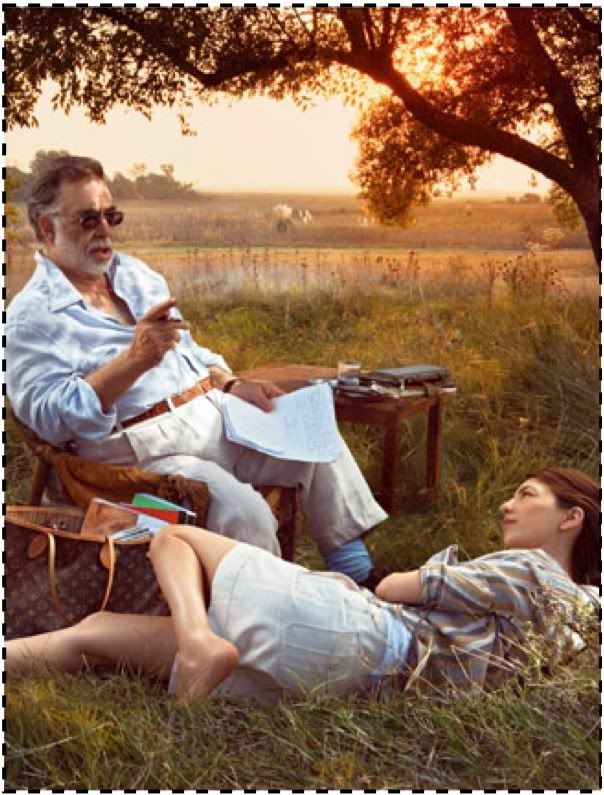
Michael Ashburner or Francis Ford Coppola in the New York Times?


Imagine my surprise when I opened the New York Times a few days ago and saw a giant picture of Michael Ashburner the Drosophila genomics guru, open science advocate, and Won for All author. Now, Ashburner is one of my favorite people in all of science (see my posting from a while ago recruiting him top start a blog to which he even responded). I mean, sure, people I know are in the Times everyonce in a while but this was astonishing. Here he was in some sort of fashions of the Times type of section, shirt unbuttoned, lounging in some field.

Alas, closer examination and some google searching found the truth. This is alas not Ashburner, but actually Francis Ford Coppola and his daughter Sofia. But I mean - look at the pics of Ashburner below. It really could have been him. Oh well, maybe next time ...


Friday, June 05, 2009

Archaea get no respect from the New York Times

There was kind of funny and certainly interesting article in the New York Times on June 4: Greening the Herds - Trying to Limit Cows' 'Emissions'

The article by Leslie Kaufman discussed how there are attempts in some dairy farms in the US to change the diet of cows to reduce their methane output. The methane is a strong greenhouse gas and in total cows make a surprisingly large global contribution to greenhouse gases. The article states:
Cows have digestive bacteria in their stomachs that cause them to belch methane, the second-most-significant heat-trapping emission associated with global warming after carbon dioxide.
Alas, this is not correct. Yes, bacteria in the cow rumen contribute to the production of methane. But they do not make the methane. The methane is made by archaea (for those not in the know, archaea are a distinct group of organisms relative to bacteria - they resemble bacteria in many ways but are a separate branch on the tree of life). For those of us who study archaea this is a major slight. A diss. A taunt. A sad day. And all those other things. Not sure how we archaea fans will have our revenge but I swear we will. Too bad Carl Zimmer does not think that this is important enough to go on one of his newspaper fact chekcing investigations.

Thursday, June 04, 2009

David Byrne on Bicycling and Davis in the New York Times

For those of you who are obsessed with bicycling (like me), and live in bicycling heaven Davis, CA, and occasionally look at the New York Times, you may have noticed this already. But for others who have not I want to call your attention to a book review in the New York Times this past Sunday by David Byrne Book Review - 'Pedaling Revolution - How Cyclists Are Changing American Cities,' by Jeff Mapes - Review - NYTimes.com.

Amazingly this is indeed the same David Byrne of them Talking Heads. It turns out he has a book coming out in the fall called "Bicycle Diaries." Anyway he reviews this book on the effect of bicyclists on American Cities and right there in the review are some props for my town, Davis, CA. The article is worth checking out and I will both be buying this book and awaiting Byrne's. Maybe we can have a reading here in Davis when the Bicycling Hall of Fame opens its doors.

Saturday, May 30, 2009

Children's Science Books from NY Times 5/10/09

Better late than never I guess.  I missed the NY Times Children's Books section in teh 5/10 Book Review but my mother brought it with her and left it so I am posting a tiny bit about it.

They review/suggest a few books for kids and many of them have a theme related to this blog including:

Wednesday, May 27, 2009

Art-Science Fusion and Darwin's Face at Davis

ART/SCIENCE FUSION STUDENTS EXHIBIT PHOTOGRAPHY AND A CERAMIC MOSAIC MURAL, THE FACE OF DARWIN

The final student exhibition for "Photography: Bridging Art and Science," a Science and Society Program class taught by Terry Nathan as a part of the Art/Science Fusion series at the University of California, Davis (UC Davis), will be held at the Buehler Alumni and Visitors Center on the University of California, Davis campus beginning June 3 and continuing through July 3. The exhibit features over 50 student photographs exploring the conceptual connections between art and science and the role of art and science on the UC Davis campus. The opening reception, which is free and open to the public, is June 4 from 3-5 p.m.

Also included in the exhibition is a ceramic mosaic mural, The Face of Darwin, created by students and community members in a special Freshman Seminar entitled, “The Face of Darwin: Exploring the Art/Science Borderland”. In recognition of Darwin’s 200th birthday, students from majors across campus studied Darwin’s life and the observations that led him to propose evolution by natural selection.  Darwin’s face is formed by selections from his secret notebooks and the images of those organisms that influenced him most.  With a beard of peppered moths, hair of barnacles and a coat of iguanas, finches, orchids and a host of other creatures, this mosaic is a profound learning experience in and of itself. The seminar was led by Diane Ullman and Donna Billick (co-directors of the Art/Science Fusion Program). 


(this came in an email to me and am posting here)

Junk mail and trash associated with science

Just got back from the ASM Meeting that was in Philly last week.  It was good and bad - and will write more about it soon.

But what I am writing about now relates to an annoying part of the meeting.  It seems ASM has sold my name/address to various entities since I have been receiving a significant amount of junk/trash advertising things associated with microbiology.  I am sure ASM gets some $$$ out of this, but at what cost to the world?  The last thing I want is more trash and there seems to be no way to say no to this.  

And on top of it, many science related publications also seem really keen on wrapping themselves in plastic.


In this case I am showing Nature Methods and the ASM Microbe and even the HHMI magazine  wrapped in plastic. Bad Nature. Bad ASM. Bad HHMI.  Sure there may be reasons for this (e.g., maybe they have an insert), but there must be non plasticy solutions.  And fortunately the news from the JDRF has no plastic. Good JDRF.  Here's to sciency publications getting a little greener.


Saturday, May 23, 2009

Good science education resource: HHMI Cool Science

Just a quick one here. Was reading the HHMI Bulletin and saw a note about this web site they have set up on science education (see Cool Science: Home). It has all sorts of goodies for educators, kids, and others. Some of my favorite things there in looking so far include material from the Genome Consortium for Active Learning (GCAT) and the Biointeractive page. YAGTFH (Yet another good thing from HHMI).

Saturday, May 16, 2009

Do not fall for SPAM pretending to be from Elsevier

Just got the email below (with some key parts blotted out). It is clearly (to me) fake (although it is kind of funny in a way given the recent news about Elsevier publishing fake journals). But just in case someone else out there got the same SPAM and did not figure out it was fake, I am posting this message here.

ELSEVIER:
BUILDING INSIGHTS; BREAKING BOUNDARIES
MANUSCRIPTS SUBMISSION

Dear Colleague,

On behalf of all the Editors-in-chief of Elsevier Journals, we wish to Communicate to you that we are currently accepting manuscripts in all Fields of human Endeavour.
All articles published will be peer-reviewed. The following types of papers are considered for publication:

• Original articles in basic and applied research.
•Critical reviews, surveys, opinions, commentaries and essays.

Authors are invited to submit manuscripts reporting recent developments in their fields. Papers submitted will be sorted out and published in any of our numerous journals that best Fits. This is a special publication procedure which published works will be discussed at seminars (organized by Elsevier) at strategic Cities all over the world. Please maximize this opportunity to showcase your research work to the world.

The submitted papers must be written in English and describe original research not published nor currently under review by other journals. Parallel submissions will not be accepted.

Our goal is to inform authors about their paper(s) within one week of receipt. All submitted papers, if relevant to the theme and objectives of the journal, will go through an external peer-review process.

Prospective authors should send their manuscript(s) in Microsoft Word or PDF format to XXXXX and should Include a cover sheet containing corresponding Author(s) name, Paper Title, affiliation, phone, fax number, email address etc.

Kind Regards,

XXXXXXXXX

PS: Pls. show interest by mailing XXXXXX if your Manuscript is not ready but will be ready soon.

Thursday, May 14, 2009

Fun at Novozymes in Davis

Normally, I hate marketing slogans.  But I must say I was pretty happy with the way Novozymes portrayed its "Rethink Tomorrow" branding.  Yesterday, I went over to Novozymes in Davis for the opening of a new building (Novozymes has an R&D branch in Davis).  It was a short and nice ceremony that included presentations by honchos from their HQ, some local Novozymes employees, as well as folks from the community including the Mayor Pro Tem of Davis Don Saylor and the head of the UC Davis Genome Center where I work, Richard Michelmore (who also happens to be the Novozymes Chair of Genomics).

What I liked about the marketing/branding discussion was how Novozymes is focused on making enzymes that can reduce the environmental impact of various industrial, agricultural, and personal processes like the making of biofuels.  Sure, everyone is going green these days or attempting to in some way.  But their argument that custom designed enzymes can reduce waste, allow for lower environmental impacts, etc, made sense to me.  In addition, they made significant efforts to make their building a low impact building.  Sure, nobody is perfect, but Novozymes seems to be making significant efforts towards the greater good even when they do not have to.  

Of course, perhaps I am a little biased since I live off Novolog from NovoNordisk, a "sister" company of Novozymes (see picture at the end of my slide show on my Novolog pen ...).  


See also

Got phylogeny?


For an obsessed evolutionary biologist, it is always good to see "Need phylogeny" on the blackboard while sitting through a faculty meeting.

Wednesday, May 13, 2009

Very strange "permission" form to use my name in a story

I just got a request from a fact checker for a publication who wanted to reference my April 1 joke on Brain Doping in a story (I was not interviewed for the story).  And they wanted me to sign over some rights associated with them using my name.  The text of the form is below.  I have been quoted and written about and even had my picture in places like the Scientific American, the New Yorker, US News and World Report, USA Today, PLoS Biology, Nature, Science, blogs, etc and not once has anyone sent me such a form.  Anyone seen anything like this?  

For good and valuable consideration, the receipt of which is hereby 

acknowledged, I, ___________________________ (“Subject”), hereby irrevocably grant 

to XXXXXXXXXXXX, and YYYYYYYYYYYYYY , the absolute right 

and permission to publish my name and/or photograph or likeness and/or statements 

(either in part or in their entirety) in: (a) the publication, ZZZZZZZZZZZZZZ, that ,

 (including all print and digital versions), (b) reprints of the article, including excerpts thereof, 

in which Subject’s name and/or photograph or likeness 

and/or statements originally appeared (including all print or digital versions) and (c) 

promotional materials relating to ZZZZ, YYYY, XXXXX, in any and all media. 


In the event this Consent & Release cannot by signed by the Subject, the undersigned represents that 

he/she is fully authorized by Subject to grant the rights herein.  


Subject agrees that electronic signatures shall have the same force and effect as original signatures. 


________________________________________________ 

Print Name 

________________________________________________ 

Signature 

________________________________________________ 

Address 

________________________________________________ 

City/State/Zip Code 

________________________________________________ 

Telephone 

________________________________________________ 

Email 

________________________________________________ 

Date 


he/she is fully authorized by Subject to grant the rights herein.  


Tuesday, May 12, 2009

Is it a faux pas to wear the same T-shirt as another professor when you like the shirt?

No plans to wear the same shirt as Marc Facciotti who is another faculty in the UC Davis Genome Center (who by the way does brilliant stuff on gene regulatory networks in yeast and halophilic archaea). But there we were in our Hamsters Love PLoS shirts. And rather than run away in shame, I begged Lizzy Wilbanks, a grad. student, to take this picture (and note the picture of Harold Varmus, Pat Brown and my brother Michael Eisen from the Genome Technology cover in the background ...)

Sunday, May 10, 2009

New Web Resource on Evolution ... EvolverZone

Looks like T. Ryan Gregory, who writes the GenoMicron blog has evolved ... he has released a new web resource on evolution - Evolver Zone. Clearly still a work in progress, it has some good collections of links to videos, journals, books and other materials about evolution. Worth checking out.

Saturday, May 09, 2009

Must reading for those interested in Open Science - Michael Nielsen on "Doing Science in the Open"

Not much for me to add here other than to tell everyone interested in Open Science that you should look at Michael Nielsen's article: Doing science in the open - physicsworld.com. It covers a wide range of topics from secrecy to journals to the internet to online commenting to wikipedia to collaboration to FriendFeed. It has lots of interesting points in there. Hat tip toDavie Bacon / The Quantum Pontiff.

Open Access Pioneer Award: Bob Shafer HIV DB

Bob Shafer, an Associate Professor at Stanford, is fighting to make information about HIV freely available. He runs a database called HIVDB that aims to make information about HIV drug resistance available to the broader community. And he has been doing this for years (note - I worked with Bob when I was a PhD student and he was getting HIVDB started - we even wrote a paper together where I helped him do some phylogenetic analysis of HIV). For that alone, Bob deserves an Open Access Pioneer award. But I am giving him one here for a fight he has taken on recently.

You see, a company called Advanced Biological Laboratories, S.A has been suing Shafer and Stanford over a patent dispute. The company seems to be trying to claim to have rights over many (or maybe they think all) uses of using computers to help doctors make medical decisions. And they have been trying to get people to license their IP/software for doing this and one way they appear to be trying to get "users" is by suing them. And Bob is one of the people they have sued.

Sadly, Stanford University appears to have given in to the lawsuits even though their validity is debatable (see The Fight of His Life which provides some of the details - Hat Tip to Bill Hooker and FriendFeed for highlighting this article) and Bob has been left hanging on his own. Instead of caving to the lawsuit and shutting down HIVDB or making it less openly available or requiring people to say they will give commercial rights to Advanced Biological Laboratories for anything they develop using the DB. And rather than cave to the lawsuits Bob is fighting back - with a website called harmfulpatents.org and with a set of letters and communications. Mind you, I know little about IP/patent laws or the legal issues behind this dispute. But if this lawsuit leads to the shutting down or restriction of HIVDB that would be proof enough to me that Advanced Biological Laboratories and the legal system that supports them is doing a disservice to the progress of science.

For his efforts in keeping HIVDB open I am giving Bob Shafer a Open Access Pioneer Award.

For more on this story see

Friday, May 08, 2009

Elsevier, fake medical journals, and yet another reason for #openaccess

For those of you not in the loop on this there is a bubbling story going around the web and in some news sources about Elsevier publishing fake science/medical journals for hire. First reported by The Scientist (as far as I can tell), the story just seems to get worse and worse. Basically, it seems one branch of Elsevier published a series of journals that were little more than advertisements for Merck products while pretending to be independent journals.

The whole thing is pretty sad. The head of Elsevier as well as multiple people that have worked at Elsevier seem to have not been aware of that these were being used to pretend they were real journals. But I think one this is abundantly clear - we can cross of the list of criticisms of Open Access publishing that the costly non open access journals and publishers are protecting the world from bad science. Instead, it seems like they are in fact explicitly and purposefully pushing bad science and medicine in order to make extra money. Lovely.

For more informaiton on the story see for example, Kate McDonald in the Australian Life Scientist (see Elsevier published fake medical journals - Elsevier Australia, Merck, Vioxx - Australian Life Scientist). In this article she reports:
The CEO of Elsevier’s Health Sciences division in the US, Michael Hansen, has now issued a statement admitting the company’s Australian office published six journals paid for by pharmaceutical companies.
Also see for example Forbes (via AP). The best source on this has been the Bloggosphere where there were a large number of discussions including
My favorite source so far has been Bill Hooker at Open Reading Frame who did some really useful digging into the details of what was being published. After his posting there has been an interesting discussion on FriendFeed (see embed below)


There also has been some other discussion on FriendFeed including the following from a Graham Steel posting:

Thursday, May 07, 2009

Tour of California moving to May for 2010

The Tour of California has announced it will be held May 16-23 next year (see e.g., Velonews -  Amgen Tour of California May 16-23 ).  Good and bad news in this.  The good news is the weather will likely be a lot better than the February time slot.  Bad news is this competes with the Giro and it is unclear what riders/teams will come. 

Wednesday, May 06, 2009

Research council of UK gives additional thumbs up for open access publishing

The RCUK (Research Councils of the UK) has published a new report on open access (see RCUK publishes report on open access study):

The purpose of the study was to identify the effects and impacts of open access on publishing models and institutional repositories in light of national and international trends. This included the impact of open access on the quality and efficiency of scholarly outputs, specifically journal articles. The report presents options for the Research Councils to consider, such as maintaining the current variation in Research Councils’ mandates, or moving towards increased open access, eventually leading to Gold Standard.

...

In response to the study, the Chief Executives of the Research Councils have agreed that over time the UK Research Councils will support increased open access, by:

  • building on their mandates on grant-holders to deposit research papers in suitable repositories within an agreed time period, and;
  • extending their support for publishing in open access journals, including through the pay-to-publish model.
Hat tip to Karla Heidelberg for pointing this out.

Public Lecture on Population Genomics at Davis Today

Once each year the Davis Division of the Academic Senate selects a Faculty Research Lecturer, who gives a public lecture under the auspices of the Chancellor and the Chair of the Davis Division. The lecturer is singled out for the distinction of their scholarly research, chiefly for efforts carried out while a member of the Davis faculty.

The Faculty Research Lectureship is the highest honor the Davis Division of the Academic Senate accords its members.

Please join us this evening as the campus honors our distinguished colleague

Charles “Chuck” Langley

Distinguished Professor

&

2009 Faculty Research Lecturer

Wednesday May 6, 2009

4:00 – 5:00 p.m.

A reception sponsored by Ken Burtis, Dean of the College of Biological Sciences, and

Maureen Stanton, Chair of the Department of Evolution and Ecology will follow the lecture.

Activities & Recreation Center (ARC) Ballroom

BioSci_Sig_Horizontal_emailsig (2)

Events Coordinator Office of the Dean

202 Life Science Davis, CA 95616

phone 530.752.2358 fax 530.752.2604

Public Lecture at Davis Today - Chuck Langley on "Population Genomics"

Once each year the Davis Division of the Academic Senate selects a Faculty Research Lecturer, who gives a public lecture under the auspices of the Chancellor and the Chair of the Davis Division. The lecturer is singled out for the distinction of their scholarly research, chiefly for efforts carried out while a member of the Davis faculty.


The Faculty Research Lectureship is the highest honor the Davis Division of the Academic Senate accords its members.


Please join us this evening as the campus honors our distinguished colleague

Charles “Chuck” Langley

Distinguished Professor

&

2009 Faculty Research Lecturer


Wednesday May 6, 2009

4:00 – 5:00 p.m.


A reception sponsored by Ken Burtis, Dean of the College of Biological Sciences, and

Maureen Stanton, Chair of the Department of Evolution and Ecology will follow the lecture.


Activities & Recreation Center (ARC) Ballroom


BioSci_Sig_Horizontal_emailsig (2)

Events Coordinator   Office of the Dean

202 Life Science   Davis, CA 95616

phone 530.752.2358   fax 530.752.2604

Tuesday, May 05, 2009

Morgan Price - Pushing the Frontiers of Genomics

Well, this is one of those times when I feel completely blown away by some else's brilliance.  And, since I am a bit on the cocky side, this does not happen all that often. But last week it did.  We had a guest come and give a presentation for my lab meeting. His name is Morgan Price and he works in Adam Arkin's lab at Lawrence Berkeley Lab. He is truly pushing the bubble in terms of designing useful software for carrying out comparative and evolutionary genome analyses.  Among his software/tools are FastTree and FastHMM & FastBLAST and MicrobesOnline.org
all of which are of great value in the era of ever expanding genome data accumulation. FastTree is particularly nice, allowing one to build evolutionary trees for data sets including hundreds of thousands of sequences.  And on top of all of this he appears to be big on Open Access Publishing. Anyway - just a little posting here to get people to check out some of his cool computational toys.

Seeking information on undergraduate programs/majors in genomics and/or genome biology?

I am looking around to find examples of undergraduate programs/majors in genomics or genome biology.  I got a couple of potential examples from a post I made on friendfeed but am looking for more.  What I am looking for is not just courses in genomics but majors/programs in genomics ... do they exist and if so, where and what do they look like.  Any information would be helpful.  Here is what I have found so far:

Francis Collins Launches Biologos - a strange re-working of theistic evolution

Biologos.  All I can say is, well, I am just really baffled by the whole thing. I am all for trying to have discussions about science and religion. But I do not think the two topics are really compatible in the sense of merging them together. Science (and medicine) should be about, well, science. And religion can be about whatever it wants to be. And when we can get religious and scientific leaders together to talk about the implications of each area on the other and on the world, fine too.  But merging the two together into one hybrid such as Christian Science and Creation Science?  Not for me.

Thus it is with some horror that I have been browsing the web site for Francis Collins' new The BioLogos Mission | The BioLogos Foundation (f0r some other discussions of it see e.g., Larry Moran's discussion here, and PZ Myers here and Time Magazine here and US News here). BioLogos appears to be Collins attempt to promote a slight variant of "theistic evolution" which he has been discussing for years and is also in his recent book.

And whatever you may think of theistic evolution, the Biologos version of it is just icky in many ways in my mind. For example, the site has many many links and pointers to books authored by the members of the Foundation (e.g., the front page says "Among other resources, this website posts responses to many of the questions received by Collins, Giberson, and Falk since the publication of their books, including: The Language of God; Saving Darwin; and Coming to Peace With Science.") There are also other links to this page with ads for their books. Not that there is anything wrong with selling ones books, but to have a foundation whose purpose seems in a large part to promote one's books really seems distasteful. 

And the details of Collins attempt to merge science and religion into a version of theistic evolution are really unclean.  Basically, he is trying to argue that on the one hand science and religion are completely separate activities (I support this) but at the same time argues that God can intervene in the setting up of natural laws and in providing some guidance here and there in order to, for example, produce human beings in his image.  

The web site repeats some things from Collins book that are equally illogical - such as saying that altruism can be explained by science (and even specifically saying that science is the way to explain the natural world) but then turning around and saying that science cannot explain extreme forms of altruism (and therefore implying that actually, the natural world cannot be explained by science).  Which is it?  Is science for the natural world or not?

What one wants to believe in terms of faith/religion is a highly personal issue.  But trying to both say that science and religion are completely separate but also that they are not is just completely illogical.  

UPDATE: See also:

Monday, May 04, 2009

Worst new omics word award: ethomics

Well, look at what I just saw on twitter:

tlemberger omics mania: 'ethomics' http://is.gd/wOcg - should be added to http://omics.org/ but perhaps also nominated for this http://is.gd/g2Bc

That is from Thomas Lemberger and so I followed the last link first, since I thought I might be to, well me. And indeed it was a link to my "Worst new omics word award" for museumomics.

And so then I went to the link on ethomics: High-throughput ethomics in large groups of : Drosophila : Abstract : Nature Methods.
And indeed they use "ethomics" - what is clearly a quite new omics word (only 62 google hits as of this PM). I confess, I stopped reading at the abstract because it was just too much:


We present a camera-based method for automatically quantifying the individual and social behaviors of fruit flies, Drosophila melanogaster, interacting in a planar arena. Our system includes machine-vision algorithms that accurately track many individuals without swapping identities and classification algorithms that detect behaviors. The data may be represented as an ethogram that plots the time course of behaviors exhibited by each fly or as a vector that concisely captures the statistical properties of all behaviors displayed in a given period. We found that behavioral differences between individuals were consistent over time and were sufficient to accurately predict gender and genotype. In addition, we found that the relative positions of flies during social interactions vary according to gender, genotype and social environment. We expect that our software, which permits high-throughput screening, will complement existing molecular methods available in Drosophila, facilitating new investigations into the genetic and cellular basis of behavior.

For trying to extend omics to ethogram and beahvioral plots I am giving my second coveted "worst new omics word award" to Kristin Branson, Alice A Robie, John Bender, Pietro Perona & Michael H Dickinson. Here is a prediction - ethomics will not become widely used - not soon - not ever. Thanks for pointing this one out Thomas.

Worst new omics award: ethomics

Oops - posted this to the wrong blogspot blog.  Please go to my Tree of Life blog to see this post here.  

Oops. Seems like Davis, CA does not have the swine flu, yet.

See :
Probable swine flu cases in Yolo County found to be human flu - Daily Democrat Online
and News 10 and KCRA

Sunday, May 03, 2009

Should evolutionary biologists "debate" creationists/ID advocates?

Last week I received an email also sent to a group of other local evolutionary biologists asking if one of us would be willing to participate in a "debate" with a creationist who was coming in to town to give some sort of talk.  The email said, among other things:
... we have a creationist (who holds to the 6-literal day creation and young earth 6,000 year position), (name deleted), coming on our campus challenging someone to debate him. 
And, well, I ignored the email as did the others apparently.  Then we all got a second email a few days later:

Dear Professors, 

The Creationist side is offering $300 for accepting the challenge! And another $250,000 to anyone presenting any empirical evidence for macro evolution! 

Why has this offer been out there for years? Where are the experts??? Where is the evidence?? How is  this possible?

If you are convinced that Darwin was right, if you accept it, if you teach it to students, as a career, then WHY DO YOU REFUSE TO DEBATE?!

You betray the students that look up to you!! Come on, Creationist don’t bite!

Sorry for this sarcastic tone, but it doesn't make sense. If you teach it in class you must be the first ones defending it.

We have a philosophy graduate wanting to debate, no science professors yet, especially Biology and Anthropology.

Please respond to this email asap!

Clearly, they people organizing this were trying to get someone to do the debate.  But this strategy just convinced me that debating creationists was an absurdly silly thing.  So I wrote back:

The issue is pretty simple to me.  There is nothing really to debate.  Creationism is not science.  It is a religion driven position that pretends (and does so poorly) to be about science.  I for one have perfectly pleasant interactions with many creationists and I understand their beliefs at least at some level.  But just as I would not encourage physicists to debate with those who deny gravity, and just as I would not encourage chemists to debate with those who claim the periodic table is invented, I think it is inappropriate to evolutionary biologists to "debate" with creationists in this type of setting.  Discussing creationism - fine.  Discussing criticism of evolutionary hypotheses - fine.  Having a reasonable panel discussion of science and religion - fine.  Meeting with creationists to discuss their ideas about evolution - ok too.  But engaging in a "debate" and thus even for a second implying that creationism stands on the same ground as evolution - completely ludicrous.  

Sincerely

Jonathan Eisen
Alas, the people doing the inviting were not particularly impressed with my answer:

You Sir, are a COWARD.
If it is so easy in your mind to refute Creationist's arguments, why don't you do it publically? FOR MONEY?! 
Your words do nothing to change the standing offer of $250,000 for evidence of Macro-Evolution. How about Actions, not Words only?

By denying there is a challenge, and at the same time refusing to accept the challenge you tell us that you're unable to defend your position.
We know why you are fine with a panel discussion: because there is no Looser or Winner, you are afraid to loose, that is the real reason behind your rhetoric.

your answer is a nonanswer

Try again.
I guess they did not get my point.  But anyway - I am asking readers out there - what do you think one should do?  Should one debate creationists/ID supporters?  

Saturday, May 02, 2009

More on Swine Flu in Davis from the Davis Enterprise.

There is a mini update on the swine flu incidence(s) in Davis at the Davis Enterprise.

Basically it appears the city of Davis is backing off some of the extreme quarantine type measures that were reported yesterday.

GIS mapping of bike accidents in Davis

A PhD student in my lab has generated a nice GIS mapping of auto and bike accidents in Davis, CA.  Worth browsing ...

Friday, May 01, 2009

Swine Flu Hits Davis?

Seems like Swine Flu (aka H1N1) has hit Davis.  See here

Swine Flu Hits Davis?

Seems like Swine Flu (aka H1N1) has hit Davis.  See here

Open Access Pioneer Award: Rick Prelinger, Image Access

Just saw an interesting article in the UC Davis "Dateline" newsletter about Rick Prelinger who is the founder of the Prelinger Library in San Francisco (and see their blog here). He gave a talk at Davis and thus they wrote an article about him here.

Some good lines from the article include
Rick Prelinger’s biggest thrill is “mainstreaming" historical documents for public consumption.

But getting history into the hands of the average citizen is no easy task, the archivist says.

Overbearing copyright issues and rampant commercialism, he argues, threaten the free exchange of information on which a knowledge society — especially its libraries — depends.

...

Rather than concern themselves with rigid lending policies or copyright protections, library systems should focus on “more product, less process” to better serve patrons, Prelinger said.

...

“If the Google book deal is approved without any changes, we could soon lose 100 million books that society doesn’t know what to do with,” said Prelinger, referring to “orphan works,” or works under copyright, but whose owner is not known.

....
On the other hand, archives are empowering, Prelinger said. “Let’s open up the past. Interesting things happen when we do so.”

In general since Prelinger has been pushing for more openness in libraries and in images, I am giving him an "Open Access Pioneer Award".  Sorry I missed the talk but glad I read the article.  

Thursday, April 30, 2009

Open Flu: Up to date Open analysis of Human/Swine A/H1N1 Influenza

Just got a pointer to a fantastic site with detailed up to date analyses of flu (e.g., swine flu) data. The site is http://tree.bio.ed.ac.uk/groups/influenza/. The site says
These pages are to allow the rapid dissemination of results and analysis of genetic data from the ongoing Influenza A/H1N1 outbreak attributed to swine flu.
And there is some great stuff there posted by among others, Andrew Rambaut, Oliver Pybus, Nicholas Grassly, Mike Worobey and Gavin Smith. Definitely worth checking out. Hat tip to Eddy Holmes for pointing this out.

Wednesday, April 29, 2009

Marketplace piece on open access

Marketplace on NPR had a mini story on Open Access publishing. See Marketplace: Publicly funded research for a price. Hat tip to Aaron Gussman and Keith Bradnam for pointing this out. I did not listen to the piece but the text is online here. Here are some bits (does not seem to be a particularly well researched piece but it is still something)
KAI RYSSDAL: A lot of the scientific research that goes on in this country is really expensive. And, as it happens, a lot of it is publicly funded. But when taxpayers want to read a particular study that has been paid for with their money, they have to pay again to read about it in, say, The New England Journal of Medicine.
...

JANET BABIN: People who grew up with the Internet expect information to be free. That's what 21-year-old Josh Sommer thought. In 2006 he was a typical college freshman. Studying environmental engineering, hanging out, making new friends. Suddenly, he started to get severe headaches. He had a series of routine tests.

JOSH SOMMER: End up having an MRI and being told that I have a mass right in the very center of my head, entwined with critical arteries, in one of the most difficult locations to operate on. The cancer Josh has is called Chordoma. It's a rare disease with a low survival rate. Even doctors don't know much about it. So Josh threw himself into Chordoma research. He Googled the disease to find out all he could about it, but kept hitting roadblocks.

SOMMER: I'd find an abstract, and I'd click on it. And oh, you have to pay $60 to read this article. Oh, you have to pay $40 to read this article. I mean, I have this disease, I want to know about it. Journal subscriptions -- like the Journal of the American Medical Association -- can cost thousands of dollars each year. With universities and libraries trimming budgets, they can't afford all of them either. What Josh needed was free access to the research online. Last year, the National Institutes of Health unlocked the gates on a lot of research. Through its Web portal called PubMed Central, you can now search research papers for any disease scientists are studying with public funds. It's an estimated 80,000 articles a year. Duke University law professor James Boyle says open access is only fair.

JAMES BOYLE: Why would you possibly say that when the taxpayers funded something, then the public can't get to read it afterwards without paying again?
...
Then they quote Martin Frank from the American Physiological Society. saying something defending restricted access. They also quote rebuttal from Professor Boyle, at Duke:
BOYLE: The Web works great for porn or for shoes, or for flirting on social networks. But it doesn't work really well for science. We haven't done for science what we did on the rest of the Web, which is basically to have this open Web with everything linked together.

Monday, April 27, 2009

Assembling the Marine Metagenome, One Cell at a Time

As I have already divulged on twitter and friendfeed, a paper on which I am an author just came out in PLoS One. The paper is Assembling the Marine Metagenome, One Cell at a Time

It represents a collaboration between a bunch of different institutes including the Joint Genome Institute, UC Davis, and the Bigelow Lab in Maine. The main thing in the paper is the use of whole genome amplification to aid in the sequencing of the genome from a single cell.

The first author on the paper Tonja Woyke at the Joint Genome Institute has been adopting and developing methods for this type of single cell work (extending for example the MDA "multiple displacement amplification" protocol. Woyke is one of those rare types who can do both complex lab work and genome analysis and a variety of other things and is also great to be around.

The other main player in the project was Ramunas Stepanauskas from the Bigelow Lab in Maine who is the "biologists" with an interest in the specific samples which were being worked on. These samples were flavobacteria (a type of bacteria) that live in surface ocean waters but have never been grown in isolation in the laboratory. And in such cases, single cell genomics is very useful and powerful. In the paper we show that having this genome is quite useful for interpreting metagenomic data (not surprising, but good to show).

Anyway - check out the paper if you are interested in microbial ecology and/or metagenomics. Or look at the press release here.


Figure 2. Biogeography of microorganisms closely related to MS024-2A and MS024-3C.
A. Geographic distribution of the Global Ocean Sampling (GOS) metagenome fragments with >95% identity to MS024-2A and MS024-3C DNA. Numerals on the map indicate GOS station numbers. B. Sea surface temperature in December 2003, which demonstrates hydrological separation of GOS aquatic samples collected north and south of Cape Hatteras (near GOS station 13). Provided is a composite Aqua-MODIS image for December 2003 (http://oceancolor.gsfc.nasa.gov). The GOS stations were numbered in the order of their sampling, and stations 12, 13 and 14 were sampled on December 18, 19 and 20, 2003.
doi:10.1371/journal.pone.0005299.g002

Saturday, April 25, 2009

Open Access Flu - Updated

In regard to the swine flu infections going on, here are some Open Access PLoS papers articles about flu.  In total they provide some useful background reading on flu that anyone can get access to.  I have updated the list after prodding from @bpb on Twitter ...
More from PLoS Pathogens (click here for a link to a title search for "influenza")
More from PLoS Medicine
More from PLoS Computational Biology
More from PLoS One (see even more here)

Wednesday, April 22, 2009

A blog posting of my email signature to reduce clutter.

-----------------------------------------------------------
Jonathan A. Eisen, Ph.D
With appointments in:      UC Davis Genome Center
Academic Editor in Chief, PLoS Biology

Mailing address:
UC Davis Genome Center
451 East Health Sciences Drive
Davis, CA 95616-8816

Blog: 
http://phylogenomics.blogspot.com/
Twitter: 
http://twitter.com/phylogenomics/
FriendFeed: 
http://friendfeed.com/treeoflife/
LinkedIn: 
http://www.linkedin.com/in/jonathaneisen
--------------------------------------------------------------
Support open access to scientific literature:
http://www.publiclibraryofscience.org


--------------------------------------------------------------
In order to reduce the length of my signature in my email, I am posting my signature here and then am tinyurling the link in order to make it as short as possible and not clutter up my email (so now my signature reads http://tinyurl.com/jonathaneisen). I do not know if anyone else does this or if there is a better way to do it I would love to know. I have deleted the phone # and email address portions of this but it does have most else.

Most recent post

A ton to be thankful for -- here is one part of that - all the acknowledgement sections from my scholarly papers

So - it is another Thanksgiving Day and in addition to thinking about family, and football, and Alice's Restaurant, I also think a lot a...