Some notes on talks here:
My favorite talk yesterday morning was David Cox from Perlegen. He had as usual some good one liners including "Everybody and their mother is doing this so doing this is not so novel. What is novel about it is that it worked." I should add that David Cox helped shape my career indirectly in many many ways. When I was a PhD student at Stanford, I got into genomics in part by teaching a course with David Botstein, Rick Myers and David Cox. When Craig Venter offered me a job at TIGR in 1998, I was not sure if moving to a non university was a good idea or not. So I asked many people for their opinions. Some said "You must do an academic post doc or you will never get a faculty job" I pretty much knew to ignore those folks. Cox gave the best advice. He said as long as I published things while at TIGR, it would not hurt me in any way. It probably would help. And so I took the job. And no doubt that was a great career move.
Other talks that were good were one by Joe Ecker, who discussed methylation in Arabidopsis and one by Andy Clark.
I skipped out on some of the lunch time to finish my talk for the PM session and also worked on my talk in the back of the room during the other PM talks. The PM session was on metagenomics and the most pleasing thing was that David Relman did not show up and he was replaced by Peter Turnbaugh from Jeffrey Gordon's lab. Now - I wam not saying it was good that Relman was not there --- he usually gives smashingly good talks. But Turnbaugh, a PhD student, stepped in as pinch hitter and gave a great talk on gut microbiome studies, really setting the stage for the whole session. I do not know if he was nervous stepping into a session like this but it did not show if he was. He certainly seemed relaxed when he said "Thanks to Dr. Relman for getting stuck in Chicago"
Forest Rowher gave a good talk on metagenomics and pointing out that viruses still get ignored in this field relative to their likely importance in communities. I have written about Forest before so I am going to discuss the other talks more ... but if you have not heard him talk before try to find a way. He has a VERY different perspective on genomics and metagenomics than most of the people doing it. And he is dead right about the need to do more work on viruses.
Garth Ehrlich gave a talk on "bacterial plurality" and why he thinks gene content variation within communities of microbes in biofilms is important. His data certainly seemed solid and he showed some results that call into question the claims that some aspects of the "pangenome" hypothesis (he showed that the total number of genes in the Steptococcus strain collection does seem to level off after sequencing ~ 30 genomes and thus that the number of genes is not infinite as some people have suggested). So I liked some aspects of his talk. But he did make some evolution statements I found disagreeable (for those who care about the nitty gritty - he showed a cluster diagram of strain similarity and then used the position of strains within the cluster diagram to reflect relative branching order and historical patterns. A cluster diagram is a bad thing to use and one should use a phylogenetic tree for this. In addition he implied that one could make a genome-phylogeny from gene presence/absence information that would be more robust than a standard alignment phylogeny. This is not a reasonable thing
in my opinion --- gene presence/absence patterns tend to end up grouping together unrelated lineages that have separately undergone gene loss. I just do not understand why people so badly want to not use alignments to build trees). Anyway - overall many of the things he said were interesting but I find certain non-evolution evolutionary analyses really grating.
Anyway - I was going to ask him a question after his talk about this, but then decided that, since I was talking next, getting into an argument with him just before my talk might seem lame. So I passed on the question. And then I gave my talk on the need to fill in the tree of life in terms of genome sequencing projects. I discussed a project we are just wrapping up that was part of the NSF "Tree of Life" program in which we sequenced genomes of eight bacteria that are from phyla that at the time had no genomes available. And then I talked about a new project I am coordinating at the Joint Genome Institute in which we are sequencing 100 genomes to really fill in some of the bacterial and archaeal tree. Next week I will post more about this project but I note - this is not done to study the tree of life per se. It is being done because if we have reference genomes from across the tree, all of our genome analyses of other systems and of metagenomes get better.
After dinner and some shell cllecting on the beach, there were evening talks and I went to the informatics session. Some of the talks there were good but the best thign I saw there was someone (I think Ben Blackburne) saying his slides were going to be on something called slideshare.net. I had never heard of this and checked it out and it seems pretty cool. I may use it in the future ... but gotta go off to other things.
Friday, February 08, 2008

Marco Island Evening One - The Strange and the Good
Well, I made it through my talk at Marco Island without too many scars. It seemed to go pretty well - I talked about a new project in which I am involved at the Joint Genome Institute on creating a Genomic Encyclopedia for Bacteria and Archaea. I will write about that more here at another time.
But what I want to do now is discuss some of the marketing ploys from last night. One of the strangest was from the Pacific Biosciences group which sponsored a beach party with fireworks. It was completely surreal. People lingering at the beach with drinks and loud music and then all of a sudden - fireworks were launched into the sky. Not the "greenest" of activities I must say. But never mind that. What was the reason for fireworks in the middle of February? I guess the company is trying to make a big splash but the whole thing was just strange to me.
Much better was the party sponsored by Genome Technology magazine. It was a few hundred yards down the road at a bar. Everyone had to walk there which was good since many people end up never leaving the halls around the conference area. And the place was packed to the gills with people drinking and eating and seemingly having a good time. No fireworks (thankfully) and a good respite from the hotel.
Needless to say, these types of festivities do not happen at any evolution or ecology conference I have been to. The genomics world is still heavy on the marketing and self promotion. Sometimes that makes it fun (Genome Technology) and sometimes it just makes me want to run away (Pacific Biosciences).
Thursday, February 07, 2008
AGBT Marco Usland Update - Long Live Sequencing
Well, I am sitting in the back of the room at the AGBT meeting and just heard Eric Green give the introduction and Joe Ecker is talking right now. And the theme of the meeting is pretty clear:
LONG LIVE SEQUENCING
Basically, the meaning of this is that, though many said sequencing was dead a few years ago, sequencing is alive, thriving, and going a bit crazy. With the new massively parallel high throughput sequencing machines sequencing is being used for everything and anything. For example, Ecker is using sequencing to study methylation of the genome of Arabidopsis. And others are usign sequencing for expression studies. And of course there is population genetics. And genetic mapping. And my favorite - metagenomics. And so on. So, despite the push to move into a "post genomics" world, sequencing is growing in use not shrinking.
Wednesday, February 06, 2008
Advances in Genome Biology and Technology Meeting - First Post
Well, I have just finally gotten online at the "Advances in Genome Biology and Technology Meeting" also known as the Marco Island Genome Meeting (because it is held in Marco Island in Florida), or, as we used to call it at TIGR when I worked there, the "I don't want to go to Venter's Genome Meeting Meeting".
My flight in had some issues so alas I missed the workshop today on new technologies, and cannot report on that here, but I think I will get enough on the new technologies at the rest of the meeting to report later.
I got in to Ft Myers Airport at about 5 PM and took a shuttle bus ride from the airport to the Marriott on Marco Island. As usual, I blabbed away on the bus ride. Somehow, I always end up talking about my time at TIGR and my interactions with Craig Venter and Claire Fraser and my witnessing the fights between the Venter camp and the TIGR camp (if you do not know what I am talking about, feel blessed).
I checked in, dumped my bags and then went to the meeting registration where I got a free backpack full of meeting marketing material. Then I bumped into some colleagues and friends including Neil Hall, who was on the faculty at TIGR when I was there and has now moved back to the UK to Liverpool. I also saw Elaine Mardis, who was just at Davis giving a talk about new sequencing technologies (I missed her talk but took her out to lunch in Davis).
After ditching the backpack full of dead trees, I went to the reception/party by the pool. The food was not so bad, the drinks were free, and I bumped into many other colleagues, some of whom I have not seen in many years, and some who I should see more often (e.g., Chuck Langley, who is a colleague at Davis was there as was Len Pennacchio who is at the Joint Genome Institute where I have an Adjunct Appointment and where I try to spend some time, but alas, usually do not).
Anyway - I will post notes and pictures from the meeting as the days go by ... I will try to do it in some regular manner but we will see how that goes.
Tuesday, February 05, 2008
Charles Darwin Endorses Obama as the "Natural Selection"
LONDON (AP).
Charles Darwin, famous for his work on the evolution of species, has announced that he is endorsing Sen. Barack Obama for President of the United States. Darwin through his family website said
Charles Darwin, famous for his work on the evolution of species, has announced that he is endorsing Sen. Barack Obama for President of the United States. Darwin through his family website said
"I have been watching the election in the States closely from my resting place. And though I like both Clinton and McCain in some ways, Obama is the clear choice from an evolutionary perspective."Darwin has not endorsed a political candidate since Churchill and has never weighed in on elections in the US. He went on to say
"With all the trouble in the US over evolution, they need a strong candidate that embodies what evolution is all about. In this respect he is the natural selection. He stands for change and for survival. Plus he is the strongest advocate for science among the bunch"Representatives from the Clinton camp would not discuss the endorsement on the record but one who asked to not be named since they were not authorized to discuss the issue said
"You know, we tried to reason with Charlie about this. We even got Bill to send some messages his way. But in the end, there is no changing the minds of some people, especially the dead."Obama was thrilled. He said
"Since I was a little boy, I have been fascinated by dinosaurs. And I have carried that with me to today, where I am a strong supporter of having science education be independent of religion. I cannot think of a better person to get behind my candidacy."Other deceased scientists are also considering endorsing candidates but none had made an announcement as of press time.
Saturday, February 02, 2008
Top Roles of Microbes in the Superbowl
Well, it is the time of year for everyone to hunker down and watch some good ads on TV in between football plays (I am a football fan, but most years, the ads are better than the game).
And in the spirit of microbiology education I have created a my list of some of the fun roles microbes will play in the superbowl.
And in the spirit of microbiology education I have created a my list of some of the fun roles microbes will play in the superbowl.
- Can anyone say HGH? Sure you can get it from grinding up cadavers, but it is a bit easier to get it from engineered bacteria.
- Cleanliness is next to Godliness.With all the blood, grass, sweat, and other stuff from the Championship games, cleaning those uniforms is going to be tough. Better use some detergents with extra enzymes like these.
- Victory celebration. To the victor goes the bubbly. And boy, that bubbly would really rot without microbes.
- Making a good football. Without some serious processing, a cowhide or pigskin is not something you would want to throw around. Enzymes are a key part of most leather processing. And hey - who makes most of the best enzymes on the planet. That's right, microbes.
- Obesity epidemic. Sure, pumping iron and taking steroids will get you big. But maybe those linemen just have a health dose of some of Ruth Ley's gut bacteria.
- Avoid double dipping. MSNBC (and everyone else) is reporting this story. MSNBC says "Keep an eye on the salsa this Super Bowl Sunday: A researcher inspired by a famous “Seinfeld” episode has concluded that double dipping is just plain gross." Not just gross. "They found that three to six double dips transferred about 10,000 bacteria from an eater’s mouth to the remaining dip sample."
- Football transmits bacteria much like STDs. Yes that is right. Tara Parker-Pope in a blog via the New York Times is reporting about a Salon.Com discussion of MRSA (methicillin resistant Staphylococcus aureus). Salon was weighing in on a recent study that focused on transmission of MRSA among gay men. Salon dug out an New England Journal of Medicine article about MRSA transmission among football players. And Salon says "When it comes to spreading the bacteria, it is not homosexuals we have to worry about….The medical researchers were not studying gays, they were studying the St. Louis Rams. That is correct: football players; in particular, linebackers."
Monday, January 28, 2008
What kid would want to study bacterial evolution when they grow up?
OK - I am a bit scared by this, because it shows how little I have changed since I was young. And in my memory, I was not a total science geek for my whole life (you know - I focus on the fact that in high school, I played baseball and hockey and other sports pretty seriously, I guess my memory skips over that I was captain of the math team too).
But I was digging through some old papers and found this ... a paper I wrote in ninth grade. We got to select a topic for the paper and mine ... "Describe one step in the evolution of a bacterium." The funny thing is --- I do not remember this at all. I mean, I remember reading books by Gould that got me interested in evolution. But surely Gould did not write a lot about bacterial evolution. Where did I come up with this topic? I haven't a clue. Anyway - here is the essay - errors, fluffy handwriting, and all.
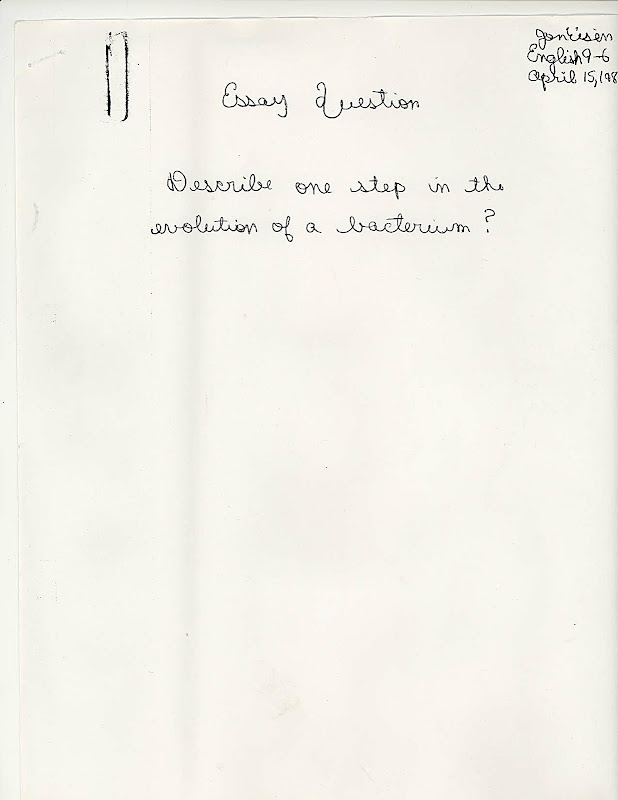
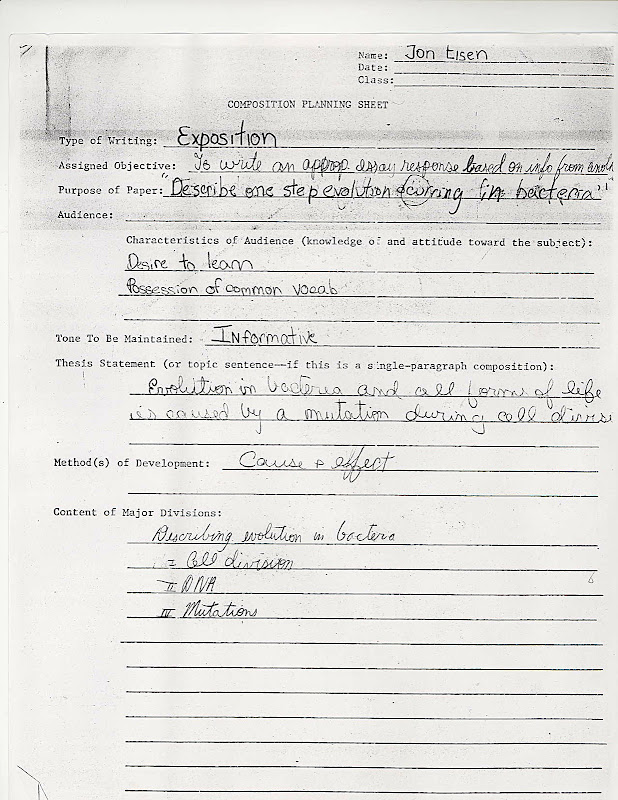


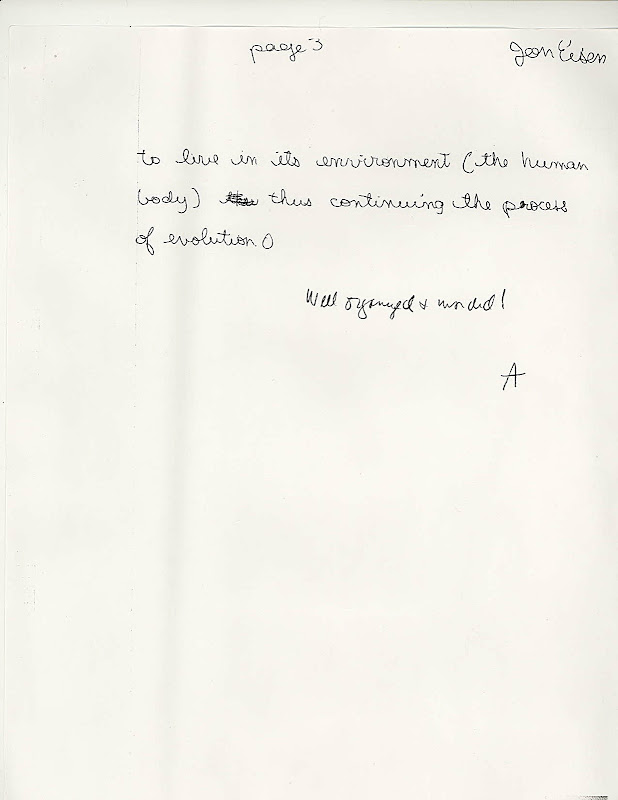
But I was digging through some old papers and found this ... a paper I wrote in ninth grade. We got to select a topic for the paper and mine ... "Describe one step in the evolution of a bacterium." The funny thing is --- I do not remember this at all. I mean, I remember reading books by Gould that got me interested in evolution. But surely Gould did not write a lot about bacterial evolution. Where did I come up with this topic? I haven't a clue. Anyway - here is the essay - errors, fluffy handwriting, and all.


Wednesday, January 23, 2008
Leslie Orgel - Still Speaking Wisely and Openly Even After Death
OK - my mind has been blown. Leslie Orgel, who just passed away recently, has a new Essay in PLoS Biology called "The Implausibility of Metabolic Cycles on the Prebiotic Earth." Anyone interested in the origin of life should check this out.
He had me at the beginning ... and as usual has very clear discussions of the steps needed for life to have originated:
Anyway, once you get over the fact that some ID supporters will misuse his work, the end is a great call for what needs to be done:
Yes, that is right, he got "if pigs could fly" into a paper. He was a great scientist. And it is nice for me to see one more paper of his. And this one, unlike pigs, can fly forever, because it is truly OA.
He had me at the beginning ... and as usual has very clear discussions of the steps needed for life to have originated:
If complex cycles analogous to metabolic cycles could have operated on the primitive Earth, before the appearance of enzymes or other informational polymers, many of the obstacles to the construction of a plausible scenario for the origin of life would disappear. If, for example, a complex system of nonenzymatic cycles could have made nucleotides available for RNA synthesis, many of the problems of prebiotic chemistry would become irrelevant. Perhaps a simpler polymer preceded RNA as the genetic material—for example, a polymer based on a glycerol-phosphate backbone [5] or a phosphoglyceric acid backbone. Could a nonenzymatic “metabolic cycle” have made such compounds available in sufficient purity to facilitate the appearance of a replicating informational polymer?The paper then discusses details of various metabolic cycles and why the current evidence is not completely convincing in terms of the exact path that was taken in the origin of life. Note to ID supporters - this does not friggin' mean that he is saying life could not have originated from non living systems. He is simply pointing out that our understanding of it is incomplete. As, by the way, is our understanding of how blood works. But that does not stop us from thinking that blood does in fact, well, work.
Anyway, once you get over the fact that some ID supporters will misuse his work, the end is a great call for what needs to be done:
The prebiotic syntheses that have been investigated experimentally almost always lead to the formation of complex mixtures. Proposed polymer replication schemes are unlikely to succeed except with reasonably pure input monomers. No solution of the origin-of-life problem will be possible until the gap between the two kinds of chemistry is closed. Simplification of product mixtures through the self-organization of organic reaction sequences, whether cyclic or not, would help enormously, as would the discovery of very simple replicating polymers. However, solutions offered by supporters of geneticist or metabolist scenarios that are dependent on “if pigs could fly” hypothetical chemistry are unlikely to help
Yes, that is right, he got "if pigs could fly" into a paper. He was a great scientist. And it is nice for me to see one more paper of his. And this one, unlike pigs, can fly forever, because it is truly OA.
Saturday, January 19, 2008
Syphilis origin solved?
A new paper in PLoS Neglected Tropical Diseases attempts to tackle a rather sensitive topic - the evolutionary origin of treponematoses (i.e., diseases caused by bacteria in the genus Treponema including yaws, pinta, and the one everyone wants to know about - syphilis). The paper, by Kristin Harper and others uses evolutionary reconstructions to try and determine if good old Christopher Columbus played a role in bringing syphilis to the New World.
There was an extensive article about this study in the New York Times on 1/15/08 (by John Noble Wilford). Overall the Times article is good (except Wilford gets the definition of phylogenetic analysis a bit wrong - saying it is the study of the evolutionary relationships between organisms when really it is the study of evolutionary relationships of anything... but hey that is OK).
I confess I am not sure if I am completely convinced by all of Harper et al's arguments concerning the evolution of these bugs. My main concern is that the amount of variation they observe (in ~ 20 genes across these strains) is very very low. And thus the resolution of the phylogenetic trees is quite poor.
Because this is a PLoS paper, it is truly "Open Access" and I can include the Figure here in my blog as long as I cite the original source (see below). If you look at the tree you can see some #s on the branches in the tree. These are based on a statistical test called bootstrapping and the numbers indicate (roughly) how well the tree that is shown represents all of the polymorphisms in the data. The #s are percentages and alas the % support is not very high for many of the branches. So a better resolution of the question of the origin of these diseases will likely require, well, a better resolution on the tree. This in turn will likely require complete genome sequences and perhaps more strains samples. Nevertheless, given the results they have, their arguments seem sound ... and this should stimulate people to gather more genomic data from these bugs.
Also see some other blogs on this
Here is Figure 3. It is from Harper KN, Ocampo PS, Steiner BM, George RW, Silverman MS, et al. (2008) On the Origin of the Treponematoses: A Phylogenetic Approach. PLoS Negl Trop Dis 2(1): e148. doi:10.1371/journal.pntd.0000148
Figure 3. This maximum likelihood tree is based on 20 polymorphic regions in the T. pallidum genome. Bootstrap support was estimated with 1,000 replicates in order to assess confidence at branching points and are shown within circles where values are high (>90%). Bootstrap support values for both maximum likelihood and maximum parsimony trees are shown, in that order.

There was an extensive article about this study in the New York Times on 1/15/08 (by John Noble Wilford). Overall the Times article is good (except Wilford gets the definition of phylogenetic analysis a bit wrong - saying it is the study of the evolutionary relationships between organisms when really it is the study of evolutionary relationships of anything... but hey that is OK).
I confess I am not sure if I am completely convinced by all of Harper et al's arguments concerning the evolution of these bugs. My main concern is that the amount of variation they observe (in ~ 20 genes across these strains) is very very low. And thus the resolution of the phylogenetic trees is quite poor.
Because this is a PLoS paper, it is truly "Open Access" and I can include the Figure here in my blog as long as I cite the original source (see below). If you look at the tree you can see some #s on the branches in the tree. These are based on a statistical test called bootstrapping and the numbers indicate (roughly) how well the tree that is shown represents all of the polymorphisms in the data. The #s are percentages and alas the % support is not very high for many of the branches. So a better resolution of the question of the origin of these diseases will likely require, well, a better resolution on the tree. This in turn will likely require complete genome sequences and perhaps more strains samples. Nevertheless, given the results they have, their arguments seem sound ... and this should stimulate people to gather more genomic data from these bugs.
Also see some other blogs on this
- Neil Woodburn
- John Dennehy (who mentions an article by Carl Zimmer in a non OA publication ... find out which by going to his blog)
Here is Figure 3. It is from Harper KN, Ocampo PS, Steiner BM, George RW, Silverman MS, et al. (2008) On the Origin of the Treponematoses: A Phylogenetic Approach. PLoS Negl Trop Dis 2(1): e148. doi:10.1371/journal.pntd.0000148
Figure 3. This maximum likelihood tree is based on 20 polymorphic regions in the T. pallidum genome. Bootstrap support was estimated with 1,000 replicates in order to assess confidence at branching points and are shown within circles where values are high (>90%). Bootstrap support values for both maximum likelihood and maximum parsimony trees are shown, in that order.
Tuesday, January 15, 2008
Is that a sex organ on the cover of Nature?

OK --- dipping into the gutter here a bit. But everyone must check out the cover of Nature this week. The issue is on the genetics of sex, and I'll be damned if that phycomyces colony on the cover (the one in the back) does not look like some sort of male sexual organ.
I do not know where to go with this. It has to be on purpose right? Is this what they refer to in the cover caption as a "pseudo-sexual" structure?
And I know I am probably not supposed to say this as an obsessed supporter of Open Access publishing but I dream of the day Nature becomes a fully OA journal. I still think PLoS Biology is a better journal, but Nature definitely has some good stuff there.
Monday, January 14, 2008
International Congress of Genetics --- you should all go ---
OK - I am a bit biased as I am chairing a session at this "International Congress of Genetics" meeting. But it does look pretty good. Plenary talks by Richard Axel, Liz Blackburn, Mario Capecchi, Rudy Kaenisch, Eric Lander, Svante Paabo and Phil Sharp. Sessions on many things, including (hint hint) - metagenomics. Other speakers are listed below. So - you really should consider going ...check out the website here.
 | | |||||||||||||||||||||||||||||||||||||||||||||||||||||||||||||||||||||||||||||||||||||||||||||||||||||||||||||||||||||||||||||||||||||||||||||||||||||||
| Chairs/Speakers | ||||||||||||||||||||||||||||||||||||||||||||||||||||||||||||||||||||||||||||||||||||||||||||||||||||||||||||||||||||||||||||||||||||||||||||||||||||||||
| ||||||||||||||||||||||||||||||||||||||||||||||||||||||||||||||||||||||||||||||||||||||||||||||||||||||||||||||||||||||||||||||||||||||||||||||||||||||||
| ||||||||||||||||||||||||||||||||||||||||||||||||||||||||||||||||||||||||||||||||||||||||||||||||||||||||||||||||||||||||||||||||||||||||||||||||||||||||
| The following Chairs/Speakers (in alphabetical order) have been confirmed so far:
| ||||||||||||||||||||||||||||||||||||||||||||||||||||||||||||||||||||||||||||||||||||||||||||||||||||||||||||||||||||||||||||||||||||||||||||||||||||||||
Friday, January 11, 2008
Can openness stop wars?

Thanks to Doug Rusch for pointing me to this video of a talk by Michael Shermer. It is a bit over the top, but I like the bit at the end suggesting that open access to information can basically stop wars.
Not sure I buy into the whole argument, but I do think that keeping scientific information behind closed walls is generally a bad idea ....
Thursday, January 10, 2008
Oakley Keeping his Eye on Evolution
I saw an interesting talk today and thought I would post on it. I was not expecting to be able to go to the talk as I was supposed to be at a workshop in San Francisco but had to bail on it because my kids have been sick. But I did go in to Davis for a brief spell to go to a seminar by Todd Oakley who gave a talk here today.
It was a generally insightful phylogenomic tour of the evolution of opsins and eyes in animals. He also mentioned a paper he had recently in PLoS One on Animal Opsin evolution. This is from the work of his graduate student David Plachetzki and it does a nice job of doing "phylogenomic" analysis in the way I think of phylogenomics -- that is -- a integration of evolutionary and genomic analyses. (NOTE - I think it is kind of lame that people use the term phylogenomics, which I coined by the way, to refer to "using genomes to infer evolutionary trees). It is a paper worth checking out if you are interested in the origin of novelty.
I am putting links here to some of their figures and embedding them in this blog because, well, I can since PLoS One uses a broad Creative Commons license. For example - see Figure 6 from their paper below (the citation is Plachetzki DC, Degnan BM, Oakley TH (2007) The Origins of Novel Protein Interactions during Animal Opsin Evolution. PLoS ONE 2(10): e1054. doi:10.1371/journal.pone.000105).
Figure 6. Ancestral state reconstruction of G protein-binding interactions for each metazoan opsin-mediated phototransduction cascade obtained by simulated mutational mapping [64] (see methods).For each class of opsin, the P value of the reconstructed ancestral G α interactions is represented in pie graphs. Ancestral G protein interactions in phototransduction cascades mediated by ciliary, rhabdomeric and Go opsins can be significantly resolved (P>0.95) but the ancestral states of the rhabdomeric+Go, and cnidops clades are equivocal. ML state reconstructions shown for each node as colored branches. Red, Gi/t; Blue, Gq; Green, Go; Black, no G protein interaction (as is the case for RGR/Retinochrome opsins); Grey, equivocal reconstruction from ML. Reconstructed ancestral amino acid motifs of the 4th cytoplasmic loop region of opsin are shown along branches in logos. Maximum vertical height scales to P = 1.0. We obtained clear reconstructed states for most of the residues in a conserved tripeptide motif (residues 310, 311 and 312, horizontal bar) for the ciliary, rhabdomeric and Go /RGR nodes. For the most part, the remainder of the residues in can be unequivocally reconstructed to the level of Dayhoff classes. B = HRK, X = LIVM, J = GATSP, Z = DENQ..

See also Figure 2
"Figure 2. Unrooted metazoan-wide phylogeny of opsins, new cnidarian genes in bold, branches proportional to substitutions per site. Circles at nodes indicate Bayesian posterior probabilities (White = 1.0, Red>0.90, Blue>0.80, Green>0.70, Yellow>0.60, Black>0.50). cil = ciliary, rh = rhabdomeric."

It was a generally insightful phylogenomic tour of the evolution of opsins and eyes in animals. He also mentioned a paper he had recently in PLoS One on Animal Opsin evolution. This is from the work of his graduate student David Plachetzki and it does a nice job of doing "phylogenomic" analysis in the way I think of phylogenomics -- that is -- a integration of evolutionary and genomic analyses. (NOTE - I think it is kind of lame that people use the term phylogenomics, which I coined by the way, to refer to "using genomes to infer evolutionary trees). It is a paper worth checking out if you are interested in the origin of novelty.
I am putting links here to some of their figures and embedding them in this blog because, well, I can since PLoS One uses a broad Creative Commons license. For example - see Figure 6 from their paper below (the citation is Plachetzki DC, Degnan BM, Oakley TH (2007) The Origins of Novel Protein Interactions during Animal Opsin Evolution. PLoS ONE 2(10): e1054. doi:10.1371/journal.pone.000105).
Figure 6. Ancestral state reconstruction of G protein-binding interactions for each metazoan opsin-mediated phototransduction cascade obtained by simulated mutational mapping [64] (see methods).For each class of opsin, the P value of the reconstructed ancestral G α interactions is represented in pie graphs. Ancestral G protein interactions in phototransduction cascades mediated by ciliary, rhabdomeric and Go opsins can be significantly resolved (P>0.95) but the ancestral states of the rhabdomeric+Go, and cnidops clades are equivocal. ML state reconstructions shown for each node as colored branches. Red, Gi/t; Blue, Gq; Green, Go; Black, no G protein interaction (as is the case for RGR/Retinochrome opsins); Grey, equivocal reconstruction from ML. Reconstructed ancestral amino acid motifs of the 4th cytoplasmic loop region of opsin are shown along branches in logos. Maximum vertical height scales to P = 1.0. We obtained clear reconstructed states for most of the residues in a conserved tripeptide motif (residues 310, 311 and 312, horizontal bar) for the ciliary, rhabdomeric and Go /RGR nodes. For the most part, the remainder of the residues in can be unequivocally reconstructed to the level of Dayhoff classes. B = HRK, X = LIVM, J = GATSP, Z = DENQ..
See also Figure 2
"Figure 2. Unrooted metazoan-wide phylogeny of opsins, new cnidarian genes in bold, branches proportional to substitutions per site. Circles at nodes indicate Bayesian posterior probabilities (White = 1.0, Red>0.90, Blue>0.80, Green>0.70, Yellow>0.60, Black>0.50). cil = ciliary, rh = rhabdomeric."
Monday, January 07, 2008
Science and the presidential election
Nothing really new from me here but saw some good blogs on the topic of science and the presidential election.
Steve Salzberg has summary information and some comments here.
Popular Mechanics has some info here
The ever active Bora has some comments here
Wired has a bit here
My little bit .... I think science is clearly not strongly supported by the current administration. However, scientists need to be careful about how they word things, since in the end, we are asking for money from taxpayers to, well, pay our salaries and pay for our work. This is one of the reasons I am very strongly in support of "open science." The more open we scientists are, I think, the easier it is to justify to the "public" that we deserve some of their/our money. That is not to say that lots of taxpayer money is not completely wasted on other things. And even not completely open science is frequently good for the world. But openness should help make scientists not seem so ivory toweresque and would show that we want to give back in exchange for what we are given.
Sunday, January 06, 2008
More fun at Long's
OK. Just had to post something because this is getting comical. I went in to Long's in E. Davis the other day to pick up some prescription refills. I had requested the refills online through the Long's web site and received an email saying they were reads. When I got in to the store, they told me that the refills were not ready. This is funny because this was about the 15th or so time in a row that my prescriptions were not ready when I was told they would be. One time it was problems with the online system. Another time it was that they needed a new prescription from my Doctor. Sure prescriptions expire and that is not really Long's fault. But apparently, when my prescriptions expire they decide to send faxes to a doctor I used to have in Maryland, even though I moved over two years ago. I came in like four times once over two weeks and every time they person at the counter would say "We faxed a request to Dr. So and So' and I would say "That person has not been my doctor for years. My new doctor is Dr. So and So in Davis." and they would sit there and click away at the keyboard supposedly fixing things and then they would say "OK, we will send it to the new doctor" And then I would come back and the person would say "We faxed your doctor in Maryland but he has not responded". This happened over and over and over. I began to view it as a game. How many times could I come to the pharmacy and could they get something wrong? The good things was, the people at the Long's pharmacy were very very nice. The bad thing was, something always seemed to go wrong. For a while I tried to use their automated prescription refill system, but that always went wrong too. So instead now, since I live near Long's and go to the Nugget all the time, I view my trips to the Long's Pharmacy as kind of an experiment in how many different ways my prescriptions can get screwed up.
Friday, January 04, 2008
Shameless Self Promotion ---- Another Good Review on my New Evolution Textbook
Well, again, here is another shameless self promotion. We got another good review of the new Evolution Textbook on which I am a co-author. This one is by Dan Hartl and was in Nature OK, it is not an Open Access review, but as I have said before, I am obsessed about open access to research articles, not book reviews, etc.
In the review Hartl tells a story about an encounter with Max Delbrück at Cold Spring Harbor where Delbruck implied that molecular aspects of evolution were uninteresting. Hartl goes on to say many nice things about our book (he does get on our case about having problems on the web and not in the book - but hey nobody is perfect). My favorite from the review is the following
In the review Hartl tells a story about an encounter with Max Delbrück at Cold Spring Harbor where Delbruck implied that molecular aspects of evolution were uninteresting. Hartl goes on to say many nice things about our book (he does get on our case about having problems on the web and not in the book - but hey nobody is perfect). My favorite from the review is the following
Textbooks in evolutionary biology have gen-Thanks Dr. Hartl. And a much belated thanks for a personal encounter that I had with you many years ago where you were MUCH more encouraging to me about working on bacterial genomes than Delbruck was to you about molecular evolution.
erally kept pace with these changes and several
excellent books are available. This new one by
Barton and colleagues is among the best. The
production quality is superb in layout, compo-
sition, typesetting, colour palette, illustrations
and gorgeous half-tones; and the writing is
excellent, as one might expect from such a stel-
lar cast of experts in population genetics, palae-
ontology, human genetics, bacterial genomics
and developmental biology (respectively).
Microbial communities highlighted by MIT Technology Review: The Year in Biotech
The MIT Technology review has an interesting piece on the "Year in Biotech". See Technology Review: The Year in Biotech
The selected key items that they discuss:
The selected key items that they discuss:
- Personal genomics
- Microbial communities
- Stem cells without embryos
- Brain repair
- Human genetic variation
Wednesday, January 02, 2008
In memory of Sam Karlin
I just got an email telling me that Sam Karlin had passed away. Sam, for those who do not know, was one of the luminaries in bioinformatics and mathematical biology. You can learn a bit more about him by going to this site which relates to a workshop that was help in honor of his 80th birthday.
His passing saddens me greatly. Sam was a curmudgeony guy at times, but also a great scientist and teacher. He was one of my mentors when I was in graduate school at Stanford. I was kind of a fish out of water --- trying to learn boinformatics in a lab that studies the cell biology of DNA repair processes. So I took a course from Sam Karlin and Volker Brendel and then spent three years meeting on and off with Sam in his office discussing various aspects of genome and gene sequence analysis. We did not always agree. But I think I learned more about bioinformatics from those meetings with Sam than from anything else I have done in my career.
Sam reminded me a lot of my grandfather (who was a physicist). We would meet to ostensibly talk about RecA (my favorite protein) or DNA composition (Sam's favorite thing at the time) or evolution or something or other. But Sam turned every meeting into some type of lesson about bioinformatics. We rarely got to our end goal, but that did not really matter.
So - in his honor I am going to start a new section of this blog --- the Something about Math in Biology or the SAM in Biology section ... stay tuned.
NOTE Lee Altenberg has a memorial page to him, consisting of his doctoral advisor genealogy:
Friday, December 28, 2007
Why "neglected tropical diseases" are going to bite us in the *$&#
Malaria. Chagas. Filariasis. Dengue fever. Onchocerchiasis. Trachoma. Cholera. Leishmaniasis. Yaws. Leprosy.
Neglected tropical diseases. You certainly don't want to get them (I have had at least one). And they are not as neglected as they used to be with some money being dedicated to them (e.g. from the Gates Foundation) and their own PLoS journal dedicated to them and even famous people blogging about them. The World Health Organization pushes for them to get more attention.
But given that these diseases kill and injure BILLIONS of people and cause untold amounts of economic damage, they clearly still do not get what they deserve, in terms of research dollars and drug development efforts, etc.
Well, listen up people in the non-tropical (a.k.a. developed) world. Even if the "let's help others" line does not light your fire, you better start worrying about these diseases. That is because many of these diseases are on the march in part due to global warming and will likely soon be a bigger part of our life in the developed world.
There has been lots in the press and web about this but it still seems to get ignored which is why I am blogging about it here. For example see
The thing that reminded me of this issue was a 12/23/07 New York Times article discussing the spread of the tropical virus that causes chikungunya into Europe for the first time.
So, next time you are lingering in Berlin or New York or Moscow and you feel a weird itch. Or have a fever that just won't go away. Or have strange swellings where you never had them before. Don't just look for diseases that were once common wherever you are. Start to think about things like Dengue (my favorite, since I have had it). And maybe just maybe, you should start to worry about these things BEFORE you get them. And support efforts to make these diseases not so neglected.
Wednesday, December 26, 2007
Happy Hollidays Open Access Movement
Well there is damn good news on the Open Access to scientific literature front. President Bush signed the big spending bill today that includes a provision requiring all papers coming from NIH funded work to be made freely available after 1 year. From the Washington Post:
Under the bill's terms, scientists getting grant money from the National Institutes of Health would now have to submit to the NIH a final copy of their research papers when those papers are accepted for publication in a journal. An NIH database would then post those papers, free to the public, within 12 months after publication.I am giddy with excitement about this. Congratulations to all who lobbied so hard for this, such as Heather Joseph from SPARC. Her quote from the Post article is helpful here:
"The basic reason we went to bat so hard for this was because we thought it was the right thing to do with taxpayers' science," Joseph said. "Now there will be $29 billion in taxpayer investments freely available to the public," she said, referring to the NIH medical research budget
Wednesday, December 19, 2007
NIH wants proposals on the human microbiome ...
NIH has an press release regarding the new Roadmap Initiative on the Microbiome. I quote from it below:
Though I risk introduce more competition for myself here I thought I would add some key links to the calls for proposals:
* Development of New tools for Computational Analysis of Human Microbiome
Project Data (R01)
* (RFA-RM-08-008)
* NIH Roadmap Initiatives
* Application Receipt Date(s): February 15, 2008
* http://grants.nih.gov/grants/guide/rfa-files/RFA-RM-08-008.html
*
*
* Development of New tools for Computational Analysis of Human Microbiome
Project Data (R21)
* (RFA-RM-08-009)
* NIH Roadmap Initiatives
* Application Receipt Date(s): February 15, 2008
* http://grants.nih.gov/grants/guide/rfa-files/RFA-RM-08-009.html
*
*
* Development of New Technologies Needed for Studying the Human Microbiome
(R01)
* (RFA-RM-08-010)
* NIH Roadmap Initiatives
* Application Receipt Date(s): February 15, 2008
* http://grants.nih.gov/grants/guide/rfa-files/RFA-RM-08-010.html
*
*
* Development of New Technologies Needed for Studying the Human Microbiome
(R21)
* (RFA-RM-08-011)
* NIH Roadmap Initiatives
* Application Receipt Date(s): February 15, 2008
* http://grants.nih.gov/grants/guide/rfa-files/RFA-RM-08-011.html
Bethesda, Md., Wed., Dec. 19, 2007 – The human body contains trillions of microorganisms, living together with human cells, usually in harmony. Because of their small size, however, microorganisms make up only about one to two percent of the body's mass. Many microbes maintain our health, while others cause illness. Yet, surprisingly little is known about the role this astounding assortment of bacteria, fungi and other microbes play in human health and disease. To better understand these interactions, the National Institutes of Health (NIH) today announced the official launch of the Human Microbiome Project. The human microbiome is the collective genomes of all microorganisms present in or on the human body."The human microbiome is largely unexplored," said NIH Director Elias A. Zerhouni, M.D. "It is essential that we understand how microorganisms interact with the human body to affect health and disease. This project has the potential to transform the ways we understand human health and prevent, diagnose and treat a wide range of conditions."
Part of the NIH's Roadmap for Medical Research, the Human Microbiome Project will award a total of $115 million to researchers over the next five years. Initially, researchers will sequence 600 microbial genomes, completing a collection that will total some 1,000 microbial genomes and providing a resource for investigators interested in exploring the human microbiome. Other microbial genomes are being contributed to the collection by individual NIH institutes and internationally funded projects. A meeting between international partners was recently convened to discuss forming an international consortium.
Researchers will then use new, comprehensive laboratory technologies to characterize the microbial communities present in samples taken from healthy human volunteers, even for microbes that cannot be grown in the laboratory. The samples will be collected from five body regions known to be inhabited by microbial communities: the digestive tract, the mouth, the skin, the nose, and the female urogenital tract. Demonstration projects will subsequently be funded to sample the microbiomes from volunteers with specific diseases. This will allow researchers to correlate the relationship between changes in a microbiome present at a particular body site to a specific illness.
"We now understand that there are more microbial cells than human cells in the human body. The Human Microbiome Project offers an opportunity to transform our understanding of the relationships between microbes and humans in health and disease," said Dr. Alan Krensky, the director of the Office of Portfolio Analysis and Strategic Initiatives (OPASI), which oversees the NIH Roadmap for Medical Research.
While the term "microbiome" may be relatively new in biomedical research, most people are familiar with some of the effects - both good and bad - that microbes can have on our health. Consider the example of the biggest reservoir of microbes in humans: the digestive tract. The human gut harbors many beneficial microorganisms, including certain bacteria called probiotics. There is evidence these probiotics, found in dietary supplements, yogurt and other dairy products as well as various soy products, can stimulate the immune system and improve digestive functions. In contrast, previous research suggests that variations in the composition of microbial communities may contribute to chronic health conditions, including diabetes, asthma, obesity and digestive disorders.
"Microbes play a significant role in the health of the digestive tract and many digestive diseases result when the microbial environment is out of balance," said Griffin P. Rodgers, M.D., M.A.C.P., director of the National Institute of Diabetes and Digestive and Kidney Diseases (NIDDK), and co-chair of the Human Microbiome Project's Implementation Group. "The Human Microbiome Project will help us better understand the microbial environment in the gut, as well as provide us with the tools and technology to expand our exploration into this field of research."
Traditionally, microbiology has focused on the study of individual species as isolated units, making it difficult to develop and inventory all of the microbes in and on the human body. Because their growth is dependent upon a specific natural environment, it's difficult to recreate microbe-host interactions in the laboratory. Advances in next generation DNA sequencing technologies relying on a process called metagenomic sequencing will be used. Instead of isolating each microbe, all of the DNA within the collected samples will be sequenced.
"Our goal is to discover what microbial communities exist in different parts of the human body and to explore how these communities change in the presence of health or disease," said National Human Genome Research Institute Director, Francis S. Collins, M.D., Ph.D., co-chair of the Human Microbiome Project Implementation Group. "In addition, we will likely identify novel genes and functional elements in microbial genomes that will reshape the way we think about and approach human biology."
NIH recently awarded $8.2 million to four sequencing centers, to start building a framework and data resources for the Human Microbiome Project. One-year awards were given to the sequencing centers at the Baylor College of Medicine, Houston, and Washington University School of Medicine, St. Louis, which are part of the NHGRI Large-Scale Sequencing Research Network; and the Broad Institute of MIT/ Harvard, Cambridge, Mass., and the J. Craig Venter Institute, Rockville, Md., which are funded through the National Institute of Allergy and Infectious Diseases (NIAID) Microbial Genome Sequencing Centers Program.
The objectives of this initial work are to sequence the genomes of 200 microbes that have been isolated from the human body as part of the 1,000 microbial genomes collection. Researchers will also begin recruiting healthy volunteers who will donate samples from the five body regions. NHGRI, NIAID, and the National Institute of Dental and Craniofacial Research (NIDCR) have led the initial phases of the project.
"The recent emergence of faster and cost-effective sequencing technologies promises to provide an unprecedented amount of information about these microbial communities, which in turn will bolster the development and refinement of analytical tools and strategies," said NIAID Director Anthony S. Fauci, M.D., co-chair of the Human Microbiome Project's Implementation Group.
Following the precedents set by other large-scale genomics efforts, such as the Human Genome Project and the International HapMap Project, data from the Human Microbiome Project will be swiftly deposited in public databases, including those supported by the National Center for Biotechnology Information (www.ncbi.nlm.nih.gov/mapview), part of the National Library of Medicine. The project also will fund the establishment of a Data Analysis and Coordinating Center, which will coordinate data access and develop data retrieval tools for the research community.
Also following on the lead of those efforts, the Human Microbiome Project will monitor and support research on the ethical, legal and social implications of the research. Areas of focus include the clinical and health implications of using probiotics, potential forensic uses of microbiome profiles, bioterrorism and biodefense applications, the application of new technologies from the project, and patenting and privacy issues.
"Examining and addressing the emerging ethical, legal and social implications of metagenomics research is central to our goal of one day moving any resulting diagnostic, prevention, or treatment tools into the clinic in a safe and effective manner," said NIDCR Director Lawrence Tabak, D.D.S., Ph.D., co-chair for the NIH Human Microbiome Project Implementation Group.
Additional information about the Human Microbiome Project is available at www.nihroadmap.nih.gov/hmp. For more information about funding opportunities, go to: www.nihroadmap.nih.gov/hmp/grants.asp. A high resolution image of the bacteria, Entercoccus faecalis, a microbe that lives in the human gut, is available in color at www.genome.gov/pressDisplay.cfm?photoID=20023, or in black and white at www.genome.gov/pressDisplay.cfm?photoID=20024.
The Human Microbiome Project is part of the NIH Roadmap for Medical Research. The Roadmap is a series of initiatives designed to pursue major opportunities and gaps in biomedical research that no single NIH institute could tackle alone, but which the agency as a whole can address to make the biggest impact possible on the progress of medical research. Additional information about the NIH Roadmap can be found at www.nihroadmap.nih.gov.
The National Institutes of Health (NIH) -"The Nation's Medical Research Agency" - includes 27 Institutes and Centers and is a component of the U. S. Department of Health and Human Services. It is the primary federal agency for conducting and supporting basic, clinical and translational medical research, and it investigates the causes, treatments and cures for both common and rare diseases. For more information about NIH and its programs, visit www.nih.gov.
Though I risk introduce more competition for myself here I thought I would add some key links to the calls for proposals:
* Development of New tools for Computational Analysis of Human Microbiome
Project Data (R01)
* (RFA-RM-08-008)
* NIH Roadmap Initiatives
* Application Receipt Date(s): February 15, 2008
* http://grants.nih.gov/grants/guide/rfa-files/RFA-RM-08-008.html
*
*
* Development of New tools for Computational Analysis of Human Microbiome
Project Data (R21)
* (RFA-RM-08-009)
* NIH Roadmap Initiatives
* Application Receipt Date(s): February 15, 2008
* http://grants.nih.gov/grants/guide/rfa-files/RFA-RM-08-009.html
*
*
* Development of New Technologies Needed for Studying the Human Microbiome
(R01)
* (RFA-RM-08-010)
* NIH Roadmap Initiatives
* Application Receipt Date(s): February 15, 2008
* http://grants.nih.gov/grants/guide/rfa-files/RFA-RM-08-010.html
*
*
* Development of New Technologies Needed for Studying the Human Microbiome
(R21)
* (RFA-RM-08-011)
* NIH Roadmap Initiatives
* Application Receipt Date(s): February 15, 2008
* http://grants.nih.gov/grants/guide/rfa-files/RFA-RM-08-011.html
Phylogenomics makes the big time --- University of Manitoba seeking a "Chair" in Phylogenomics
Now I know Phylogenomics has hit the big time.
University of Manitoba is looking for a chair in the emerging area of phylogenomics. See below. PS - Good job phylogenomics. You have made it.
From their ad:
University of Manitoba is looking for a chair in the emerging area of phylogenomics. See below. PS - Good job phylogenomics. You have made it.
From their ad:
UNIVERSITY OF MANITOBA – CANADA RESARCH CHAIR – TIER II
Phylogenomics Chair, Department of Biological Sciences, Faculty of Science
Position # 06661 and 06662
The University of Manitoba is seeking applications or nominations for a Canada Research Chair established by the Government of Canada to enable Canadian Universities to foster world-class research excellence (http://www.chairs.gc.ca). Our Strategic Research Plan (http://www.umanitoba.ca/admin/vp_research/research_chairs.html) identifies a Tier II Chair in the Faculty of Science in the area of Phylogenomics as a priority.
The emerging field of Phylogenomics uses an exciting comparative approach to research that integrates the study of the evolution of species using genomic data and the study of genome function using phylogenetic data, and can powerfully inform a broad spectrum of biological research
Performance enhancing drugs - I confess
Yup, that is right. I took steroids today. I hope this does nto rule out my chances of getting into the hall of fame. But hey, I am going to be up front about it so I wanted to post here in case there is a future investigation into performance enhancing drugs among scientists.
What I took was cortisone, by injection for tendinitis in my fingers. The shot, given by a doctor, hurt like nothing else. But I needed it to recover from an injury. This injection hopefully will let me return in a few weeks to "normal" in terms of my typing. And I am sure all of you out there will be happy about that.
So - the question is - am I cheating? Or is using steroids to recover from an injury OK (see Andy Pettite). What if I got the steroids to make my typing faster. Would that be cheating?
Friday, December 07, 2007
Survival of the fittest M&Ms
Fantastic evolution post on the best of Craigslist.
The post starts off with
Thanks to Michael Eisen for pointing this out.
The post starts off with
Whenever I get a package of plain M&Ms, I make it my duty to continue the strength and robustness of the candy as a species. To this end, I hold M&M duels.And then, after a crushing test of fitness
Occasionally I will get a mutation, a candy that is misshapen, or pointier, or flatter than the rest. Almost invariably this proves to be a weakness, but on very rare occasions it gives the candy extra strength. In this way, the species continues to adapt to its environment.Then the winning M&M is sent to Mars with a note
Please use this M&M for breeding purposes.Best part - Mars sent him a coupon for free M&Ms which he considers "grant money." Who said evolution can't be fun.
Thanks to Michael Eisen for pointing this out.
Fired for (not believing in evolution) promising to do sucky science
The Boston Globe reports on a story about a post doc (Nathanial Abraham) from Woods Hole Oceanographic Institution who was fired recently, apparently because he does not believe in evolution. Apparently, even though Abraham was supposed to focus on comparative and evolutionary studies in the lab of Mark E. Hahn, at some point Abraham told Hahn he did not believe in evolution.
This raises the question - that the Globe asks
So this looks like a case where the issue is much clearer than in some other cases reported recently. Abraham basically was telling his boss "I vow to do sucky science." And for this, I think it is perfectly reasonable that he got canned.
PS - Thanks for Iddo Friedberg for pointing this story.
Also - see PZ Myers' post about this for much more detail.
This raises the question - that the Globe asks
"Can people work in a scientific field if they don't believe in its basic tenets?"I think the answer in this is a bit slippery. If someone does not believe in evolution, but in their work still uses evolutionary analyses and perspective I am not sure what one should do. But Abraham apparently went further and said he would not even discuss evolution in papers on the project. This is reflected in a letter from Hahn quoted in the Globe:
". . . You have indicated that you do not recognize the concept of biological evolution and you would not agree to include a full discussion of the evolutionary implications and interpretations of our research in any co-authored publications resulting from this work," Hahn wrote in the letter, which the commission provided to the Globe. "This position is incompatible with the work as proposed to NIH and with my own vision of how it should be carried out and interpreted."This then becomes more than "not believing" in evolution outside of work. This is clearly a stance that could jeopardize the quality and integrity of the papers coming out of the project (imagine if I said I was going to write all genome papers from now one based on my belief that DNA is not the material of inheritance but instead that membranes are).
So this looks like a case where the issue is much clearer than in some other cases reported recently. Abraham basically was telling his boss "I vow to do sucky science." And for this, I think it is perfectly reasonable that he got canned.
PS - Thanks for Iddo Friedberg for pointing this story.
Also - see PZ Myers' post about this for much more detail.
Tuesday, December 04, 2007
Sharpshooters, dual symbioses and new ways to sequence a genome
Those interested in symbioses and in new sequencing methods should look at a paper that just came out in PNAS by John McCutcheon and Nancy Moran (OK - I am a bit biased - this work is related to something I did previously with Nancy). Their paper reports a further dissection of a dual symbioses in sharpshooters (a group of insects that feed on xylem sap). The dual symbioses involves two types of bacteria that live inside specialized cells in the gut of these insects.

Previously, my group had worked with Nancy to sequence the genome of one of the symbionts (Baumannia) as well as part of the genome of the second one (Sulcia). Nancy was interested in this symbioses for many reasons including that as obligate xylem feeders the sharpshooters almost certainly were not getting gall the nutrients they needed in their diet. Based on what was known about bacterial symbionts in other sap feeding insects (e.g., aphids) it seemed likely that the symbionts of the sharpshooters were making the missing nutrients for their host. However, all previous genomic based studies had been done on phloem feeding insects like aphids. Phloem and xylem are the two main circulatory systems in plants. Phloem tends to be nutrient rich, although still not rich enough for the aphids to live on it alone. Thus the aphids rely on bacterial symbionts to make amino acids missing in the phloem.
Xylem is generally much poorer in nutrients and this Nancy wanted to compare the genomes of the symbionts of xylem feeders with those of phloem feeders. Nancy and others had done preliminary work on the sharpshooters showing that they had multiple symbionts living inside cells in their gut and that one of the symbionts (which she named Baumannia after Paul Baumann who she had worked with previously) was closely related to the Buchnera symbionts found in aphids.
So Nancy approached me when I was at TIGR and asked if I would be interested in helping her sequence the Baumannia genome. I said yes (secretly, truth be told, I would have tried to sequence the genome of a rock if Nancy asked. She is perhaps the smartest person I know in all of science and is always doing the coolest types of research. Plus, I figured, I might also be able to interact with her husband, Howard Ochman, who also does cool stuff).
Of all the possible sharpshooters (the symbionts are found in all sharpshooters), Nancy chose to focus on the glassy winged sharpshooter because it is an important pest organism (it is a vector for Pierce's disease in grapes).
So - we (well, the core facility at TIGR under my supervision) sequenced the Baumannia genome using DNA that Nancy had isolated from dissections of the gut of glassy winged sharpshooters. In analysis of the genome we (well, again, the royal we --- in this case Dongying Wu in my lab did most of the analysis) found, among many things, that Baumannia appeared to be making vitamins and cofactors for the host. But alas, we also found something missing --- Baumannia did not appear to be able to make amino acids for the host. Since xylem was likely to be missing amino acids that all animals require in their diet, we had figured that Baumannia must be making them for the host. So we were vexed.
That was, until Nancy pointed out (or reminded us - since she probably had mentioned it before) that there was another symbiont living in the gut of these insects --- a symbiont called Sulcia. She suggested that we look at the DNA sequence pieces that did not assemble with the Baumannia genome and look for any that might encode genes similar to genes from the group of bacteria in which Sulcia is found. And, 1.5 years later, after much informatics and lab work, we obtained about 130 kb of the genome of this second symbiont and found that it encoded at least some of the essential amino acid synthesis pathways that could make the needed amino acids for the host. And we stopped there, published a paper in PLoS Biology proposing the existence of a dual symbiosis with one symbiont making vitamins and cofactors and the other making amino acids, and moved on to other things.
Now in this new paper, Nancy's lab has returned to this symbioses and has finished the genome of Sulcia (the genome is available here in Genbank). And the story just gets cooler and cooler. With this complete genome they get a more detailed picture of the symbiosis than we were able to obtain, and are able to really reconstruct the whole system (and correct some mistakes we had made in our paper). My favorite thing in their paper is Figure 3 which you can find here (I am not sure about the PNAS policy of putting the image in my blog since this does not seem to be an Open article). This figure shows their reconstruction of what could be called to community metabolism. Interestingly it appears the symbionts depend on each other and are not just passing things on to the host separately.
Another important aspect of their paper is that it is the first (as far as I know) example of a genome being finished using a combination of the two hot new sequencing methods - 454/Roche and Illumina/Solexa. Basically they used the Roche/454 method to provide deep coverage of the Sulcia genome and then used Illumina/Solexa sequencing to get accurate sequence data for the types of sequence for which the Roche method does not work well.
So - check out the paper in PNAS. You won't regret it.
Monday, December 03, 2007
An interactive Tree of Life (Web Tool)
 Thanks to Michael Ferrari who has pointed out a cool new phylogenetics visualization tool called the "Interactive Tree of Life"
Put out (I believe) by Peer Bork's group, this tool allows users to upload their own trees and then view and manipulate them from anywhere. Seems like Peer is trying to become the Google of phylogenetics.
Wanna sequence a microbial genome? Try applying to this NSF-USDA
Contrary to rumors that I had heard (and I confess was spreading too) the NSF and USDA have announced the continuation of their Microbial Genome Sequencing program. This is by far and away my favorite grant program pretty much ever. I have gotten funding for most of my favorite projects through this program. So - I hate to bring in competition, but I thought I should post an announcement here:
Microbial Genome Sequencing Program FY2008
As a collaborative, interagency effort, the National Science Foundation (NSF), and the Cooperative State Research, Education, and Extension Service (CSREES) of the U.S. Department of Agriculture invite research proposals (i) to support high-throughput sequencing of the genomes of microorganisms, and (ii) to develop and implement strategies, tools and technologies to make currently available genome sequences more valuable to the user community.
Full Proposal Deadline: February 19, 2008
The link for the solicitation should be up later today at:
http://www.nsf.gov/publications/pub_summ.jsp?ods_key=nsf08511
Saturday, December 01, 2007
Personal Genome Project seeking volunteers
The Personal Genome Project is seeking volunteers. The project would sequence (at least part of) your genome. In exchange you would agree to have the data released openly and also have some data about you released as well. I think it this could become a phenomenal medical resource and I am happy some people are volunteering for this. I probably would not do it myself - mostly out of concern for the privacy of my children and relatives. But hey - if you want to do it - all the power to you. Go to their website to sign up.
Subscribe to:
Posts (Atom)
Most recent post
A ton to be thankful for -- here is one part of that - all the acknowledgement sections from my scholarly papers
So - it is another Thanksgiving Day and in addition to thinking about family, and football, and Alice's Restaurant, I also think a lot a...

-
Wow. Just wow. And not in a good way. Just got an email invitation to a meeting. The meeting is " THE FIRST ANNUAL WINTER Q-BIO ...
-
 I have a new friend in Google Scholar Updates I have written about the Updates system before and if you want more information please see...
-
See Isolation and sequence-based characterization of a koala symbiont: Lonepinella koalarum Paper based on PhD thesis work of Katie Dahlha...
