And this reminds me to say - in the past I have avoided talking about people in my lab in my blog because it se
Tuesday, February 26, 2008
A really good day at work
And this reminds me to say - in the past I have avoided talking about people in my lab in my blog because it se
Monday, February 25, 2008
PLoS Biology 2.0
Well, I guess it is official now so I should post about it here. As for this afternoon, I am now the new Academic Editor in Chief of PLoS Biology. To read more about this new role of mine go to the source. I will probably cross post the editorial here at some later point.
Also see other blogs/notes about this
- Egghead - UC Davis Research Blog
- PLoS Blog
- Coturnix's Blog Around the Clock
- Deepak Singh at BBGM
- Pedro Baltrao at Public Rambling
- EVOLGEN
- Genome Technology Blog
- nsaunders at What you're doing is rather desperate
- Pimm blog
- Highlight Health "More steps for Open Access"
See Evolgen for a field guide to seminar audiences
The pre-schooler: This dude uses the departmental seminar as his nap-time. He sits in the back, and when the lights go out, he's nodding off faster than River Phoenix in My Own Private Idaho. Someone get this guy a good-night's sleep.I simply could not stay awake in any seminar so I would have to sit at the back. Now that I have kids, I am used to sleep deprivation and only rarely nod off in a seminar. I am no longer sure which one I am ...
Calling Michael Ashburner - please start a blog
See also some other Reviews of the book:
Friday, February 22, 2008
How human rights work and microbial ecology are similar
To understand Ball’s accomplishments, you might start with the problem of counting rattlesnakes.And then he goes on to describe how one can estimate how many rattlesnakes are in a population by marking ones that you find and then counting how many times you refind one you have marked previously. This is a method generally known as mark-release-recapture (e.g., see the Wikipedia entry here, which seems OK but I have not read too carefully).
Apparently, Ball uses a similar type of statistic to estimate the number of murders and/or deaths in particular areas, by looking for overlap among different reports of deaths.
What you say does this have to do with microbial ecology? Well, everything. Because one of the most common methods for estimating the number of microbial species in a sample is to use a gene survey method where one isolates DNA from environmental samples and then one looks in the DNA for multiple versions of a gene found in all species (the gene most commonly used is known as small subunit rRNA). The gene survey method is needed because appearance is not a robust method of identifying microbial species.
From the gene sampling data, one then compares each version of the gene to the others and counts how many times one sees the same form of the gene (suggesting that one has found two different cells of the same species). If one keeps seeing the same forms of the gene even with only a few samples, one would estimate there are few species in the sample. If one keeps seeing different forms of the gene, one would estimate there are many species in the sample.
Things that seem to be hidden - be the murders or populations of rattlesnakes or microbes - can still be studied with what the Times perfectly refers to as
"A statistical sleight of hand"
Forget McCain - the Real Problem in the New York Times - Adaptationism
This week the Times has a doozy in the article on "Play" from the Sunday Magazine. In the article, Robin Henig writes
"If play is an extravagance, why has it persisted? It must have some adaptive function, or at least a benefit that outweighs its cost, or it would have been winnowed out by the forces of natural selection."This is nearly a PERFECT adaptationistic line. And more importantly, it is simply not true. Some things persist in biological systems even when they have a cost that outweighs the benefit. And other things persist when they are neutral. Now I am not saying one way or another whether play has a benefit (the article is interesting and reasonably sound in many ways). But such statements as the one quoted above show a common misunderstanding of evolution. Evolution is NOT only about beneficial things persisting and detrimental ones going away. It is much more complex and interesting in fact. If you want to learn more about the perils of adaptationism, go to Larry Moran's blog. He really has some good stuff on it. Or go to the great gurus themselves - Gould and Lewontin.
Friday, February 15, 2008
Wednesday, February 13, 2008
Harvard's Moving To Open Access - Let's Use this to Push for OA at other places
The Times reports
"Faculty members are scheduled to vote on a measure that would permit Harvard to distribute their scholarship online, instead of signing exclusive agreements with scholarly journals that often have tiny readerships and high subscription costs."and
"Under the proposal Harvard would deposit finished papers in an open-access repository run by the library that would instantly make them available on the Internet. Authors would still retain their copyright and could publish anywhere they pleased — including at a high-priced journal, if the journal would have them."In my opinion, there is no doubt this is a smart move. Sure, there are some potential downsides to open access. Some journals do good things and they may have to reinvent themselves to continue to bring in revenue. But welcome to the 21st century. It is not like other industries - like music and TV and movies and electronics and so on - have not had to reinvent themselves.
And the result are in --- Harvard approved the initiative (see here for example). Now - I think we should use this as an example to get other institutions to do the same thing. As reported in the Boston Globe, Harry Lewis a CS Professor at Harvard said:
"Harvard is in a unique position to do the right thing in the academic world," he said. "In this case, I think others will be emboldened by Harvard to follow its lead, and the course of collective action will be greater than the course any individual school will take."I will do my best to get UC Davis to do the same thing, but given the animosity towards open access exhibited by our acting provost Barbara Horwitz, it may be a tough ride here. Fortunately, they are interviewing candidates for provost now and hopefully whomever they pick will be more supportive.
So - here is a call to others out there. Push for the same type of thing at your institution. I will be posting more on this in the coming days/weeks. Maybe collectively we can follow Harvard's lead on this and make Universities more about what they are supposed to be about - spreading knowledge.
Monday, February 11, 2008
Creating Mitochondria and a sign that we need open peer review
For example on p8 the authors say:
"Alternatively, instead of sinking in a swamp of endlessSay what you want about the journal Proteomics but boy did they screw this one up. I think they probably should have caught this without much effort but who knows exactly what happened. In all fairness to them, it is possible for weird thin gs to slip through at any journal. Reviewers are busy. Editors are busy. Everyone is busy. How can we prevent this from happening again. There is a simple change we could make that would help. It is called Open Peer review. That is, if reviewers names were publicly attached to papers they reviewed, and their reviews were published, we would be less likely to see things like this happen. Then, if someone agrees to do paper review, they would be careful about it. Sure, we would probably have a harder time getting reviewers, but that would be better than publishing crap.
debates about the evolution of mitochondria, it is better to
come up with a unified assumption that all living cells
undergo a certain degree of convergence or divergence to or
from each other to meet their survival in specific habitats.
Proteomics data greatly assist this realistic assumption that
connects all kinds of life. More logically, the points that show
proteomics overlapping between different forms of life are
more likely to be interpreted as a reflection of a single common
fingerprint initiated by a mighty creator than relying on
a single cell that is, in a doubtful way, surprisingly originating
all other kinds of life."
What are the risks with Open Peer review? Well, some people might feel afraid to criticize others especially people with power. Well, I find this sad. Scientists criticize our collaborators and friends ALL the time in private. Why not be public about it? Aren;t we supposed to be searching for the truth? If we are, shouldn't we be willing to give our opinions in public forums?
Saturday, February 09, 2008
Marco Island - Saving Some of the Best for Last
Stephan Schuster gave a funny, entertaining and interesting talk on mammoth mitochondrial genomics. He riddled the talk with funny stories and one liners about his efforts to sequence old DNA and to publish the results. He did a good job of showing why Roche-454 sequencing is quite ideally suited for studies of old DNA.
John Leamon from Raindance Technologies summarize some of their work on droplet based microfluidics. He showed videos of droplets moving through their system and showed how it sould be used for various digital PCR-like activities.
But it was the last talk of the whole meeting that really did blow my mind. It was from Steve Turner from Pacific Biosciences. He presented an overview of their sequencing technology as well as a tiny bit of data. Now, normally I am uninterested in marketing talks where little data is presented. But this talk was different. First, their technology clearly has enormous potential for revolutionizing the sequencing field. Basically, what they are doing is reading the activity of a DNA polymerase as it replicates a single DNA molecule and they do it in real time. He referred to this as using the DNA polymerase as a sequencing engine and then he took the crowd through the details of the technology and some of the modifications they have made to make it work better. I will try to post later with more detail on their methods.
No - they are not quite ready for prime time yet. But the potential is pretty absurd. I see two key major advantages of their method if it can be fine tuned to work well -- (1) it is screamingly fast - because they let the polymerase do all the work in essence (2) it can potentially get long reads -- right now he claimed they could do up to 1500 base pairs and theoretically it could go much higher. If they can get this to work with reads of 10,000 bases for example, this will completely reconfigure the field. No longer will one have to worry about the complexities of mapping short reads as with many of the current "new" methods. And the long reads, coupled with many molecules per run, plus the high speed, this technology is the first I have seen that has shown some results and that could really lead to the $1000 human genome. Again, not clear when/if they will be ready for release to the world so don't hold off buying one of the other systems that currently work (i.e., Illumina, Roche, ABI Solid) if you want to do "next gen" sequencing. But this company is one to keep an eye on.
NOTE - SEE ALSO
Marco Island sequencing frenzy - are we getting lost in all the data?
Certainly, much of this new work is truly revolutionary. Sequencing has gotten so cheap, and so easy, relative to even 3-4 years ago, that it can be used in all sorts of new ways. And new developments in sequencing seem poised to happen too, to make sequencing even cheaper and even better. Sequencing will get even better for a few reasons.
First, the current players in the market (Roche, Illumina, and possibly soon ABI Solid) are improving both their systems and their informatics such that they are getting more and more robust and easy to use and producing more data (Roche for example presented details on how they can extend their sequence reads to ~350 base pairs mostly by software and reagent changes). Lots of companies can say "We have some sequencing system about ready to be introduced" And lots of them are doing this at this meeting. But there is nothing like having sequencers in the hands of scientists to really test how well they work and to really help push the development of the technology.
Second, it does seem like some competitors for Illumina and Roche are coming. ABI presented multiple results from ABI Solid technology that makes it seem like these systems are ready for prime time. Whether other systems are ready for prime time is unclear. Helicos presented what could be seen as data. It was disappointingly minimal on detail but though I am rooting for them, it was far from convincing. But the discussions in the hallway seemed to suggest that Helicos is getting close. And there are 5+ other players itching to get into the market (some of which are apparently presenting later today). Some will fail. Some will succeed. And as long as their are a couple of good systems, the competition will push further development and reductions in costs. Thus everyone at the meeting I talked to said basically the same thing --- this is an exciting time in sequencing.
So - sequencing is getting better and cheaper. That certainly will be good in many ways. But there are some negative aspects to this frenzy. I see two in particular. The first, which was discussed extensively at the meeting, is that nobody is really prepared to deal with the sheer volume of data coming out of these new systems. Data storage, transfer and analysis will unquestionably be the rate limiting steps in turining the new sequence data into knowledge.
And this is the other negative aspect of the new frenzy. Right now there seems to be a mad rush to apply the new sequencing methods to everything under the sun. And the data piles up. And piles up. And the biology seems to have taken a back seat in some cases. Perhaps the bext example of this is exemplified by something Neil Hall pointed out yesterday to me. There has been almost no mention at this whole meeting of things related to function of genes. For example, I have not heard "gene ontology" once. I do not think I have even heard "annotation" once. Function and process have been replaced by terms like "systems biology" and "SNPs" and "networks" and "massively parallel." We have in a way regressed in terms of treating organisms (or communities) as a black box. Fine scale detail has been lost in a sea of data. In a way, we have all become born again geneticists. And I do not mean to disparage genetics. But I mean the part of genetics that treats organisms as a bit of a black box and focuses just on transmission of traits. We need to find a way to not get lost in all the data. I am not sure how to do that, but when we do, then the full potential of the new sequencing methods will be realized.
Friday, February 08, 2008
Coolest Thing at Marco Island - The Polonator
Without a doubt, the coolest thing at AGBT/Marco Island is the Polonator. This is a new sequencing system build by Denaher Motion based on the polony method from George Church's lab. Now I have no idea if this machine even works. And even if it works, I have no idea how useful it will be. But the idea is brilliant and appealing. They are trying to be an "Open Development" Massively High Throughput Sequencing system. By Open they mean, they will use open source software (and would love developers to help) and will use non proprietary reagents and supposedly try to make everything as cheap as possible. They will still make the main piece of equipment and I assume this is what they hope to make money off of.
I went to a showing in a room nearby the seminar room. There were many skeptics there. Most were concerned about the read lenght coming from the machine. But it should get better. And if the price is a lot less for reagents and the machine than anyone else's system --- this could be an important player in the market.
See also
More notes from Marco Island/ AGBT
My favorite talk yesterday morning was David Cox from Perlegen. He had as usual some good one liners including "Everybody and their mother is doing this so doing this is not so novel. What is novel about it is that it worked." I should add that David Cox helped shape my career indirectly in many many ways. When I was a PhD student at Stanford, I got into genomics in part by teaching a course with David Botstein, Rick Myers and David Cox. When Craig Venter offered me a job at TIGR in 1998, I was not sure if moving to a non university was a good idea or not. So I asked many people for their opinions. Some said "You must do an academic post doc or you will never get a faculty job" I pretty much knew to ignore those folks. Cox gave the best advice. He said as long as I published things while at TIGR, it would not hurt me in any way. It probably would help. And so I took the job. And no doubt that was a great career move.
Other talks that were good were one by Joe Ecker, who discussed methylation in Arabidopsis and one by Andy Clark.
I skipped out on some of the lunch time to finish my talk for the PM session and also worked on my talk in the back of the room during the other PM talks. The PM session was on metagenomics and the most pleasing thing was that David Relman did not show up and he was replaced by Peter Turnbaugh from Jeffrey Gordon's lab. Now - I wam not saying it was good that Relman was not there --- he usually gives smashingly good talks. But Turnbaugh, a PhD student, stepped in as pinch hitter and gave a great talk on gut microbiome studies, really setting the stage for the whole session. I do not know if he was nervous stepping into a session like this but it did not show if he was. He certainly seemed relaxed when he said "Thanks to Dr. Relman for getting stuck in Chicago"
Forest Rowher gave a good talk on metagenomics and pointing out that viruses still get ignored in this field relative to their likely importance in communities. I have written about Forest before so I am going to discuss the other talks more ... but if you have not heard him talk before try to find a way. He has a VERY different perspective on genomics and metagenomics than most of the people doing it. And he is dead right about the need to do more work on viruses.
Garth Ehrlich gave a talk on "bacterial plurality" and why he thinks gene content variation within communities of microbes in biofilms is important. His data certainly seemed solid and he showed some results that call into question the claims that some aspects of the "pangenome" hypothesis (he showed that the total number of genes in the Steptococcus strain collection does seem to level off after sequencing ~ 30 genomes and thus that the number of genes is not infinite as some people have suggested). So I liked some aspects of his talk. But he did make some evolution statements I found disagreeable (for those who care about the nitty gritty - he showed a cluster diagram of strain similarity and then used the position of strains within the cluster diagram to reflect relative branching order and historical patterns. A cluster diagram is a bad thing to use and one should use a phylogenetic tree for this. In addition he implied that one could make a genome-phylogeny from gene presence/absence information that would be more robust than a standard alignment phylogeny. This is not a reasonable thing
in my opinion --- gene presence/absence patterns tend to end up grouping together unrelated lineages that have separately undergone gene loss. I just do not understand why people so badly want to not use alignments to build trees). Anyway - overall many of the things he said were interesting but I find certain non-evolution evolutionary analyses really grating.
Anyway - I was going to ask him a question after his talk about this, but then decided that, since I was talking next, getting into an argument with him just before my talk might seem lame. So I passed on the question. And then I gave my talk on the need to fill in the tree of life in terms of genome sequencing projects. I discussed a project we are just wrapping up that was part of the NSF "Tree of Life" program in which we sequenced genomes of eight bacteria that are from phyla that at the time had no genomes available. And then I talked about a new project I am coordinating at the Joint Genome Institute in which we are sequencing 100 genomes to really fill in some of the bacterial and archaeal tree. Next week I will post more about this project but I note - this is not done to study the tree of life per se. It is being done because if we have reference genomes from across the tree, all of our genome analyses of other systems and of metagenomes get better.
After dinner and some shell cllecting on the beach, there were evening talks and I went to the informatics session. Some of the talks there were good but the best thign I saw there was someone (I think Ben Blackburne) saying his slides were going to be on something called slideshare.net. I had never heard of this and checked it out and it seems pretty cool. I may use it in the future ... but gotta go off to other things.
Marco Island Evening One - The Strange and the Good
But what I want to do now is discuss some of the marketing ploys from last night. One of the strangest was from the Pacific Biosciences group which sponsored a beach party with fireworks. It was completely surreal. People lingering at the beach with drinks and loud music and then all of a sudden - fireworks were launched into the sky. Not the "greenest" of activities I must say. But never mind that. What was the reason for fireworks in the middle of February? I guess the company is trying to make a big splash but the whole thing was just strange to me.
Much better was the party sponsored by Genome Technology magazine. It was a few hundred yards down the road at a bar. Everyone had to walk there which was good since many people end up never leaving the halls around the conference area. And the place was packed to the gills with people drinking and eating and seemingly having a good time. No fireworks (thankfully) and a good respite from the hotel.
Needless to say, these types of festivities do not happen at any evolution or ecology conference I have been to. The genomics world is still heavy on the marketing and self promotion. Sometimes that makes it fun (Genome Technology) and sometimes it just makes me want to run away (Pacific Biosciences).
Thursday, February 07, 2008
AGBT Marco Usland Update - Long Live Sequencing
LONG LIVE SEQUENCING
Basically, the meaning of this is that, though many said sequencing was dead a few years ago, sequencing is alive, thriving, and going a bit crazy. With the new massively parallel high throughput sequencing machines sequencing is being used for everything and anything. For example, Ecker is using sequencing to study methylation of the genome of Arabidopsis. And others are usign sequencing for expression studies. And of course there is population genetics. And genetic mapping. And my favorite - metagenomics. And so on. So, despite the push to move into a "post genomics" world, sequencing is growing in use not shrinking.
Wednesday, February 06, 2008
Advances in Genome Biology and Technology Meeting - First Post
My flight in had some issues so alas I missed the workshop today on new technologies, and cannot report on that here, but I think I will get enough on the new technologies at the rest of the meeting to report later.
I got in to Ft Myers Airport at about 5 PM and took a shuttle bus ride from the airport to the Marriott on Marco Island. As usual, I blabbed away on the bus ride. Somehow, I always end up talking about my time at TIGR and my interactions with Craig Venter and Claire Fraser and my witnessing the fights between the Venter camp and the TIGR camp (if you do not know what I am talking about, feel blessed).
I checked in, dumped my bags and then went to the meeting registration where I got a free backpack full of meeting marketing material. Then I bumped into some colleagues and friends including Neil Hall, who was on the faculty at TIGR when I was there and has now moved back to the UK to Liverpool. I also saw Elaine Mardis, who was just at Davis giving a talk about new sequencing technologies (I missed her talk but took her out to lunch in Davis).
After ditching the backpack full of dead trees, I went to the reception/party by the pool. The food was not so bad, the drinks were free, and I bumped into many other colleagues, some of whom I have not seen in many years, and some who I should see more often (e.g., Chuck Langley, who is a colleague at Davis was there as was Len Pennacchio who is at the Joint Genome Institute where I have an Adjunct Appointment and where I try to spend some time, but alas, usually do not).
Anyway - I will post notes and pictures from the meeting as the days go by ... I will try to do it in some regular manner but we will see how that goes.
Tuesday, February 05, 2008
Charles Darwin Endorses Obama as the "Natural Selection"
Charles Darwin, famous for his work on the evolution of species, has announced that he is endorsing Sen. Barack Obama for President of the United States. Darwin through his family website said
"I have been watching the election in the States closely from my resting place. And though I like both Clinton and McCain in some ways, Obama is the clear choice from an evolutionary perspective."Darwin has not endorsed a political candidate since Churchill and has never weighed in on elections in the US. He went on to say
"With all the trouble in the US over evolution, they need a strong candidate that embodies what evolution is all about. In this respect he is the natural selection. He stands for change and for survival. Plus he is the strongest advocate for science among the bunch"Representatives from the Clinton camp would not discuss the endorsement on the record but one who asked to not be named since they were not authorized to discuss the issue said
"You know, we tried to reason with Charlie about this. We even got Bill to send some messages his way. But in the end, there is no changing the minds of some people, especially the dead."Obama was thrilled. He said
"Since I was a little boy, I have been fascinated by dinosaurs. And I have carried that with me to today, where I am a strong supporter of having science education be independent of religion. I cannot think of a better person to get behind my candidacy."Other deceased scientists are also considering endorsing candidates but none had made an announcement as of press time.
Saturday, February 02, 2008
Top Roles of Microbes in the Superbowl
And in the spirit of microbiology education I have created a my list of some of the fun roles microbes will play in the superbowl.
- Can anyone say HGH? Sure you can get it from grinding up cadavers, but it is a bit easier to get it from engineered bacteria.
- Cleanliness is next to Godliness.With all the blood, grass, sweat, and other stuff from the Championship games, cleaning those uniforms is going to be tough. Better use some detergents with extra enzymes like these.
- Victory celebration. To the victor goes the bubbly. And boy, that bubbly would really rot without microbes.
- Making a good football. Without some serious processing, a cowhide or pigskin is not something you would want to throw around. Enzymes are a key part of most leather processing. And hey - who makes most of the best enzymes on the planet. That's right, microbes.
- Obesity epidemic. Sure, pumping iron and taking steroids will get you big. But maybe those linemen just have a health dose of some of Ruth Ley's gut bacteria.
- Avoid double dipping. MSNBC (and everyone else) is reporting this story. MSNBC says "Keep an eye on the salsa this Super Bowl Sunday: A researcher inspired by a famous “Seinfeld” episode has concluded that double dipping is just plain gross." Not just gross. "They found that three to six double dips transferred about 10,000 bacteria from an eater’s mouth to the remaining dip sample."
- Football transmits bacteria much like STDs. Yes that is right. Tara Parker-Pope in a blog via the New York Times is reporting about a Salon.Com discussion of MRSA (methicillin resistant Staphylococcus aureus). Salon was weighing in on a recent study that focused on transmission of MRSA among gay men. Salon dug out an New England Journal of Medicine article about MRSA transmission among football players. And Salon says "When it comes to spreading the bacteria, it is not homosexuals we have to worry about….The medical researchers were not studying gays, they were studying the St. Louis Rams. That is correct: football players; in particular, linebackers."
Monday, January 28, 2008
What kid would want to study bacterial evolution when they grow up?
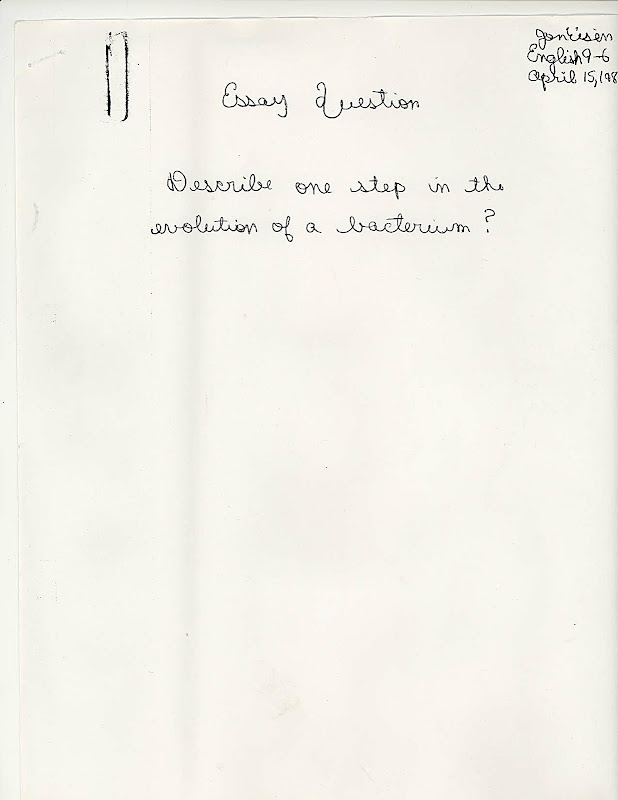
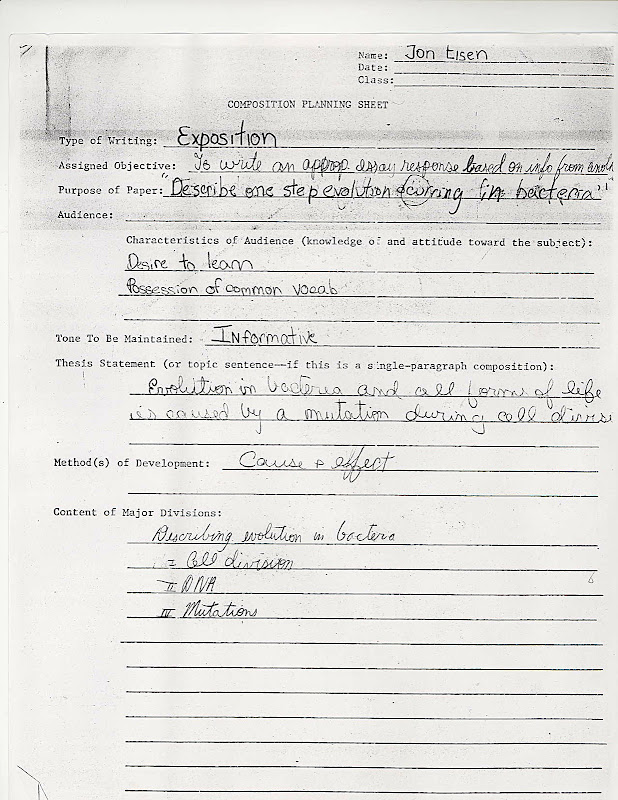
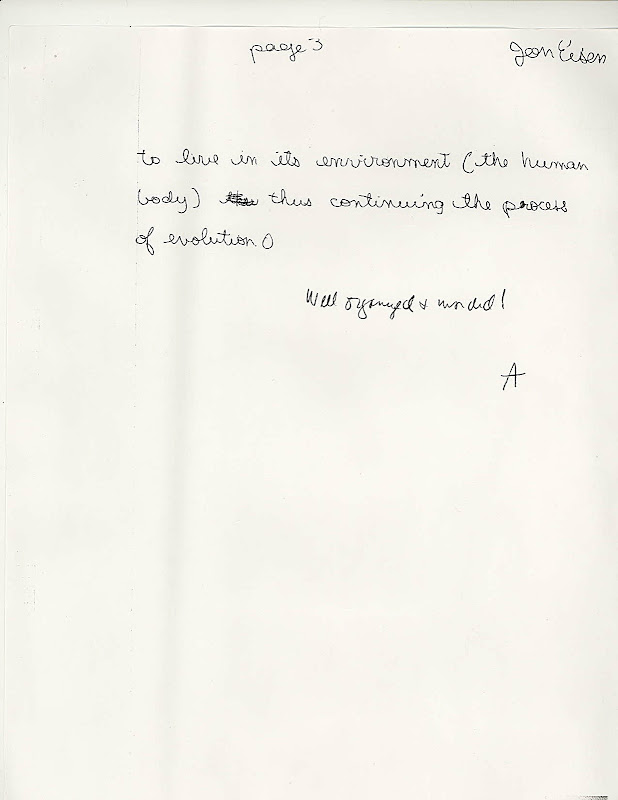
But I was digging through some old papers and found this ... a paper I wrote in ninth grade. We got to select a topic for the paper and mine ... "Describe one step in the evolution of a bacterium." The funny thing is --- I do not remember this at all. I mean, I remember reading books by Gould that got me interested in evolution. But surely Gould did not write a lot about bacterial evolution. Where did I come up with this topic? I haven't a clue. Anyway - here is the essay - errors, fluffy handwriting, and all.


Wednesday, January 23, 2008
Leslie Orgel - Still Speaking Wisely and Openly Even After Death
He had me at the beginning ... and as usual has very clear discussions of the steps needed for life to have originated:
If complex cycles analogous to metabolic cycles could have operated on the primitive Earth, before the appearance of enzymes or other informational polymers, many of the obstacles to the construction of a plausible scenario for the origin of life would disappear. If, for example, a complex system of nonenzymatic cycles could have made nucleotides available for RNA synthesis, many of the problems of prebiotic chemistry would become irrelevant. Perhaps a simpler polymer preceded RNA as the genetic material—for example, a polymer based on a glycerol-phosphate backbone [5] or a phosphoglyceric acid backbone. Could a nonenzymatic “metabolic cycle” have made such compounds available in sufficient purity to facilitate the appearance of a replicating informational polymer?The paper then discusses details of various metabolic cycles and why the current evidence is not completely convincing in terms of the exact path that was taken in the origin of life. Note to ID supporters - this does not friggin' mean that he is saying life could not have originated from non living systems. He is simply pointing out that our understanding of it is incomplete. As, by the way, is our understanding of how blood works. But that does not stop us from thinking that blood does in fact, well, work.
Anyway, once you get over the fact that some ID supporters will misuse his work, the end is a great call for what needs to be done:
The prebiotic syntheses that have been investigated experimentally almost always lead to the formation of complex mixtures. Proposed polymer replication schemes are unlikely to succeed except with reasonably pure input monomers. No solution of the origin-of-life problem will be possible until the gap between the two kinds of chemistry is closed. Simplification of product mixtures through the self-organization of organic reaction sequences, whether cyclic or not, would help enormously, as would the discovery of very simple replicating polymers. However, solutions offered by supporters of geneticist or metabolist scenarios that are dependent on “if pigs could fly” hypothetical chemistry are unlikely to help
Yes, that is right, he got "if pigs could fly" into a paper. He was a great scientist. And it is nice for me to see one more paper of his. And this one, unlike pigs, can fly forever, because it is truly OA.
Saturday, January 19, 2008
Syphilis origin solved?
There was an extensive article about this study in the New York Times on 1/15/08 (by John Noble Wilford). Overall the Times article is good (except Wilford gets the definition of phylogenetic analysis a bit wrong - saying it is the study of the evolutionary relationships between organisms when really it is the study of evolutionary relationships of anything... but hey that is OK).
I confess I am not sure if I am completely convinced by all of Harper et al's arguments concerning the evolution of these bugs. My main concern is that the amount of variation they observe (in ~ 20 genes across these strains) is very very low. And thus the resolution of the phylogenetic trees is quite poor.
Because this is a PLoS paper, it is truly "Open Access" and I can include the Figure here in my blog as long as I cite the original source (see below). If you look at the tree you can see some #s on the branches in the tree. These are based on a statistical test called bootstrapping and the numbers indicate (roughly) how well the tree that is shown represents all of the polymorphisms in the data. The #s are percentages and alas the % support is not very high for many of the branches. So a better resolution of the question of the origin of these diseases will likely require, well, a better resolution on the tree. This in turn will likely require complete genome sequences and perhaps more strains samples. Nevertheless, given the results they have, their arguments seem sound ... and this should stimulate people to gather more genomic data from these bugs.
Also see some other blogs on this
- Neil Woodburn
- John Dennehy (who mentions an article by Carl Zimmer in a non OA publication ... find out which by going to his blog)
Here is Figure 3. It is from Harper KN, Ocampo PS, Steiner BM, George RW, Silverman MS, et al. (2008) On the Origin of the Treponematoses: A Phylogenetic Approach. PLoS Negl Trop Dis 2(1): e148. doi:10.1371/journal.pntd.0000148
Figure 3. This maximum likelihood tree is based on 20 polymorphic regions in the T. pallidum genome. Bootstrap support was estimated with 1,000 replicates in order to assess confidence at branching points and are shown within circles where values are high (>90%). Bootstrap support values for both maximum likelihood and maximum parsimony trees are shown, in that order.
Tuesday, January 15, 2008
Is that a sex organ on the cover of Nature?
OK --- dipping into the gutter here a bit. But everyone must check out the cover of Nature this week. The issue is on the genetics of sex, and I'll be damned if that phycomyces colony on the cover (the one in the back) does not look like some sort of male sexual organ.
Monday, January 14, 2008
International Congress of Genetics --- you should all go ---
| Chairs/Speakers | ||||||||||||||||||||||||||||||||||||||||||||||||||||||||||||||||||||||||||||||||||||||||||||||||||||||||||||||||||||||||||||||||||||||||||||||||||||||||
| The following Chairs/Speakers (in alphabetical order) have been confirmed so far:
| ||||||||||||||||||||||||||||||||||||||||||||||||||||||||||||||||||||||||||||||||||||||||||||||||||||||||||||||||||||||||||||||||||||||||||||||||||||||||
Friday, January 11, 2008
Can openness stop wars?
Thanks to Doug Rusch for pointing me to this video of a talk by Michael Shermer. It is a bit over the top, but I like the bit at the end suggesting that open access to information can basically stop wars.
Not sure I buy into the whole argument, but I do think that keeping scientific information behind closed walls is generally a bad idea ....
Thursday, January 10, 2008
Oakley Keeping his Eye on Evolution
It was a generally insightful phylogenomic tour of the evolution of opsins and eyes in animals. He also mentioned a paper he had recently in PLoS One on Animal Opsin evolution. This is from the work of his graduate student David Plachetzki and it does a nice job of doing "phylogenomic" analysis in the way I think of phylogenomics -- that is -- a integration of evolutionary and genomic analyses. (NOTE - I think it is kind of lame that people use the term phylogenomics, which I coined by the way, to refer to "using genomes to infer evolutionary trees). It is a paper worth checking out if you are interested in the origin of novelty.
I am putting links here to some of their figures and embedding them in this blog because, well, I can since PLoS One uses a broad Creative Commons license. For example - see Figure 6 from their paper below (the citation is Plachetzki DC, Degnan BM, Oakley TH (2007) The Origins of Novel Protein Interactions during Animal Opsin Evolution. PLoS ONE 2(10): e1054. doi:10.1371/journal.pone.000105).
Figure 6. Ancestral state reconstruction of G protein-binding interactions for each metazoan opsin-mediated phototransduction cascade obtained by simulated mutational mapping [64] (see methods).For each class of opsin, the P value of the reconstructed ancestral G α interactions is represented in pie graphs. Ancestral G protein interactions in phototransduction cascades mediated by ciliary, rhabdomeric and Go opsins can be significantly resolved (P>0.95) but the ancestral states of the rhabdomeric+Go, and cnidops clades are equivocal. ML state reconstructions shown for each node as colored branches. Red, Gi/t; Blue, Gq; Green, Go; Black, no G protein interaction (as is the case for RGR/Retinochrome opsins); Grey, equivocal reconstruction from ML. Reconstructed ancestral amino acid motifs of the 4th cytoplasmic loop region of opsin are shown along branches in logos. Maximum vertical height scales to P = 1.0. We obtained clear reconstructed states for most of the residues in a conserved tripeptide motif (residues 310, 311 and 312, horizontal bar) for the ciliary, rhabdomeric and Go /RGR nodes. For the most part, the remainder of the residues in can be unequivocally reconstructed to the level of Dayhoff classes. B = HRK, X = LIVM, J = GATSP, Z = DENQ..
See also Figure 2
"Figure 2. Unrooted metazoan-wide phylogeny of opsins, new cnidarian genes in bold, branches proportional to substitutions per site. Circles at nodes indicate Bayesian posterior probabilities (White = 1.0, Red>0.90, Blue>0.80, Green>0.70, Yellow>0.60, Black>0.50). cil = ciliary, rh = rhabdomeric."
Monday, January 07, 2008
Science and the presidential election
Steve Salzberg has summary information and some comments here.
Popular Mechanics has some info here
The ever active Bora has some comments here
Wired has a bit here
My little bit .... I think science is clearly not strongly supported by the current administration. However, scientists need to be careful about how they word things, since in the end, we are asking for money from taxpayers to, well, pay our salaries and pay for our work. This is one of the reasons I am very strongly in support of "open science." The more open we scientists are, I think, the easier it is to justify to the "public" that we deserve some of their/our money. That is not to say that lots of taxpayer money is not completely wasted on other things. And even not completely open science is frequently good for the world. But openness should help make scientists not seem so ivory toweresque and would show that we want to give back in exchange for what we are given.
Sunday, January 06, 2008
More fun at Long's
Friday, January 04, 2008
Shameless Self Promotion ---- Another Good Review on my New Evolution Textbook
In the review Hartl tells a story about an encounter with Max Delbrück at Cold Spring Harbor where Delbruck implied that molecular aspects of evolution were uninteresting. Hartl goes on to say many nice things about our book (he does get on our case about having problems on the web and not in the book - but hey nobody is perfect). My favorite from the review is the following
Textbooks in evolutionary biology have gen-Thanks Dr. Hartl. And a much belated thanks for a personal encounter that I had with you many years ago where you were MUCH more encouraging to me about working on bacterial genomes than Delbruck was to you about molecular evolution.
erally kept pace with these changes and several
excellent books are available. This new one by
Barton and colleagues is among the best. The
production quality is superb in layout, compo-
sition, typesetting, colour palette, illustrations
and gorgeous half-tones; and the writing is
excellent, as one might expect from such a stel-
lar cast of experts in population genetics, palae-
ontology, human genetics, bacterial genomics
and developmental biology (respectively).
Microbial communities highlighted by MIT Technology Review: The Year in Biotech
The selected key items that they discuss:
- Personal genomics
- Microbial communities
- Stem cells without embryos
- Brain repair
- Human genetic variation
Wednesday, January 02, 2008
In memory of Sam Karlin
His passing saddens me greatly. Sam was a curmudgeony guy at times, but also a great scientist and teacher. He was one of my mentors when I was in graduate school at Stanford. I was kind of a fish out of water --- trying to learn boinformatics in a lab that studies the cell biology of DNA repair processes. So I took a course from Sam Karlin and Volker Brendel and then spent three years meeting on and off with Sam in his office discussing various aspects of genome and gene sequence analysis. We did not always agree. But I think I learned more about bioinformatics from those meetings with Sam than from anything else I have done in my career.
Sam reminded me a lot of my grandfather (who was a physicist). We would meet to ostensibly talk about RecA (my favorite protein) or DNA composition (Sam's favorite thing at the time) or evolution or something or other. But Sam turned every meeting into some type of lesson about bioinformatics. We rarely got to our end goal, but that did not really matter.
So - in his honor I am going to start a new section of this blog --- the Something about Math in Biology or the SAM in Biology section ... stay tuned.
NOTE Lee Altenberg has a memorial page to him, consisting of his doctoral advisor genealogy:
Friday, December 28, 2007
Why "neglected tropical diseases" are going to bite us in the *$
Neglected tropical diseases. You certainly don't want to get them (I have had at least one). And they are not as neglected as they used to be with some money being dedicated to them (e.g. from the Gates Foundation) and their own PLoS journal dedicated to them and even famous people blogging about them. The World Health Organization pushes for them to get more attention.
But given that these diseases kill and injure BILLIONS of people and cause untold amounts of economic damage, they clearly still do not get what they deserve, in terms of research dollars and drug development efforts, etc.
Well, listen up people in the non-tropical (a.k.a. developed) world. Even if the "let's help others" line does not light your fire, you better start worrying about these diseases. That is because many of these diseases are on the march in part due to global warming and will likely soon be a bigger part of our life in the developed world.
There has been lots in the press and web about this but it still seems to get ignored which is why I am blogging about it here. For example see
The thing that reminded me of this issue was a 12/23/07 New York Times article discussing the spread of the tropical virus that causes chikungunya into Europe for the first time.
So, next time you are lingering in Berlin or New York or Moscow and you feel a weird itch. Or have a fever that just won't go away. Or have strange swellings where you never had them before. Don't just look for diseases that were once common wherever you are. Start to think about things like Dengue (my favorite, since I have had it). And maybe just maybe, you should start to worry about these things BEFORE you get them. And support efforts to make these diseases not so neglected.
Wednesday, December 26, 2007
Happy Hollidays Open Access Movement
Under the bill's terms, scientists getting grant money from the National Institutes of Health would now have to submit to the NIH a final copy of their research papers when those papers are accepted for publication in a journal. An NIH database would then post those papers, free to the public, within 12 months after publication.I am giddy with excitement about this. Congratulations to all who lobbied so hard for this, such as Heather Joseph from SPARC. Her quote from the Post article is helpful here:
"The basic reason we went to bat so hard for this was because we thought it was the right thing to do with taxpayers' science," Joseph said. "Now there will be $29 billion in taxpayer investments freely available to the public," she said, referring to the NIH medical research budget
Most recent post
A ton to be thankful for -- here is one part of that - all the acknowledgement sections from my scholarly papers
So - it is another Thanksgiving Day and in addition to thinking about family, and football, and Alice's Restaurant, I also think a lot a...
-
Wow. Just wow. And not in a good way. Just got an email invitation to a meeting. The meeting is " THE FIRST ANNUAL WINTER Q-BIO ...
-
I have a new friend in Google Scholar Updates I have written about the Updates system before and if you want more information please see...
-
See Isolation and sequence-based characterization of a koala symbiont: Lonepinella koalarum Paper based on PhD thesis work of Katie Dahlha...