- "Studies in adults show that more than 90 percent of patients are cured following such therapy and, experts say, they have every reason to believe the numbers would be equally impressive in children." - not sure this is true (i.e., the 90% cured level).
- In less than a decade, we’ll have lab-cooked poop that we can administer to restore balance in the guts of people with a wide array of conditions caused by the imbalance between good and bad germs.” OK - a bit overenthusiastic
- But this is my favorite: "The concept is hardly new. The method originated with ancient Chinese healers who gave their diarrhea-ravaged patients “yellow soup,” a concoction of fecal matter and water. Thousands of years later, the delivery approach has evolved" - So - I have been writing and talking about fecal transplants for a while now (e.g., see this) and have linked them to coprophagy and poo tea and such but never heard of the yellow soup thing.
Sunday, September 22, 2013
Jerusalem Post on Allergy and Fecal transplants
Some interesting tidbits in this Jerusalem Post article: Health Scan: Ungluing the complexity of allergy | JPost | Israel News (a bit overenthusiastic too but just thought I would point some of these lines /quotes out):

Friday, September 20, 2013
The Saga of Howard Zochlinski, ex-#UCDavis PhD Student
I met with Howard Zochlinski last week at UC Davis. His story is like none I have ever heard. Howard does not have ready web access. He has little money. He needs to go to the library to check his email. And he met with me to ask me to share his story. And I readily agreed to. I do not know ANY of the history personally. I do not even know whether all of what he says is true or not. But the story is worth putting out there in my opinion for people to make their own judgements.
To begin to get to know the details behind the saga of Howard Zochlinski you might want to start with the petition he just posted on Change.Org: Petitioning To The Honorable John G. Roberts, Chief Justice, and the Honorable Justices of the Supreme Court of the United States.
Other sources of information about Howard's story are linked below:
I am still trying to wrap my brain around the whole saga. But if even a tiny fraction of it is true, which certainly seems to be these case, he has been pretty badly treated. Again, I do not know all the details or what is the "truth" but I can say for certain that Howard continues to struggle and I cannot for the life of me see any reason not to allow him to be readmitted as a student.
To begin to get to know the details behind the saga of Howard Zochlinski you might want to start with the petition he just posted on Change.Org: Petitioning To The Honorable John G. Roberts, Chief Justice, and the Honorable Justices of the Supreme Court of the United States.
Other sources of information about Howard's story are linked below:
- DavisWiki page: Howard Zochlinski (with lots of background and links)
- Sacramento News and Review Story from 2001: Howard's End
- UC Davis student paper "The Aggie" story from 2011: Two-decade-long fight for Ph.D. continues
- Facebook Page maintained by Howard (I think): Justice for Howard Zochlinski
The DavisWiki page summarizes some of the details on the saga and I have copied the current text from there below:
Howard Zochlinski has been the center of academic and judicial controversy within California and the UC System, including at UC Davis.
When Howard was an undergraduate at UC Santa Barbara in the early 1970s he was arrested; none of the charges stuck. 20 years later he was a Genetics doctoral candidate at UC Davis and was arrested by the same policeman who had arrested him back in Santa Barbara.
The arrests in Santa Barbara resulted in either dropped charges or were thrown out of court. All three of these arrests were made by the same two officers, John Jones and John MacPherson. Howard believes that these arrests were the result of his being a Vietnam War protestor. During his detainment he claims that he was sexually assaulted while in police custody and believes that officer Jones was instrumental in arranging it.
He transferred to UC Berkeley where four years later he graduated with a Bachelors degree. He then earned two Masters over the next six years from University of Hawaii and John Hopkins University. During this time officer Jones transferred from UC Santa Barbara to the UC Davis Police Department.
In 1984 Howard was admitted to UC Davis as a PhD candidate. In 1992 officer Jones again arrested Howard, this time for stalking. Jones claims that there was nothing personal or targeted about the arrest; Howard claims that the arrest was the result of Jones holding a vendetta and being an anti-semite. This charge as well was dropped when the victim did not appear in court. Howard also maintains that Jones arrest report does not meet the legal definition for the charges that were filled against him.
In 1993 he was arrested again, but acquitted in court. His defense attorney claimed that the police were not conscientious in the manner in which they handled the case. It does not appear that officer Jones was involved in this case.
Shortly prior to the time of this last arrest after having been a PhD candidate for 9 years Howard was dismissed for not filling an acceptable thesis by the deadline his committee had assigned.
Howard believes that the stalking arrest had prejudiced his department against him. Part of his feelings of persecution stem from having had a conduct hold placed on his academic record; one with an end date in the year 2099. Student Judicial Affairs says that this was a clerical error. Howard thinks that this contributed to his difficulty in landing a job.
Howard filed a lawsuit with the University in regards to his dismissal as a student. As of 2006, the details and status of this lawsuit are unknown. In 2005, the Academic Senate of UC Davis overwhelmingly ruled to re-admit Zochlinski as a student. Such a ruling by the Academic Senate is fairly unheard of, prompting University officials to question what would happen next. However Jeff Gibeling, Dean of Graduate Studies, ruled against readmitting Zochlinski on the basis that his predecessor had made the same ruling. As such, this case is still ongoing.
Tuesday, September 17, 2013
Really? Nature put the #HeLa genome paper behind a paywall? Time for Nature Publishing Group to return ALL money obtained from genome papers
This is just fucking ridiculous. As I have written about many many times - Nature Publishing Group many years ago promised to make papers reporting genome sequence data freely available. They do not generally live up to this promise well. See for example


- Hey Nature Publishing Group - When are you going to live up to your promises about "free" genome papers? #opengate #aaaaaarrgh
- Please help keep the pressure on Nature Publishing Group to restore free access to genome papers #opengate
- I am highly skeptical of the CHORUS system proposed by scientific publishers as an end run around PubMed Central
- Calling on Nature Publishing Group to return all money received for genome papers and article corrections
- A Solution to Nature Publishing Group's Inability to Keep Free Papers Free: Deposit them in Pubmed Central
Today I discovered that not only are some important genome papers not freely available but one for the ages - the paper on the HeLa genome - reported with much fanfare recently as a triumph of an agreement with the family of Henrietta Lacks - is only available if you pay.


Once again I call on Nature Publishing Group to publicly disclose all financial gains that have come from people paying for the these genome papers and for the money to be returned.
Friday, September 13, 2013
Can academics use the "copyright termination" system to recover academic works?
Heard an interesting story on copyright termination on NPR last night: Taking Back 'Funkytown': Songwriters Prepare For A Custody Battle By Joel Rose. This in turn led me to a New York Times article on the same general topic: A Copyright Victory, 35 Years Later - NYTimes.com.
The gist of these stories is that it turns out UC Copyright law has a "termination" provision which allows artists / writers / etc to terminate copyright agreements that they made for work they produced. This is allowed 35 years after the copyright was assigned. And many musicians are using this provision of copyright law to reacquire some works they made three and a half decades ago.
So - I am asking the world out there - could this same provision be applied to scientific or academic works? Would this be a way to move a lot of material that is behind a wall back into the hands of authors and/or into the public domain? I am looking into doing this with work published by my father as a test case (as part of my long struggle of Freeing My Father's Publications (since termination rights apparently transfer to family members if the holder passes away as my dad did in 1987).
So - anyone out there know if this termination has been used for scientific or academic works?
UPDATE: Other reading
The gist of these stories is that it turns out UC Copyright law has a "termination" provision which allows artists / writers / etc to terminate copyright agreements that they made for work they produced. This is allowed 35 years after the copyright was assigned. And many musicians are using this provision of copyright law to reacquire some works they made three and a half decades ago.
So - I am asking the world out there - could this same provision be applied to scientific or academic works? Would this be a way to move a lot of material that is behind a wall back into the hands of authors and/or into the public domain? I am looking into doing this with work published by my father as a test case (as part of my long struggle of Freeing My Father's Publications (since termination rights apparently transfer to family members if the holder passes away as my dad did in 1987).
So - anyone out there know if this termination has been used for scientific or academic works?
UPDATE: Other reading
- U.S. Copyright Office - Copyright Law: Chapter 2
- Navigating US Copyright Termination Rights - WIPO
- United States Copyright Termination Rights: What Does the Future ...
- Copyright Termination Rights: Giving Artists Their Second Bite at the ...
- Superman Lawsuit Tests Copyright Termination Rights | Astronomy ...
Thursday, September 12, 2013
Story behind the paper guest post by Corey Nislow (w/ Metka Lenassi) on "Genomics w/o Borders"
Below is another in the "Story behind the paper" series of guest posts here. This one is from Corey Nislow w/ Metka Lenassi. If anyone else has published an open access paper on anything relating to this blog and would like to write a guest post on the Story behind the paper, please let me know.
Genomics without Borders: Genome Sequence of the Extremely Halotolerant Yeast Hortaea werneckii
by Corey Nislow (with Metka Lenassi)
The story is set in Slovenia a beautiful country which was part of the former Yugoslavia and which is home to about 2 million inhabitants, 2400+ fungal species (thanks Wikipedia) and some very interesting environments. One of these environments is the Secovlje Salterns where one can find the yeast Hortaea werneckii.
I hadn't heard of Hortaea until I started googling around looking for a yeast extremophile that I can grow in the lab to dissect out its nucleosomes to ask questions regarding nucleosome occupancy and transcription in the face of extreme environments. Turns out it was not a crazy idea--
13 years ago a peculiar black yeast Hortaea werneckii was isolated from its natural habitat: waters containing so much salt, it would kill most living organisms instantly. Since then, two small (but enthusiastic) Slovenian groups have tried to understand its halotolerance. This demanded field trips to the beautiful Slovenian coast, but also a lot of hard work and inventiveness to optimizing protocols used for other organisms – and to do it on a low budget. The first important obstacle was actually cultural - to persuade the scientific community that such extreme yeast even exists in nature! You can see it below. We now have ample evidence as Hortaea has been isolated from many seawater-related environments, saline lakes, but also from surface layers of tropical microbial mats in salterns and even from spider webs in Atacama Desert caves. All these different Hortaea strains are now waiting in their freezer (the Ex culture collection) to be analyzed.
 |
| A worker harvests sea salt in the Secovlje salterns, July 17, 2010. Some 2600 tons of salt is expected to be produced during the two and a half month season at the salterns.(Xinhua/Reuters Photo) |
I hadn't heard of Hortaea until I started googling around looking for a yeast extremophile that I can grow in the lab to dissect out its nucleosomes to ask questions regarding nucleosome occupancy and transcription in the face of extreme environments. Turns out it was not a crazy idea--
13 years ago a peculiar black yeast Hortaea werneckii was isolated from its natural habitat: waters containing so much salt, it would kill most living organisms instantly. Since then, two small (but enthusiastic) Slovenian groups have tried to understand its halotolerance. This demanded field trips to the beautiful Slovenian coast, but also a lot of hard work and inventiveness to optimizing protocols used for other organisms – and to do it on a low budget. The first important obstacle was actually cultural - to persuade the scientific community that such extreme yeast even exists in nature! You can see it below. We now have ample evidence as Hortaea has been isolated from many seawater-related environments, saline lakes, but also from surface layers of tropical microbial mats in salterns and even from spider webs in Atacama Desert caves. All these different Hortaea strains are now waiting in their freezer (the Ex culture collection) to be analyzed.
 |
| Hortaea werneckii growing happily on 2M salt. |
Monday, September 09, 2013
Nice show on KQED on Inspiring Girls and Women to Code #Diversity #STEM
Listened to a nice show on KQED this AM on my bike ride in to work (note - I listen with one earplug in, and one ear free to hear the world around me, and I listed on relatively low volume ...). We still need to do so much to make STEM fields and related fields more diverse ...
Inspiring Girls and Women to Code:
Inspiring Girls and Women to Code:
Saturday, September 07, 2013
Families that share everything: Health2Fit video on brother helping sister by being a donor for a fecal transplant
I guess today is fecal transplant day. So why not a little news story from Health2Fit about families that share everything ...
Fecal transplants taken up by American Hospital Association in letter to HHS about Medicare/Medicaid
Interesting discussion of Fecal Transplants is this letter from the American Hospital Association to HHS about Medicaid / Medicare: Marilyn Tavenner September 6, 2013 Page 1 of 33 September 6 ...
Key text is below:
Effective with the 2013 edition of the CPT manual, the American Medical Association developed the CPT code 44705 (Preparation of fecal microbiota for instillation, including assessment of donor specimen) that includes:
Key text is below:
"FECAL MICROBIOTA TRANSPLANTATION
Fecal microbiota transplantation (FMT), also known as fecal bacteriotherapy, or human probiotic infusion, is a medical treatment for patients with Clostridium difficile (C. difficile) enteritis or ulcerative colitis. C. difficile infection occurs in patients who have been administered antibiotics for a long period of time. The antibiotics destroy important disease-fighting bacterial flora in the intestine. Fecal transplants are believed to restore the bacteria back to normal, and the patient can recover. The fecal transplant works by repopulating friendly flora in the infected intestines. The donated feces is screened for disease and then mixed with a saline solution to the consistency of a “milkshake.” FMT can be performed by various routes including nasogastric (NG) tube, nasojejunal tube, upper tract endoscopy (EGD), colonoscopically or by retention enema. However, based on an editorial published in the Journal of Clinical Gastroenterology (Volume 45, Number 8, September 2011), colonoscopic FMT is the preferred method for the vast majority of C. difficile infection patients, and if carried out early, may prevent development of severe infection.
Fecal microbiota transplantation (FMT), also known as fecal bacteriotherapy, or human probiotic infusion, is a medical treatment for patients with Clostridium difficile (C. difficile) enteritis or ulcerative colitis. C. difficile infection occurs in patients who have been administered antibiotics for a long period of time. The antibiotics destroy important disease-fighting bacterial flora in the intestine. Fecal transplants are believed to restore the bacteria back to normal, and the patient can recover. The fecal transplant works by repopulating friendly flora in the infected intestines. The donated feces is screened for disease and then mixed with a saline solution to the consistency of a “milkshake.” FMT can be performed by various routes including nasogastric (NG) tube, nasojejunal tube, upper tract endoscopy (EGD), colonoscopically or by retention enema. However, based on an editorial published in the Journal of Clinical Gastroenterology (Volume 45, Number 8, September 2011), colonoscopic FMT is the preferred method for the vast majority of C. difficile infection patients, and if carried out early, may prevent development of severe infection.
Effective with the 2013 edition of the CPT manual, the American Medical Association developed the CPT code 44705 (Preparation of fecal microbiota for instillation, including assessment of donor specimen) that includes:
- development of the intestinal instillate for the recipient; and
- evaluation of the donor specimen, including the physician review of results of testing the donor’s specimen for infectious pathogens
Fecal transplant recruiting on Craigslist
See this Craigslist post for the Boston area: Are you a healthy adult, 18-50 years old? - copied below. It seems that fecal transplants really are everywhere ...
Fecal Microbiota Transplant
Healthy adult volunteers 18-50 years old
Involves donation of stool samples and medical screening
Blood draws, complete medical exam
No medical problems
5-7 out-patient visits at MGH
Compensation up to $700 for completion of study
617-724-8625
Are you a healthy adult, 18-50 years old? (Massachusetts General Hospital)
Healthy adult volunteers 18-50 years old
Involves donation of stool samples and medical screening
Blood draws, complete medical exam
No medical problems
5-7 out-patient visits at MGH
Compensation up to $700 for completion of study
617-724-8625
Posting ID: 4050676649
Posted: 2013-09-06, 4:04PM EDT
Updated: 2013-09-06, 5:09PM EDT
Friday, August 30, 2013
Overselling the microbiome award: Swiss National Science Foundation on smoking, weight gain and bacteria

National Post:
- The title alone shows how badly they were misled by the authors: there is NO evidence that changes in bacteria caused anything here.
- "Have you noticed that you gain weight every time you quit smoking?" ... "you may be surprised to learn that it has little to do with your calorie intake." "Researchers attributed the weight gains to changes in the bacterial diversity of the intestine."
- Thanks "researchers" for misleading everyone about your study.
The saga of my pancreas..feet..microbiome ..blood.. liver - part 1
Well, this just keeps going - on and on and on. I thought I would be able to write a post when it was all done. But clearly not. So below is part 1 of an ongoing tale about me - my microbiome - my pancreas - my feet - my liver - my blood - and more.
This particular saga started - I guess - in 1984. That was when, at 15 years old, I came pretty close to dying before being diagnosed with type I diabetes.
My immune system had betrayed me by killing the beta cells in my pancreas. Thanks a lot immune system. Anyway - this is not supposed to be a post about diabetes. So - flash forward to a few weeks ago. Diabetes for almost 30 years and no major complications to note. Many annoyances. Some minor complications. But overall, I am doing OK. Obsessive checking of my blood sugar and trying to keep my sugar in control and trying to regularly exercise seems to have kept the diabetes gods appeased. Eyes generally always have looked good. Feet HAD always checked out. Kidneys always seemed good. Knock on wood - all was as good as I could hope for.
But then ... something came up. A month and a half or so ago I kept noticing this funny feeling on the bottom of my right foot. Near the toes. Exactly the same kind of feeling one gets when one has a bandaid or tape stuck to my foot (which, given I have two kids both of whom put bandaids on every minor scratch and then leave them lying all over the house and our pool deck - is not too rare). I thought - maybe the feeling will go away. But it didn't. It was lurking there. And after a week or so I decided I should get my doctor to check it out. So I put in an electronic request for an appointment on 7/21:
 |
| Medical Record from my being admitted to the hospital in 1984. |
My immune system had betrayed me by killing the beta cells in my pancreas. Thanks a lot immune system. Anyway - this is not supposed to be a post about diabetes. So - flash forward to a few weeks ago. Diabetes for almost 30 years and no major complications to note. Many annoyances. Some minor complications. But overall, I am doing OK. Obsessive checking of my blood sugar and trying to keep my sugar in control and trying to regularly exercise seems to have kept the diabetes gods appeased. Eyes generally always have looked good. Feet HAD always checked out. Kidneys always seemed good. Knock on wood - all was as good as I could hope for.
But then ... something came up. A month and a half or so ago I kept noticing this funny feeling on the bottom of my right foot. Near the toes. Exactly the same kind of feeling one gets when one has a bandaid or tape stuck to my foot (which, given I have two kids both of whom put bandaids on every minor scratch and then leave them lying all over the house and our pool deck - is not too rare). I thought - maybe the feeling will go away. But it didn't. It was lurking there. And after a week or so I decided I should get my doctor to check it out. So I put in an electronic request for an appointment on 7/21:
Wednesday, August 28, 2013
Overselling the microbiome award: VIB press release saying "Intestinal flora determines health of obese people"
Now, mind you, the person discussed in this PR Jeroen Raes is completely brilliant and one of my favorite people in science in many ways. And also it is important to point out that the paper does not make these claims. The paper says things like
Our classifications based on variation in the gut microbiome identify subsets of individuals in the general white adult population who may be at increased risk of progressing to adiposity-associated co-morbidities
Announcing CAFA 2: The Second Critical Assessment of Protein Function Annotations
Just received this from Iddo Friedberg:
Friends and Colleagues,
We are pleased to announce the Second Critical Assessment of protein
Function Annotation (CAFA) challenge. In CAFA 2, we would like to
evaluate the performance of protein function prediction tools/methods
(in old and new scenarios) and also expand the challenge to include
prediction of human phenotypes associated with genes and gene
products. As the last time, CAFA will be a part of the Automated
Function Prediction Special Interest Group (AFP-SIG) meeting that will
be held alongside the ISMB conference. AFP-SIG will be held as a
two-day meeting in July 2014 in Boston.
The targets and all information about the CAFA challenge are now
available at http://biofunctionprediction.org. The submission deadline
for predictions is January 15, 2014. The initial evaluation will be
done during the AFP-SIG meeting in Boston. Anyone in the world is
welcome to participate.
The mission of the Automated Function Prediction Special Interest
Group (AFP-SIG) is to bring together computational biologists who are
dealing with the important problem of gene and gene product function
prediction, to share ideas and create collaborations. We also aim to
facilitate interactions with experimental biologists and biocurators.
We hope that AFP-SIG serves an important role in stimulating research
in annotation of biological macromolecules, but also related fields.
About the CAFA experiment
Friends and Colleagues,
We are pleased to announce the Second Critical Assessment of protein
Function Annotation (CAFA) challenge. In CAFA 2, we would like to
evaluate the performance of protein function prediction tools/methods
(in old and new scenarios) and also expand the challenge to include
prediction of human phenotypes associated with genes and gene
products. As the last time, CAFA will be a part of the Automated
Function Prediction Special Interest Group (AFP-SIG) meeting that will
be held alongside the ISMB conference. AFP-SIG will be held as a
two-day meeting in July 2014 in Boston.
The targets and all information about the CAFA challenge are now
available at http://biofunctionprediction.org. The submission deadline
for predictions is January 15, 2014. The initial evaluation will be
done during the AFP-SIG meeting in Boston. Anyone in the world is
welcome to participate.
The mission of the Automated Function Prediction Special Interest
Group (AFP-SIG) is to bring together computational biologists who are
dealing with the important problem of gene and gene product function
prediction, to share ideas and create collaborations. We also aim to
facilitate interactions with experimental biologists and biocurators.
We hope that AFP-SIG serves an important role in stimulating research
in annotation of biological macromolecules, but also related fields.
About the CAFA experiment
Stunningly bad news-like report on UC Davis neurosurgeons - bacteria in brain story
Well, if you are not keeping up the saga of the UC Davis neurosurgeons who injected bacteria into patients brains continues.
This week it was reported that the surgeons have (finally) stepped down from UC Davis Medical School: See the SacBee story for more detail.
Also I have been compiling information on the case here: #UCDavis neurosurgeons conducted experimental surgery w/o IRB approval.
And personally I am glad to see them go. That being said, it would be nice if news stories about the case were not too outrageous. This one from "NerdAlert" is particularly bad:
This week it was reported that the surgeons have (finally) stepped down from UC Davis Medical School: See the SacBee story for more detail.
Also I have been compiling information on the case here: #UCDavis neurosurgeons conducted experimental surgery w/o IRB approval.
And personally I am glad to see them go. That being said, it would be nice if news stories about the case were not too outrageous. This one from "NerdAlert" is particularly bad:
Tuesday, August 27, 2013
#UCDavis Department of Evolution & Ecology Faculty Search for an "Ecologist"
ECOLOGIST, UNIVERSITY OF CALIFORNIA, DAVIS -- The College of Biological Sciences, University of California, Davis invites applications and nominations for a tenure-track position in the Department of Evolution and Ecology at the ASSISTANT PROFESSOR level. Candidates must have a Ph.D. (or equivalent) in the biological sciences or related fields. We seek a terrestrial or freshwater ecologist with research interests that will complement and build upon existing faculty strengths to address important ecological questions. We welcome applicants who address important ecological questions at any spatial or temporal scale. We seek a colleague who is committed to participating in the departmental community through collaborative teaching, research, service and graduate mentoring. Letters of recommendation should specifically address this aspect of the application. The successful candidate will be expected to teach in undergraduate and graduate programs, and should be committed to mentoring and fostering diversity. Applicants should submit materials online at
which contains additional information about the position. These should include: cover letter, curriculum vitae, description of current and projected research, summary of teaching interests and experience, and three publications. Applicants should also provide the information requested for three referees (fourth referee optional). Once entered, applicants will electronically request letters from referees who will then be prompted by email with upload instructions for their letters. Closing Date: Open until filled, but all application materials, including letters of recommendation, must be received by October 15th, 2013 to assure full consideration. Administrative contact: Carla Munoz (camunoz@ucdavis.edu). Faculty contacts: Jay Stachowicz (jjstachowicz@ucdavis.edu), Sharon Strauss (systrauss@ucdavis.edu). The University of California is an Equal Opportunity/Affirmative Action Employer with a strong institutional commitment to the development of a climate that supports equality of opportunity and respect for differences.
Monday, August 26, 2013
Spammy journal Editorial Board invitation of the week - Avens Journal of Food Processing and Beverages
I get lots of semi-Spammy email invites to be involved in various new journals. Here is one from this week. I figure - the more I post such things, when people Google for the journal they will sometimes see my posts about how idiotic some of these journals are. No idea how I ended up on their radar here ..
We are glad to invite you as an eminent editor for the Journal of Food Processing and Beverages (JFPB). Journal of Food Processing and Beverages is an international, non profit, open access, peer reviewed journal that is being recently launched by Avens Publishing Group with a commitment to serve the scientific community.
We are aware of your reputation and distinction in research in some of the fields relating to our journal and that is why you have been chosen as an Editorial Board Member of our Journal of Food Processing and Beverages.
Editorial Board benefits:
Dear Dr. Jonathan Eisen,
We are glad to invite you as an eminent editor for the Journal of Food Processing and Beverages (JFPB). Journal of Food Processing and Beverages is an international, non profit, open access, peer reviewed journal that is being recently launched by Avens Publishing Group with a commitment to serve the scientific community.
We are aware of your reputation and distinction in research in some of the fields relating to our journal and that is why you have been chosen as an Editorial Board Member of our Journal of Food Processing and Beverages.
Editorial Board benefits:
Thursday, August 22, 2013
YAMMGM - yet another mostly male genomics meeting (series): Plant Genomic Congresses by Global Engage

- John Manners, Chief, CSIRO Plant Industry, Australia
- Dave Edwards, Principal Research Fellow, School of Agriculture and Food Sciences, University of Queensland, Australia
- Nagendra Singh National Professor-BP Pal Chair, National Research Centre on Plant Biotechnology, Indian Council of Agricultural Research, India
- Han Zhao, Professor of Biology and Biotechnology, Institute of Biotechnology Jiangsu, Academy of Agricultural Sciences, China
- Huaan Yang, Department of Agriculture and Food (DAFWA), Australia
- Rajeev K. Varshney, Principal Scientist (Applied Genomics) & Director, Centre of Excellence in Genomics, ICRISAT, India
- Apichart Vanavichit, Professor, The Rice Gene Discovery Unit, Kasetsart University, Thailand
- Norman Warthmann, Senior Post Doc, Borevitz Laboratory, ANU College of Medicine, Biology and Environment, Australian National University, Australia
- Chungui Lu Lecturer in Post-Genomics, Faculty of Science, Nottingham University, UK
- Beng Kah (Bk) Song, Lecturer, Monash University, Sunway Campus, Australia/ Malaysia
- Kenneth Olsen, Associate Professor Department of Biology, Washington St Louis University, USA
- Yue-Ie Hsing, Distinguished Research Fellow, Institute of Plant and Microbial Biology, Academica Sinica, Taiwan
- Meilina Ong Abdullah, Breeding and Tissue Culture Unit, The Advanced Biotechnology and Breeding Centre, Malaysian Palm Oil Board (MPOB) Malaysia
- Yijun Ruan, Professor and Director, Systems Biology Center, HuaZhong Agricultural University, Wuhan, China
- Sachiko Isobe, Head Applied Plant Genomics, Kaduza DNA Research Institute (KDRI), Japan
- Yuan-Ming Zhang, Professor of Statistical Genomics, State Key Lab. of Crop Genetics and Germplasm Enhancement, Nanjing Agricultural University, China
- Parveen Chhuneja, Geneticist, Bioinformatics Centre School of Agricultural Biotechnology, Punjab Agricultural University, India
- Shengyi Liu, Professor and Head, The Key Lab of Oil Crops Biology, the Ministry of Agriculture, PRC Department of Genomics, Oil Crops Research Institute, Chinese Academy of Agricultural Sciences, China
- Wen-Hsiung Li, Director and Distinguished Research Fellow, Biodiversity Research Center, Institute of Plant and Microbial Biology, Academica Sinica, Taiwan
- Graham King, Director, Southern Cross Plant Science Professor of Plant Genomics and Epigenetics, Southern Cross University, Australia
- Ryan Lister, Professor/ARC Future Fellow, Plant Energy Biology ARC CoE, School of Chemistry and Biochemistry, The University of Western Australia
- Amitabh Mohanty, Lead Trait Discovery, E.I. DuPont India Pvt Ltd.
Wednesday, August 21, 2013
Institutional repository success story: Master's on "War Eagles" contributes to amazing ring recovery story
 |
| Image from NPR. |
So - how on earth is this a story connected to institutional archives. Well, it turns out that the Turners figured out who the original owner of the ring was because their Google searches based on the ring's inscriptions took them within a few minutes to this Master's Thesis posted in 2006 at the NC State Digital Repository: War Eagles: A Bird's Eye View of 305th Bomb Group and the Eighth Air Force from the experiences of David C. Cox and Joseph B. Boyle - NCSU Digital Repository. The thesis was written by Norwood McDowell, who happens to be the younger Cox's son in law. And his thesis was about the elder Cox and had a brief discussion of the ring.
Kudos to all involved, including NC State and Norwood McDowell for making his Masters thesis available.
Tuesday, August 20, 2013
Strange emails about microbes: probiotic water
I get some strange emails about microbes. Here is one I got today:
Dear Prof. Jonathan,
I am nothing, but I write my wish because of duty for the great future of Probiotics, which shall be big fortune of earth people.
I, by G-d's grace, made Probiotics Multiplication "Water" at my kitchen to help my sister's intestine problem.
And I soon found out how many many applications of the Probiotics Multiplication Water shall be opened for most peoples in the earth.
Please invite me at your cost and let me introduce the Probiotics Water and the vary applications in front of your team, then, I will show 100ml spray and mist of Probiotics Water to them. It would be great great opportunity of your meeting if you will do.
You said in Video of TED website that we have to surround ourselves by good bacteria.
How? I convince the Probiotics Water Mist and Spray is the answer. Easy and economic valuable answer!
- Probiotics Water's color is plain, light pale yellow and near transparency white.
Smell is some sour, and disappeared immediately after spray. -
If you have questions, please send me your reply asap.
My smart phone number : XX-XX-XXXX-XXXX /Phone: XX-XX-XXXX-XXXX
Please send me your message before calling. Thanks very much,
XXXXXX, XX
Pohang City, South Korea
Tuesday, August 13, 2013
Closed access irony of the day: Who Will Pay for Access to Research Data? You Will ...
Though I would share this with people who read this blog but don't follow me on Twitter.

F#$*#ing brilliant - article by Cerf & Berman "Who Will Pay for Public Access to Research Data?" costs $20 to read pic.twitter.com/UOZwGuiXr4
— Jonathan Eisen (@phylogenomics) August 13, 2013

Sunday, August 11, 2013
Because it is there? (Why Larry Smarr freezes his feces)
Hat tip to ...
Why Professor Larry Smarr (@lsmarr) freezes his own faeces | @BBCNews VIDEO http://t.co/fVZrQNXaYo #DigitalHealth #QuantifiedSelf #QS
— Paul Sonnier (@Paul_Sonnier) August 12, 2013
I f$*#@#ing love science but really f$*#Ing hate travel much of the time
Well, have already written a bit about my fun trip to DC on Twitter and Facebook but thought I would sum it up here too.
Last week I had to go to DC for a meeting relating to a Department of Homeland Security grant we have in my lab (it was the annual meeting of the program). Of course the point of the whole trip was to present about our work. And for the record - here are the slides for my talk I gave on Wednesday.
But alas, going to give talks is not just about the Science is it? It unfortunately is also about the travel. And boy do I hate travel most of the time these days. Here is a tale of my trip .... I was supposed to go on Monday but had to delay going until Tuesday due to illnesses in the family. So I called United and changed my flight and called the Westin in Alexandria and changed my hotel reservation and emailed the meeting organizers and let them know.
All seemed good. Then Tuesday AM I got an email from United saying my flight had been cancelled and I had been rebooked on another flight. After calling up United and finding out that the seat upgrade using my miles / Premier status was not available I at least confirmed that I would be getting in to DC not too late. And so after lingering at home I headed to the airport and got on the flight from SMF to Houston.
I got to Houston, walked around for a while and eventually made my way to the connection to DC. I went to board and the machine gave the ticket agent an error message saying "Passenger is not ticketed for this flight" or something like that. Great. And I had to leave the line, go to the desk and wait a bit until someone helped me. There I found out that United had somehow cancelled the entire rest of my flight and thus I was not only no longer booked on a flight to DC I had no return flight either. After a painful but brief delay somehow they put me on the connection and I got to DC.
It was after getting the error message that I ended up engaging some social media to express my frustration and I tweeted about United. And eventually the United Twitter handler got back to me and helped me confirm that I did now have a return flight.
Anyway - I moved on past the United issue and got in a cab in DC and headed to the Westin Alexandria. I got there and checked in. Sadly I found out there was no food available anywhere at the hotel (it was only 10:50 PM or so). So I decided to just go up to my room and crash. I went up to my room and - well - was seriously in for a shock. My room was a meeting room of some sort overrun with meeting tables and with a small, rollaway bed smushed up against the wall.

Oh my God. You have got to be kidding me. I have serious trouble sleeping when I travel and am not exactly the smallest guy in the world. A rollaway bed in the middle of a conference room? Uggh. So I called up the front desk and asked
"Is this some sort of mistake. Is there supposed to be a bedroom connected to this room?"
And the person from the desk said "No. That is your room."
And I said "Well, I can't sleep on that bed"
And he said "Sorry - we are fully booked - that is all we have."
And I said, again "Listen, I called yesterday and confirmed my room and told you I was coming late and this is not acceptable. I want a normal bedroom with a normal bed. Nothing fancy. Just a bedroom."
And he said "OK. I have another room."
So I said "Can someone bring up the key?"
And he said "No. There is no one else here."
So I said "OK I will come back down."
 So I got my stuff and went back down and really wanted to ask "Well, why is there a room now if you told me the room with the rollaway bed was the last room" but I held my tongue. And after a computer malfunction that led to a 5-10 minute wait he gave me a new room key.
And I was off again. Once there, I opened the door to the room and I knew before even getting into it why they did not give it to me at first. It reeked of cigarette smoke. Like someone had a cigarette testing party in the room. Drowning in smoke smell. I took a pic of the air vents to represent the smell ... for what that was worth. So I immediately went to the phone and called the desk again.
Me: "Hey it's the guy who you just gave a new room to. This room is even worse. Unbearable cigarette smell here. Is this a smoking room?"
But alas, going to give talks is not just about the Science is it? It unfortunately is also about the travel. And boy do I hate travel most of the time these days. Here is a tale of my trip .... I was supposed to go on Monday but had to delay going until Tuesday due to illnesses in the family. So I called United and changed my flight and called the Westin in Alexandria and changed my hotel reservation and emailed the meeting organizers and let them know.
All seemed good. Then Tuesday AM I got an email from United saying my flight had been cancelled and I had been rebooked on another flight. After calling up United and finding out that the seat upgrade using my miles / Premier status was not available I at least confirmed that I would be getting in to DC not too late. And so after lingering at home I headed to the airport and got on the flight from SMF to Houston.
I got to Houston, walked around for a while and eventually made my way to the connection to DC. I went to board and the machine gave the ticket agent an error message saying "Passenger is not ticketed for this flight" or something like that. Great. And I had to leave the line, go to the desk and wait a bit until someone helped me. There I found out that United had somehow cancelled the entire rest of my flight and thus I was not only no longer booked on a flight to DC I had no return flight either. After a painful but brief delay somehow they put me on the connection and I got to DC.
It was after getting the error message that I ended up engaging some social media to express my frustration and I tweeted about United. And eventually the United Twitter handler got back to me and helped me confirm that I did now have a return flight.
Anyway - I moved on past the United issue and got in a cab in DC and headed to the Westin Alexandria. I got there and checked in. Sadly I found out there was no food available anywhere at the hotel (it was only 10:50 PM or so). So I decided to just go up to my room and crash. I went up to my room and - well - was seriously in for a shock. My room was a meeting room of some sort overrun with meeting tables and with a small, rollaway bed smushed up against the wall.
Oh my God. You have got to be kidding me. I have serious trouble sleeping when I travel and am not exactly the smallest guy in the world. A rollaway bed in the middle of a conference room? Uggh. So I called up the front desk and asked
"Is this some sort of mistake. Is there supposed to be a bedroom connected to this room?"
And the person from the desk said "No. That is your room."
And I said "Well, I can't sleep on that bed"
And he said "Sorry - we are fully booked - that is all we have."
And I said, again "Listen, I called yesterday and confirmed my room and told you I was coming late and this is not acceptable. I want a normal bedroom with a normal bed. Nothing fancy. Just a bedroom."
And he said "OK. I have another room."
So I said "Can someone bring up the key?"
And he said "No. There is no one else here."
So I said "OK I will come back down."
So I got my stuff and went back down and really wanted to ask "Well, why is there a room now if you told me the room with the rollaway bed was the last room" but I held my tongue. And after a computer malfunction that led to a 5-10 minute wait he gave me a new room key. And I was off again. Once there, I opened the door to the room and I knew before even getting into it why they did not give it to me at first. It reeked of cigarette smoke. Like someone had a cigarette testing party in the room. Drowning in smoke smell. I took a pic of the air vents to represent the smell ... for what that was worth. So I immediately went to the phone and called the desk again.
Me: "Hey it's the guy who you just gave a new room to. This room is even worse. Unbearable cigarette smell here. Is this a smoking room?"
Friday, August 09, 2013
Article by Amy Maxmen "Preserving Research" on ways to share unpublished manuscripts
There is a nice article by Amy Maxmen in The Scientist titled "Preserving Research" on ways to share unpublished manuscripts. It includes some discussion of pros and cons of various archives including arXiv, Figshare, ResearchGate and more. Definitely worth a look. There are of course many many many ways to share your articles before and after you publish them.
For more about sharing PDFs/articles see my post: The Tree of Life: Ten simple ways to share PDFs of your papers. And of course, don't forget that just posting your paper somewhere does not mean that it will continue to be available to all. Also - the license that you use when sharing your article affects how people can use and reshare it so pay attention to the fine print and use as broad a license as possible ...
For more about sharing PDFs/articles see my post: The Tree of Life: Ten simple ways to share PDFs of your papers. And of course, don't forget that just posting your paper somewhere does not mean that it will continue to be available to all. Also - the license that you use when sharing your article affects how people can use and reshare it so pay attention to the fine print and use as broad a license as possible ...
Great use of metagenomic data: community wide adaptation signatures
OK I have been dreaming about doing something like this for many years. One of the potentially most useful aspects of shotgun metagenomic data is that you get a sample of many/all members of a microbial community at once. And then in theory one could look across different species and taxa and ask - do they all have similar adaptations in response to some sort of environmental pressure. There have been a few papers on this over the last few years (e.g. check out this one from Muegge et al on Diet Driving Convergence in Gut Microbes). But this new paper is really the type of thing I have been hoping to see: Environmental shaping of codon usage and functional adaptation across microbial communities. Basically they looked at codon usage in organisms in different metagenomic samples and found major metagenome specific signatures, suggesting that different taxa were in essence converging on common codon usage.
 The paper is definitely worth a look.

Sunday, August 04, 2013
News coverage of SpaceMicrobes event
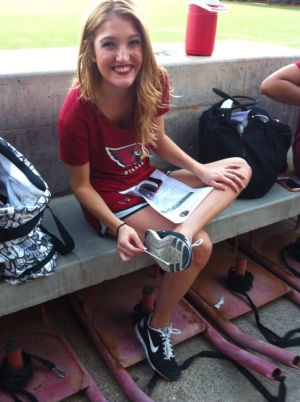
From the article:
"The event — held at the Arizona Cardinals' training facility on July 20 — featured members of the Cardinals’ cheerleading squad swabbing their shoes and cell phones to collect microbe samples later sent to a lab at the University of California Davis for analysis. Microbes are microscopic single-cell organisms that have existed for millions of years and are found just about everywhere on the planet."
Also some mention of out sampling the Space Station and other parts of the project.
See more about the project here.
Thursday, August 01, 2013
Perhaps this meeting should be renamed "Of Microbiomes and Men" ....

Confirmed Keynote Speakers: both male.
- Mark Adams, Ph.D., Scientific Director, J. Craig Venter Institute, San Diego
- Sarkis K. Mazmanian, Professor of Biology, California Institute of Technology
Confirmed other speakers: all seven male
- Pierre Belichard, Co-founder and CEO, Enterome
- Adam Godzik, Ph.D., Bioinformatics and Systems Biology, Professor & Program Director, Sanford-Burnham Research Institute
- JunHua Li, Team Leader of Reference Metagenomics, BGI Research
- Victor Nizet, MD, Professor & Division Chief, Department of Pediatrics, UCSD School of Medicine, San Diego
- Steve Orndorff, NuMe Health
- Andrei Osterman, Ph.D., Professor, Bioinformatics & Systems Biology, Infectious and Inflammatory Disease Center, Sanford-Burnham Medical Research Institute
- Bernd Schnabl, MD, Assistant Professor, Division of Gastroenterology, UCSD School of Medicine, TSRI California Campus
- David Odelson, R&D Program Director, Life Technologies
- Peter B. DiLaura, President & CEO, Second Genome
- Chris Christofferson, Morganthaler Ventures
- Lou Tartaglia, Third Rock Ventures
- Mike Grey, Pappas Ventures
- Justin L. Sonnenburg, Assistant Professor, Microbiology & Immunology, Stanford School of Medicine, Palo Alto, CA
Tuesday, July 30, 2013
Misleading microbial headline of the month: Bacteria in Brains Suggest Alzheimer’s-Gum Disease Link
Wow. Check out this story from Bloomberg: Bacteria in Brains Suggest Alzheimer’s-Gum Disease Link - Bloomberg. The title suggests that there is some connection between Alzheimer's and Gum Disease. And so does the story. Plus check out these other stories:
All based on the same work. Sounds like a real connection was made in this new work showing a link between bad dental hygiene and Alzheimer's, and also between the bacterium Porphyromonas gingivalis and Alzheimer's. These would both be a big big deal. After all - tooth decay is something you can do something about. And if tooth decay causes Alzheimer's - then - well - we could probably prevent Alzheimer's.
Sounds awesome. Was going to go invest in companies that are working on this topic. Then I made a dreadful mistake. I decided to look at the paper that all of this is based on: Determining the Presence of Periodontopathic Virulence Factors in Short-Term Postmortem Alzheimer's Disease Brain Tissue.
Hmm .. that is weird. The paper does not seem to have anything in it really closely tied to all the claims in the news stories. Here is the Abstract:
I could go on and on. There are so so so so so so so many jumps that are needed to go from the limited results presented in this paper to getting anywhere near supporting a hypothesis that periodontal disease causes Alzheimer's that it makes we want to scream. The news reporting here is awful. The scientists involved seem to be overhyping their work to extremes with risky, dangerous possible consequences (e.g., - oh - so you have Alzheimer's - it's your fault for not taking care of your teeth ... we need more money for dental care to prevent Alzheimer's; everyone should take prophylactic antibiotics to prevent Alzheimer's and so on).
- Bad dental hygiene linked to Alzheimer's
- Study links poor oral hygiene with a greater risk of developing Alzheimer's
- Could gum disease and poor dental health be an early sign of Alzheimer's disease?
All based on the same work. Sounds like a real connection was made in this new work showing a link between bad dental hygiene and Alzheimer's, and also between the bacterium Porphyromonas gingivalis and Alzheimer's. These would both be a big big deal. After all - tooth decay is something you can do something about. And if tooth decay causes Alzheimer's - then - well - we could probably prevent Alzheimer's.
Sounds awesome. Was going to go invest in companies that are working on this topic. Then I made a dreadful mistake. I decided to look at the paper that all of this is based on: Determining the Presence of Periodontopathic Virulence Factors in Short-Term Postmortem Alzheimer's Disease Brain Tissue.
Hmm .. that is weird. The paper does not seem to have anything in it really closely tied to all the claims in the news stories. Here is the Abstract:
The aim of this study was to establish a link between periodontal disease and Alzheimer's disease (AD) with a view to identifying the major periodontal disease bacteria (Treponema denticola, Tannerella forsythia, and Porphyromonas gingivalis) and/or bacterial components in brain tissue from 12 h postmortem delay. Our request matched 10 AD cases for tissue from Brains for Dementia Research alongside 10 non-AD age-related controls with similar or greater postmortem interval. We exposed SVGp12, an astrocyte cell line, to culture supernatant containing lipopolysaccharide (LPS) from the putative periodontal bacteria P. gingivalis. The challenged SVGp12 cells and cryosections from AD and control brains were immunolabeled and immunoblotted using a battery of antibodies including the anti-P. gingivalis-specific monoclonal antibody. Immunofluorescence labeling demonstrated the SVGp12 cell line was able to adsorb LPS from culture supernatant on its surface membrane; similar labeling was observed in four out of 10 AD cases. Immunoblotting demonstrated bands corresponding to LPS from P. gingivalis in the SVGp12 cell lysate and in the same four AD brain specimens which were positive when screened by immunofluorescence. All controls remained negative throughout while the same four cases were consistently positive for P. gingivalis LPS (p = 0.029). This study confirms that LPS from periodontal bacteria can access the AD brain during life as labeling in the corresponding controls, with equivalent/longer postmortem interval, was absent. Demonstration of a known chronic oral-pathogen-related virulence factor reaching the human brains suggests an inflammatory role in the existing AD pathology.Alas, even via UC Davis Libraries I do not have access to the full article. So my inferences will have to be based on the abstract (note to authors, if you want people to judge your full papers not just your abstracts, well, it would be good to have your paper be available). From what I can tell - what they showed in this paper is that antibodies that are known to find to lipopolysaccharide (LPS) from P. gingivalis showed positive binding to brain material from a few patients who had Alzheimer's and did not show binding to brain material from controls. So let's ask and try to answer a few questions about this:
- Does LPS from a specific organism in the brain mean that the organism was in the brain: I don't think so - LPS could move around?
- Does binding by the antibody they used mean that there is LPS from P. gingivalis there? Definitely no - there could be cross reactivity with other LPSs or even other molecules?
- Did they do any more specific tests (e.g., DNA)? Doesn't seem like it.
I could go on and on. There are so so so so so so so many jumps that are needed to go from the limited results presented in this paper to getting anywhere near supporting a hypothesis that periodontal disease causes Alzheimer's that it makes we want to scream. The news reporting here is awful. The scientists involved seem to be overhyping their work to extremes with risky, dangerous possible consequences (e.g., - oh - so you have Alzheimer's - it's your fault for not taking care of your teeth ... we need more money for dental care to prevent Alzheimer's; everyone should take prophylactic antibiotics to prevent Alzheimer's and so on).
Sunday, July 28, 2013
Another genomics meeting featuring men men men and men: International Forum on "Genomics, Innovation and economic growth"
The International Forum on Genomics, Innovation & Economic Growth will be held on 25 - 27 Nov 2013 in Mexico City. http://t.co/0M54BLg1IU.And my first thought was - please - please - please let this meeting have a decent gender ratio. I am so so sick of genome meetings that have gender ratio issues. Alas, then I went to their site: International Forum "Genomics, Innovation and economic growth"
— Human Genome Org (@humangenomeorg) July 29, 2013
11 plenary speakers. All of them men. See here.
Forum president: 1 man
Advisory Board: 5 men
Crap crap crap. What is WRONG WITH PEOPLE?
Nothing else to say really. But I will not be going I guess I can say that.
Saturday, July 27, 2013
Cool open science project: rOpenSci just got 180K funding boost
Just a quick post here. Just found out from Carl Boettiger that this cool project "rOpenSci" in which he is involved just got a boost in funding with a grant from the Alfred P. Sloan Foundation - see rOpenSci - What we hope to accomplish with the new funding. The goals of the project are summarized on their site
"At rOpenSci we are creating packages that allow access to data repositories through the R statistical programming environment that is already a familiar part of the workflow of many scientists. We hope that our tools will not only facilitate drawing data into an environment where it can readily be manipulated, but also one in which those analyses and methods can be easily shared, replicated, and extended by other researchers. While all the pieces for connecting researchers with these data sources exist as disparate entities, our efforts will provide a unified framework that will be quickly connect researchers to open data."
Friday, July 26, 2013
Worst science by press release of the year: nitrogen fixation in crops
Well, this is one heck of a science - by - press release case.
Was pointed to this press release: World-Changing Technology Enables Crops to Take Nitrogen from the Air which comes to us from the University of Nottingham. It makes some really bold claims like
A major new technology has been developed by The University of Nottingham, which enables all of the world's crops to take nitrogen from the air rather than expensive and environmentally damaging fertilisersAnd
This ground-breaking development potentially provides every cell in the plant with the ability to fix atmospheric nitrogen. The implications for agriculture are enormous as this new technology can provide much of the plant's nitrogen needs.And
Applied to the cells of plants (intra-cellular) via the seed, it provides every cell in the plant with the ability to fix nitrogen. Plant seeds are coated with these bacteria in order to create a symbiotic, mutually beneficial relationship and naturally produce nitrogen.And
N-Fix is a natural nitrogen seed coating that provides a sustainable solution to fertiliser overuse and Nitrogen pollution. It is environmentally friendly and can be applied to all crops. Over the last 10 years, The University of Nottingham has conducted a series of extensive research programmes which have established proof of principal of the technology in the laboratory, growth rooms and glasshouses.And
There is a substantial global market for the N-Fix technology, as it can be applied globally to all crops. N-Fix has the power to transform agriculture, while at the same time offering a significant cost benefit to the grower through the savings that they will make in the reduced costs of fertilisers. It is a great example of how University research can have a world-changing impact.And
The proof of concept has already been demonstrated. The uptake and fixation of nitrogen in a range of crop species has been proven to work in the laboratory and Azotic is now working on field trials in order to produce robust efficacy data. This will be followed by seeking regulatory approval for N-Fix initially in the UK, Europe, USA, Canada and Brazil, with more countries to follow.
Sounds f$*@#$# awesome. So awesome that it was picked up by multiple news sources including
- Better Crops: Building In Automatic Nitrogen Fixation - RedOrbit
- Technology could enable all crops to take nitrogen from the air - R & D magazine
- Burrowing bacteria may end need to fertilise plants - Telegraph
- Bacteria discovery could revolutionize crop science - Examiner
The only problem is - they don't present any evidence. None. No data. No paper. No poster. Nothing. It is simply a press release with a bunch of words. Ridiculous. I think I am going to announce I have a way to not only get all crops to fix nitrogen, but that it will work by telepathy. This is one of the worst science-by-press-release cases I have ever ever seen.
UPDATE 7/27/13
Richard Conniff, who was the one who pointed me to the PR has a post about this too: http://strangebehaviors.wordpress.com/2013/07/27/best-news-ever-in-agriculture-or-utter-bullshit/
UPDATE 7/27/13
Richard Conniff, who was the one who pointed me to the PR has a post about this too: http://strangebehaviors.wordpress.com/2013/07/27/best-news-ever-in-agriculture-or-utter-bullshit/
Postdoc position in innovating scholarly communication at #UCDavis w/ me, Mario Biagioli & Mackenzie Smith
7/26/13
Postdoc Position in Innovating Scholarly Communication
A new UC Davis initiative on "Innovating the Communication of Scholarship" is hiring a 3-year postdoctoral fellow, starting September 1, 2013. This is a cross-disciplinary project to study the future of academic publishing, involving faculty from the Center for Science and Innovation Studies, the Library, the Genome Center, and the School of Law (with additional collaborators in Computer Science, English, Philosophy, and the Graduate School of Management). Research topics include open access models, peer review, new forms of quality metrics, data publication, use of social media, and new forms of misconduct.
The successful candidate will conduct research, collaborate on or lead organization of conferences, workshops, pedagogical activities, and grant writing. A Ph.D. is required in a relevant field such as Science and Technology Studies, Library and Information Sciences, Communication, Law, Science, or English. Other disciplines will be considered depending on the specific focus of the candidate?s research and other experience. Qualified applicants will have experience working successfully in teams and managing multi-year projects. He or she will possess excellent written and oral communication and administrative skills.
Salary is based on experience and qualifications according to UC Davis guidelines.
To apply: E-mail a PDF file containing your CV, short description of your research experience relevant to this position, and contact details for three references to Mario Biagioli, MacKenzie Smith, Jonathan Eisen.
Another quick post - condoms and probiotics
Another quick post. Just read this article in LiveScience about a new PLOS One paper: Condoms May Boost Beneficial Vaginal Bacteria | LiveScience. Am wondering - when will condoms start coming with probiotics in them? Anyone out there know if this has been done yet? I mean, I do not want to oversell the microbiome but hey it seems like there could be something to do here ...
Quick post - very interesting interview of Peter Suber by Richard Poynder
For those interested in Academic Publishing and OpenAccess issues this is really worth a read: Open and Shut?: Peter Suber on the state of Open Access: Where are we, what still needs to be done?. It is an interview of Peter Suber by Richard Poynder.
UPDATE 10 minutes later - not saying I endorse or support everything Suber says (I am much more enthusiastic about gold open access than green OA which I find limited in use). But the interview is worth a read.
UPDATE 10 minutes later - not saying I endorse or support everything Suber says (I am much more enthusiastic about gold open access than green OA which I find limited in use). But the interview is worth a read.
Wednesday, July 24, 2013
Do small organisms form species? New paper suggests not ...
Quick post here about a press release about a new paper: New mathematical theory says small organisms may not form species. Seems that this new theoretical paper might be of interest to people out there. The paper is available openly here: http://rspb.royalsocietypublishing.org/content/280/1767/20131248.abstract. Not sure quite what to make of this but thought it would be of interest. The abstract is below:
The rapid advance in genetic sequencing technologies has provided an unprecedented amount of data on the biodiversity of meiofauna. It was hoped that these data would allow the identification and counting of species, distinguished as tight clusters of similar genomes. Surprisingly, this appears not to be the case. Here, we begin a theoretical discussion of this phenomenon, drawing on an individual-based ecological model to inform our arguments. The determining factor in the emergence (or not) of distinguishable genetic clusters in the model is the product of population size with mutation rate—a measure of the adaptability of the population as a whole. This result suggests that indeed one should not expect to observe clearly distinguishable species groupings in data gathered from ultrasequencing of meiofauna.
Tuesday, July 23, 2013
Expansion of Academic Freedom at the University of California
Just got pointed to this revision of the UC Faculty Code of Conduct which was recently approved by the UC Regents: http://regents.universityofcalifornia.edu/aar/jule.pdf
I was pointed to it by Greg Pasternack from UC Davis who has been a major force in trying to guarantee academic freedoms at UC Davis.
The section he called particular attention to is in line 4 in the part on "Professional Rights of Faculty" which reads "freedom to address any matter of institutional policy or action when acting as a member of the faculty whether or not as a member of an agency of institutional governance." This clearly relates to some real and perceived challenges to academic freedom at various UCs and it is good to have a formal policy that says such a freedom is a right of the faculty.
You go Greg ...
Related posts:
I was pointed to it by Greg Pasternack from UC Davis who has been a major force in trying to guarantee academic freedoms at UC Davis.
Colleagues,
Four years and one month after the UCD Committee on Academic Freedom and Responsibility first raise the alarm about the danger of unjust discipline faculty in the UC system may face (and certainty have faced) for speech and actions regarding institutional matters, I am very happy to report to you all that on July 18 the UC Regents approved our proposed amendment to APM-015 that guarantees faculty academic freedom to speak out about institutional matters. Given the number of judges that have ruled that faculty speech on institutional matters is *not* protected by the First Amendment, even in public universities, getting this freedom inscribed into APM-015 provides a policy-based guarantee no longer reliant on external interpretation.
See attached, notably the underlines in attachment 2. You can also download it from http://regents.universityofcalifornia.edu/aar/aar.html under "committee on educational policy"
This is the greatest expansion in academic freedom in the history of the UC system, because all previous notions of academic freedom limited the application of the idea to just one's area of scholarship. Prior to this, the biggest change was to no longer require "dispassionate" scholarship. However, academic freedom is no longer shackled to scholarship. We are free to speak on all institutional matters, whether they are within our sphere of scholarship or not. We may do so using any forum or medium.
Now go out and use your freedom to stir up brilliant controversies ;)
Best wishes,
-Prof. Greg Pasternack
The section he called particular attention to is in line 4 in the part on "Professional Rights of Faculty" which reads "freedom to address any matter of institutional policy or action when acting as a member of the faculty whether or not as a member of an agency of institutional governance." This clearly relates to some real and perceived challenges to academic freedom at various UCs and it is good to have a formal policy that says such a freedom is a right of the faculty.
You go Greg ...
Related posts:
Subscribe to:
Posts (Atom)
Most recent post
A ton to be thankful for -- here is one part of that - all the acknowledgement sections from my scholarly papers
So - it is another Thanksgiving Day and in addition to thinking about family, and football, and Alice's Restaurant, I also think a lot a...

-
Wow. Just wow. And not in a good way. Just got an email invitation to a meeting. The meeting is " THE FIRST ANNUAL WINTER Q-BIO ...
-
 I have a new friend in Google Scholar Updates I have written about the Updates system before and if you want more information please see...
 -
See Isolation and sequence-based characterization of a koala symbiont: Lonepinella koalarum Paper based on PhD thesis work of Katie Dahlha...
