Tuesday, June 30, 2009

Really sick of Bentham Open Spam

Once again, I am getting sick of getting email after email from various Bentham Open Journals like the one below.  This is basically a form of SPAM as they send these out to people no matter what the connection is to the journals field.  I like how they now emphasize that "Please note that submission of a manuscript is not a guarantee for acceptance for publication"
This likely has something to do with the recent controversy over a Bentham Open journal accepting a nonsense paper .
Just goes to show you that just as their are annoying commercial journals and annoying society journals, there certainly are annoying open access journals.  And many Bentham journals take the prize for being as annoying as they come.  Perhaps not all Bentham journals are like this, but I get spam-like email from dozens of them ... and do not get any from other Open Access journals.


Dr. J.A. Eisen
Institute for Genomic Research Rockville MD 20850
United States

Dear Dr. Eisen,

I am writing to you in my capacity as the Editor-in-Chief of Current Molecular Pharmacology, which is a cutting-edge peer-reviewed journal published by Bentham Science Publishers. Bentham Science publishes more than 300 print and open access journals.

Current Molecular Pharmacology is in its second volume and is indexed by all major indexing media includingChemical Abstracts, EMBASE, Genamics JournalSeek, Scopus, etc. The journal's homepage may be viewed athttp://www.currmolpharm.org

The journal invites contributions for both comprehensive review articles and guest edited issues in all areas of cellular and molecular pharmacology with a major emphasis on the mechanism of action of novel drugs under development, innovative pharmacological technologies, cell signaling, transduction pathway analysis, genomics, proteomics, and metabonomics applications to drug action.

It is a great pleasure to invite you to contribute to Current Molecular Pharmacology. If you wish to submit your work to the journal, then please provide us the title and an abstract (up to 250 words) of your article by email toeditorial@currmolpharm.org You may submit the full article.

Please note that submission of a manuscript is not a guarantee for acceptance for publication, as all manuscripts will be subjected to peer review. Each prospective first-named (corresponding) author will receive a limited number of free reprints and PDF of the paper.

Please could you also refer the journal to your colleagues and other contacts in the field, including your librarian, for promotional purposes. I look forward to hearing from you soon.

Yours sincerely,

Nouri Neamati,
Editor-in-Chief CMP


Here are some comments from FriendFeed

Nature Biotechnology is auditing me?

Just got this mail - it says "Important Audit Material Enclosed"

Turns out, it is a subscription notice from Nature Biotechnology (which I get for free).

Annoying, to say the least. I really wanted them to audit me.

Sunday, June 28, 2009

Cool open source software of the month - mothur - for microbial ecology

Anyone interested in microbial ecology informatics should check out the "mothur" software (Main Page - mothur) from Pat Schloss at U. Mass. Schloss, who has developed a lot of great software tools inlcuding for example dotur and sons, is now developing an open source modular sofwate system for microbial ecology studies. And the name of it is mothur (get the theme?). Here is some more detail about mothur:
This project seeks to develop a single piece of open-source, expandable software to fill the bioinformatics needs of the microbial ecology community. As of version 1.2.0 we have incorporated the functionality of dotur, sons, treeclimber, s-libshuff, and unifrac. In addition to improving the flexibility of these algorithms, we have added a number of other features including calculators and visualization tools. If you would like to contribute code to the project feel free to download the source code and make your own improvements. Alternatively, if you have an idea or a need, but lack the programming expertise, let us know and we'll add it to the queue of features we would like to add. Our current goal is to release a new iteration of the project monthly.
Anyway, thanks to my student Amber Hartman for pointing this out --- I will be perusing it but thought others should too. Hopefully, we can include some of the software from my lab such as AMPHORA, STAP, etc. into their code at some point.

Have money, would like to buy entrance to PhD program

Got this letter today.  Thought I would share, with some specifics removed.  I have never seen anything quite like this and I have gotten lots and lots of emails about jobs, positions, students, etc.

Subject: Application for Ph.D. studies

Dear Prof.


Hope for your best.  I am working as lecturer, Department of XXXX, XXXX University, XXXX, Pakistan. I have completed my M.Phil (Biotechnology)  from XXXX University XXXXX, Pakistan (Thesis title something about microbe interactions with plants).  I have recently secured a fully funded scholarship for Ph.D studies (funding agency: Higher Education Commission, Islamabad, Pakistan).  This scholarship includes living expenses, university fees and travel expenses etc.  I wish to conduct my Ph.D studies at your esteemed university (in any area of biological sciences) .  I will highly appreciate if you kindly send me an acceptance letter for Ph,.D studies under your esteemed supervision,  so that I can proceed with my paper work with Higher Education commission, Islamabad.  Please also find attached herewith my brief CV.


Best regards


XXXXXX

Lecturer

Department of XXXX

XXXX University, XXXX

Pakistan


Here are some comments from FriendFeed

Saturday, June 27, 2009

Another reason to publish as Open Access - libraries hurting big time financially and they will be cancelling many subscriptions

If you need any more incentive to publish a paper in an Open Access manner if you have a choice - here is one. If you publish in a closed access journal of some kind, it is likely fewer and fewer colleagues will be able to get your paper as libraries are hurting big time and will be canceling a lot of subscriptions. (e.g., see this page from UC Davis system Library Collections: A Forum - About the Libraries - University Library - UC Davis).

From Friendfeed

Who should have acess to publications supported by federal money? Well, everyone. See Federal Research Public Access Act

Well, this is good news. Here is some information on the Federal Research Public Access Act S. 1373 introduced by Sen. Lieberman and Sen. Cornyn (information is mostly from this site: Alliance for Taxpayer Access | Federal Research Public Access Act). This is really important as it will expand the accessibility of papers to agencies outside NIH (e.g., NSF are you listening, DOE are you listening). To help with this see Call to action: Tell Congress you support the Federal Research Public Access Act

Every federal agency with an annual extramural research budget of $100 million or more will implement a public access policy that is consistent with and advances the federal purpose of the respective agency. Each agency must:

  • Require each researcher – funded totally or partially by the agency – to submit an electronic copy of the final manuscript that has been accepted for publication in a peer-reviewed journal.
  • Ensure that the manuscript is preserved in a stable digital repository maintained by that agency or in another suitable repository that permits free public access, interoperability, and long-term preservation. Agencies have the flexibility to choose the best suitable location for their repository.
  • Require that free, online access to each taxpayer-funded manuscript be available as soon as possible, and no later than six months after the article has been published in a peer-reviewed journal.

To whom this policy applies:

  • Any researcher employed by a federal agency with an annual research budget exceeding $100 million who publishes an article based on the work done for the funding agency in a peer-reviewed journal.
  • Any researcher funded by a federal agency with an annual research budget exceeding $100 million who publishes an article based on the funded research in a peer-reviewed journal.

What is not covered by this legislation:

  • The public access policy does not apply to laboratory notes, preliminary data analyses, author notes, phone logs, or other information used to produce the final manuscript.
  • The policy does not apply to classified research. Research that results in works that generate revenue or royalties for the author (such as books), or patentable discoveries are exempt only to the extent necessary to protect copyright or a patent.

Also see below from the Congressional Record (and Hat Tip to Heather Joseph from SPARC for pointing all of this out).

From June 25 Congressional Record:          By Mr. LIEBERMAN (for himself and Mr. Cornyn):

S. 1373. A bill to provide for Federal agencies to develop public access policies relating to research conducted by employees of that agency; or from funds administered by that agency to the Committee on Homeland Security and Governmental Affairs

Mr. CORNYN. Mr. President, I rise to introduce the Federal Research Public Access Act. I am very pleased to be joined again by my good friend and colleague, Senator Joe Lieberman, who has remained dedicated to seeing this important legislation passed. This bipartisan bill is the same legislation we introduced in the 109th Congress. The purpose of this legislation is to ensure American taxpayers' dollars are spent wisely, which is even more important now in this time of fiscal tension.

To put things in perspective, the Federal Government spends upwards of $55 billion on investments for basic and applied research every year. There are approximately 11 departments/agencies that are the recipients of these investments, including: the National Institutes of Health, National Science Foundation, NASA, the Department of Energy, the Department of Defense, and the Department of Agriculture. These departments/agencies then distribute the taxpayers' money to fund research which is typically conducted by outside researchers working for universities, health care systems, and other groups.

While this research is undoubtedly necessary and is beneficial to America, it remains the case that not all Americans are capable of experiencing these benefits firsthand. Usually the results of the researchers are published in academic journals. Despite the fact that the research was paid for by Americans' tax dollars, most citizens are unable to attain timely access to the wealth of information that the research provides.

Some Federal agencies, most notably the NIH, have recognized this lack of availability and have proceeded to take positive steps in the right direction by requiring that those articles based on government- funded research be easily accessible to the public in a timely manner. I am proud to report that the NIH's public access policy has been a success over the past few years. By the NIH implementing a groundbreaking public access policy, there has been strong progress in making the NIH's federally funded research available to the public, and has helped to energize this debate.

Although this has surely been an encouraging and important step forward, Senator Lieberman and I believe there is more that can and must be done, as this is just a small part of the research funded by the Federal Government.

With that in mind, Senator Lieberman and I find it necessary to reintroduce the Federal Research Public Access Act that will build on and refine the work done by the NIH and require that the Federal Government's leading underwriters of research adopt meaningful public access policies. Our legislation provides a simple and practical solution to giving the public access to the research it funds.

Our bill will ask all Federal departments and agencies that invest $100 million or more annually in research to develop a public access policy. Our goal is to have the results of all government-funded research to be disseminated and made available to the largest possible audience. By speeding access to this research, we can help promote the advancement of science, accelerate the pace of new discoveries and innovations, and improve the lives and welfare of people at home and abroad.

Each policy that these departments and agencies develop will require that articles resulting from federal funding must be presented in some publicly accessible archive within six months of publication. In doing so, the American taxpayers will have guaranteed access to the latest research, ensuring that they do not have to pay for the same research twice--first to conduct it and then again to view the results.

This simple legislation will provide our government with an opportunity to better leverage our investment in research and in turn ensure a greater return on that investment. All Americans stand to benefit from this bill, including patients diagnosed with a disease who will have the ability to use the Internet to read the latest articles in their entirety concerning their prognosis, students who will be able to find full abundant research as they further their education, or researchers who will have their findings more broadly evaluated which will lead to further discovery and innovation.

While a comprehensive competitiveness agenda is still a work-in- progress, this legislation is good step forward. Providing public access to cutting-edge scientific information is one way we can encourage public interest in these fields and help accelerate the pace of discovery and innovation. In promoting this legislation, I hope to guarantee that students, researchers, and every American can access the published results of the research they funded.

Thursday, June 25, 2009

Still hiring - despite budget issues

Recently I blogged about issues with the California budget possibly leading to major salary cuts/furloughs at UC campuses. Well, furloughs and salary cuts have been happening all around the country as many schools have had similar issues. But the good news is (1) if you are looking for a staff type position many people will have more money in their grants available since the people on the grants might get paid less and (2) many universities are not doing full faculty hiring freezes.

For example, the Center for Bioinformatics and Computational Biology - at U. Maryland is hiring faculty and post docs. UC Davis is continuing searches for faculty positions that are in progress (and we have some good candidates for people for the Genome Center). In evolution, a good place to look for job positings is Evoldir on the web or on Twitter.

And very shortly I will be posting ads for some bioinformatics related positions in my group - but have not finished writing the ads. Anyway - though the financial condition of many US Universities is less than ideal, those fields with a lot of government grant support seems to be doing OK.

Tuesday, June 23, 2009

Scientists getting antsy over possible salary reductions/furloughs at University of California

Just got this via email - a letter circulating at UC Santa Cruz about the possibility of furloughs/salary reductions at the University of California. Basically the issue is that UC is having some major financial trouble due mostly to getting less money from the state of California (due to California's financial problems). And the UC has circulated a memo saying that they are considering 4-8% pay cuts or furloughs that will reduce salary by 4-8% for ALL UC personnel.

This is a bit off putting to many since some personnel get their money from government grants not from the UC budget, but apparently to try and avoid inequality (which of course already exists) or to avoid hard decisions or for other reasons, UC is planning to have these cuts apply to everyone, even if that does not save UC money. I do find it strange that most of the people who work for/with me will get pay cuts which will lead to having extra $$ in my grants to spend. The extra weird thing is, if I cannot spend the money save from salary reductions, then UC loses money due to getting less indirect costs. I personally accept that the budget is in the toilet right now and UC needs to do some drastic things, but I am not sure if this across the board cut makes sense.

Anyway I thought the letter would be of interest to some.


We in the biomedical research community at the University of California, Santa Cruz are writing to express serious concerns about the salary budget cuts proposed as of 6/17/09. This letter represents the concerns of technicians, graduate students, postdoctoral scholars and fellows, research specialists, and project scientists in the departments of Molecular, Cell and Developmental Biology, Microbiology and Environmental Toxicology, Chemistry, Biomolecular Engineering, and Computer Engineering. We generally fall into the category of “staff”, and thus we understand that any staff salary cuts instituted in the future will affect all of us. However, it is important to understand that nearly all of us are paid by funds that do not come from the state of California, but rather from federal grants awarded by the National Institute of Health, the National Science Foundation, and grants awarded by many other public and private agencies. In many cases, the grant has been awarded to a Principal Investigator, and then is used by the Principal Investigator to pay us for our research work. In other cases, the grants are awarded directly to us to cover the salary necessary for our scientific training. So, as the majority of our salaries are not provided by the California state budget, a mandatory salary cut for our staff will not ease the University budget crisis, while it will indeed make our day-to-day living more difficult. Other effects of a mandatory reduction of our salaries are that: 1) This will actually reduce the amount of money the University receives in indirect costs from grants. 2) This will decrease the amount of income tax we pay to the state of California, further exacerbating the existing budget crisis. 3) The depletion of the funds coming into the University of California due to these salary cuts will make it increasingly difficult for the University to support its employees. 4) Lastly, the salary cut propos al may, in the longer-term, undermine confidence in the University of California system and lead talented people to move to states that are able and willing to support higher education and scientific research.

In summary, we strongly urge that no salary cut be instituted for University of California-affiliated personnel like ourselves whose salary is independent from the California state budget. Below you will find our signatures along with those of our supporting staff and Principal Investigators. Sincerely, The biomedical researchers of the University of California, Santa Cruz
See also
Plus here is a note from UC explaining their approach on reductions/furloughs:
Here is a communication from UC about the furloughs:

June 18, 2009

UC Furlough/Salary Reduction Plan Options – Questions & Answers
A summary of options for systemwide furloughs/salary reductions was sent to the UC
community on June 17, 2009. Following broad consultation, President Yudof intends to present
a specific option for approval to The Regents at their July 2009 meeting. To date, no decisions
have been made as to which option will be implemented. Below are answers to questions about
the proposals. Additional information will be added throughout this process as answers to other
questions become available and as the University approaches a decision on this issue.

Are these furloughs/salary reductions intended to be permanent?
No – the intent is for these actions to be temporary or short-term in nature, to help the University
through the current budget crisis. As indicated, the proposed duration for all three options is
August 1, 2009 through July 31, 2010 unless extended by the Regents.

Will furloughs/salary cuts apply to all employees, including faculty and represented
employees?
Yes. In order to ensure equity across the University, whichever option is chosen would apply to
all faculty and staff, except student employees. The Academic Senate has been closely involved
in consultation on these options. Implementation of the final plan is subject to collective
bargaining for represented employees. The President may recommend a hybrid Plan that
achieves the eight percent reduction in slightly different ways for the various employee groups.

If my salary is not supported by state funds, will I still have to take a furlough or salary cut?
Yes – participation is not based on the source of salary funds. Each of the options would apply to
UC employees whose salaries are funded by contracts and grants, clinical income and other
auxiliary activity, and general funds.

Will the proposed reductions apply to employees at the Lawrence Berkeley National
Laboratory?
The intent is for whatever option is selected to apply to all UC employees, including LBNL
employees. Since LBNL is funded by the Department of Energy (DOE), UC will comply with
all contractual obligations with the DOE.

W ill this be additive for the senior leaders who have already taken a five percent pay cut?
The senior UC officials who voluntarily agreed to have their salary reduced by five percent will
have their salaries reduced by a total of at least eight percent under these options.

How will the furlough/salary reduction impact vacation and sick leave accruals, UCRP service
credit and benefit calculations, and other benefits?
Under each option, the intent is to protect benefits and leave accruals to the extent possible. This
may not be possible in all situations. This issue continues to be evaluated and no final decisions
have been made yet. Approval from the Regents is required to protect UCRP benefits from being
impacted by a furlough/salary reduction plan.

I volunteered to participate in START to help the University manage the budget situation. Will
I have to take further reductions if a systemwide furlough or salary reduction is implemented?
How these options impact/relate to the START program is currently being analyzed. More
information on this issue is expected soon.

What’s the difference between the three options?
All three options are intended to achieve the same budgetary savings and have the same impact
on employee pay -- each option is closely equivalent to an eight percent pay reduction. Option I
is a straight pay reduction with no changes to work hours. Under Options II and III, employees
will be scheduled to work fewer days and a number of holidays will no longer be paid holidays.

In Options II and III, will I be able to schedule the unpaid day at a time that’s convenient for
me and my department, or will the days be pre-scheduled?
This is still being looked at. The unpaid days would include a combination of University
holidays and additional days, but the precise mix of holidays vs. additional days has not been
determined. The additional days may be pre-scheduled by the University in order to manage
critical operations, for example to ensure patient care at a medical center.

For unpaid days, can I "make up" for the lost salary by using my vacation leave, sick leave, or
compensatory time off?
No. The objective of these options is for the University to achieve budgetary savings. Accrued
vacation, paid time off (PTO), comp time and/or sick leave all are forms of paid time off and
thus may not be substituted for unpaid days.

Will furloughs or salary reductions affect the health of the UC retirement plan?
The potential impact of the options on the funding status of the UC retirement plan is being
analyzed by the Plan Actuary, and this will be taken into consideration as decisions are made.


also see Friendfeed comments

Tuesday, June 16, 2009

Now this is my kind of meeting

Just got to Asilomar conference center for a meeting organized by
CIFAR on integrated microbial diversity

It is my Kind of meeting in every way

1. On the coast
2. Few talks with lots of discussion and free time
3. Really diverse with runs and bacteria and archaea and viruses covered
4 not all about genomics (some meetings I go to are)
5. Did I say it is on the coast?
6 ford Doolittle is supposed to be here . He is one of my science heroes
7. The meeting is VERY small but still seems great
8 My family came (little Kids and wife)
And already felt welcome
9 I do not know many of the people
10 Elio Schaechter of Small Things Considered is giving a special talk

This is such a contrast to the big ASM meeting .. Which was fun in
ways and useful but overwhelming

Looking forward to the week


----------------------------------

Note added after the fact -

 Here are my tweets about the meeting (mostly mine) some by Rosie Alegado

rosiealegado Listening to Jonathan Eisen at #CIFAR talk about a genomic encyclopedia for bacteria & archaea. 2 days ago from Tweetie phylogenomics Huge % of talks at #CIFAR make use of Venter Sargasso or GOS metagenomic data 2 days ago from TwitterFon phylogenomics I am next at #CIFAR talking about a phylogeny driven genomic encyclopedia of bacteria and archaea 2 days ago from TwitterFon phylogenomics The one and only WF Doolittle is talking at #CIFAR about Thermotogales and lateral transfer 2 days ago from TwitterFon phylogenomics Rebecca Rundell is talking at #CIFAR about the amazing diversity of "meiofauna" (not big nor tiny) in marine samples 2 days ago from TwitterFon phylogenomics Nicole King at #CIFAR is talking about using choanoflagellate genomics/experiments to study the origins of multicellularity in animals 2 days ago from TwitterFon phylogenomics Barry Leadbetter at #CIFAR is using modelling/microscopy to study how choanoflagellates (single celled animal relatives) move/assemble 2 days ago from TwitterFon nthmost #ff @phylogenomics is live-tweeting some very interesting stuff from #CIFAR (Canadian Institute for Advanced Research): http://bit.ly/Eei6X 2 days ago from TweetDeck phylogenomics Michael Worobey at #CIFAR is telling how phylogenetics of archival samples helps resolve questions about the history of HIV movement 2 days ago from TwitterFon phylogenomics Michael Worobey at #CiFAR just told the story of how the brilliant WD Hamilton died after their trip to Africa to get chimp SIV samples 2 days ago from TwitterFon phylogenomics Michael Worobey who does fantastic "open science" flu work is talking at #CIFAR about HIV and swine flu origins 2 days ago from TwitterFon MicrobeWorld @phylogenomics Is there a site for this #CIFAR event? 2 days ago from web phylogenomics Relman at #CIFAR outlines benefits from microbes in gut: vitamins, digestion, infection protection, developmnt, immune training, etc 2 days ago from TwitterFon phylogenomics David Relman at #CIFAR is talking about humans as an ecological collective with microbes as an extension/component of self 2 days ago from TwitterFon CigarRadio @NetworkCacher Thanks, glad you enjoyed tghe show. #cigars #cifar #dogwatch 3 days ago from TweetDeck domonicmongello RT @phylogenomics Rob Beiko at #CIFAR is talking re: geospatial visualization of microbial diversity - genomics .. http://bit.ly/AYVEJ 3 days ago from twitterfeed aeroculus RT @phylogenomics Rob Beiko at #CIFAR is talking re: geospatial visualization of microbial diversity - genomics ecology geography - GenGIS 3 days ago from web phylogenomics Rob Beiko at #CIFAR is talking re: geospatial visualization of microbial diversity - merging of genomics, ecology and geography - GenGIS 3 days ago from TwitterFon phylogenomics Rebeeca Case is taking at #CIFAR about how marine algae also suffer from bleaching like coral 3 days ago from TwitterFon rosiealegado Listening to Kevin Carpenter #CIFAR. Learned a new word: ectosymbiont. 3 days ago from Tweetie phylogenomics Kevin Carpenter at #CIFAR is talking about and showing aamazing picture of microbes that live in termite and cockroach guts 3 days ago from TwitterFon phylogenomics Jan Janouskovec talking at #CIFAR about alveolate plastids "assessing the evidence" & how # of membranes are useful to know 4 days ago from TwitterFon phylogenomics Adrian Reyes-Prieto at #CIFAR is talking about plastid and chromatophore evolution 4 days ago from TwitterFon pathoadaptation @phylogenomics #CIFAR exactly the kind of meeting I need to get back to going to...must work harder to get out of my government 'hole'. 4 days ago from Tweetie phylogenomics Andrew Roger at #CIFAR is talking about the origin and evolution of mitochondria and related organelles 4 days ago from TwitterFon phylogenomics Joel Dacks at #CIFAR is talking about evolution of eukaryotic membrane traffiicking & how it is about "more than just eating" 4 days ago from TwitterFon JATetro @phylogenomics Will there be a proceedings or at least a review of the meeting? #CIFAR 4 days ago from Seesmic Desktop phylogenomics Tom Cavalier-Smith at #CIFAR is one of the few people who can really mix molecar phylogenetics and function/morphology for microbial euks 4 days ago from TwitterFon phylogenomics Listening to THE Tom Cavalier-Smith talking about eukaryotic evolution at #CIFAR - I don't always agree with him but he still rocks 4 days ago from TwitterFon phylogenomics Yan Boucher at #CIFAR is talking about "the life aquatic - vibrio an their mobile gene pool" - looking at lateral transfer & recombination 4 days ago from TwitterFon matthewherper RT @phylogenomics Alex Worden at #CIFAR communities of microbes are not a black box "physiology is not a bulk or an average property" 4 days ago from web matthewherper RT @phylogenomicsAlex Worden at #CIFAR communities of microbes are not a black box "physiology is not a bulk or an average property" 4 days ago from web phylogenomics Alex Worden at #CIFAR says we cannot treat communities of microbes as a black box "physiology is not a bulk or an average property" 4 days ago from TwitterFon phylogenomics Listening to Andrew Allen talk about phylogenomics, transposins, and gene transfer in diatoms at #CIFAR 4 days ago from TwitterFon phylogenomics Hearing Robert Morris from UW talking about proteomic studies of functions of bacterioplankton in Atlantic ocean at #CIFAR 4 days ago from TwitterFon phylogenomics Hearing Jennifer Foster discuss diatom bacterial symbioses and nitrogen fixation in oceans at #CIFAR microbial diversity meeting

Monday, June 15, 2009

Jonathan Losos wins E O Wilson award

Just got this in email
Harvard Biologist Jonathan Losos to Receive 2009 E. O. Wilson Naturalist
Award

The American Society of Naturalists is pleased to announce that Dr.
Jonathan B. Losos of Harvard University has been selected to receive
the 2009 E. O. Wilson Naturalist Award. The award, established in
recognition of Professor Wilson's lifetime contributions to ecology
and evolutionary biology, is given each year to a scholar who has made
significant contributions to the knowledge of a particular ecosystem
or group of organisms.

Dr. Losos is the Monique and Philip Lehner Professor for the Study of
Latin America, and Curator of Herpetology, Museum of Comparative
Zoology, Harvard University. His work with anole lizards in the West
Indies has contributed fundamentally to our understanding of the roles
of natural selection, competition, and niche evolution in shaping
assemblages of Anolis species.

Through the pioneering application of molecular phylogenetics and
comparative methods, he has thoroughly characterized the historical
biogeography and evolutionary radiation of anoles in the Caribbean,
including the roles of historical contingency and reiterated adaptive
evolution. His work on ecomorphology established early on the
relationship between morphology and ecologically relevant aspects of
behavioral performance, providing a foundation for work on
morphological evolution in the group. His experimental work with Tom
Schoener has demonstrated rapid selective impacts of introduced
predators, altered competition, and, by chance, hurricanes on Anolis
populations on tiny islands.

His work culminated this year in the publication of a major book on
the biology and adaptive radiation of the genus Anolis.

As Editor of The American Naturalist from 2002 to 2006, Dr. Losos
encouraged the publication of natural history observations in the
context of major issues in ecology and evolutionary biology.

"His enthusiasm as a colleague and mentor has inspired a generation of
biologists," said Dr. Robert Rickfels, a professor at University of
Missouri-St. Louis and chair of the award committee. "Dr. Losos's work
epitomizes the integration of natural history into scientific
investigation at the highest level."

The E. O. Wilson Naturalist Award was established in 1987, the year of
Professor Wilson's retirement from Harvard University. An appropriate
work of art and an honorarium of $2,000 will be presented to Dr. Losos
at the annual meeting of the American Society of Naturalists in June.

http://www.oeb.harvard.edu/faculty/losos/

Friday, June 12, 2009

Post Doc in quantitative modeling of viral dynamics and evolution

A postdoctoral position in quantitative modeling of viral dynamics and evolution is available under the direction of Prof. Joshua Weitz (School of Biology, Georgia Tech). The postdoc will work in an interdisciplinary research group of biologists, physicists, and computer scientists. The postdoc will collaborate on research focusing on bacteriophage dynamics and evolution, at the molecular and ecological scales. Specific project goals will be to develop gene regulatory models of viral exploitation and link intracellular dynamics to long-term changes in viral functional traits at the population scale. The postdoc will also have the opportunity to develop new research projects at the interface of systems biology, theoretical ecology & dynamical systems.

The position will provide competitive salaries and benefits. The postdoc will be based in the School of Biology at Georgia Tech, with a preferred start date of September 2009, though the start date is flexible. The initial appointment will be for one year, with renewal up to three years subject to satisfactory progress and mutual agreement.

REQUIREMENTS: (1) PhD in computational biology, physics, mathematics, microbiology, ecology or related area; (2) Demonstrated research excellence; (3) Strong quantitative skills; (4) Strong oral and written communication skills. Ideal candidates from the biological sciences should have experience with scientific programming. Ideal candidates from the physical/mathematical sciences should have prior exposure to research in the biological sciences. However, outstanding applicants looking to broaden their field of interest will also be considered.

TO APPLY: Applications should be emailed to jsweitz(at)gatech.edu and consist of (1) a cover letter describing your interest in the position, (2) the names and contact information for three references, (3) a curriculum vita (including publications). Applications will be reviewed upon receipt, and continue until the position is filled.

ABOUT THE GROUP: The Weitz group is supported by grants from the Burroughs Wellcome Fund, the James F. McDonnell Foundation, DARPA, and the National Science Foundation. For more information, consult the Weitz group website or contact Joshua Weitz: jsweitz(at)gatech.edu.

More information is available at: http://ecotheory.biology.gatech.edu/

Tuesday, June 09, 2009

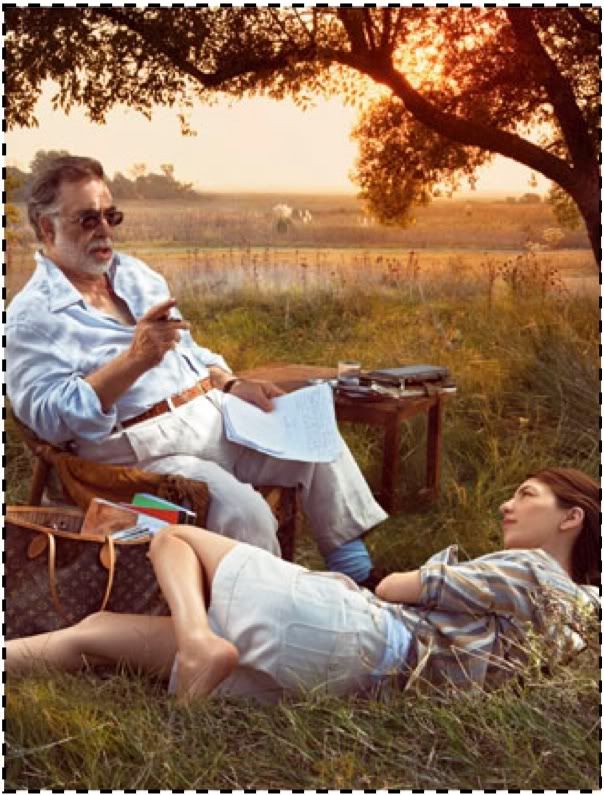
Michael Ashburner or Francis Ford Coppola in the New York Times?


Imagine my surprise when I opened the New York Times a few days ago and saw a giant picture of Michael Ashburner the Drosophila genomics guru, open science advocate, and Won for All author. Now, Ashburner is one of my favorite people in all of science (see my posting from a while ago recruiting him top start a blog to which he even responded). I mean, sure, people I know are in the Times everyonce in a while but this was astonishing. Here he was in some sort of fashions of the Times type of section, shirt unbuttoned, lounging in some field.

Alas, closer examination and some google searching found the truth. This is alas not Ashburner, but actually Francis Ford Coppola and his daughter Sofia. But I mean - look at the pics of Ashburner below. It really could have been him. Oh well, maybe next time ...


Friday, June 05, 2009

Archaea get no respect from the New York Times

There was kind of funny and certainly interesting article in the New York Times on June 4: Greening the Herds - Trying to Limit Cows' 'Emissions'

The article by Leslie Kaufman discussed how there are attempts in some dairy farms in the US to change the diet of cows to reduce their methane output. The methane is a strong greenhouse gas and in total cows make a surprisingly large global contribution to greenhouse gases. The article states:
Cows have digestive bacteria in their stomachs that cause them to belch methane, the second-most-significant heat-trapping emission associated with global warming after carbon dioxide.
Alas, this is not correct. Yes, bacteria in the cow rumen contribute to the production of methane. But they do not make the methane. The methane is made by archaea (for those not in the know, archaea are a distinct group of organisms relative to bacteria - they resemble bacteria in many ways but are a separate branch on the tree of life). For those of us who study archaea this is a major slight. A diss. A taunt. A sad day. And all those other things. Not sure how we archaea fans will have our revenge but I swear we will. Too bad Carl Zimmer does not think that this is important enough to go on one of his newspaper fact chekcing investigations.

Thursday, June 04, 2009

David Byrne on Bicycling and Davis in the New York Times

For those of you who are obsessed with bicycling (like me), and live in bicycling heaven Davis, CA, and occasionally look at the New York Times, you may have noticed this already. But for others who have not I want to call your attention to a book review in the New York Times this past Sunday by David Byrne Book Review - 'Pedaling Revolution - How Cyclists Are Changing American Cities,' by Jeff Mapes - Review - NYTimes.com.

Amazingly this is indeed the same David Byrne of them Talking Heads. It turns out he has a book coming out in the fall called "Bicycle Diaries." Anyway he reviews this book on the effect of bicyclists on American Cities and right there in the review are some props for my town, Davis, CA. The article is worth checking out and I will both be buying this book and awaiting Byrne's. Maybe we can have a reading here in Davis when the Bicycling Hall of Fame opens its doors.

Saturday, May 30, 2009

Children's Science Books from NY Times 5/10/09

Better late than never I guess.  I missed the NY Times Children's Books section in teh 5/10 Book Review but my mother brought it with her and left it so I am posting a tiny bit about it.

They review/suggest a few books for kids and many of them have a theme related to this blog including:

Wednesday, May 27, 2009

Art-Science Fusion and Darwin's Face at Davis

ART/SCIENCE FUSION STUDENTS EXHIBIT PHOTOGRAPHY AND A CERAMIC MOSAIC MURAL, THE FACE OF DARWIN

The final student exhibition for "Photography: Bridging Art and Science," a Science and Society Program class taught by Terry Nathan as a part of the Art/Science Fusion series at the University of California, Davis (UC Davis), will be held at the Buehler Alumni and Visitors Center on the University of California, Davis campus beginning June 3 and continuing through July 3. The exhibit features over 50 student photographs exploring the conceptual connections between art and science and the role of art and science on the UC Davis campus. The opening reception, which is free and open to the public, is June 4 from 3-5 p.m.

Also included in the exhibition is a ceramic mosaic mural, The Face of Darwin, created by students and community members in a special Freshman Seminar entitled, “The Face of Darwin: Exploring the Art/Science Borderland”. In recognition of Darwin’s 200th birthday, students from majors across campus studied Darwin’s life and the observations that led him to propose evolution by natural selection.  Darwin’s face is formed by selections from his secret notebooks and the images of those organisms that influenced him most.  With a beard of peppered moths, hair of barnacles and a coat of iguanas, finches, orchids and a host of other creatures, this mosaic is a profound learning experience in and of itself. The seminar was led by Diane Ullman and Donna Billick (co-directors of the Art/Science Fusion Program). 


(this came in an email to me and am posting here)

Junk mail and trash associated with science

Just got back from the ASM Meeting that was in Philly last week.  It was good and bad - and will write more about it soon.

But what I am writing about now relates to an annoying part of the meeting.  It seems ASM has sold my name/address to various entities since I have been receiving a significant amount of junk/trash advertising things associated with microbiology.  I am sure ASM gets some $$$ out of this, but at what cost to the world?  The last thing I want is more trash and there seems to be no way to say no to this.  

And on top of it, many science related publications also seem really keen on wrapping themselves in plastic.


In this case I am showing Nature Methods and the ASM Microbe and even the HHMI magazine  wrapped in plastic. Bad Nature. Bad ASM. Bad HHMI.  Sure there may be reasons for this (e.g., maybe they have an insert), but there must be non plasticy solutions.  And fortunately the news from the JDRF has no plastic. Good JDRF.  Here's to sciency publications getting a little greener.


Saturday, May 23, 2009

Good science education resource: HHMI Cool Science

Just a quick one here. Was reading the HHMI Bulletin and saw a note about this web site they have set up on science education (see Cool Science: Home). It has all sorts of goodies for educators, kids, and others. Some of my favorite things there in looking so far include material from the Genome Consortium for Active Learning (GCAT) and the Biointeractive page. YAGTFH (Yet another good thing from HHMI).

Saturday, May 16, 2009

Do not fall for SPAM pretending to be from Elsevier

Just got the email below (with some key parts blotted out). It is clearly (to me) fake (although it is kind of funny in a way given the recent news about Elsevier publishing fake journals). But just in case someone else out there got the same SPAM and did not figure out it was fake, I am posting this message here.

ELSEVIER:
BUILDING INSIGHTS; BREAKING BOUNDARIES
MANUSCRIPTS SUBMISSION

Dear Colleague,

On behalf of all the Editors-in-chief of Elsevier Journals, we wish to Communicate to you that we are currently accepting manuscripts in all Fields of human Endeavour.
All articles published will be peer-reviewed. The following types of papers are considered for publication:

• Original articles in basic and applied research.
•Critical reviews, surveys, opinions, commentaries and essays.

Authors are invited to submit manuscripts reporting recent developments in their fields. Papers submitted will be sorted out and published in any of our numerous journals that best Fits. This is a special publication procedure which published works will be discussed at seminars (organized by Elsevier) at strategic Cities all over the world. Please maximize this opportunity to showcase your research work to the world.

The submitted papers must be written in English and describe original research not published nor currently under review by other journals. Parallel submissions will not be accepted.

Our goal is to inform authors about their paper(s) within one week of receipt. All submitted papers, if relevant to the theme and objectives of the journal, will go through an external peer-review process.

Prospective authors should send their manuscript(s) in Microsoft Word or PDF format to XXXXX and should Include a cover sheet containing corresponding Author(s) name, Paper Title, affiliation, phone, fax number, email address etc.

Kind Regards,

XXXXXXXXX

PS: Pls. show interest by mailing XXXXXX if your Manuscript is not ready but will be ready soon.

Thursday, May 14, 2009

Fun at Novozymes in Davis

Normally, I hate marketing slogans.  But I must say I was pretty happy with the way Novozymes portrayed its "Rethink Tomorrow" branding.  Yesterday, I went over to Novozymes in Davis for the opening of a new building (Novozymes has an R&D branch in Davis).  It was a short and nice ceremony that included presentations by honchos from their HQ, some local Novozymes employees, as well as folks from the community including the Mayor Pro Tem of Davis Don Saylor and the head of the UC Davis Genome Center where I work, Richard Michelmore (who also happens to be the Novozymes Chair of Genomics).

What I liked about the marketing/branding discussion was how Novozymes is focused on making enzymes that can reduce the environmental impact of various industrial, agricultural, and personal processes like the making of biofuels.  Sure, everyone is going green these days or attempting to in some way.  But their argument that custom designed enzymes can reduce waste, allow for lower environmental impacts, etc, made sense to me.  In addition, they made significant efforts to make their building a low impact building.  Sure, nobody is perfect, but Novozymes seems to be making significant efforts towards the greater good even when they do not have to.  

Of course, perhaps I am a little biased since I live off Novolog from NovoNordisk, a "sister" company of Novozymes (see picture at the end of my slide show on my Novolog pen ...).  


See also

Got phylogeny?


For an obsessed evolutionary biologist, it is always good to see "Need phylogeny" on the blackboard while sitting through a faculty meeting.

Wednesday, May 13, 2009

Very strange "permission" form to use my name in a story

I just got a request from a fact checker for a publication who wanted to reference my April 1 joke on Brain Doping in a story (I was not interviewed for the story).  And they wanted me to sign over some rights associated with them using my name.  The text of the form is below.  I have been quoted and written about and even had my picture in places like the Scientific American, the New Yorker, US News and World Report, USA Today, PLoS Biology, Nature, Science, blogs, etc and not once has anyone sent me such a form.  Anyone seen anything like this?  

For good and valuable consideration, the receipt of which is hereby 

acknowledged, I, ___________________________ (“Subject”), hereby irrevocably grant 

to XXXXXXXXXXXX, and YYYYYYYYYYYYYY , the absolute right 

and permission to publish my name and/or photograph or likeness and/or statements 

(either in part or in their entirety) in: (a) the publication, ZZZZZZZZZZZZZZ, that ,

 (including all print and digital versions), (b) reprints of the article, including excerpts thereof, 

in which Subject’s name and/or photograph or likeness 

and/or statements originally appeared (including all print or digital versions) and (c) 

promotional materials relating to ZZZZ, YYYY, XXXXX, in any and all media. 


In the event this Consent & Release cannot by signed by the Subject, the undersigned represents that 

he/she is fully authorized by Subject to grant the rights herein.  


Subject agrees that electronic signatures shall have the same force and effect as original signatures. 


________________________________________________ 

Print Name 

________________________________________________ 

Signature 

________________________________________________ 

Address 

________________________________________________ 

City/State/Zip Code 

________________________________________________ 

Telephone 

________________________________________________ 

Email 

________________________________________________ 

Date 


he/she is fully authorized by Subject to grant the rights herein.  


Tuesday, May 12, 2009

Is it a faux pas to wear the same T-shirt as another professor when you like the shirt?

No plans to wear the same shirt as Marc Facciotti who is another faculty in the UC Davis Genome Center (who by the way does brilliant stuff on gene regulatory networks in yeast and halophilic archaea). But there we were in our Hamsters Love PLoS shirts. And rather than run away in shame, I begged Lizzy Wilbanks, a grad. student, to take this picture (and note the picture of Harold Varmus, Pat Brown and my brother Michael Eisen from the Genome Technology cover in the background ...)

Sunday, May 10, 2009

New Web Resource on Evolution ... EvolverZone

Looks like T. Ryan Gregory, who writes the GenoMicron blog has evolved ... he has released a new web resource on evolution - Evolver Zone. Clearly still a work in progress, it has some good collections of links to videos, journals, books and other materials about evolution. Worth checking out.

Saturday, May 09, 2009

Must reading for those interested in Open Science - Michael Nielsen on "Doing Science in the Open"

Not much for me to add here other than to tell everyone interested in Open Science that you should look at Michael Nielsen's article: Doing science in the open - physicsworld.com. It covers a wide range of topics from secrecy to journals to the internet to online commenting to wikipedia to collaboration to FriendFeed. It has lots of interesting points in there. Hat tip toDavie Bacon / The Quantum Pontiff.

Open Access Pioneer Award: Bob Shafer HIV DB

Bob Shafer, an Associate Professor at Stanford, is fighting to make information about HIV freely available. He runs a database called HIVDB that aims to make information about HIV drug resistance available to the broader community. And he has been doing this for years (note - I worked with Bob when I was a PhD student and he was getting HIVDB started - we even wrote a paper together where I helped him do some phylogenetic analysis of HIV). For that alone, Bob deserves an Open Access Pioneer award. But I am giving him one here for a fight he has taken on recently.

You see, a company called Advanced Biological Laboratories, S.A has been suing Shafer and Stanford over a patent dispute. The company seems to be trying to claim to have rights over many (or maybe they think all) uses of using computers to help doctors make medical decisions. And they have been trying to get people to license their IP/software for doing this and one way they appear to be trying to get "users" is by suing them. And Bob is one of the people they have sued.

Sadly, Stanford University appears to have given in to the lawsuits even though their validity is debatable (see The Fight of His Life which provides some of the details - Hat Tip to Bill Hooker and FriendFeed for highlighting this article) and Bob has been left hanging on his own. Instead of caving to the lawsuit and shutting down HIVDB or making it less openly available or requiring people to say they will give commercial rights to Advanced Biological Laboratories for anything they develop using the DB. And rather than cave to the lawsuits Bob is fighting back - with a website called harmfulpatents.org and with a set of letters and communications. Mind you, I know little about IP/patent laws or the legal issues behind this dispute. But if this lawsuit leads to the shutting down or restriction of HIVDB that would be proof enough to me that Advanced Biological Laboratories and the legal system that supports them is doing a disservice to the progress of science.

For his efforts in keeping HIVDB open I am giving Bob Shafer a Open Access Pioneer Award.

For more on this story see

Friday, May 08, 2009

Elsevier, fake medical journals, and yet another reason for #openaccess

For those of you not in the loop on this there is a bubbling story going around the web and in some news sources about Elsevier publishing fake science/medical journals for hire. First reported by The Scientist (as far as I can tell), the story just seems to get worse and worse. Basically, it seems one branch of Elsevier published a series of journals that were little more than advertisements for Merck products while pretending to be independent journals.

The whole thing is pretty sad. The head of Elsevier as well as multiple people that have worked at Elsevier seem to have not been aware of that these were being used to pretend they were real journals. But I think one this is abundantly clear - we can cross of the list of criticisms of Open Access publishing that the costly non open access journals and publishers are protecting the world from bad science. Instead, it seems like they are in fact explicitly and purposefully pushing bad science and medicine in order to make extra money. Lovely.

For more informaiton on the story see for example, Kate McDonald in the Australian Life Scientist (see Elsevier published fake medical journals - Elsevier Australia, Merck, Vioxx - Australian Life Scientist). In this article she reports:
The CEO of Elsevier’s Health Sciences division in the US, Michael Hansen, has now issued a statement admitting the company’s Australian office published six journals paid for by pharmaceutical companies.
Also see for example Forbes (via AP). The best source on this has been the Bloggosphere where there were a large number of discussions including
My favorite source so far has been Bill Hooker at Open Reading Frame who did some really useful digging into the details of what was being published. After his posting there has been an interesting discussion on FriendFeed (see embed below)


There also has been some other discussion on FriendFeed including the following from a Graham Steel posting:

Thursday, May 07, 2009

Tour of California moving to May for 2010

The Tour of California has announced it will be held May 16-23 next year (see e.g., Velonews -  Amgen Tour of California May 16-23 ).  Good and bad news in this.  The good news is the weather will likely be a lot better than the February time slot.  Bad news is this competes with the Giro and it is unclear what riders/teams will come. 

Wednesday, May 06, 2009

Research council of UK gives additional thumbs up for open access publishing

The RCUK (Research Councils of the UK) has published a new report on open access (see RCUK publishes report on open access study):

The purpose of the study was to identify the effects and impacts of open access on publishing models and institutional repositories in light of national and international trends. This included the impact of open access on the quality and efficiency of scholarly outputs, specifically journal articles. The report presents options for the Research Councils to consider, such as maintaining the current variation in Research Councils’ mandates, or moving towards increased open access, eventually leading to Gold Standard.

...

In response to the study, the Chief Executives of the Research Councils have agreed that over time the UK Research Councils will support increased open access, by:

  • building on their mandates on grant-holders to deposit research papers in suitable repositories within an agreed time period, and;
  • extending their support for publishing in open access journals, including through the pay-to-publish model.
Hat tip to Karla Heidelberg for pointing this out.

Public Lecture on Population Genomics at Davis Today

Once each year the Davis Division of the Academic Senate selects a Faculty Research Lecturer, who gives a public lecture under the auspices of the Chancellor and the Chair of the Davis Division. The lecturer is singled out for the distinction of their scholarly research, chiefly for efforts carried out while a member of the Davis faculty.

The Faculty Research Lectureship is the highest honor the Davis Division of the Academic Senate accords its members.

Please join us this evening as the campus honors our distinguished colleague

Charles “Chuck” Langley

Distinguished Professor

&

2009 Faculty Research Lecturer

Wednesday May 6, 2009

4:00 – 5:00 p.m.

A reception sponsored by Ken Burtis, Dean of the College of Biological Sciences, and

Maureen Stanton, Chair of the Department of Evolution and Ecology will follow the lecture.

Activities & Recreation Center (ARC) Ballroom

BioSci_Sig_Horizontal_emailsig (2)

Events Coordinator Office of the Dean

202 Life Science Davis, CA 95616

phone 530.752.2358 fax 530.752.2604

Public Lecture at Davis Today - Chuck Langley on "Population Genomics"

Once each year the Davis Division of the Academic Senate selects a Faculty Research Lecturer, who gives a public lecture under the auspices of the Chancellor and the Chair of the Davis Division. The lecturer is singled out for the distinction of their scholarly research, chiefly for efforts carried out while a member of the Davis faculty.


The Faculty Research Lectureship is the highest honor the Davis Division of the Academic Senate accords its members.


Please join us this evening as the campus honors our distinguished colleague

Charles “Chuck” Langley

Distinguished Professor

&

2009 Faculty Research Lecturer


Wednesday May 6, 2009

4:00 – 5:00 p.m.


A reception sponsored by Ken Burtis, Dean of the College of Biological Sciences, and

Maureen Stanton, Chair of the Department of Evolution and Ecology will follow the lecture.


Activities & Recreation Center (ARC) Ballroom


BioSci_Sig_Horizontal_emailsig (2)

Events Coordinator   Office of the Dean

202 Life Science   Davis, CA 95616

phone 530.752.2358   fax 530.752.2604

Most recent post

A ton to be thankful for -- here is one part of that - all the acknowledgement sections from my scholarly papers

So - it is another Thanksgiving Day and in addition to thinking about family, and football, and Alice's Restaurant, I also think a lot a...