Tuesday, October 14, 2008

Open Access Day: Thanks to OA Journals Staff

Well, today is a big day for Open Access, as it is, well, Open Access Day. And one thing I really wanted to put out there is that I think we all should say a big thanks to all of those who have worked tirelessly at various OA journals to help move OA into the mainstream and to produce a vast collection of fully open biomedical and scientific literature.

As I am involved in PLoS journals in many ways, I want to thank all of the staff who work behind (and sometimes in front) of the scenes there. There is a relatively full list of these people here. And I am publishing that list here too, with, along with a heartfelt thank you. Thank you. You all rock. And we should also thank all the staff at other OA Publishers (e.g., BMC). You rock too.

PLoS Staff

Finance/Administration Team

Strategic Alliances/Development

IT/Web Team

Publishing Teams

Marketing Team

Production Team

PLoS Biology Team

PLoS Medicine Team

PLoS Community Journals Team

PLoS ONE Team

Open Access Day

Today is Open Access Day.  For more information see here.  It is a big celebration of, well, Open Access to scientific and medical literature.

We are going to have a little shindig at Davis (organized by a grad. student Collin Ellis who is also starting a new organization here on Campus - the UCD-SSOA (Society of Scientists for Open Access).  The shindig will include a live WebCast of OA Day presentations by Richard Roberts (who has one of them Nobel Prize thingies) and Phil Bourne (Editor in Chief of PLoS Computational Biology, and creative mind behind a ton of OA initiatives).  The meeting will be in the Genome Center, GBSF 4202.  FIrst showing of the webcast at 4.  Second showing at 7.  In between I will give a little talk on "Why Open Access is Good for Scientists and the World".

Hope others will enjoy the day too.  More later ...

Saturday, October 11, 2008

arXiv reaches 500,000 papers ...

Pretty cool that there are 500,000 papers in arXiv (see Slashdot | Free Online Scientific Repository Hits Milestone). Hat tip to Jeremy Peterson for pointing this out. See also Peter Suber on this (Milestone for arXiv)

Open Science Pioneer Award: Douglas Prasher and the Sharing of the GFP Gene

There is a touching and fascinating story in the Cape Cod Times about Douglas Prasher who used to work at Woods Hole Oceanographic Institute. In the 1960s he did some of the pioneering work on GFP (the discovery of which was why Osamu Shimomura, Roger Tsein and Martin Chalfie were given the Nobel Prize in Chemistry this year). Prasher had cloned the gene for GFP but his research funds ran out and he stopped working on GFP (he is currently living in Huntsville Alabama and working as a shuttle driver for a car dealership).

His pioneering work was critical to the later work on GFP and one of the nobel winner Martin Chalfie says
"Prasher's work was critical and essential for the work we did in our lab," Chalfie said. "They could've easily given the prize to Douglas and the other two and left me out."
What Prasher did that was so critical was that he gave the cloned gene away to Tsein and Chalfie and others. He was under no obligation per se to give away the gene. But he bears no sour grapes. And he says something fundamentally true about this:
"When you're using public funds, I personally believe you have an obligation to share," Prasher said. "I put my heart and soul into it, but if I kept that stuff, it wasn't gonna go anyplace."
Sharing of resources is common in science but not universal. And many do it, well, just because it is common practice. But I think we forget sometimes that we have an obligation to share beyond what is common practice. We have an obligation because the advancement of science is why the government (and the public) gives us money to do our work. So, for not harboring sour grapes about missing out on a Nobel Prize, and for emphasizing the "public good" part of sharing scientific resources, I am giving Douglas Prasher an "Open Science Pioneer Award"

See also

Thursday, October 09, 2008

Nature using Creative Commons license for genome papers

A new paper that just came out by friends and colleeagues of mine from my days at TIGR (Comparative genomics of the neglected human malaria parasite : Plasmodium vivax) reminded me I wanted to blog about how it is a good thing that Nature is using a Creative Commons License for some (maybe all) genome sequencing papers they publish (at least in the main Nature journal). They do not use the fully open CC license that PLoS/BMC use but hey, it is better than many other journals who claim they are making this "Open."

The license they use is
"This article is distributed under the terms of the Creative Commons Attribution-Non-Commercial-Share Alike licence (http://creativecommons.org/licenses/by-nc-sa/3.0/), which permits distribution, and reproduction in any medium, provided the original author and source are credited. This licence does not permit commercial exploitation, and derivative works must be licensed under the same or similar licence."
Too bad they do not do this for all the papers they publish. Maybe Chris Gunter can convince them to do that even though she is now at Hudson Alpha. I think when she was at Nature she helped convince them to do this for genome papers.

Tuesday, October 07, 2008

Biomed Central sold to Springer

Got to run but thought people might be interested in this story. See the scoop at Scientific American. Will post more later. Open access publisher BioMed Central sold to Springer: Scientific American Blog

Rosie Redfield's Open Access Saga ...

Rosie Redfield has an agonizing and interesting series on her blog about her attempts to pay for an article of her's coming out in the Journal of Molecular Biology to be "Open Access" under the Elsevier OA option (note - this is not fully OA, but it is better than the standard option for this journal). Here are some of her postings worth looking at:
Rosie is one of the true pioneer's of Open Science, as she has turned her blog into a form of open notebook where she posts discussions about her current research, her papers in progress, grant proposals, and other ideas. Yet the process of trying to pay Elsevier to make her article somewhat more open, and the confusing way "Open Access" is presented by this journal has caused Rosie to (1) give up on the open option for this article and (2) become possibly more enamored with journals that are a bit more committed to Open Access from the beginning.

In her latest post she says
"The Elsevier sponsored-access system is confusing, the policy is not clearly explained, and the necessary information is hard to find.

The Journal of Molecular Biology is an excellent journal, and we're proud to have our article appear there. The submission and review process went very smoothly, the copy editing was very professionally done, and the 50 free offprints are a nice treat. But I feel strongly that taxpayer-supported research should be published where the taxpayers can see it, so I won't be submitting to any Elsevier journals in the future."


Monday, October 06, 2008

Nobel Prize in Medicine Winner is a PLoS One Author ...

For You Open Access supporters out there, check out the recent PLoS One paper by Françoise Barré-Sinouss one of the new 2008 winners of the Nobel Prize in Physiology/Medicine.

The paper is
Scott-Algara D, Arnold V, Didier C, Kattan T, Pirozzi G, Françoise Barré-Sinoussi, Gianfranco Pancino (2008) The CD85j+ NK Cell Subset Potently Controls HIV-1 Replication in Autologous Dendritic Cells. PLoS ONE 3(4): e1975. doi:10.1371/journal.pone.0001975

You go PLoS One.

Nobel Prize in Medicine for Viral Discoveries

Nobel Prize in Physiology or Medicine goes to Harald zur Hausen, Françoise Barré-Sinoussi and Luc Montagnier for discovery of viruses (HPV and HIV) (see Nobel Announcement - Medicine 2008).

Saturday, October 04, 2008

Open genetics: genome rearrangement videos and more

A little late I know, but I was going through my draft postings and I rediscovered this one from July. There is an interesting paper in PLoS Genetics by Aaron Darling et al (full disclosure -- Aaron is now working in my lab as a Post Doc ... though I started writing this before I realized the paper was his). The paper is about genome rearrangement in bacterial populations (see Dynamics of Genome Rearrangement in Bacterial Populations). Though the science in the paper is quite interesting, the part I want to promote here are the fun genome rearrangment videos in the supplemental material.


The figure and video are from Darling AE, Miklós I, Ragan MA (2008) Dynamics of Genome Rearrangement in Bacterial Populations. PLoS Genet 4(7): e1000128. doi:10.1371/journal.pgen.1000128.

Friday, October 03, 2008

Who do Nobel Laureates Endorse (guess ...)

Not much more to say - just thought I would post a link to this posting from "A Vote for Science" by Michael Stebbins (A Vote For Science : 61 Nobel Laureates in Science Endorse Obama)

Open Access Pioneer Award #4: Carl Malamud and Public.Resource.Org

This is not about science but I think this guy deserves an award.  I just read an interesting and funny story in the S.F. Chronicle (Sebastopol man puts code manuals online) by Matthew Stannard about Carl Malamud who has been putting building codes, plumbing codes and other codes online at Public.Resource.Org.

Basically, he is doing this because many of the codes are only available for a fee.  He says
"Not everybody is going to read the building code, but everybody who wants to should be able to without putting 100 bucks in the slot," Malamud said. "Primary legal materials are America's operating system."
And though his work has been questioned by some (who would like to make money off of the codes) he appears to be on solid legal ground. 
"It's very clear in American law that you can't get intellectual property protection for law," said Pamela Samuelson, co-director of the UC Berkeley Center for Law and Technology. "Law belongs to everybody."
So for this work, I am giving Malamud by Open Access Pioneer Award (#4).  Keep up the good work.

For more see (among many):

Thursday, October 02, 2008

Strange Helicopter Sighting over Davis


Strange military style helicopter came very close to houses in Wildhorse this PM.  Not sure what they were doing but they seemed to be searching for something and it came just after hearing some very loud car-like motors revving by.

Twisted Tree of Life Award #2: Science Friday on the Five Kingdoms

Well, I love Science Friday. I listen to podcasts of it now almost every day when I bike to work. It is a brilliant show, covering a wide range of science and science related topics in depth. Plus it is freely downloadable in a variety of formats. And they have a great website too. But every once in a while they get something a bit wrong. Yesterday, on my way home from a new introductory biology class we are teaching at Davis on "The Tree of Life" (which I will write more about later), I was listening to a Science Friday about Fungi (Science Friday Archives: The Fabulous Fungi). And unfortunately, in the introduction, Joe Palca started off with a pretty outdated discussion of the tree of life.
When you ask people to name the kingdoms, most people get the big ones, animals, plants, bacteria. Some people may even come up with the protists. But there is one more. Here's a hint. Yeast are part of it. So are shitakes. Are you getting it? Well the answer is fungi.
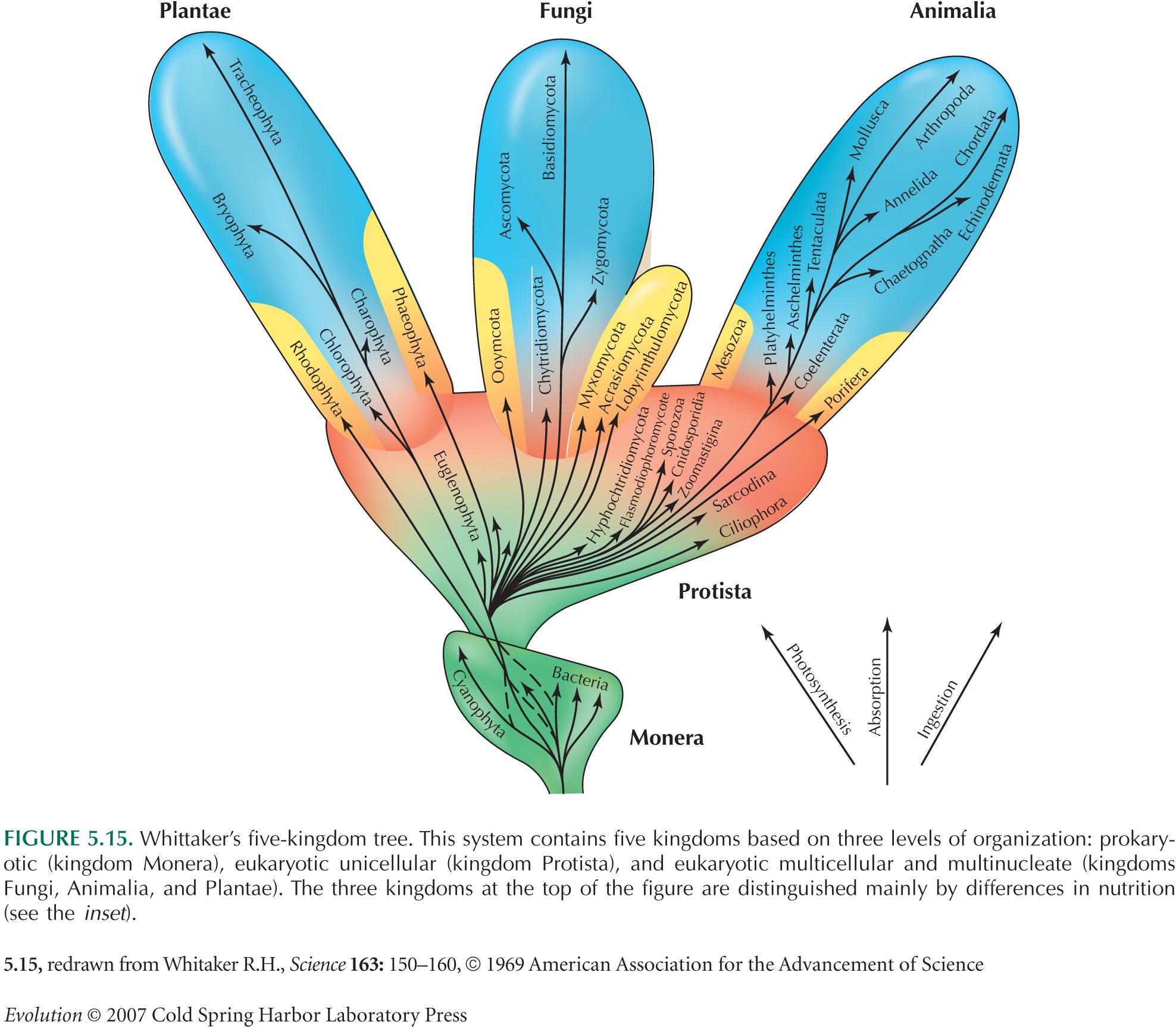
Yes, they are in fact referring to the Whittaker "Five Kingdoms" tree of life, which is no longer in use. (I am placing an image here from my Evolution Textbook) where we talk in Chapter 5 about the history of various trees of life that have been used. The figures from our book are available for free at the book site)


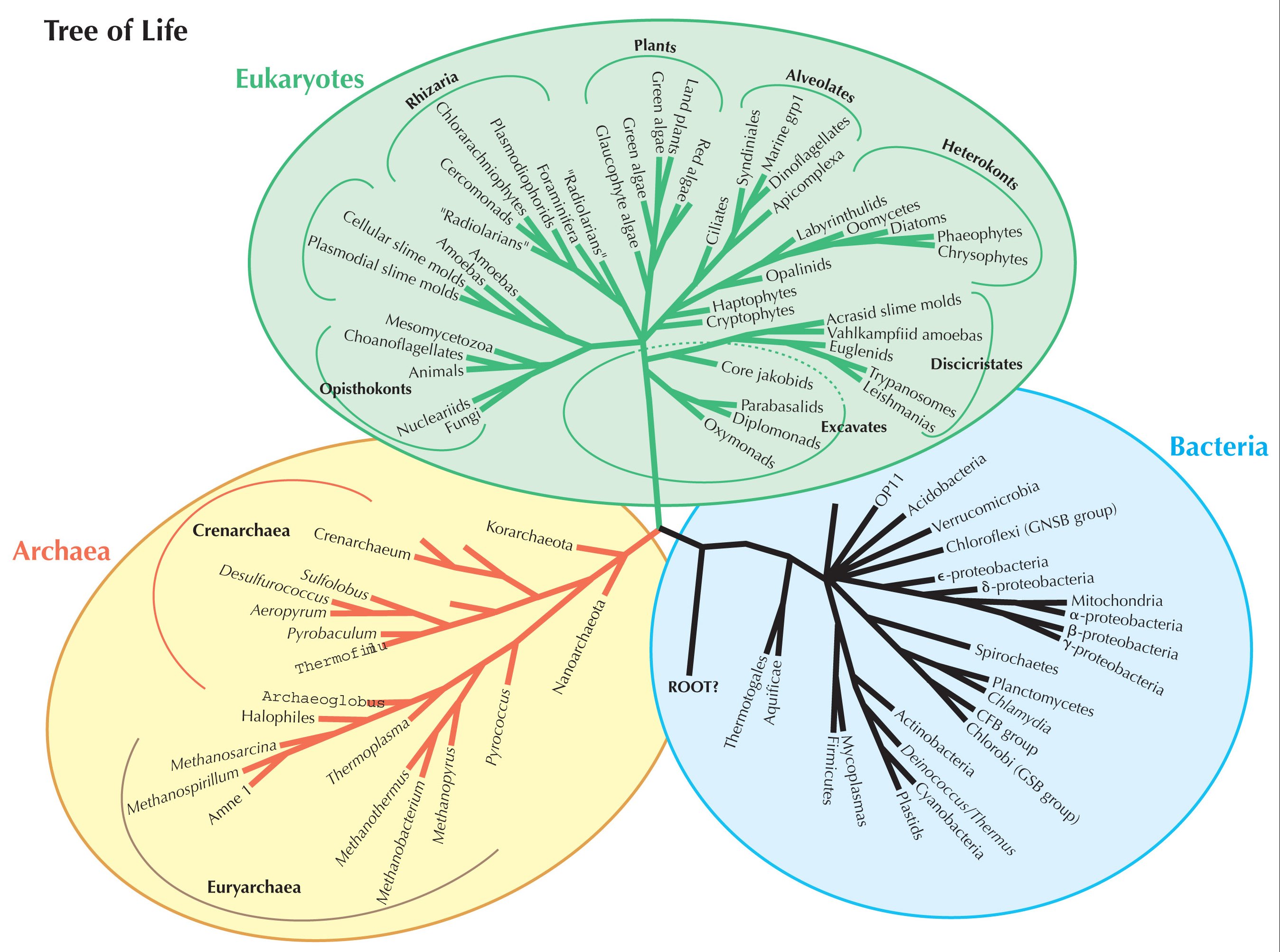
Today we talk about the Three Domains (Bacteria, Archaea and Eukaryotes) and within each of those domains, they are many lineages (which are sometimes referred to as kingdoms). But the five kingdom concept is done and gone. The modern tree looks more like the following (which is an adaptation for our book of a tree by Baldauf).


Mind you, the show on Fungi is worth listening to (although they did miss the opportunity to use the tree of life to answer a question that came up on "Are fungi from outer space?" - the answer should have been - "No, fungi are deeply embedded within the tree of life on this planet, so if life came from elsewhere, it was at the beginning of the origin of life").

Unfortunately, I could not call in to the show (as I have done before) to try and comment on these issues (since I was not listening live). So instead, I am giving Science Friday my Second "Twisted Tree of Life" Award for ignoring the new concepts of the tree of life that have been in play since Woese, Fox and others first laid the groundwork for the existence of the Archaea.

Wednesday, October 01, 2008

Sarah Palin's Still Dangerous Views on Teaching Evolution

Well, Palin has clearly revised her public position on teaching evolution. In part of her interview with Katie Couric it was addressed (I got the transcript here. )
Couric: Do you believe evolution should be taught as an accepted scientific principle or one of several theories?

Palin: Oh, I think it should be taught as an accepted principle. And, you know, I say that also as the daughter of a school teacher, a science teacher, who has really instilled in me a respect for science. It should be taught in our schools. And I won't ever deny that I see the hand of God in this beautiful creation that is Earth, especially coming from one of the most beautiful states in the Union and traveling around this country also in this last month. My goodness, just seeing, you know, the beautiful landscape of New Mexico recently. That was just breath taking and seeing the rolling hills in Virginia and all … the beauty that is this Earth, I see the hand of God in that. But that is not part of state policy or a local curriculum in a school district. Science should be taught in science class.
Sounds promising right? I mean, previously, she seemed to be wishy washy on the separation of science and religion and now she seems to be trying to do the right thing. But just when you might have thought the anti-science part of her was winning out, look at her response to the next question:
Couric: Should creationism be allowed to be taught anywhere in public schools?

Palin: Don't have a problem at all with kids debating all sides of theories, all sides of ideas that they ever - kids do it today whether … it's on paper, in a curriculum or not. Curriculums also are best left to the local school districts. Instead of Big Brother, federal government telling a district what they can and can't teach, I would like to see more control taken over by our school boards, by our local schools, and then state government at the most. But federal government, you know, kind of get out of some of this curriculum and let the locals decide what is best for their students.
This basically follows the script of the Intelligent Design supporters who have been pushing for changes in the education curriculum by local school boards. And it is pretty dangerous in my mind. There should be separation of church and state. Period. At the federal level. At the state level. And at the local level. And this is clearly an attempt to circumvent that concept. So - Palin is towing toeing the ID line here pretty closely and who knows who what havoc she would wreak on science in this country if she were elected. McCain-Palin is starting to look more anti-science than Bush-Cheney, hard as that is for scientists to imagine.

See my earlier post on Palin and evolution here.

Tuesday, September 30, 2008

Congrats to Gary Andersen, Developer of the Phylochip, for Getting a WSJ Technology Award

The Phylochip, developed by Gary Andersen, of Lawrence Berkeley National Lab, and colleagues, has won a Wall Street Journal, Technology Innovation Award. For more see the Wall Street Journal here. Their phylochip is a microarray which can be used to rapidly survey rRNAs from different organisms and get a measure of the types and abundances of organisms present in a sample. It is similar in concept although different in design from a rRNA chip that was used by David Relman, Pat Brown, Chana Palmer and others. Not sure why the chip from Brown et al did not also win the award (it probably was not nominated, or something like that), but still, always good to see cool things in microbiology win awards like this.

Joe Derisi and Open Science featured on Voice of America

Well, I already gave him one of my awards, so what else could he do?  Anyway, always good to see Open Science getting promoted and nice to see Voice of America running a story on Joe Derisi after his Heinz Award and featuring this openness (listen to an MP3 of the radio story here).  And they even interviewed me because of my blog about him.  Blogs and the "real" news merge closer and closer every day.

Monday, September 29, 2008

Humorous sciency signs #2: Squirrel liberation front


Here is another funny science related sign. I think this was from the Grand Canyon or somewhere near there, taken by my mother, many years ago.

Like I needed any more justification to not trust organisms bigger than a large protist.

Wanted - Evolutionary Genomicist at UCSB

Todd Oakley, of UCSB and more importantly, the Evolutionary Novelty Blog, forwarded this to me.  UCSB is looking for an Asst. Prof. in Evolutionary Genomics.  If only they had said "Phylogneomics" then I would have written a longer posting ...

See here for more detail. Also see the ad on Oakley's blog.

Science Faux Pas #4: Nature wishes their dog ate this advertisement

I know others have written about this already but I had to add this to my collection of Science Faux Pas because it is pretty good.  Nature had a recent issue that was covering the US election.  And look at the front and back cover ... they claim it was an accident but hard to imagine given the posing/color matching.  I note I first heard about this from Bora on FriendFeed. And now the Times Online has a whole story on it.

Saturday, September 27, 2008

$ 700 billion will buy a lot of taq, LB, submarines, and other things

I know, my research tends to be expensive as I work on deep sea organisms and do genomics and such. But for $700 billion, a lot could get done in my work areas. Here are some things one could get for that amount of money that directly relate to my work (this was inspired by a conversation with Drew Endy Friday)
  • 1,400,000 Roche 454 Sequencing Machines (for $500,000 each). If you had money for reagents, that would get you a lot of sequencing.
  • 70 million bacterial genomes (at $10,000 each for the shotgun sequencing)
  • 280,000 liters (yes that is right, liters) of Taq polymerase (at 100$/40 ul)
  • 29.16 billion liters of sterilized LB broth (from Sigma at 12$/500 ml). That is one big vat of LB. It is also about 11,666 olympic swimmings pools worth of LB.
  • 7 billion copies of my Evolution textbook
  • 7 million people years of computational biologists to analyze data (at $100,000 per person year)
  • 538 million open access fees for publishing in PLoS One (at $1300 each)
  • 116.67 years of the National Science Foundation's Budget (at current costs of $6 billion per year)
  • A fleet of 32,407 Alvin submarine replacements (at 21.6 million a pop). Think of all of the deep sea work that could be done
  • Registration fees for 350 million people to go to the AGBT meeting in Marco Island
  • 28 million special guest appearances by Craig Venter (assuming he charges a 25,000 speaking fee, which is probably a bit high)
So it goes. I was always thinking of writing this type of blog about the money spent on the Iraq War. But this "bailout" $$$ got me thinking again.

And please post your own lists of what else this $$$ could buy.

Humorous sciency signs #1: Please do not molest the spawning salmon

I am starting yet another thread here --- my favorite humorous science related signs.  This one is from Alaska.  Not sure what Sarah Palin would think of this one, but that is another topic.

Davis Outdoor Art


I am planning to keep posting pics of Davis outdoor art whenever I can. Here are some pictures from the UC Davis Vet Hospital in an art display in honor of companion animals

Thursday, September 25, 2008

Drew Endy talking at Davis tomorrow ....

For those from UC Davis or the area who read the blog and have an interest in genetic engineering or synthetic biology or open science, you should come to this talk.

Genome Center Colloquium
Storer Life Sciences Endowment Presents

Drew Endy, PhD
Stanford University

"Post-Synthesis Genetics & Engineering Biological Simplicity"

Friday, September 26, 2008

10:00 a.m., 1005 GBSF Auditorium

For more on Drew Endy, well, use google of course or go here:

Science Faux Pas #3: Editirs in Chief

The pictire seys it all.  Note - we think this was the restaurant's fault.

Funny Davis Signs #1

Going to start a new section here ... posting pictures of funny Davis
signs. This is one of my favorites.

MapMyRun for Davis is a nice way to find new places to explore in town

I meant to post this a while ago but was in over my head with other things.  I found this cool site while googling for Davis MAPS and thought I would share --MapMyRun.com | Find Runs and Running Routes in Davis, CA

It has a diversity of routes for biking, walking and running in and around town.

Wednesday, September 24, 2008

Lance Armstrong Coming to Davis for the Tour of California

Get ready Davis.  Not only will Davis host a stage of the Tour of California this year, but new reports are today confirming the rumors - Lance Armstrong will apparently race in the Tour of California for the Astana team.  See for example

Tuesday, September 23, 2008

Much ado about plants and blogs in PLoS Biology

Some good new articles in PLoS Biology in the last few weeks worth checking out.  There is definitely a theme there if you want to look for it.  So here are some of the papers connected to that theme and even one that covers both.

What does privacy mean to you? Please complete this survey

ThePrivacyPlace.Org Privacy Survey is Underway!

Researchers at ThePrivacyPlace.Org are conducting an online survey about privacy policies and user values. The survey is supported by an NSF ITR grant (National Science Foundation Information Technology Research) and was first offered in 2002. We are offering the survey again in 2008 to reveal how user values have changed over the intervening years. The survey results will help organizations ensure their website privacy practices are aligned with current consumer values.

The URL is: http://theprivacyplace.org/currentsurvey

We need to attract several thousand respondents, and would be most appreciative if you would consider helping us get the word out about the survey, which takes about 5 to 10 minutes to complete. The results will be made available via our project website (http://www.theprivacyplace.org/).

Prizes include
$100 Amazon.com gift certificates sponsored by Intel Co.
and
IBM gifts

On behalf of the research staff at ThePrivacyPlace.Org, thank you!

Friday, September 19, 2008

Fwd: MG-RAST User Newsletter No.2 -- MG-RAST paper available // NEW version released // 2nd User Workshop planned

Out sick so email updates will have to do
Got this by email

Subject: MG-RAST User Newsletter No.2 -- MG-RAST paper available // NEW version released // 2nd User Workshop planned


Dear MG-RAST users,

The MG-RAST team has some news we would like to share:

1) MG-RAST manuscript published
*******************************

The manuscript for MG-RAST has been accepted in BMC Bioinformatics and is available under the following URL:

http://www.biomedcentral.com/1471-2105/9/386/abstract

Please cite:
--------
The metagenomics RAST server F. Meyer, et al
BMC Bioinformatics 2008, 9:386


2) New version of the server software available
***********************************************

After a lot of testing (Thanks again to all beta testers), we have released a new version of our MG-RAST server software. You will notice improvements in nearly all aspects of the MG-RAST platform and user experience.

Here is a  summary of changes and additions:
- added overview page with statistical summary
- ability to download arbitrary subsets of fragments as fasta
- user can change parameters for metabolic reconstruction and phylogenetic reconstruction on the fly
- ditto comparison/heatmaps
- recruitment plot
- metabolic comparison tool using KEGG pathway maps
- updated databases in background (NR no longer from 2006, Silva RNA database included)
- detailed sequence information and alignments
- support for groups and inviting friends to look at data
- much faster user interface
- ability to see/download fragments and see blast alignments
- added Silva rRNA database (from: http://www.arb-silva.de/)
- many small detailed fixes


3) MG-RAST workshop planned for winter 2008/2009
************************************************
In addition to the tutorial at Metagenomics 2008 in San Diego (see: http://metagenomics.calit2.net/) we are inviting participant registration for our second MG-RAST workshop. Please send an email to mg-rast@mcs.anl.gov if you are interested in participating.


-- from the MG-RAST team

Wednesday, September 17, 2008

Amy Harmon, New York Times, on Open Access publishing

Amy Harmon, who writes for the New York Times and has written some excellent recent pieces on evolution and genomics is answering some questions on the New York Times website

And one of them was about communicating science and Amy responded (with other comments):
Of course, the one way scientists do, theoretically, communicate with the public is by publishing their results. Since these papers are written for other scientists, they can be hard to understand. But even for people game to wade through them, they are often hard to obtain. The two leading scientific journals, Science and Nature, and many others, require people to pay for access to papers whose authors have been financed by taxpayers. “Open access” publishers like the Public Library of Science do not, so it would be nice to see scientists choosing — or being required — to publish in journals that are open to the public.
Nothing more for me to add.

Tuesday, September 16, 2008

Congratulations to Stanley Falkow, Microbiologist Extraordinaire and Lasker Winner

Short one here as I am at a conference. Very happy to see Stan Falkow get a Lasker Award.
"The breadth and depth of Falkow’s career is being recognized with the 2008 Lasker-Koshland Award for Special Achievement in Medical Science."
He is a great scientist but more importantly to me, he has an infectious (no pun intended) enthusiasm for science, microbiology, and life. For more detail, there is a really nice article in the Stanford Report about him and his career. Every time I interact with him (e.g., when I was a student at Stanford) I feel like I got a microbiology passion boost that lasted for years. And clearly he has had this effect on many many others. Congratulations to him for a well deserved award.

Caution - Maverick Scientist Ahead

Interesting article on David Goldstein (a co-author of my Evolution textbook) in the New York Times Mostly, it is kind of portraying him as a "maverick" in genomics (Note - Nick Wade seems to specialize a bit in portraying scientists as mavericks -- think of Craig Venter). Maverick of course is a term that is being overused in the election in the US these days and Wade does not use it to describe Goldstein, but that is the gist. Even the title "A Dissenting Voice as the Genome Is Sifted to Fight Disease."

The key quote is
“There is absolutely no question,” he said, “that for the whole hope of personalized medicine, the news has been just about as bleak as it could be.
He also sort of disses the HapMap project and related activities. Goldstein, who I went to grad. school with, certainly can be contrary. And I do not work on human genomics so I do not know how close to home his claims about the lack of utility of the HapMap. But I think his general feeling here is probably right. Human genomics, as with many other genomicy things, has been oversold by many of the practitioners. That does not mean it is not useful --- and Goldstein makes this point. It is just that we need to be careful (I think and it seems so does Goldstein) in making claims about what the benefits of something in genomics will be before we see the actual benefits.

Most recent post

A ton to be thankful for -- here is one part of that - all the acknowledgement sections from my scholarly papers

So - it is another Thanksgiving Day and in addition to thinking about family, and football, and Alice's Restaurant, I also think a lot a...