Thursday, May 25, 2017
Wakelets summarizing Tweets about "An open digital global south meeting" at #UCDavis
I made a Storify of Tweets and some pictures from the "An open digital Global South" meeting that I am a co-organizer of. This was organized by my "ICIS project and was, to be honest, really put together by other people on the project (I helped, but definitely was not one of the major organizers). Much of the credit should go to Michael Wolfe and Alexandra Lippman. See more in the Storify below.
UPDATE March 14, 2019 - replaced Storify w/ Wakelet.

Thursday, May 18, 2017
Paywall the movie - trailer
Hat tip to Mackenzie Smith for pointing this out to me
Paywall The Movie Trailer from Paywall The Movie on Vimeo.
Paywall The Movie Trailer from Paywall The Movie on Vimeo.
Monday, May 01, 2017
Overselling the microbiome award: Marie Claire for its "article" on Mother Dirt

Wow. And not in a good way. Marie Claire has bough in to the Mother Dirt sales pitch wholesale. Here are some quotes form an article by Roxanne Adamiyatt published today in Marie Claire (see Probiotic Mist - Cleansing Body Mist)
"Like Febreze for your body, Mother Dirt's AO + Mist is a live probiotic spray that restores essential bacteria to our microbiomes. How? In short, the ammonia-oxidizing bacteria works to consume sweat on your body and turn it into a beneficial byproduct your skin can use."Ugh. No that is just not true. This is what the people from Mother Dirt may claim. But I have yet to see any evidence for this.
And then there is
"For example, if you were to use this formula on your face, the "good" bacteria in the mist would consume the ammonia (which raises pH) and restore balance to the skin i.e. it would become less sensitive, dry, or oily. And it's not just your face and body that can benefit from a reset spritz. You can use it in your hair too."Ugh again.
And then the president of Mother Dirt is quoted
According to Jasmina Aganovic, president of Mother Dirt, it can help you go longer between washes. "The bacteria converts your sweat into byproducts your skin can use and with that, you're restoring a microorganism that once naturally existed on the scalp," she explains.And there is more
You can also use AO+ as a quick post-workout fix as the good bacteria will consume the ammonia and urea in your sweat, AKA food for body odor.And
So whether it's balancing your skin, helping you prolong a blowout, or functioning as a deodorant, AO+ is working overtime to keep your hygiene in check...even if you're not. So we can't imagine something more useful to have on hand for summer.I normally would not go the next step but I think it may be needed here - is it time to ask if Marie Claire is getting any money from Mother Dirt for this advertisement?
And for presenting the spray from Mother Dirt as proven to do things without presenting any evidence, I am giving Marie Claire a coveted Overselling the Microbiome Award.
----------------
Update: 5/1/2017 8:50 PM
But wait. A little search of the Maria Claire web site pulled up another advertisement for Mother Dirt that is pretending to be an actual article:
Is Bacteria the Secret to Healthy Skin? by Renee Saleh in 2016.
In this article, the author basically reports on PR from Mother Dirt as though it is factual. For example consider this:
Take acne, for example. Aganovic, who has a degree in chemical and biological engineering from MIT, has studied the presence of ammonia-oxidizing bacteria (a key component of the Mother Dirt product line) in both Western and aboriginal communities. She found that there were almost no acne cases in the aboriginal communities of Paraguay and New Guinea. These communities also shared the universal presence ammonia-oxidizing bacteria in skin cultures. In Western communities, however, acne occurs in 80 percent of adolescents, and there is less than a one percent occurrence of detectable ammonia-oxidizing bacteria on the skin. The absence of this type of bacteria in the West can be traced to the ingredients found in common household soaps and cleansers—and the decrease in time we spend in the great outdoors.
I mean. It is a nice story. But what is the evidence for this? None as far as I can tell. I searched Google Scholar for papers by Aganovic on acne or aboriginal communities and found nothing. Again, I am left wondering if Mother Dirt has paid Marie Claire for this advertising.
Sunday, April 02, 2017
Thursday, March 16, 2017
Monday, March 13, 2017
Round up of responses to my sign captioning request
Round up of responses to my sign captioning request
Thursday, March 09, 2017
Kissing between humans and Neanderthals? Could be oral - anal contact too. Or neither.
Umm - I really do not know what to say here. There is a new incredibly exciting paper out on Neanderthal oral microbiomes.
I saw some news stories about a new study on Neanderthal oral microbiomes. And one thing caught my eye - a claim about how the data provided evidence that Neanderthal's and humans were kissing each other.
See for example the LA Times: Vegetarian Neanderthals? Extinct human relatives hid a mouthful of surprises - LA Times
The scientists also managed to sequence the oldest microbial genome yet — a bug called Methanobrevibacter oralis that has been linked to gum disease. By looking at the number of mutations in the genome, the scientists determined it was introduced to Neanderthals around 120,000 years ago — near the edge of the time period when humans and Neanderthals were interbreeding, Weyrich said
There are a few ways to swap this microbe between species, she pointed out: by sharing food, through parental care, or through kissing.
“We really think that this suggests that Neanderthals and humans may have had a much friendlier relationship than anyone imagined,” Weyrich said. “Certainly if they’re swapping oral microorganisms — or swapping spit — it’s not these brute, rash-type encounters that people were suspecting happened during interbreeding. It’s really kind of friendly interactions.”And Redorbit: Neanderthals were vegetarian– and probably kissed early humans

Another surprise was the discovery of the near-complete genome for Methanobrevibacter oralis, a microbe known to live between the gums and teeth of modern humans, in the dental calculus of the Neanderthals. Weyrich said that this organism is the oldest of its kind to ever be sequenced, and that its existence in Neanderthals means that it had to have been spread to humans somehow – likely through kissing, which supports the growing notion that humans and Neanderthals were known to become intimate with one another on occasion.
And the Washington Post Neanderthal microbes reveal surprises about what they ate — and whom they kissed

And there is this doozy of a quote in the Post article
Sadly the paper is not open access and I generally avoid writing about closed access papers here. But I am making an exception here because the media has run with what I believe to be an inaccurate representation of the science.
So I went to the paper. Neanderthal behaviour, diet, and disease inferred from ancient DNA in dental calculus. I have access to it at UC Davis but if you do not have access to it, you could search for it in SciHub (for more about SciHub see Wikipedia). I am not encouraging you to use SciHub - a site that makes papers available view what may be illegal means in some countries. But if you want to see the paper, and you have determined that you are OK with using SciHub, well, that is an option. This is a link that might get you access in SciHub, if you wanted to do that.
Anyway - I read the paper. And it really is quite fascinating. It has all sorts of interesting information and really does represent an incredible tour de force of both lab and computational work. Kudos to all involved. But alas, there is nothing in the paper about kissing. If you search in the paper for the word kiss - it is not found. The possible transfer of microbes between Neanderthal and humans is briefly discussed however.

And there is this doozy of a quote in the Post article
“In order to get microorganisms swapped between people you have to be kissing,” Weyrich said.And many others. Now - this seemed like it would be really hard to prove. After all, it is really hard to prove from microbiome data that two people have been kissing even when we have high quality data from many samples and even when we have data from both the possible donor and recipient. So how could one show that humans and Neanderthals were kissing with data from ancient samples and only from one of the partners in the putative exchange? Well, as far as I can tell, you cannot.
Sadly the paper is not open access and I generally avoid writing about closed access papers here. But I am making an exception here because the media has run with what I believe to be an inaccurate representation of the science.
So I went to the paper. Neanderthal behaviour, diet, and disease inferred from ancient DNA in dental calculus. I have access to it at UC Davis but if you do not have access to it, you could search for it in SciHub (for more about SciHub see Wikipedia). I am not encouraging you to use SciHub - a site that makes papers available view what may be illegal means in some countries. But if you want to see the paper, and you have determined that you are OK with using SciHub, well, that is an option. This is a link that might get you access in SciHub, if you wanted to do that.
Anyway - I read the paper. And it really is quite fascinating. It has all sorts of interesting information and really does represent an incredible tour de force of both lab and computational work. Kudos to all involved. But alas, there is nothing in the paper about kissing. If you search in the paper for the word kiss - it is not found. The possible transfer of microbes between Neanderthal and humans is briefly discussed however.
From what I can tell, what they did here was the following:
It is cool and very interesting stuff. See this figure for example.

And then based on this they write:
So they are inferring transfer of commensal microbes based on molecular clock dating from one single M. oralis genome from Neanderthal and one from humans and a comparison of the inferred dating of their common ancestor versus the timing of supposed divergence between humans and Neanderthal. Personally it seems like a big big stretch to make that inference here. What if the dating from their analysis is off (such dating estimates are generally highly debated and unclear how accurate they are)?
But let's just say that this is in fact good evidence for some sort of more recent common ancestry of the M. oralis found in their sample and the M. oralis found in a human than one would expect based on knowledge of Neanderthal and human common ancestry. Does that mean swapping of the microbes between humans and Neanderthal? Not at all. Maybe the M. oralis comes from food. And if it is living in some sort of food source (could be animal, or plant or something else) and it comes into both humans and Neanderthal separately, then one could easily have a way for the one found in their Neanderthal sample to have a more recent common ancestry with the one found from humans than the common ancestry of the "hosts" here.
Interestingly, the genome they used to compare to Methanobrevibacter oralis JMR01 actually came from a fecal sample and not an oral sample - see Draft Genome Sequencing of Methanobrevibacter oralis Strain JMR01, Isolated from the Human Intestinal Microbiota. So this microbe is not solely found in the mouth and it apparently can survive transit between the mouth and another orifice, and may even be a gut resident (i.e., not just transiting).
So anyway - it seems woefully premature to conclude that the data they have here provides evidence for exchange between humans and Neanderthals of M. oralis. Could have occurred. But also could be separate colonization from similarly environmental sources.
And finally, even if we assume that the M. oralis was exchanged, which again there seems to be no good evidence for, what is to suggest that this was do due to kissing? Nothing as far as I can tell. How about sharing utensils? How about contact with fecal contaminated water (since M. oralis seems to do OK in feces)? Or I guess would could go extreme and say this could be evidence for oral anal contact between Neanderthal and humans, if we wanted to sensationalize this even more. After all, we do know many cases of microbes getting exchanged by oral - anal contact. But we don't do we? How about we stick to what we have good evidence for and then carefully discuss possibilities, of which kissing is one, but it is just one of many and it relies upon a lot of conclusions for which the evidence is tenuous at best.
This There is really amazing science in this work. But the kissing claims are premature as far as I can tell (I honestly hope I am wrong and that there is more data than presented in the paper, but if there is it should be presented somewhere - or maybe I have misinterpreted the paper - but I don't think so). If the claims are as premature as they seem to be, this is damaging in my mind to the field of microbiome science.
-----------------------------
UPDATE 3/10/17
Thanks to Ed Yong for updating his Atlantic article on this story to add a reference to my concerns.
He wrote
UPDATE 2 - Made a Storify of some responses
- reconstructed a genome from their samples of Methanobrevibacter oralis subsp. neandertalensis.
- compared the genomes to other Methanobrevibacter genomes including just one other M. oralis (this one from humans)
- Inferred a
possbilepossible date range for the split between their M. oralis and that from humans
It is cool and very interesting stuff. See this figure for example.

And then based on this they write:
Date estimates using a strict molecular clock place the divergence between the M. oralis strains of Neanderthals and modern humans between 112–143 ka (95% highest posterior density interval; mean date of 126 ka) (Fig. 3b; see Supplementary Information). As this is long after the genomic divergence of Neanderthals and modern humans (450–750 ka)29, it appears that commensal microbial species were transferred between the two hosts during subsequent interactions, potentially in the Near East30.
So they are inferring transfer of commensal microbes based on molecular clock dating from one single M. oralis genome from Neanderthal and one from humans and a comparison of the inferred dating of their common ancestor versus the timing of supposed divergence between humans and Neanderthal. Personally it seems like a big big stretch to make that inference here. What if the dating from their analysis is off (such dating estimates are generally highly debated and unclear how accurate they are)?
But let's just say that this is in fact good evidence for some sort of more recent common ancestry of the M. oralis found in their sample and the M. oralis found in a human than one would expect based on knowledge of Neanderthal and human common ancestry. Does that mean swapping of the microbes between humans and Neanderthal? Not at all. Maybe the M. oralis comes from food. And if it is living in some sort of food source (could be animal, or plant or something else) and it comes into both humans and Neanderthal separately, then one could easily have a way for the one found in their Neanderthal sample to have a more recent common ancestry with the one found from humans than the common ancestry of the "hosts" here.
Interestingly, the genome they used to compare to Methanobrevibacter oralis JMR01 actually came from a fecal sample and not an oral sample - see Draft Genome Sequencing of Methanobrevibacter oralis Strain JMR01, Isolated from the Human Intestinal Microbiota. So this microbe is not solely found in the mouth and it apparently can survive transit between the mouth and another orifice, and may even be a gut resident (i.e., not just transiting).
So anyway - it seems woefully premature to conclude that the data they have here provides evidence for exchange between humans and Neanderthals of M. oralis. Could have occurred. But also could be separate colonization from similarly environmental sources.
And finally, even if we assume that the M. oralis was exchanged, which again there seems to be no good evidence for, what is to suggest that this was do due to kissing? Nothing as far as I can tell. How about sharing utensils? How about contact with fecal contaminated water (since M. oralis seems to do OK in feces)? Or I guess would could go extreme and say this could be evidence for oral anal contact between Neanderthal and humans, if we wanted to sensationalize this even more. After all, we do know many cases of microbes getting exchanged by oral - anal contact. But we don't do we? How about we stick to what we have good evidence for and then carefully discuss possibilities, of which kissing is one, but it is just one of many and it relies upon a lot of conclusions for which the evidence is tenuous at best.
-----------------------------
UPDATE 3/10/17
Thanks to Ed Yong for updating his Atlantic article on this story to add a reference to my concerns.
He wrote
But after the paper was published, and several publications noted Weyrich’s suggestion about kissing in their headlines, Jonathan Eisen from the University of California, Davis, expressed skepticism about the claim. “Maybe the M. oralis comes from food,” he wrote in a blog post. It could have been picked up independently from the environment, or from water contaminated with feces, or from other kinds of sexual contact. A kissing route “it is just one of many and it relies upon a lot of conclusions for which the evidence is tenuous at best,” Eisen said.
UPDATE 2 - Made a Storify of some responses
Wednesday, March 01, 2017
Blast form the past - videos from 2002 research cruise at the Galapagos Rift
OK it is only 15 years after the fact but am posting some videos from the 2002 Galapagos Rift Expedition I went on May 24 - June 4, 2002. It was the cruise honoring the 25th Anniversary of the discovery of deep sea hydrothermal vent ecosystems.
For more information see the web site from Dive and Discover
Here is a playlist with all my videos, some from the cruise and some from the Galapagos Islands where the cruise started / stopped. I have not edited any of the videos - just digitized everything from the tapes and posted them. Apologies if anything is, well, inappropriate for any reason.
For more information see the web site from Dive and Discover
- Mission & Objectives
- Daily Updates
- Mail Buoy
- Scientists & Crew
- Interviews
- Hot Topics
- Slideshows
- Videos
Here is a playlist with all my videos, some from the cruise and some from the Galapagos Islands where the cruise started / stopped. I have not edited any of the videos - just digitized everything from the tapes and posted them. Apologies if anything is, well, inappropriate for any reason.
Wednesday, February 08, 2017
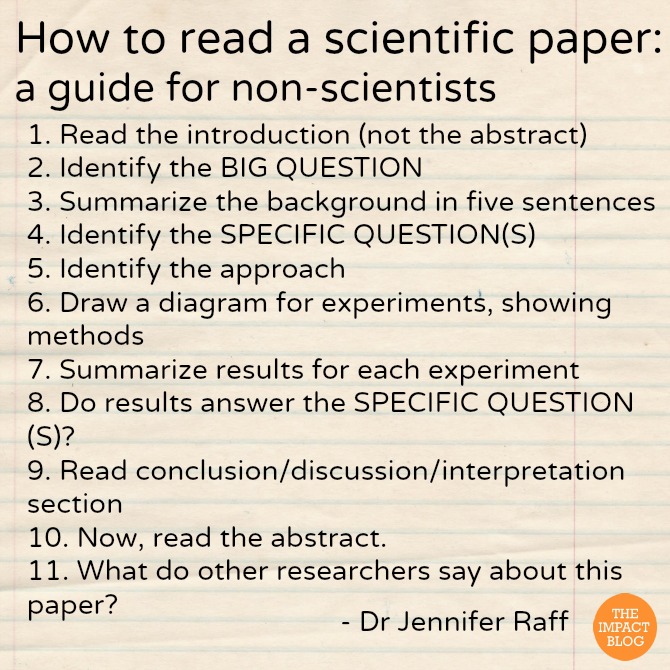
Useful post: How to read and understand a scientific paper: a guide for non-scientists
Just a quick one here. This is a useful post for anyone interested in science literacy. By Jennifer Raff: How to read and understand a scientific paper: a guide for non-scientists

These are actual living microbiologists #actuallivingscientist
Crossposting this - which I already posted at microBEnet
I have been tracking #actuallivingscientist postings on Twitter compiled those by people doing microbiology. Actual living microbiologists.
Monday, February 06, 2017
The #falcons may have lost, but the birders won Twitter with #Superb_Owls vs. #Superbowl
Was fun yesterday watching all the punny posts about #Superb_Owls. I really love owls.
I posted some too and also made a Storify of some of the posts of the day.
Here are mine:
Sunday, January 01, 2017
Real time blood glucose levels on Apple Watch
Made a storify of a discussion from Twitter.
Loving my new Apple Watch with real time glucose values via my Dexcom CGM.
What to do with old Knome exome data ...
A little discussion from Twitter
More coming but thought I would post this
Friday, October 28, 2016
A gloomy day at the #UCDavis Genome Center Halloween Symposium - a model for a #manel #yammm
It is a gloomy day, at least for me, at #UCDavis today.
Yes it is raining and cloudy. But that is not the gloomy part. I like rain and clouds and we don't get enough of either around here. The issue for me is the Symposium happening today in my building. Run by the UC Davis Genome Center, which I am a part of. What is the problem?
Well here is the flier

That is nine presenters. Eight of which are men.
- S. Dinesh-Kumar
- Brett Phinney
- Anthony Herren
- Jessica Franco
- Jack Cuniff
- John Yates
- John Muchena
- Ilias Tagkopoulos
- Nuno Bandeira
That comes to 11% female speakers. Not a good ratio. But you know this is just one sample right? It could be a random anomaly, or something else.
So - lets look at last years Halloween symposium.

That is five speakers, all men.
- Mingcheng Luo UC Davis
- Chris Streck 10X
- Marco Blanchette Dovetail
- Matthew Seetin PacBio
- Matthew Settles, UC Davis
OK so let's give it one more chance. How about 2014. See http://genomecenter.ucdavis.edu/2014/10/23/details-available-for-the-genome-center-halloween-symposium/

Four speakers. All male.
2014
- Bruce Draper UC Davis, Molecular and Cellular Biology
- Bruce Conklin, Gladstone Institute of Cardiovascular Disease, UCSF
- David Segal, UC Davis, Genome Center
- Dana Carroll, University of Utah, Department of Biochemistry
So over the last three years we have 94% male presenters. It is a better if you go back further. 2013 was 50-50. 2012 was ~ 70-% male. 2011 was 55:45 or so. But over the last three years something has devolved. And no, I will not be attending. And yes, I have made comments about this, but maybe too few.
It is so frustrating to keep seeing this happening over and over in academia and science. And to see it so close to home, well, it is really extraordinarily disappointing.
I sent the organizers which I think has some great examples of how to run a diverse meeting.
Below are some articles worth looking at on the topic.
- Diversity matters in planning journalism conferences by Steve Buttry
- show me the policy | cubist crystal by Jenny Martin
- Stop Agreeing To Be On All-Male Panels — Just Stop - Emily Peck the Huff Post.
- Increasing Diversity at Your Conference
- Promoting Gender Diversity at Conferences
- Encourage speaker diversity at synthetic biology conferences from Synberc
- 6 Steps for Planning a Diverse Conference by Jessica Fleuti
- White male lineup at medical meeting sparks 'public shaming' in STAT
- STEM Women: How Men Can Help, with Professor Jonathan Eisen ...
- Discussion of speaker diversity triggered by a #manel (Storify)
- Speaker gender balance at Society for the Neurobiology of Language conferences 2009–2015
- Countering gender bias at conferences Carrie Arnold in Science
- Ten Simple Rules to Achieve Conference Speaker Gender Balance by Jenny Martin
- How to Add More Women Speakers to Your Meetings by Michelle Russell in PCMA Convene
- Welcoming Women at STEM Conferences – and Beyond - the StoryExchange
- To Get More Female Conference Speakers - GenomeWeb
- Female Scientists Turn to Data to Fight Lack of Representation on Panels NY Times
- How likely is an all-male speakers list, statistically speaking? A mathematician weighs in.
I certainly feel partially responsible for this, because it is in my building and run by my Center. Now I had nothing to do with this even, but still ... I will do my best to make sure this does not happen ever again at the UC Davis Genome Center. But I will not be attending this year's meeting.
Monday, October 17, 2016
Thanks to all for "Suggestions for 11 year old daughter who wants to learn to code"
 I am so thankful to the whole community out there who gave answers to my request for suggestions for my 11 year old daughter who wants to learn to code.
Today we were both home sick and when she said she was bored she then asked if we could try some of the examples people suggested. And we ended up playing around with Python at Codeacademy and she spent hours on it. So much fun. See below:
Daughter & I both home sick - she is bored - so we reviewed this https://t.co/T0F15Bv8MH & today she is learning Python via @Codecademy— Jonathan Eisen (@phylogenomics) October 17, 2016
No - #FFS - no - I will not speak at your meeting given the lack of diversity of speakers
So a few days ago I got asked to do a paid speaking engagement for a meeting
Dear Dr. Eisen,
Sounded nice - getting paid to go to New York. What could go wrong right?. Then I did some Googling to find out about the meeting. Found it - the Interdisciplinary Autoimmune Summit: http://joinias.com. And, as I do for all meeting invites these days, I looked at their speaker line up. For this years and previous years. And well, I was not impressed.


A lot of men. Men men men and men. So I wrote back
Dear Dr. Eisen,
I hope this email finds you well!
We have a client that's interested in you speaking at their Autoimmune Conference in New York on March 24, 2017.
Do you have a standard speaking fee/range that I can report back to my client? If you're able to confirm your availability as well, that would be great!
The audience would be primarily physicians.
Your consideration is very much appreciated!
Sincerely,


A lot of men. Men men men and men. So I wrote back
Friday, October 07, 2016
Matt Hahn @3rdreviewer talk at #UCDavis - pen and paper notes
Matt Hahn was at UC Davis giving a talk yesterday.


I did not have my laptop available so took notes with - gasp - a pen and paper. I thought it was quite a nice talk so am posting my notes here. More about Matt and his work can be found here: http://www.indiana.edu/~hahnlab/.Yes @3rdreviewer has arrived at #UCDavis #holobiont #epigenetics #aquarius pic.twitter.com/yirR4rWdio— Jonathan Eisen (@phylogenomics) October 6, 2016


Thursday, October 06, 2016
The White Men's Microbiome Congress #YAMMM #Manel #Boycott
So I got this email this morning inviting me to attend a conference: the Second Annual Human Microbiome Congress in San Diego. (also called the North American Microbiome Congress).

And it struck me that all the featured speakers were men.

Great. So I decided to give them the benefit of the doubt, hoping that maybe if I looked at the rest of the speakers it would be better.
So I had to register on some web site to download the full agenda for the meeting. And there were the featured speakers, rippling with diversity

So then I went to scroll through the document looking for the other speakers.
OMFG - what a joke.
Sunday, October 02, 2016
Yet another biased meeting from Oxford Global - their meetings should be shunned #YAMMM #GenderBias
Well, Oxford Global has done it again. They have found a way to be one of the most extremely gender biased conferences around. Their 2016 Genome Editing Congress Speakers. Their web site lists 20 speakers, 19 of which are men. (One of the men is listed twice - I am not sure if that is due to giving two talks or a mistake. So this may be 19 speakers~ 95, 18 of which are men). Regardless that comes to ~ 95% male speakers.

Sponsors of the meeting should be contacted about this:

Sadly this is a consistent pattern for Oxford Global. See for example Oxford Global Sequencing Meetings: Where MEN Tell You About Sequencing #YAMMM and also Time to boycott Oxford Global meetings due to blatant sexism
Really - we need as a community to stand up to these types of meetings. Oxford Global meetings should be boycotted. And the companies that sponsor their meetings are complicit in their gender bias.

---------------------------------------------
UPDATE 10/2 12:56 PM - decided to look at another one of their meetings that is linked from this one
2nd Annual Next Generation Sequencing USA Congress
3-4 October 2016, Boston, USA
83 % male speakers. Grand.

For other posts on STEM Diversity see here.

- Andre Choulika, CEO Cellectis
- Guna Rajagopal, VP – Global Head, Computational Sciences, Discovery Sciences Janssen
- Lorenz Mayr, VP & Global Head, Reagents & Assay Development Astrazeneca
- Zheng-Yi Chen, Associate Professor Harvard Medical School
- Daniel Anderson, Associate Professor MIT
- Marcello Maresca, Associate Principal Scientist Astrazeneca
- John Doench, Director; Associate Director, Genetic Perturbation Platform Broad Institute
- Chad Cowan, Associate Professor Harvard
- Pablo Perez Pinera, Associate Professor University of Illinois
- Jim Collins, Professor MIT
- Channabasavaiah Gurumurthy, Director, Transgenic Core Facility University of Nebraska Medical School
- Danilo Maddalo, Senior Scientist and Lab Head Novartis Institutes for BioMedical Research
- Rodolphe Barrangou, Associate Professor North Carolina State University
- Stephanie Mohr, DRSC Director Harvard Medical School
- Robert Howes, Associate Director MedImmune
- Channabasavaiah Gurumurthy, Director, Transgenic Core Facility University of Nebraska Medical Center
- James Carothers, Assistant Professor University of Washington
- William Theodorus Hendriks, Instructor in Neurology Harvard Medical School
- Mark Osborn, Assistant Professor University of Minnesota
- Jeff Chamberlain, Professor University of Washington
1 and 19 were counted at Genome Editing USA Congress #OxfordGlobal. Learn more at GenderAvenger Tally

Sadly this is a consistent pattern for Oxford Global. See for example Oxford Global Sequencing Meetings: Where MEN Tell You About Sequencing #YAMMM and also Time to boycott Oxford Global meetings due to blatant sexism
Really - we need as a community to stand up to these types of meetings. Oxford Global meetings should be boycotted. And the companies that sponsor their meetings are complicit in their gender bias.

---------------------------------------------
UPDATE 10/2 12:56 PM - decided to look at another one of their meetings that is linked from this one
2nd Annual Next Generation Sequencing USA Congress
3-4 October 2016, Boston, USA
83 % male speakers. Grand.

- James Knight, Director of Bioinformatics Yale University
- John Quackenbush, Professor Dana-Farber Cancer Institute
- Shanrong Zhao, Director Pfizer Inc.
- Nazneen Aziz, Research Professor Arizona State University
- George Weinstock, Director and Professor Jackson Laboratory for Genomic Medicine
- Alexander Wait Zaranek, Director Informatics Harvard Medical School
- Rong Mao, Medical Director, Molecular Genetics and Genomics, ARUP Laboratories; Associate Professor, Pathology University of Utah School of Medicine
- Mark Gerstein, Albert L Williams Professor of Biomedical Informatics, Molecular Biophysics & Biochemistry, and Computer Science Co-Director of the Yale Program in Computational Biology & Bioinformatics
- James Willey, Professor of Medicine and Pathology University of Toledo
- Neil R. Smalheiser, Associate Professor in Psychiatry University of Illinois College of Medicine
- Mark Borodovsky, Regents’ Professor Georgia Tech
- Scott J. Tebbutt, Associate Professor & Chief Scientific Officer University of British Columbia & PROOF Centre of Excellence
- Michael Fraser, Program Director, Cancer Genomics, Radiation Medicine Program Princess Margaret Cancer Centre
- Justin Johnson, Associate Director and Principal Scientist AstraZeneca
- Leonora Balaj, Instructor in Neurology Massachusetts General Hospital Harvard Medical School
- Aleksandra Markovets, Senior Scientist AstraZeneca
- Baohong Zhang, Director of Clinical Bioinformatics Pfizer, Inc.
- Steven Hart, Assistant Professor of Biomedical Informatics Mayo Clinic
- Manolis Kellis, Professor and Head, MIT Computational Biology Group MIT
- John Methot, Head of Scientific Computing Biogen
- Andrew Hollinger, Associate Director: Scientific Communications Broad Institute
- Yingtao Bi, Senior Manager in Statistics Abbvie Bioresearch Center
- Paul Blainey, Assistant Professor of Biological Engineering, MIT and Core Faculty Member Broad Institute of MIT & Harvard
For other posts on STEM Diversity see here.
Saturday, September 24, 2016
Wrap up from Gender Bias Under the Microscope Symposium #RFUSymposium #GenderBias
Had an amazing time at Rosalind Franklin University for their Gender Bias Under the Microscope Symposium. I made a Storify about it here:
For other posts on STEM Diversity see here.
For other posts on STEM Diversity see here.
Thursday, September 15, 2016
Tuesday, September 13, 2016
No thanks Precision Medicine #PMWC2017 - I don't want to go to your $&*@(#@( #manel #yammm #biased meeting
Today I got this email, ostensibly from Keith Yamamoto, who I have interacted with a bit over the years, including in the writing of the NAS "New Biology" report.

So I decided to check out the meeting site. Precision Medicine World Conference. Hosted by Stanford and UCSF and Duke and Others. And also a "manel". Also known as a YAMMM (yet another mostly male meeting). A festival in fact of men. So so so many men listed as speakers. Here is my round up.

Just so sick of meetings like this. Apparently Keith Yamamoto and UCSF and Duke and Stanford and all the Sponsors endorse having a meeting where about 1 in 6 of the speakers are women. No thanks. Not interested. I am sure they can all make a litany of excuses. But I am so tired of hearing them. In the end the only way to get some of these groups to change their practices is to boycott their meetings. And to publicly discuss, with the sponsors and speakers and organizers, why their meeting is not OK.
UPDATE 1 - Some responses and discussion on Twitter
Saturday, September 03, 2016
Congratulations SynbioBeta #SBBSF16 - you are having a #YAMMMy #manel
Well this is disappointing.
Someone sent me an announcement for SynBioBeta SF 2016 - SynBioBeta possibly thinking I would go to it. Since it was local I decided to check it out. And, well, the 1st thing I did was to look at the gender balance of the speakers (as much as I could infer from a quick skim). And it did not look good. So I dug into it in more detail.
They have a speaker page and I went through most of them to make sure my inference of gender was correct (based on looking at the pronouns used to describe them in their speaker bio and also in other web sites). I know this is imperfect but seems potentially a decent estimator. And low an behold when you sum it all up you get 79% male speakers vs. 21% female speakers. They could definitely do better.

Tuesday, August 30, 2016
Viruses viruses viruses viruses viruses viruses viruses.
Actually, the title is clearly insufficient. [Viruses]^100 or something like that would be better.
And here is a story by Michaeleen Doucleff from NPR about viruses in the human microbiome with some quotes from me.
And here is a story by Michaeleen Doucleff from NPR about viruses in the human microbiome with some quotes from me.
Friday, July 22, 2016
Today's misleading overselling the #microbiome - U. Chicago on Alzheimer's and gut microbes

Well, this is disappointing if not disturbing
A new paper is out that has some interesting findings but the paper itself, and the press release form the authors (at University of Chicago) really goes overboard in misstating the findings.
Here is the paper in Scientific Reports. I purposefully am not putting the title of the paper here in the post yet, because amazingly, even the title is misleading.
But here is what a summary of what they showed, based on their results section, which seems interesting and sound
- Antibiotic treatment of a variety of mice showed alterations in the GI microbiome and in various inflammatory markers circulating in the blood
- Male mice treated with this antibiotic regime showed reduced Aβ plaque deposition but increased soluble Aβ levels
- Reactive gliosis surrounding Aβ plaques is reduced in male mice treated with this antibiotic regime
This is not all they report as they also discuss various controls and other observations about these mice and their brains and their responses to the antibiotic treatment.
But what they do not report on is any evidence of anything other than a correlation between the GI microbiome changes and the inflammatory markers and the reduced Aβ plaque deposition. They even state this VERY BRIEFLY in their paper
We are fully cognizant of the fact that the findings reported herein are purely correlative and do not elucidate precise mechanism(s).
Yet then through other papers parts of the paper they misstate what they find and somehow, almost magically, turn this correlation into evidence for a causative connection. For example in the abstract
These findings suggest the gut microbiota community diversity can regulate host innate immunity mechanisms that impact Aβ amyloidosis.No. These findings are consistent with that. They are also consistent with, for example, the antibiotics affecting microbes in the brain which in turn could affect inflammatory markers. Or microbes on the skin. Or in the blood. Or elsewhere. I don't see any evidence here for a causative connection between the gut microbes (which are certainly affected by these antibiotics) and the plaque.
Yet even worse is that this misrepresentation of a causative connection makes it into the title of the article
Antibiotic-induced perturbations in gut microbial diversity influences neuro-inflammation and amyloidosis in a murine model of Alzheimer’s disease

No no no no no no no no. No evidence that the perturbations in the gut microbes are directly influencing anything in the brain. It is a good model. But they need to be more careful with their wording.
And sadly, this gets even worse in the press release about the paper: Antibiotics weaken Alzheimer's disease progression through changes in the gut microbiome | EurekAlert! Science News
What? This "through changes in the gut microbiome" is just completely misrepresenting what was shown in the paper.
Here are some misleading parts of the PR
The study, published July 21, 2016, in Scientific Reports, also showed significant changes in the gut microbiome after antibiotic treatment, suggesting the composition and diversity of bacteria in the gut play an important role in regulating immune system activity that impacts progression of Alzheimer's disease.Nope. Nope. and Nope.
Thankfully there are a few caveats in the PR too but that does not balance misleading statements. The worst is saved for the end
"There's probably not going to be a cure for Alzheimer's disease for several generations, because we know there are changes occurring in the brain and central nervous system 15 to 20 years before clinical onset," he said. "We have to find ways to intervene when a patient starts showing clinical signs, and if we learn how changes in gut bacteria affect onset or progression, or how the molecules they produce interact with the nervous system, we could use that to create a new kind of personalized medicine."Basically, saying there will be a cure for Alzheimer's. And then saying if we learn HOW (not if) gut microbes affect onset or progression, then we can better cure or treat this disease. This is just too bold and misleading for my taste. Nice paper. Interesting work and implications. But it is misleading to say they have shown any causative connection between gut microbes and Alzheimer's in this paper and also very misleading to start to talk about how they will use this to lead to treatments or cures.
Oh, and did I mention this was in mice not humans? So how do they get from a correlative study in mice to how gut microbes affect progression of Alzheimer's in humans? Really this is not OK, even to hint at.
And of course, which such misleading material in their own paper and in their PR it is not surprising that some of the reporting on this is going awry.
See the Daily Express for example

And the Business Standard

And I am sure many more to come. Scientists have to be more careful with discussing and presenting the implications of their work. I love the microbiome field and the possible implications to me are enormous for the role of the microbiome in various areas of biology. But misrepresenting ones findings, especially when it comes to human diseases, is dangerous and bad for science and bad for the microbiome field. The author's of the paper and the people behind the PR at the University of Chicago should publish a correction of the PR and also publish a correction of their paper to correct the misleading representations. And for their misleading material in their paper and in the PR I am giving them a coveted "Overselling the Microbiome" award.

Thursday, July 14, 2016
Overselling the Microbiome Award for @nytimes on thumb sucking, nail biting protecting from allergy

I am continually torn about handing out "overselling the microbiome" awards to many "stories" that are coming out recently on new scientific studies. On the one hand, many of these studies are quite interesting. On the other hand, a huge number of them oversell the implications of the work. And for some reason it seems to me that studies that could indicate a positive role for microbes in some way seem to end up with more misrepresentation than other types of work. Mind you, I truly believe the cloud of microbes living in and on various plants and animals are likely to play fundamental roles in all sorts of important functions. But my thinking this and my thinking it is likely does not mean we should go around overstating the implications of work in this area.
And that brings me to the latest example of such overselling ... a story about thumb sucking and nail biting as covered in the New York Times: Thumb Suckers and Nail Biters May Develop Fewer Allergies
The science here is interesting - it is based on a new paper testing for associations between thumb sucking and nail biting on the one hand and atopic sensitization, asthma and hay fever on the other. The paper found the following: Children who suck their thumbs or bite their nails are less likely to have atopic sensitization in childhood and adulthood.
Interesting. But a key part of this is that they discovered a correlation. Lots and lots and lots of possible explanations for this correlation including some examined in the paper but none of which have been proven. Some news reports do a good job of covering the topic and discussing how this is still just a correlative observation. For example see this Washington Post article by Lateshia Beachum. There they report on the authors comments where the authors seem to think this supports the hygiene hypothesis
“The findings support the ‘hygiene hypothesis,’ which suggests that being exposed to microbes as a child reduces your risk of developing allergies,” Hancox said in a statement.But then immediately this is countered by some more careful thoughts
Hirsh Komarow, a staff clinician at the National Institute of Allergy and Infectious Diseases, isn’t entirely convinced about the study’s conclusions. “It’s an interesting observation, but it needs more analysis,” Komarow said.And then he is further quoted with other possible explanations
Komarow also suggested that thumb-sucking and nail-biting could be indicative behaviors that either thwart or encourage allergic reactions. He said being part of a large family and being exposed to microbes from many siblings may affect a child’s allergic sensitization.And there are other articles out there with a decent amount of caveating. But sadly the New York Times article by Perri Klass is not so tempered. Here are some of what I consider to be statements without enough caveating or countering:
A new study suggests that those habits in children ages 5 to 11 may indeed increase exposure to microbes, but that that may not be all bad.No no no. The new study did not suggest that. The new study is consistent with that, but it is consistent with many other explanations.
And then there is this:
These differences could not be explained by other factors that are associated with allergic risk. The researchers controlled for pets, parents with allergies, breast-feeding, socioeconomic status and more. But though the former thumb-suckers and nail-biters were less likely to show allergic sensitization, there was no significant difference in their likelihood of having asthma or hay fever.Well it is nice that the authors of the paper tested for some other possible explanations. But it is a giant and inappropriate leap to go from that to "These differences could not be explained by other factors that are associated with allergic risk"
And then there are multiple quotes from the authors which are not really caveated enough or at all
Robert J. Hancox, one of the authors of the study, is an associate professor in the Department of Preventive and Social Medicine at Dunedin School of Medicine, a department that is particularly oriented toward the study of diseases’ causes and risk factors. He said in an email, “The hygiene hypothesis is interesting because it suggests that lifestyle factors may be responsible for the rise in allergic diseases in recent decades. Obviously hygiene has very many benefits, but perhaps this is a downside. The hygiene hypothesis is still unproven and controversial, but this is another piece of evidence that it could be true.”Some caveats here but not enough. This is not "evidence that it could be true" but rather it is data consistent with that model, but also consistent with other models that have nothing to do with the hygiene hypothesis.
And then there is this:
Malcolm Sears, one of the authors of the paper, a professor of medicine at McMaster University in Hamilton, Ontario, who was the original leader for the asthma allergy component of the New Zealand study, said, “Early exposure in many areas is looking as if it’s more protective than hazardous, and I think we’ve just added one more interesting piece to that information.”No this study did not show that early exposure from thumb sucking or nail biting has any protective benefit. It showed a correlation between thumb sucking/nail biting and lower risk of sensitization. It did not show any causal connection. And even if a causal connection were found, one would still have to test for what was the mechanism and the mechanism could be many things unconnected to microbial exposure.
And then there is this
Dr. Hancox pointed out that the study does not show any mechanism to account for the association. “Even if we assume that the protective effect is due to exposure to microbial organisms, we don’t know which organisms are beneficial or how they actually influence immune function in this way.”
Yes, this is good in some ways. But why would we assume this? Stating this without caveats makes it seem like we should assume this.
and
Dr. Sears said, “My excitement is not so much that sucking your thumb is good as that it shows the power of a longitudinal study.” (A longitudinal study is one that gathers data from the same subjects repeatedly over a period of time.) And in fact, as researchers tease out the complex ramifications of childhood exposures, it’s intriguing to look at long-term associations between childhood behavior and adult immune function, by watching what happens over decades.None of these quotes are really caveating the claims. And then the article ends with a statement that seems to indicate that this is all a proven fact
So perhaps the results of this study help us look at these habits with slightly different eyes, as pieces of a complicated lifelong relationship between children and the environments they sample as they grow, which shape their health and their physiology in lasting ways.Yes, this study is interesting. And yes, it might be indicative of a causative connection between exposure to microbes on thumbs and nails and reducing risk to allergy. But no, the study did not show that there is a causative connection, just a correlation. And thus we cannot conclude at this point that we should "look at these habits with slightly different eyes, as pieces of a complicated lifelong relationship between children and the environments." The correlation could be due to other factors that have nothing to do with these habits. And this is just a massive difference. Shame on the New York Times for not reporting on this carefully enough.
And thus I am awarding a coveted Overselling the Microbiome Award to the New York Times and Perri Klass.
Hat tip to Mark Sagoff for pointing me to the NY Times article.
Sunday, July 10, 2016
Today in Overselling the #microbiome: Lick-hiker's guide to Inner Strength
Well, thanks, I think to Christie Aschwanden https://christieaschwanden.com for pointing me to this.
Valio unveils Lick-hiker’s Guide to Inner Strength with travel presenter Ian Wright - hasan & partners
Valio - Gefilus Trailer from hasan & partners on Vimeo.
From the Press Release
Here is the full documentary
Valio unveils Lick-hiker’s Guide to Inner Strength with travel presenter Ian Wright - hasan & partners
Valio - Gefilus Trailer from hasan & partners on Vimeo.
From the Press Release
International travel presenter Ian Wright is on a mission to seek out and lick the dirtiest locations in Europe for The Lick-hiker’s Guide to Inner Strength, a campaign that promotes the virtues of Gefilus, a good bacteria product range by dairy giant, Valio.Simultaneously almost certainly over-promoting the benefits of this one probiotic and also the risks of licking things all over the globe.
Our 25-minute documentary sees Wright’s tongue come into contact with places that harbour bad bacteria - all in the name of testing immunity, gut health, and science. These include a metro station, public toilet, telephone, kindergarten, river, €10 note, bronze statue and Tottenham Hotspur FC.Did they really have to pick on Tottenham?
Valio commissioned hasan & partners to demonstrate the power of Gefilus, which contains the friendly Lactobacillus rhamnosus GG and vitamins. Lactobacillus rhamnosus GG is the world’s most researched lactic acid bacterium and its qualities have since been scrutinized in more than 800 scientific studies globally.Umm - just because there are 800 papers does not mean it is necessarily good for you. I mean, published papers is a good thing. But there are also 1000s of papers on anthrax and smallpox ...
Armed with bottles of good bacteria and a luminometer to count germs, the two-week tongue tour of Europe tests Wright’s taste buds and nerve to the limit. Viewers will find out if he survived the ordeal without contracting any stomach bugs and where in the world is the location with the worst bacterial score.OK - well then. A luminometer will reveal everything you need to know about a sample of microbes. We should just use them for every microbial study everywhere (nothing against luminometers per se, but they really are not what is needed here).
Jussi Lindholm, COO of hasan & partners, comments: "Good bacteria in Gefilus products has been carefully studied and people believe in it. But seeing is believing, so the documentary is both educational and fun, designed to physically draw attention to the link between the gut, our inner strength, and our wellbeing. World traveller Ian Wright has experienced many challenges and Gefilus was probably the weirdest."OK. Doesn't actually seem that weird. Just oversold ...
Here is the full documentary
Subscribe to:
Posts (Atom)
Most recent post
A ton to be thankful for -- here is one part of that - all the acknowledgement sections from my scholarly papers
So - it is another Thanksgiving Day and in addition to thinking about family, and football, and Alice's Restaurant, I also think a lot a...

-
Wow. Just wow. And not in a good way. Just got an email invitation to a meeting. The meeting is " THE FIRST ANNUAL WINTER Q-BIO ...
-
See Isolation and sequence-based characterization of a koala symbiont: Lonepinella koalarum Paper based on PhD thesis work of Katie Dahlha...
-
 I have a new friend in Google Scholar Updates I have written about the Updates system before and if you want more information please see...
