Just got pointed to this by Sharon Strauss, the chair of the Evolution and Ecology department here at UC Davis: The Science of Science Communication II Sackler Colloquium. This is a collection of papers from a colloquium held in Septment 2013. Slides and videos of the talks are available online. The papers and links (copied from the PNAS site) are listed below. There are many papers here of relevance to work done at microBEnet and are also likely of general interest to many:
Wednesday, October 01, 2014
Crosspost from microBEnet: Collection of papers on "The Science of Science Communication"
Crossposting this from microBEnet
Just got pointed to this by Sharon Strauss, the chair of the Evolution and Ecology department here at UC Davis: The Science of Science Communication II Sackler Colloquium. This is a collection of papers from a colloquium held in Septment 2013. Slides and videos of the talks are available online. The papers and links (copied from the PNAS site) are listed below. There are many papers here of relevance to work done at microBEnet and are also likely of general interest to many:
Just got pointed to this by Sharon Strauss, the chair of the Evolution and Ecology department here at UC Davis: The Science of Science Communication II Sackler Colloquium. This is a collection of papers from a colloquium held in Septment 2013. Slides and videos of the talks are available online. The papers and links (copied from the PNAS site) are listed below. There are many papers here of relevance to work done at microBEnet and are also likely of general interest to many:

Tuesday, September 30, 2014
Today on "Express Yourself" Teen Radio - me - being interviewed about #Microbes & #OpenScience
Just a little self-centered plug. I was interviewed recently for Express Yourself! | VoiceAmerica™ teen radio show. The teens interviewing me included Henna Hundal who worked in my lab this summer as an intern on our "Seagrass Microbiome" project. See a post from Cassie Ettinger about Henna's work. Also see:
It was a fun interview and I love the idea of teens doing a science radio show. From their site
.
Now watching our brilliant high school student Henna Hundal present about her summer project pic.twitter.com/WjlnkEuwuo
— Jonathan Eisen (@phylogenomics) July 31, 2014
It was a fun interview and I love the idea of teens doing a science radio show. From their site
Science is everywhere. From the stars that light the night sky to the intricate patterns on a butterfly’s wings, science is at play in all parts of our world and is continually making our lives so great. Hosts Henna Hundal and Courtney Chung discuss how science shapes our perspective on life from cell phones to lawn mowers, from cures for diseases to prosthetic limbs. Global Youth Talk reporter, Ryan Sim, talks about science careers in the United Nations, and how this international community is looking at science innovation to create solutions for the next generation. Special guest Dr. Jonathan Eisen,a Full Professor at the University of California, Davis, with appointments in the UC Davis Genome Center, the School of Medicine, and the College of Biological Sciences focuses on communities of microbes and how they provide new functions - to each other or to a host. Dr. Eisen is entertaining with his study systems of boiling acid pools, surface ocean waters, agents of many diseases, and the microbial ecosystems in and on plants and animals. In Health with Henna, Henna Hundal reports on how we can prevent the negative effects of prolonged sitting. It’s important to take those “stretch breaks” every hour. Whether it’s writing scientific articles, thoughtful science reporting, or even talking about science on the radio, integrating humanities with science is key to reaching a mass audience.So - I recommend everyone listen ...12 noon Pacific Time on VoiceAmerica Kids Channel. Express Yourself! | VoiceAmerica™
.
Monday, September 29, 2014
Personalized Medicine World Conference 2015: 55 speakers 7 of which are women #YAMMM #StemWomen
Well, umm, Ralph Snyderman, despite the email invitation I will not be attending PMWC 2015 Silicon Valley. Why not? Well how about the fact that you have 55 speakers listed, only 7 of which are women.

.png)

Previous year's meetings are not much better. For example, for the 2014 Meeting in Silicon Valley the Track 1 session (which they call the premier session or something like that) has a ratio of 52:5 Male:Female.
Previous year's meetings are not much better. For example, for the 2014 Meeting in Silicon Valley the Track 1 session (which they call the premier session or something like that) has a ratio of 52:5 Male:Female.
Wednesday, September 24, 2014
#YAMMM Alert: Drug Discovery and Therapy World Congress, a meeting made for @realDonaldTrump & other men
Note - see update at bottom of post
Elizabeth Bik sent me a link to this meeintg: DRUG DISCOVERY & THERAPY WORLD CONGRESS 2015 with a comment about the ratio of males to females in the keynote speakers. And it is painful. Of the plenary and keynote speakers, 15 are male and 1 is female. Below I show pics of the plenary and keynote speakers:
The gender bias at this meeting puts into perspective the push by the NIH to get drug researchers to inlcude more female subjects in their studies. See for example, Why Are All the Lab Rats Boys? NIH Tells Drug Researchers to Stop Being Sexist Pigs. Here is a thought, maybe we can get some of these speakers to cancel speaking at the meeting and also maybe we can get nobody to attent the meeting. Sigh. Yet another mostly male meeting. Also known as "YAMMM".
--------------------
UPDATE October 14, 2014.
Well, this is one of the strangest and lamest things I have seen associated with a conference in a while. Elizabeth Bik just emailed me to show me an invite she received to the "Global Biotechnology Congress 2015." And here is the bizarre thing. It is at the same time as the Drug Discovery meeting discussed here. Same place. Same speakers. It is apparently the same meeting with a new name.

Elizabeth Bik sent me a link to this meeintg: DRUG DISCOVERY & THERAPY WORLD CONGRESS 2015 with a comment about the ratio of males to females in the keynote speakers. And it is painful. Of the plenary and keynote speakers, 15 are male and 1 is female. Below I show pics of the plenary and keynote speakers:
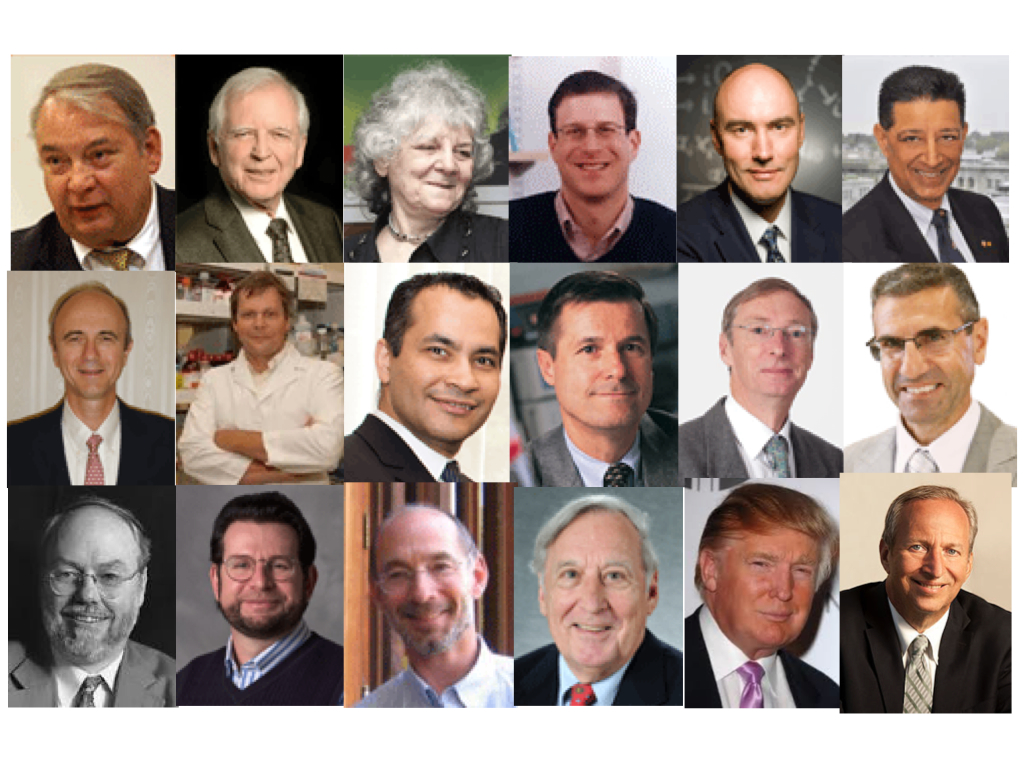 |
| Plenary and Keynote Speakers at Drug Discovery and Thearpy World Congress |
 | |
|
 |
| Two bonus people who could have been giving keynote talks but who actually are not. |
The gender bias at this meeting puts into perspective the push by the NIH to get drug researchers to inlcude more female subjects in their studies. See for example, Why Are All the Lab Rats Boys? NIH Tells Drug Researchers to Stop Being Sexist Pigs. Here is a thought, maybe we can get some of these speakers to cancel speaking at the meeting and also maybe we can get nobody to attent the meeting. Sigh. Yet another mostly male meeting. Also known as "YAMMM".
--------------------
UPDATE October 14, 2014.
Well, this is one of the strangest and lamest things I have seen associated with a conference in a while. Elizabeth Bik just emailed me to show me an invite she received to the "Global Biotechnology Congress 2015." And here is the bizarre thing. It is at the same time as the Drug Discovery meeting discussed here. Same place. Same speakers. It is apparently the same meeting with a new name.
Same bad gender ratio of course too.
Did they do this to avoid people discovering my post about the awful gender ratio? I don't know but seems like it might be so. What a joke. Well, I can guarantee people will associated this meeting name with the previous one.
Tuesday, September 23, 2014
Triclosan in toothpaste: potential risks are not a "rumor" as arrogant Colgate official argues, but are something to worry about
.png) |
| Triclosan in my toothpaste (and maybe yours too) |
First I saw a post about some issues with Crest Toothpastes containing polyethylene: Dentist calls Crest toothpaste dangerous; Now P&G changing ingredients. This seemed a bit disturbing. But then I saw a "Related Link": Shoppers Ditching Colgate Total Amid Triclosan Fears. And I thought - holy cra*## - really? I had no idea triclosan was in toothpaste. And why did I react strongly? Well triclosan, which is antimicrobial agent, though it has it's potential benefits, has some potential risks associated with it's antibacterial activity (see also this discussion from the EU). What are these possible risks? Risks like increasing the frequency and spread of antimicrobial resistance. And risks like messing with microbial ecosystems.
And due to these potential risks, I have been blogging and writing and complaining about the use of triclosan in various building materials for some time now. For example
Potentially important paper on need to regulate Triclosan http://t.co/eZaqq9mjQK - publishing behind a paywall is idiotic #ShameOnACS
— Jonathan Eisen (@phylogenomics) March 8, 2014
And also see:
- Studying – not wantonly killing – the microbes around us and the rise of the “microbiology of the built environment”
- A disturbing trend – casual and reckless use of antimicrobial agents in building materials.
Story Behind the Paper: Comparative Analysis of Functional Metagenomic Annotation and the Mappability of Short Reads (by Rogan Carr and Elhanan Borenstein)
Here is another post in my "Story Behind the Paper" series where I ask authors of open access papers to tell the story behind their paper. This one comes from Rogan Carr and Elhanan Borenstein. Note - this was crossposted at microBEnet. If anyone out there has an open access paper for which you want to tell the story -- let me know.
We’d like to first thank Jon for the opportunity to discuss our work in this forum. We recently published a study investigating direct functional annotation of short metagenomic reads that stemmed from protocol development for our lab. Jon invited us to write a blog post on the subject, and we thought it would be a great venue to discuss some practical applications of our work and to share with the research community the motivation for our study and how it came about.
Our lab, the Borenstein Lab at the University of Washington, is broadly interested in metabolic modeling of the human microbiome (see, for example our Metagenomic Systems Biology approach) and in the development of novel computational methods for analyzing functional metagenomic data (see, for example, Metagenomic Deconvolution). In this capacity, we often perform large-scale analysis of publicly available metagenomic datasets as well as collaborate with experimental labs to analyze new metagenomic datasets, and accordingly we have developed extensive expertise in performing functional, community-level annotation of metagenomic samples. We focused primarily on protocols that derive functional profiles directly from short sequencing reads (e.g., by mapping the short reads to a collection of annotated genes), as such protocols provide gene abundance profiles that are relatively unbiased by species abundance in the sample or by the availability of closely-related reference genomes. Such functional annotation protocols are extremely common in the literature and are essential when approaching metagenomics from a gene-centric point of view, where the goal is to describe the community as a whole.
However, when we began to design our in-house annotation pipeline, we pored over the literature and realized that each research group and each metagenomic study applied a slightly different approach to functional annotation. When we implemented and evaluated these methods in the lab, we also discovered that the functional profiles obtained by the various methods often differ significantly. Discussing these findings with colleagues, some further expressed doubt that that such short sequencing reads even contained enough information to map back unambiguously to the correct function. Perhaps the whole approach was wrong!
We therefore set out to develop a set of ‘best practices’ for our lab for metagenomic sequence annotation and to prove (or disprove) quantitatively that such direct functional annotation of short reads provides a valid functional representation of the sample. We specifically decided to pursue a large-scale study, performed as rigorously as possible, taking into account both the phylogeny of the microbes in the sample and the phylogenetic coverage of the database, as well as several technical aspects of sequencing like base-calling error and read length. We have found this evaluation approach and the results we obtained quite useful for designing our lab protocols, and thought it would be helpful to share them with the wider metagenomics and microbiome research community. The result is our recent paper in PLoS One, Comparative Analysis of Functional Metagenomic Annotation and the Mappability of Short Reads.
We’d like to first thank Jon for the opportunity to discuss our work in this forum. We recently published a study investigating direct functional annotation of short metagenomic reads that stemmed from protocol development for our lab. Jon invited us to write a blog post on the subject, and we thought it would be a great venue to discuss some practical applications of our work and to share with the research community the motivation for our study and how it came about.
Our lab, the Borenstein Lab at the University of Washington, is broadly interested in metabolic modeling of the human microbiome (see, for example our Metagenomic Systems Biology approach) and in the development of novel computational methods for analyzing functional metagenomic data (see, for example, Metagenomic Deconvolution). In this capacity, we often perform large-scale analysis of publicly available metagenomic datasets as well as collaborate with experimental labs to analyze new metagenomic datasets, and accordingly we have developed extensive expertise in performing functional, community-level annotation of metagenomic samples. We focused primarily on protocols that derive functional profiles directly from short sequencing reads (e.g., by mapping the short reads to a collection of annotated genes), as such protocols provide gene abundance profiles that are relatively unbiased by species abundance in the sample or by the availability of closely-related reference genomes. Such functional annotation protocols are extremely common in the literature and are essential when approaching metagenomics from a gene-centric point of view, where the goal is to describe the community as a whole.
However, when we began to design our in-house annotation pipeline, we pored over the literature and realized that each research group and each metagenomic study applied a slightly different approach to functional annotation. When we implemented and evaluated these methods in the lab, we also discovered that the functional profiles obtained by the various methods often differ significantly. Discussing these findings with colleagues, some further expressed doubt that that such short sequencing reads even contained enough information to map back unambiguously to the correct function. Perhaps the whole approach was wrong!
We therefore set out to develop a set of ‘best practices’ for our lab for metagenomic sequence annotation and to prove (or disprove) quantitatively that such direct functional annotation of short reads provides a valid functional representation of the sample. We specifically decided to pursue a large-scale study, performed as rigorously as possible, taking into account both the phylogeny of the microbes in the sample and the phylogenetic coverage of the database, as well as several technical aspects of sequencing like base-calling error and read length. We have found this evaluation approach and the results we obtained quite useful for designing our lab protocols, and thought it would be helpful to share them with the wider metagenomics and microbiome research community. The result is our recent paper in PLoS One, Comparative Analysis of Functional Metagenomic Annotation and the Mappability of Short Reads.
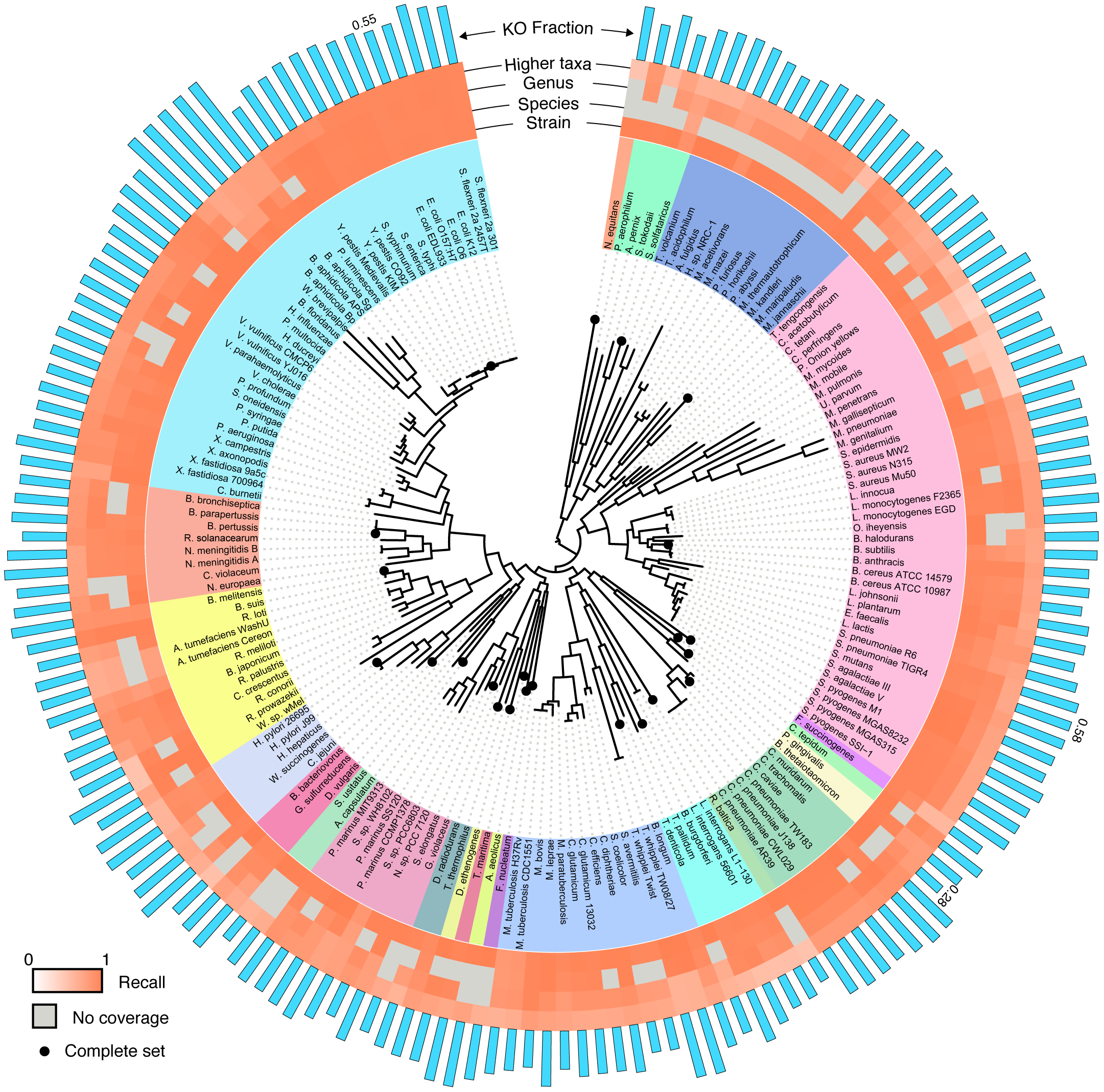 |
| The performance of BLAST-based annotation of short reads across the bacterial and archaeal tree of life using the 'top gene' protocol. See the manuscript for full details. Figure and text adapted from: Carr R, Borenstein E (2014) Comparative Analysis of Functional Metagenomic Annotation and the Mappability of Short Reads. PLoS ONE 9(8): e105776 |
Saturday, September 20, 2014
Notes from 2007 for a blog post I should have written: How many microbial cells in humans?
Well sometimes you just screw up. In 2007 I attended some planning meetings for the human microbiome project (see for example A human microbiome program? a post I wrote from one of the meetings in 2007). And at those meetings I kept asking one question. Where did this "fact" everyone kept citing that there were "10 times as many microbial cells in the human body as there were human cells" come from? I could not find a citation. So I started taking some notes for a blog post about this. Here are those notes:
But, alas I got distracted. And I did keep asking people - where did this "fact" come from. And most people just brushed me off (and probably thought I was a bit of a crank ...). And nobody had a good answer. Well, I was both pleased and sad (because I should have done it) to see Is your body mostly microbes? Actually, we have no idea by Peter Andrey Smith in the Boston Globe who addresses this issue in much much more detail that I ever could have done. Everyone who works on the human microbiome and who is interested in "facts" and how they can get misreported should read this. As a side note, Smith reports in the article that this is even given as a fact in Ted talks. Sadly mine was one of them. This is despite the fact (yes, the fact) that I swore to myself that I would NOT say that in my talk since I have been such a crank about this issue at meetings. OMG - such truisms are so pervasive that even someone who actively questioned the truism still used it. Uggh. Oh well. I really should have finished that draft post.
Wikipedia linkOnline textbook hereSears paper from Arizona site. She discusses only gut bacteria and cites a Gordon paper from 2001.
Seems to not be from this paper but really from here:
This in turn is not from there but apparently here
But, alas I got distracted. And I did keep asking people - where did this "fact" come from. And most people just brushed me off (and probably thought I was a bit of a crank ...). And nobody had a good answer. Well, I was both pleased and sad (because I should have done it) to see Is your body mostly microbes? Actually, we have no idea by Peter Andrey Smith in the Boston Globe who addresses this issue in much much more detail that I ever could have done. Everyone who works on the human microbiome and who is interested in "facts" and how they can get misreported should read this. As a side note, Smith reports in the article that this is even given as a fact in Ted talks. Sadly mine was one of them. This is despite the fact (yes, the fact) that I swore to myself that I would NOT say that in my talk since I have been such a crank about this issue at meetings. OMG - such truisms are so pervasive that even someone who actively questioned the truism still used it. Uggh. Oh well. I really should have finished that draft post.
Friday, September 19, 2014
Don't forget to positively highlight meetings w/ "good" gender ratio of presenters

See meeting w/ severely bad speaker gender ratio but don't feel comfortable posting?send me details & I will post phylogenomics@me.com
— Jonathan Eisen (@phylogenomics) September 19, 2014
From what I compute - the ratio was 30:22 male: female. I do not know what the ratio of the "pool" of speakers is but regardless, having 42% female speakers is a more even ratio than I have seen for most life sciences meetings. So they deserve some props for this.Female speakers highlighted in yellow. Male in green.
Keynote Lecture: Rebecca Heald
Special Lectures from John Gurdon and Marc Kirschner
Invited Speakers
Enrique Amaya, University of Manchester
Ruchi Bajpai, University of Southern California
A distasteful & disgraceful "Are there limits to evolution?" meeting at the University of Cambridge #YAMMM
Well, I saw this Tweet the other day
This meeting is a complete disgrace and an embarassment for the field of evolutionary biology, for the University of Cambridge which is hosting the meeting, and for the Templeton Foundation which is sponsoring it.
Why do I say this? Well, pretty simple actually. The meeting site lists theInvited Keynote speakers for the meeting. Notice anything? How about I help you by bringing all the pictures together.

Notice anything now? How about I help you some more by masking out the men and not the women.

For more on this and related issues
Posts on Women in STEM
Another for @phylogenomics's list of YAMMMs (Yet Another Mostly Male Mtg). Ratio = 1F speaker to 23M speakers. http://t.co/qgEfwtBS2B
— Hopi Hoekstra (@hopihoekstra) September 16, 2014
And though there was a bit of a discussion on Twitter I felt I had to follow up with a blog post. When I saw the post I was at a conference (Lake Arrowhead Microbial Genomes) where I could get Twitter access but for some reason very little web access. So I could not dig around until now (I am home).
This meeting is a complete disgrace and an embarassment for the field of evolutionary biology, for the University of Cambridge which is hosting the meeting, and for the Templeton Foundation which is sponsoring it.
Why do I say this? Well, pretty simple actually. The meeting site lists the
Notice anything now? How about I help you some more by masking out the men and not the women.
Impressive no? 25 speakers - 23 of them male. I guess that means there are no qualified female speakers who coudl discuss something about evolution right? It would be worth reading "Fewer invited talks bu women in evolutionary biology symposia" to get some context. What an incredible, disgusting, distasteful and disgraceful meeting.
I recommend to everyone who was considering going to this meeting - skip it. Also consider writing to the University of Cambirdge and the Templeton Foundation to express your thoughts about the meeting. This certainly is a fine example of Yet Another Mostly Male Meeting (YAMMM). Well, maybe I should word that differently - this is a disgusting example of a YAMMM.
For more on this and related issues
Also see
See meeting w/ severely bad speaker gender ratio but don't feel comfortable posting?send me details & I will post phylogenomics@me.com
— Jonathan Eisen (@phylogenomics) September 19, 2014
Sunday, September 14, 2014
Everything You Wanted to Know about the Lake Arrowhead Microbial Genomes meeting #LAMG14
The Lake Arrowhead Microbial Genomes meeting, which happens every other year, is starting tonight. I love this meeting. No bias here since I am now a co-organizer. But I really love this meeting. I am posting here some background information about the meeting for those interested. We will be live tweeting the meeting using the hashtag #LAMG14. This years program is here.
Posts of mine about previous meetings
I have uploaded slides from my previous presentations at the meeting
- March 02, 2014: Save the dates / preliminary program for Lake Arrowhead Microbial Genomes Meeting
- July 11, 2012: Lake Arrowhead Microbial Genomes 2012 #Genomes #Microbes #Mountains #Lake #Fun #Wine #MustGo
- September 22, 2012: Lake Arrowhead Microbial Genomes Meeting 2012 Speaker Gender Ratio #LAMG12
- September 22, 2012: Storify for Lake Arrowhead Microbial Genomes #LAMG12 Meeting
- October 28, 2010: The Story behind the Meeting: Lake Arrowhead Microbial Genomes 2010
- September 14, 2008: It's Miller Time - Lake Arrowhead Microbial Genomes Conference -- about to begin
- September 16, 2008: Lake arrowhead notes - UPDATED
- September 29, 2006: Genomics Education highlighted at 14th Annual International Meeting on Microbial Genomics
- December 23, 2012: Srijak Bhatnagar: Lessons from 2012: Lake Arrowhead Microbial Genomes
- September 21, 2008: Morgan Langille Review of Arrowhead Conference
- 1998_LakeArrowhead notes
- 1998_Arrowhead
- 2000_Arrowhead
- 2002 Lake_Arrowhead
- 2004 meeting notes and booklet
- 2006_Arrowhead
- 2008_Arrowhead
- 2010_Arrowhead
- 2012 Lake Arrowhead Booklet
I have uploaded slides from my previous presentations at the meeting
Jonathan Eisen talk on "The Importance of History" at Lake Arrowhead Small Genomes Meeting 2010 from Jonathan Eisen
Jonathan Eisen talk on "Genomic Encyclopedia" at Lake Arrowhead Small Genomes Meeting 2008 from Jonathan Eisen
Jonathan Eisen talk on "Enodsymbiont Genomics" at Lake Arrowhead Small Genomes Meeting 2006 from Jonathan Eisen
Jonathan Eisen talk on "Phylogenomics of Microbes" at Lake Arrowhead Small Genomes Meeting 2004 from Jonathan Eisen
Jonathan Eisen talk on "Phylogenomics of Microbes" at Lake Arrowhead Small Genomes Meeting 2002 from Jonathan Eisen
Jonathan Eisen talk on "Phylogenomics of DNA repair" at Lake Arrowhead Small Genomes Meeting 2000 from Jonathan Eisen
Subscribe to:
Posts (Atom)
Most recent post
A ton to be thankful for -- here is one part of that - all the acknowledgement sections from my scholarly papers
So - it is another Thanksgiving Day and in addition to thinking about family, and football, and Alice's Restaurant, I also think a lot a...

-
Wow. Just wow. And not in a good way. Just got an email invitation to a meeting. The meeting is " THE FIRST ANNUAL WINTER Q-BIO ...
-
 Well, I have tried to hold off giving out awards here since I kind of botched my last attempt at this. But here goes. Yesterday, researcher...
 -
Wow - until I started sniffing around actively, I never realized how much crap was out there in regard to the microbiome. But there is so s...
