Showing posts with label scifoo. Show all posts
Showing posts with label scifoo. Show all posts
Monday, August 13, 2012
Amazing video from Louie Schwartzberg / Moving Art "The Beauty of Pollination" #scifoo
I met Louie Schwartzberg at the SciFoo meeting last week. He makes absolutely amazing Nature videos ... here is one.

Friday, August 03, 2012
What #Scifoo did to me in 2006, 2007
In 2006 and 2007 I went to this amazing meeting called Science Foo camp, or "SciFoo." More about my previous experiences with it are here:Holy s$&# - I am going back to #SciFoo
Right now I want to note something that for me is pretty unusual. In 2006 I gave a mini presentation on microbial diversity at SciFoo. I just posted my slides to Slideshare here:
The next year I was not sure if I was going to try to present anything and then, while at SciFoo someone (can't remember whom) asked me if I could do a presentation on "The Human Microbiome." Silly me - I said - sure. Alas - it meant staying up very very late in the Wild Palms hotel because, well, I had never given a presentation on the Human Microbiome before that. My slides from that are below:
Why am I writing this? Well, doing that presentation is largely what moved me into being interested in the human microbiome and the microbiomes of various plants and animals. Prior to that I had done very little work on communities of microbes associated with animals or plants. I had done a lot of genomics, and studies of microbial diversity and even metagenomics. But most of work on plant or animal associated microbes was one cases where there were a small number of symbionts living in or on a host - simple systems. The complexity of the "microbiome" of plants and animals kind of scared me off. I was thinking about doing more work on microbes associated with Drosophila but not yet convinced it was the right thing to do. And that presentation - as well as the response from the people at SciFoo (e.g., Freeman Dyson said he found it fascinating) helped spur me on to do much more work on plant and animal associated microbial communities.
I wonder what will happen this year ... SciFoo starts tonight ...
Right now I want to note something that for me is pretty unusual. In 2006 I gave a mini presentation on microbial diversity at SciFoo. I just posted my slides to Slideshare here:
The next year I was not sure if I was going to try to present anything and then, while at SciFoo someone (can't remember whom) asked me if I could do a presentation on "The Human Microbiome." Silly me - I said - sure. Alas - it meant staying up very very late in the Wild Palms hotel because, well, I had never given a presentation on the Human Microbiome before that. My slides from that are below:
Why am I writing this? Well, doing that presentation is largely what moved me into being interested in the human microbiome and the microbiomes of various plants and animals. Prior to that I had done very little work on communities of microbes associated with animals or plants. I had done a lot of genomics, and studies of microbial diversity and even metagenomics. But most of work on plant or animal associated microbes was one cases where there were a small number of symbionts living in or on a host - simple systems. The complexity of the "microbiome" of plants and animals kind of scared me off. I was thinking about doing more work on microbes associated with Drosophila but not yet convinced it was the right thing to do. And that presentation - as well as the response from the people at SciFoo (e.g., Freeman Dyson said he found it fascinating) helped spur me on to do much more work on plant and animal associated microbial communities.
I wonder what will happen this year ... SciFoo starts tonight ...
Thursday, August 02, 2012
Holy s$&# - I am going back to #SciFoo
Well, I cannot wait until Friday. I am going back to SciFoo. Best. Meeting. Ever. Went in 2006 & 2007. Changed my life. Here are some posts - back when I was a very newbie blogger:
2006
2006
- SciFoo Camp, the prequel
- SciFoo Camp impressions Day 1
- My 18 month old daughter is in love with google
- SciFoo Camp Highlight1 - HowToons and Science Education Reform
- SciFoo Camp Impressions Day2
- SciFoo Camp Day 3
2007
- SciFoo, SciFoolery, Nature, O'Reilly, Google, and More
- Train to Scifoo
- SciFoo Camp Day 1
- SciFoo Camp Day 1 - More notes
- SciFoo Day 2 - Morning
- SciFoo Camp Day 2 - Afternoon
- SciFoo Camp - The End and New Beginnings
- Open Access dinosaurs and way to go Paul Sereno
2008 - didn't go to SciFoo but repercussions still felt
Thursday, April 16, 2009
Kids Science Book Recommendation #1: Pat Schrödinger's Kitty
OMG. I just got my copy of "Pat Schrödinger's Kitty" by Tiffany Ard. I only found out about this kid's science book because the author (at least, I think it was the author) linked to a posting of mine from her "electric boogaloo" blog (in a post about April Fools). And from there I read about how she was invited to Scifoo this year (Damn her -- why can't I get invited again) and how it was a really good day because someone wrote a post about her kids science book. So, since I am a total geek and love reading sciency things to my kids I took a look. And it looked pretty good so I ordered one for me and one to give to my geeky brother.

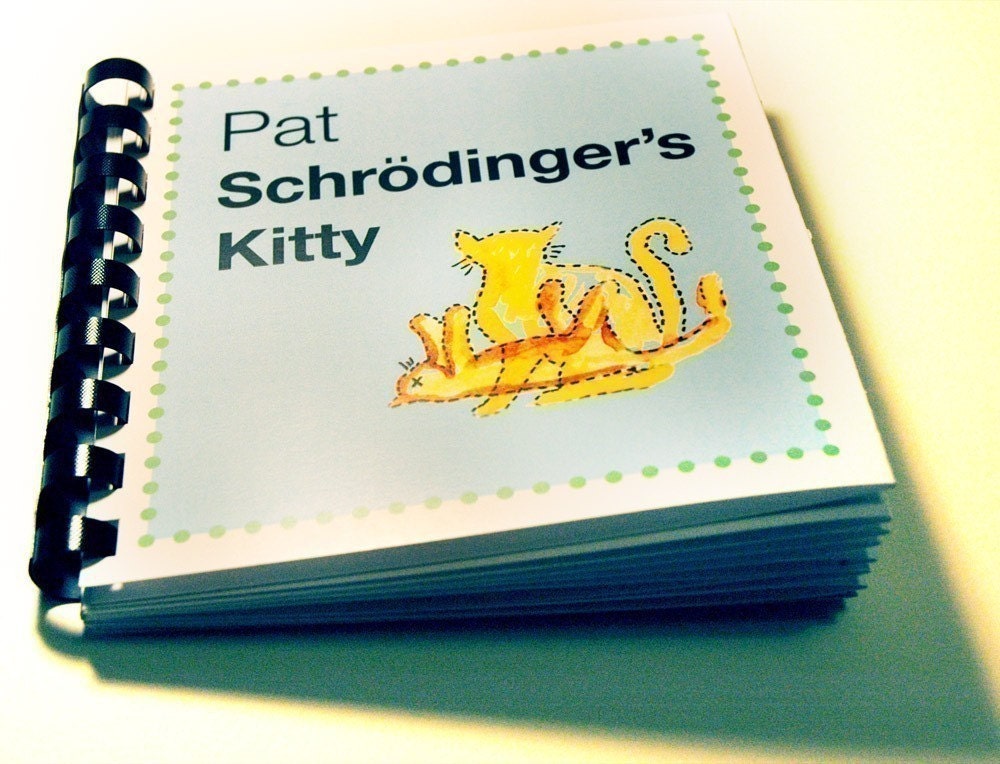
And I just got it today. And I must say, it is f*$# brilliant. It is a spoof on Pat The Bunny (which I had to read over and over to kid #1 and #2) wherein the same general things that happen in Pat the Bunny are replaced by Schrödinger kind of things (e.g., "Paul can interact with billions of neutrinos"). This means a lot to me since as a small child my grandfather, a physicist, used to tell me about relativity and Einstein thought experiments. So I encourage all to get this book, even if you do not have little kids. It is worth a serious giggle for anyone. Still haven't read it to the kids - had to post about it 20 minutes after opening the mail.
Wednesday, April 09, 2008
Confessions of an April Fool and the Dope on Brain Doping
Well, truth is imitating art in bizarre ways here. Nature today is running a news story by Brendan Maher (also see his forum here) and various related tidbits about a survey they conducted on brain doping. And the lead in to the news story? Well, it is the April 1 joke I coordinated where a group of co-conspirators (who I will name in a bit) and I posted stories about a new NIH crackdown on, yes, brain doping.
I thought the html version of the story looked great. Here it is. And I tried to send it to people in email but they kept having problems viewing the thing. So in the end, I created a PDF file of the page and emailed that to a few key co-conspirators (who I knew knew a lot of people). And they sent it around. And around. And around. I did not originally post it on my blog, because, well I was worried that Venter would want to kill me. The funny part is, he liked it. And it was the real people who I had made up fake quotes from who wanted to kill me. ( I note, a friend of mine who works at Cold Spring Harbor Press and has the initials AG says he sent it to Nick Wade who also found it funny.)
Anyway, in the end, that April 1 joke worked OK but it has some limitations. First, since I did not post it on the web it did not really use the power of the blogging world to spread. Second, some people figured out it was fake when they went to YouTube or the New York Times web site to look for the things we claimed existed. So, I decided that for this year, if I could come up with a good April 1 joke, I would try and correct these issues.
So - somehow, I hit upon a funny story to do - a spoof in on the cycling and baseball controversies over performance enhancing drugs . But the target would be scientists. That was really the extent of my idea. And then I found the perfect venue to plan it. SciFoo camp (for more on it see here and here and here). Sponsored by Nature and the O'Reilly publishing group. At Google HQ. And with TONS of bloggers and other media types there. We ven considered having a session on humor in science. But that never happened. Fortunately, I cornered various people who seemed to think it would be fun to have a collaborative conspiracy to do an April 1 joke together. And they liked the performance enhancing drugs among scientists idea.
Alas, SciFoo camp was in August of 2007. April 1, 2008 was far away. And the plan slipped to the backburner. I created a private Blogspot blog for people to share information. And invited a few of the original co-conspirators. And we did not make much progress. And then I wrote to Bora (who, like Madonna, really does not need a last name). He was at SciFoo and I knew him through my new role in PLoS. And he knows EVERYONE. And I said:
In the meantime, I came up with ANOTHER April 1 joke top do, but it seemed like this one had to be done before April 1 since for people to get it it needed to be done while the true news story was hot. So I posted a joke story spoofing the Eliot Spitzer resignation with my own fake resignation from my new position as Academic Editor in Chief of PLoS Biology over buying journal articles. I replaced his wife with my brother (and co-founder of PLoS) and placed a few friends in the story (Alex Gann at Cold Spring Harbor became my replacement, Emma Hill, who left PLoS Biology for a non fully OA journal became Kristen, and I made up a few quotes here and there). I had to post this before April 1 since I knew people would forget abouyt Spitzer quickly. And then I returned to the work on the brain doping joke.
And soon we saw that some people on the Nature Network were talking about trying to do a collaborative April 1 joke. And so I posted a message there and then recruited those who seemed interested. And we had a good core group of conspirators. And people were busy so not much happened. Although Chris Patil, who I used to work with at Stanford, made me freak out even more by posting a whole collection of stories about brain doping on our private blog.
And he and Anna Kushnir and others also said - we need a web site to link to and we need some story to jointly write about. So in a frenzy on March 31 I created a fake press release and a fake web site. To make the press release, I took a real NIH press release, and like with the New York Times story, I edited it a bit and then a bit more.
And fortunately, I had registered the domain name WABDA.ORG for the "World Anti-Brain Doping Authority) through Go Daddy and had paid a bit extra for their "WebSite Now" option, and using their not very easy to use system, I made a website and somehow got it live by about 12:10 AM on April 1.
And I sent the fake press release to the co conspirators, who did an amazing job or also writing fake blogs. And I send the story to lots of others too. And wrote my own fake blog post here. And then sat back and watched the story spread. Below are some of the formal or accidental co-conspirators blogs:
Also see
The US National Institutes of Health is to crack down on scientists 'brain doping' with performance-enhancing drugs such as Provigil and Ritalin, a press release declared last week. The release, brainchild of evolutionary biologist Jonathan Eisen of the University of California, Davis, turned out to be an April Fools' prank. And the World Anti-Brain Doping Authority website that it linked to was likewise fake. But with a number of co-conspirators spreading rumours about receiving anti-doping affidavits with their first R01 research grants, the ruse no doubt gave pause to a few of the respondents to Nature 's survey on readers' use of cognition-enhancing drugs.So here I am going to tell the tale of the creation of this April 1 joke. In a way, it all started last April 1, when I created a fake New York Times story about how Craig Venter had been deceiving everyone with stories about sailing around the world studying microbes in the ocean, and in fact he has been studying the microbes living inside his body in order to scoop Francis Collins and others at the NIH on the "microbiome." I made the fake story by taking an article by Nick Wade on Venter sequencing his own genome, downloading the html for the whole web page on the archive of the story, with all the NY Times background material, and editing the text, simply changing the story but keeping the main outline. For example, the title of the real Wade article was "Scientist Reveals Secret of Genome: It's His" and I changed it to "Scientist Reveals Secret of the Ocean: It's Him."
I thought the html version of the story looked great. Here it is. And I tried to send it to people in email but they kept having problems viewing the thing. So in the end, I created a PDF file of the page and emailed that to a few key co-conspirators (who I knew knew a lot of people). And they sent it around. And around. And around. I did not originally post it on my blog, because, well I was worried that Venter would want to kill me. The funny part is, he liked it. And it was the real people who I had made up fake quotes from who wanted to kill me. ( I note, a friend of mine who works at Cold Spring Harbor Press and has the initials AG says he sent it to Nick Wade who also found it funny.)
Anyway, in the end, that April 1 joke worked OK but it has some limitations. First, since I did not post it on the web it did not really use the power of the blogging world to spread. Second, some people figured out it was fake when they went to YouTube or the New York Times web site to look for the things we claimed existed. So, I decided that for this year, if I could come up with a good April 1 joke, I would try and correct these issues.
So - somehow, I hit upon a funny story to do - a spoof in on the cycling and baseball controversies over performance enhancing drugs . But the target would be scientists. That was really the extent of my idea. And then I found the perfect venue to plan it. SciFoo camp (for more on it see here and here and here). Sponsored by Nature and the O'Reilly publishing group. At Google HQ. And with TONS of bloggers and other media types there. We ven considered having a session on humor in science. But that never happened. Fortunately, I cornered various people who seemed to think it would be fun to have a collaborative conspiracy to do an April 1 joke together. And they liked the performance enhancing drugs among scientists idea.
Alas, SciFoo camp was in August of 2007. April 1, 2008 was far away. And the plan slipped to the backburner. I created a private Blogspot blog for people to share information. And invited a few of the original co-conspirators. And we did not make much progress. And then I wrote to Bora (who, like Madonna, really does not need a last name). He was at SciFoo and I knew him through my new role in PLoS. And he knows EVERYONE. And I said:
BoraAnd he agreed. And then he and I recruited some other bloggers. And then we saw a New York Times article on Brain Doping. We had not really completely formulated a plan to focus on brain doping per se yet (I still thought we could talk about EPO to have endurance at conferences, etc). And we got worried about being scooped by reality. But we soldiered on. At this point I thought maybe the best way to do the joke would be to have everyone separately write a story about some interaction with NIH that hinted at a crackdown on doping among scientists.
Are you up for participating in a grand April 1 joke where I am
hoping to get lots of bloggers to write in different ways about the
same topic to make it really seem real?
J
In the meantime, I came up with ANOTHER April 1 joke top do, but it seemed like this one had to be done before April 1 since for people to get it it needed to be done while the true news story was hot. So I posted a joke story spoofing the Eliot Spitzer resignation with my own fake resignation from my new position as Academic Editor in Chief of PLoS Biology over buying journal articles. I replaced his wife with my brother (and co-founder of PLoS) and placed a few friends in the story (Alex Gann at Cold Spring Harbor became my replacement, Emma Hill, who left PLoS Biology for a non fully OA journal became Kristen, and I made up a few quotes here and there). I had to post this before April 1 since I knew people would forget abouyt Spitzer quickly. And then I returned to the work on the brain doping joke.
And soon we saw that some people on the Nature Network were talking about trying to do a collaborative April 1 joke. And so I posted a message there and then recruited those who seemed interested. And we had a good core group of conspirators. And people were busy so not much happened. Although Chris Patil, who I used to work with at Stanford, made me freak out even more by posting a whole collection of stories about brain doping on our private blog.
And he and Anna Kushnir and others also said - we need a web site to link to and we need some story to jointly write about. So in a frenzy on March 31 I created a fake press release and a fake web site. To make the press release, I took a real NIH press release, and like with the New York Times story, I edited it a bit and then a bit more.
And fortunately, I had registered the domain name WABDA.ORG for the "World Anti-Brain Doping Authority) through Go Daddy and had paid a bit extra for their "WebSite Now" option, and using their not very easy to use system, I made a website and somehow got it live by about 12:10 AM on April 1.
And I sent the fake press release to the co conspirators, who did an amazing job or also writing fake blogs. And I send the story to lots of others too. And wrote my own fake blog post here. And then sat back and watched the story spread. Below are some of the formal or accidental co-conspirators blogs:
- Chris Patil
- Bora
- Anna Kushnir
- Genome Technology
- Sunclipse
- Egghead
- Eye on DNA
- Bob Ohara
- Martin Fenner
- Jennomics
- Castros Favorite Color
- Pedro Baltrao
- Rants and Raves
Also see
- Ronald Bailey
- Andy Fell
- Matthew Herper
- Ars Technica
- AFP
- Wired
- Scientists: Brains On Dope
- Mienfolks
- Voodoo Knickers
- Genetic Maize
- PopFi
- Oca Sapiens
- Metastopheles
- Buzzle.Com
- Process Algebra
- Boing Boing
- Nerdist
UPDATE May 29, 2017 - going to try and rescue some of the links here by pointing to the internet archive.
Friday, April 04, 2008
Can a spoof be scooped by reality?
Well, if you read this blog, or a few others, you may already know that what I reported on here on April 1 regarding NIH cracking down on brain doping, was, in fact an April Fool's joke. I will write more about this joke later and how we planned it, starting at something called scifoo camp at Google headquarters in the summer of last year. But I do want to write about one thing here -- we sort of got scooped by reality. I had been planning for some time to do an April 1 joke on performance enhancing drug use among scientists. And as I was recruiting others to be involved in this plot, reality got in the way when Nature and then the New York Times started to report on brain doping as a real issue. It kind of took the absurdity away from our joke and made it seem like we were making some real commentary on brain doping when in fact, we were at least originally just trying to come up with something ridiculous but possibly believable at first look.
And now it has happened again. The second spoof I considered doing was to write about doing DNA and drug testing on some water bottles I collected from the Tour of California - a bike race that came 1 block from my house. I went for a little ride on the route of the race a few minutes after the peloton came by and got about 10 bottles from different teams. (This was real). And then I was going to pretend that we took those bottles and (1) figured out whose they were by DNA testing and (2) did drug tests of them. And this would allow me to write about 23 and me and other DNA testing companies as well as to make some fun of performance enhancing drug scandals. And I thought this would be ridiculous in a way because it could not possibly be legal to test someone's DNA without any real just cause. And low and behold look at what comes along --- Amy Harmon has an article in the Times yesterday on people doing exactly this type of thing --- testing other people's DNA (good article, by the way).
So now twice my spoofs end up getting scooped by reality. To me, a good spoof/April 1 joke is completely absurd in hindsight even if it is believable initially. So every time one of these jokes/pranks I want to pull gets close to reality, it becomes much much less funny to me. Who knows, maybe Craig Venter will in fact sequence his own microbiome, as I joked about last April 1.
Maybe before my next joke, I should call up Amy Harmon and other reporters to make sure they are not working on related stories first?
And now it has happened again. The second spoof I considered doing was to write about doing DNA and drug testing on some water bottles I collected from the Tour of California - a bike race that came 1 block from my house. I went for a little ride on the route of the race a few minutes after the peloton came by and got about 10 bottles from different teams. (This was real). And then I was going to pretend that we took those bottles and (1) figured out whose they were by DNA testing and (2) did drug tests of them. And this would allow me to write about 23 and me and other DNA testing companies as well as to make some fun of performance enhancing drug scandals. And I thought this would be ridiculous in a way because it could not possibly be legal to test someone's DNA without any real just cause. And low and behold look at what comes along --- Amy Harmon has an article in the Times yesterday on people doing exactly this type of thing --- testing other people's DNA (good article, by the way).
So now twice my spoofs end up getting scooped by reality. To me, a good spoof/April 1 joke is completely absurd in hindsight even if it is believable initially. So every time one of these jokes/pranks I want to pull gets close to reality, it becomes much much less funny to me. Who knows, maybe Craig Venter will in fact sequence his own microbiome, as I joked about last April 1.
Maybe before my next joke, I should call up Amy Harmon and other reporters to make sure they are not working on related stories first?
Thursday, November 15, 2007
Open Access dinosaurs and way to go Paul Sereno

Well, I met Paul Sereno
 , the dinosaur hunter, for the first time at SciFoo camp (for more about that see here). I confess I was skeptical when he said he was committed to Open Access. But now he has really proven his OA chops. He has a new paper in PLoS One on some friggin cool dinosaur fossils.
The paper is "Structural Extremes in a Cretaceous Dinosaur" by Paul C. Sereno1*, Jeffrey A. Wilson2, Lawrence M. Witmer3, John A. Whitlock2, Abdoulaye Maga4, Oumarou Ide4, Timothy A. Rowe5
Check it out at PLoS One.
Monday, August 13, 2007
SciFoo Camp - The End and New Beginnings
Well, I am finally getting around to writing about the last day of SciFoo camp (see here for my other blogs on the topic).
For Day 3, I got up early, packed up my bag, and then polished up my presentation for a session on "The Human Microbiome." This was particularly difficult for me since I do not really at this time work on the human microbiome much (although I want to). But I figured, of all the things microbial I know about, this would be the one that would be most fun to talk about to scifooers and would catalyze the most interest. So I searched around for slides and figures and ideas on the web for a while and then said "WTF - I can do a chalk talk if I need to" and I headed downstairs to the lobby in the hopes of getting over to Googleplex and enjoying the last bits of scifoo.
There was quite a crowd in the lobby and I ended up talking to a few other evolutionary biologists which was good and then finally got a bus ride over to camp. At Google, I had a bit of breakfast and then went inside to sit at a table to do the last bits of preparation for my talk. If I had been at a normal conference I would have simply skipped the first two sessions to prepare for my talk at 11:30 (the last session of the meeting). But I said this would be silly and decided to go to a session at 9:30. My choices were:
And again, the choosing was brutal. Though I really wanted to go to Lincoln Steins Genome Voyeurism session, I followed my rule of going to things I did not know a lot about and went to the session on the International Polar Year. This was one of those sessions in a giant room and I expected a huge crowd. Instead, there were about seven people. But boy did the others miss something brilliant. Dave Carlson not only told us about the whole IPY project but proceeded to tell us about how their project was completely Open Science. That is, everyone involved was required to post their data on the web for anyone to use. OK - well apparently they are allowed to publish in non Open Access journals, which seems counter to their whole philosophy, but their openness about data is brilliant (Note - I just found out from a Google search that a childhood friend of mine, Thomas Nylen, is participating in the IPY project -- see this blog here for some of what Tom has been up to).
Unfortunately, I missed the next session due to my computer having issues and me freaking out about whether it would work for my presentation at 11:30. The choices for the session I skipped were:
Then it was time for the final session. And I was up -- the Human Microbiome. Here is what I was up against
It would have been funny if I had gone to someone elses session and skipped mine, but I am glad I did not as actually quite a few people showed up to mine. I started by saying I had a presentation but would prefer if people just asked questions along the way. And the great part was - did they ever. This included some by Freeman Dyson - kind of cool to have the guru asking me questions about microbial colonization of babies. Finally, after I had spent too much time on background - Drew Endy said something to the effect of "Lets get to the technically hard stuff" and I briefly discussed using genome sequencing to study microbes that live in and on humans. And then - we just had to stop.
I decided to linger for the wrap up session after lunch so I had lunch, made some phone calls, and then we had a wrap up which was mostly an open mike for comments and this ended up being a bit too much of "It was great" and not enough of "How could we make it better." But hey - it was great so I guess I understand. I went around saying thanks to the Google team and the Nature and O'Reilly folks and then moseyed on to the train back to Davis.
Some brief notes about the end and the new beginnings:
For Day 3, I got up early, packed up my bag, and then polished up my presentation for a session on "The Human Microbiome." This was particularly difficult for me since I do not really at this time work on the human microbiome much (although I want to). But I figured, of all the things microbial I know about, this would be the one that would be most fun to talk about to scifooers and would catalyze the most interest. So I searched around for slides and figures and ideas on the web for a while and then said "WTF - I can do a chalk talk if I need to" and I headed downstairs to the lobby in the hopes of getting over to Googleplex and enjoying the last bits of scifoo.
There was quite a crowd in the lobby and I ended up talking to a few other evolutionary biologists which was good and then finally got a bus ride over to camp. At Google, I had a bit of breakfast and then went inside to sit at a table to do the last bits of preparation for my talk. If I had been at a normal conference I would have simply skipped the first two sessions to prepare for my talk at 11:30 (the last session of the meeting). But I said this would be silly and decided to go to a session at 9:30. My choices were:
| Golem: Data Mining for Materials (and Non-Programmers): sketching information systems (Andrew Walkingshaw) --AND-- Searching the Edges of the Web | Novel Biofuels, smart materials in energy production, the energy mix in the short term. | Genome Voyeurism -- Let's poke through Jim Watson's genome | International polar year, an opportunity to... (Dave Carlson) | Simplifying citation linking (Dan Chudnov) | Would You Upload? (Melanie Swan) |
| Future health care delivery and transport models: When "science" is not enough, benefit of new research vehicles (Berman and Neelagaru) | Reforming Patent Systems, patent informatics and innovation | 5 mins on your favorite science website / tell us your dream science web tool (Richard Akerman) | How to Celebrate Darwin in 2009 (Phil Campeck) | Innovation is Not Pointless...But It's So 20th Century (Bingham) |
And again, the choosing was brutal. Though I really wanted to go to Lincoln Steins Genome Voyeurism session, I followed my rule of going to things I did not know a lot about and went to the session on the International Polar Year. This was one of those sessions in a giant room and I expected a huge crowd. Instead, there were about seven people. But boy did the others miss something brilliant. Dave Carlson not only told us about the whole IPY project but proceeded to tell us about how their project was completely Open Science. That is, everyone involved was required to post their data on the web for anyone to use. OK - well apparently they are allowed to publish in non Open Access journals, which seems counter to their whole philosophy, but their openness about data is brilliant (Note - I just found out from a Google search that a childhood friend of mine, Thomas Nylen, is participating in the IPY project -- see this blog here for some of what Tom has been up to).
Unfortunately, I missed the next session due to my computer having issues and me freaking out about whether it would work for my presentation at 11:30. The choices for the session I skipped were:
|
| Science Blogging | Towards an open source science learning collaboratory (Ted Kahn Design Worlds) | Opening the scientific literature: OpenLibrary, Google Scholar (Aaron Swartz) | 21st century medicine: electronic medical records, privacy, and data mining (Erez L. and Kevin F.) |
Then it was time for the final session. And I was up -- the Human Microbiome. Here is what I was up against
| Social limits of scientific knowledge - can too much information impede science? (Dalton Convoy) | Culture of Fear: Scientific Communication and Young Scientists (Alex Palazzo, Andrew Walkingshaw) | Towards DataWiki (Hugh Rienhoff, Alan Littleford) | Do systems organize themselves to produce entropy at the maximum rate? (Ralph Lorenz) |
| Science on the Stage, "science-in-theatre" (Djerassi) | Human Microbiome, microbes in and on us (Jonathan Eisen) | Science fiction: what is it for? (Henry Gee) |
It would have been funny if I had gone to someone elses session and skipped mine, but I am glad I did not as actually quite a few people showed up to mine. I started by saying I had a presentation but would prefer if people just asked questions along the way. And the great part was - did they ever. This included some by Freeman Dyson - kind of cool to have the guru asking me questions about microbial colonization of babies. Finally, after I had spent too much time on background - Drew Endy said something to the effect of "Lets get to the technically hard stuff" and I briefly discussed using genome sequencing to study microbes that live in and on humans. And then - we just had to stop.
I decided to linger for the wrap up session after lunch so I had lunch, made some phone calls, and then we had a wrap up which was mostly an open mike for comments and this ended up being a bit too much of "It was great" and not enough of "How could we make it better." But hey - it was great so I guess I understand. I went around saying thanks to the Google team and the Nature and O'Reilly folks and then moseyed on to the train back to Davis.
Some brief notes about the end and the new beginnings:
- I got lots of ideas for new projects and new things to do from this meeting as with the last one.
- Over the next few weeks I will be posting about some of the other things I saw there and discussing why/how they are interesting.
- I think this "un-conference" style would be really good to emulate for other gatherings. Not sure how to pull it off though.
- I know I will get in trouble from some of my Open Access colleagues, but I definitely came away from the meeting being really impressed with some of the things Nature Publishing group is doing. They really seem to be trying to move into the Web 2.0 area for science communication with Nature Preceedings, and the Nature Network and Scintilla and Connotea and Podcasts and of course Scifoo. Sure there were probably too many people from Nature at Scifoo, but hey, they were sponsoring it so why shouldn't they send them? Here's hoping that they continue to experiment with Open forums and Open material and that they change to OA for all their publications as a way to bring in more people to their Web services. And lets hope other publishers, especially truly open ones build similar resources for the community.
- Thanks to Timo Hannay, Tim O'Reilly, and all the folks at Google, Nature, and O'Reilly for organizing this and inviting me.
- Nature network discussion of Open Science
- Alex Palazzo's discussion of Open Science
- Nature.Com's SciFoo compilation
- Lexical SciFoo Campfire
- Timo Hannay's overview
Wednesday, August 08, 2007
SciFoo Camp Day 2 - Afternoon
OK - More on Scifoo Camp - Day 2.
Session 4: Here were the choices:


Session 7. Here the choices were:
And finally we had the last session. The choices here were:
Session 4: Here were the choices:
- Collecting More Data Faster Can Make an Organization Dumber (Jeff Jonas)
- Skepticism and Critical Thinking in an Age of Marvels (Guido Nurez)
- Computable Data/Mathematics (Theodore Gray) --AND-- $100 laptop demo (Ted Kaehler)
- Evolutionary robotics (Lipson Olliver)
- Ocean Exploration
- why a mouse? Multi-touch, physical and social interfaces for manipulating data (Philip Tiongson)
- Scientific Communication in 2030 (Kurte-Bilder) --AND-- The selfish scientist (Carole Goble)
- Universe or Multiverse? (Martin Rees, Frank Wiligat, Lee Smolin)
- Reuse of Sewage to Grow Food and Provide Sanitation (Frank Rijsbertian)
- Is Collaborative Policy Making Possible? (think wikipedia, economic/government simulation games) (TimHubbard, Beth Noveck)
- Viral Chatter (Nathan Wolfe)
- Sessions
- Freebase Demo
- Biodiversity on the Web: Science Publishing
- Prioritizing the World's Problems
- Display of Greater than 2D Data or Lots of 2D Data All at Once Tamara Munzner.
- E-Science Beyond Infrastructure /RichardAkerman/
- Implantable Devices and Microchips for Healthcare --AND-- Diver Assistance Devices
- Using Evolution for Design and Discovery
- Stem Cells (a.k.a. How to Get Scientists to Care about Web 2.0
- Machine Reading & Understanding Science
- Science & Fundamentalism (Durant)
- Biological Data & Research --AND-- Open Source Biomedical Research for Neglected Diseases
- My Daughter's DNA: Hacking Your Genome / Towards a Data Wiki
- Network-Centric Biomedicine (Ken Buxton)
- Squishy Magnets, Talking Paper and Disapearing Ink: How can inventables.com open its doors to kids for free?
- Since I was planning to go to a session half way through I was not sure which to do for the beginning and so I went to "Prioritizing the Worlds Problems" - a discussion led by Bjorn Lomborg about a new book he is working on. Basically the deal is - he and a bunch of economists thought a bunch and picked 10 world problems that might be solvable: climate change, communicable diseases, conflicts, education, financial stability, corruption in government (or something like that), malnutrition and hunger, sanitation and water access, and subsidies and trade barriers. And then they did an exercise basically asking - if you could spend some money in the next five years, could you solve any of these problems.
- He had some skeptics in the audience (which is not surprising given the semi-controversy over his book the Skeptical Environmentalist). For example Richard Jefferson of CAMBIA said that these were symptoms not problems and someone else said that it was bad to encourage governments to think on short time scales like a few years.
- I had to leave early for my Terraforming session and wished I had stayed. Not sure what I thought about the exact details of what he was presenting, but he was certainly not the demon some people implied he would be.
- A bunch of us met up outside the room where we were to have our Terraforming session only to find out that the occupants of the room were apparently circling the wagons and would not let us in. So we did the scifoo thing and took over the lobby area - doing an excellent job of sofaforming and chairforming.
- Then we had a discussion of Terraforming with SciFi writers and scientists and technology folks and reps from NASA. It was a pretty good discussion.
- In the end we concluded that if there is to be a Terraforming effort it should be on a near Earth asteroid encosed in some type of shell to retain gases. Sort of Biosphere 4 or something like that. Now we just need an asteroid.
- Give us your Data! Google's effort to archive and distribute the world's scientifcic datasets. (Noel Gorelick)
- Personal Impact Factor: Measuring Scientific Contributions Outside the Literature --AND-- Sensible organizations of sociometric badges
- Kids, Science, Math & Rational Thought
- Where are the aliens? (David Grinspoon, Steve Benner)
- Visual communications, graphics gesture (Barbara Teresky)
- Godel and the draft board (George Dyson)
- Micro-UAVs
- Dinosaurs, ancient humans, expedition science (Paul Sereno, Gabrielle Lyon)
- Machine Learning in the Natural Sciences
- why does science suck on TV, and what can we do about it? (Adam Rutherford)
- Hunch Engines /Eric Bonabeau/
- For this one I was completely torn. I really wanted to go to Noel Gorelicks discussion of Google's efforts to collate scientific data. But then I remembered my vow to stay away from things I might know something about.
- So I went to a session on MicroUAV. That is, small unmanned aerial vehicles. Holy *$%$. This was the best session I went to. Simply put - it was incredible. The leader (who I found out later was Chris Anderson the editor in chief of Wired) showed the evolution of his attempts to make cheap small UAVs.
- Here is the deal. He started off with trying to figure out all the things he would need to make robust small UAVs - and originally pieced together multiple various gizmos to control the planes and do things like communicate with ground and get GPS signals and take pictures. And then he realized he could use a GPS enabled cell phone with a CAMERA for all the functions and this helped reduce the costs of the planes such that one can now make one for < $700. Really. See DIYDrones.com.
- And then he showed us pics he had taken that AM of a fly over of Google HQ. Friggin' incredible. It was amazing from the fun point of view but also - I hope to use such UAVs to do sampling of microbes in air ...
- And one of the last things I heard in the session "And the sky will darken with Robots"


Session 7. Here the choices were:
- Data Mining the Sky, knoledge extraction and real-time discovery (Tony Tyson)
- All-Fluidic Computing, large-scale biological
- Science vs. Capitalism: Utopian Effots in the Overshoot Century. (KIm Stanley Robinson)
- Buildings engergy use and behavior change - can the built environment be an interface?
- The Paperless Home (Martha Stewart)
- Provenance Analytics: Illuminating Science Trails and the Future of Scientific Publications
- And here I chose to see what Martha Stewart had to say about the Paperless Home.
- Just before the session, Bora asked her about whether that meant no toilet paper and she responded by saying everyone should use bidets (really).
- She started off really well I thought - saying that homemakers are underserved by technology.
- She also complained about organizers made by other companies including Microsoft and said her plan was to make a better organizer for the homemaker.
- She also said that people need this because they need time for their families and she mentioned that many men spend less than 15 minutes a day with their kids. She also said she wanted this to help support the family unit, whatever that family was (referring back to her introduction when she said that the family has changed a lot but not saying that she thought new family structures were bad).
- She made a bunch of digressions that were basically the equivalent of "My magazine is brilliant and perfect" but I guess this did not surprise me since I think it is good that she is a perfectionist
- She did say she considers herself a typical customer for such an organizer - which made many people literally groan. Yes, Martha, with her 100s of millions of dollars, her boyfriend who pays 30 million to go into space and her many homes and giant houses and teams of assistants, she is the perfect customer.
- She did make some insightful comments about home technology like "I don't mind my talking to my computer but I do not want my refrigerator talking to me" when she was complaining about all the noise some gadgets make.
- Then she said nobody wants a drier that buzzes when it is done (I agree with her that this is annoying). She then asked the crowd if anyone wanted the buzzer and Paul Ginsparg said yes. So she skeptically dissed him and asked him why when he could just wait a little bit and put in the load a bit later. So he said "He wants to get another load in as fast as possible so he can spend more time with his kids", referring back to her comment about fathers not spending time with their kids. She knew she had lost this argument and she moved on to another topic.
- She made a funny reference to "Nature" magazine as though it was about you know, plants and bugs and well, "nature."
- She also said she wants scents out of the houses, which I agree with too. And she told a bizarre story about some worker who came over to her house with smelly pants because he had used a smelly dewrinkler. And she made him go and change into a new set of clothes because he smelled so bad.
- In the end, I guess I agree with Anna Kushnir in her brilliant "Letter to Martha" that she missed a chance to get technogeeks interested in helping the homemaker. I felt this was happening and asked her a leading question trying to get her to say something about what technogeeks could do to help but she misunderstood and answered some other question.
- In the end, I am glad I went to her talk --- it was off the beaten path and memorable even if it was not technogeeky enough for me.
And finally we had the last session. The choices here were:
- Reinventing scientific publication (Web 2.0, 3.0, and their impact on science)
- Piracy, Murder and a Media Revolution
- Engineering Living Instruments, android sensors
- Nanohype: The volumnious vacuous vapid world where only size matters.
- Biohacking science security society (Greg bear)
- The user-generated content I like (anyone can show the content they like on the internet)
- Science communication with comics... come turn your science into comic books
- And here I went to Greg Baer's session on Biohacking. It was quite interesting with a wi
- de ranging discussion of biohacking, biodefense, biosafety, etc.
- I am not sure everyone came out with the same conclusion though. I came out thinking -- we should not worry about biohecking compared to normal pathogens. But many other people said later they came out of it scared about hackers making nasty viruses and killing us all. I mean - I think the community should worry a bit about genetic engineering and put into place safeguards against terrorists and accidental released. But I still worry more about MRSA and XTR TB and so on.
Tuesday, August 07, 2007
SciFoo Day 2 - Morning
Here is the continuing Saga of SciFoo Camp. It is here that the author describes a portion of Day 2 - specifically the morning through lunch.
I got up pretty early and headed down to the lobby in the hopes of getting a bus over to Google and getting the good Google food and coffee. But alas the bus was a little behind schedule and so I was forced to hang out with other campers in the lobby area. Eventually a bus came and we went back to Googleplex. We had a lazy breakfast and I got to talk to many interesting folks.
Session 1.
I got up pretty early and headed down to the lobby in the hopes of getting a bus over to Google and getting the good Google food and coffee. But alas the bus was a little behind schedule and so I was forced to hang out with other campers in the lobby area. Eventually a bus came and we went back to Googleplex. We had a lazy breakfast and I got to talk to many interesting folks.
Session 1.
- For the first session, the choices were:
The Next Big Programming Language /Josh Block & Bob Lee/ Open Science 2.0 /BoraZivkovic/ Digital Data Libraries /Mike Halle/ Citizen Science - Where Next? /John Durant/
Future of Healthcare /Richard Satava/Visual Garage - We'll Fix Your Graphs and Visuals /Felice Frankel/ Quantum Computing - What, Why, How /Frank Wilczek/ Synthesizing Life /Steve Benner/ - Well, actually, I could not chose as I told Bora I would help with his session on Open Science. This one turned into a passionate conversation about many topics relating to Open Science. There was also quite a collection of people there including young and old. Much of the initial discussion was around the problems and difficulties in doing Open Science (see here and here and here for more detail on this and the session overall - in particular the young scientists, who I felt did not get enough time to talk in this session, had many concerns). I felt Pam Silver expressed the most important and interesting concern which was that she said that students in the Systems Biology program at Harvard seemed most dismayed by the slow pace of publishing). Some other comments by the village elders that were present (e.g., Eric Lander and Carl Djerassi) were not overly encouraging in terms of how people get jobs in the field (I am not sure Eric understood what the young scientist's concerns were completely and I think he may have made them feel worse about things when he was trying to make them feel better).
- I think I sent the session down the wrong path at the way beginning by talking about the need to identify roadblocks to Open Science and to figure out ways to circumvent them. This is a true need but it made the beginning of the session seem more about problems than visions for the ideal future, which is what most people seemed to have expected.
- But then Paul Ginsparg and Dave Carlson got us back to talking about the good, positive things about Open Science. Most importantly for me, we got a brief look at Jean Claude Bradley's Open Notebook system which I would like to use in my lab.
- Here the choices were:
Efficient Inverse Control: Through the Users Not the Resources /Wefi Vardi aka Neuman/ Clinical Problems in Neuroscience / Towards Practical Cognitive Augmentation /Vaughn Bell/ / Towards Practical Cognitive Augmentataion /Ed Boyden/ How to Build Intelligent Machines /Jeff Hawkins/ Why aren't there more Scientists on the Covers of Magazines /Jackie Floyd/ Future of Human Space Flight and Ocean Exploration /D Mindell/ Science and Art /Brian Derbey/
3D Video Applications: How to Publish Science in Video /Steve Silverman/ The Nature of Time and Mathematics /Jaren Lanier & Neal Stephenson & Lee Smolin/ Alternate terms of Science Education Future History of Biology /Rob Carlson/ Human Cell and Regeneration Map or is it worth building a cellular resolution database for the whole human body? / AhilaAttila Csordas /- I was completely torn here and even ended up being late because I was staring at the bulletin board trying to decide. Finally I went to "the future of human space and ocean exploration" since I thought this was going to be split into space for the first half hour and ocean for the second. Instead they talked about space the whole time I was there and the ocean exploration representative did not get too many words in. But the space discussion was actually really interesting with Pete Worden, the head of the NASA Ames Research Center there discussing future space flights and many other space afficionados present. I thought the most insightful and interesting comments in the session came when everyone was talking about how to better publicize space travel such that it got better attention. And then Larry Page from Google said, basically, that this was simply "marketing" and that the key was to do really cool things in space and not worry about the marketing. This also relates to the safety culture of NASA and other space travel agencies - many of us pointed out that 1000s of people die every day from various causes and that if space travel cannot take risks and accept that some people will die, we have no hope of doing anything interesting in space (e.g., Page pointed out that more people probably dies in the making and moving of the space shuttle than have died in the accidents).
3D Printing / Robot Printing / Food Printing / Printer Printing /Lipson, Olliver, Bonabeau/ Just When You Thought It Was Safe to Teach Evolution /Eugeinee Scott/ Sequencing the Genome: Implications, Ethics, Goals /Linda Avery, Steve Benner/ Are Patents Preventing Innovation? /S Patton/ Tricoder is Finally Here Ethical Implications of the Information Society /Luciano Floridi/
Reversible Computation and Its Connections to Quantum Interpretations /Gary Flake/ Mapping Science and Other Big Networks /Carl Bergstrom/ A Magician Looks at the Irrational and Pseudo-Science /James Randi/ Listening to the World: Voices from the Blue Deep /Chris Clark/ dISSEMINATION AND aCCESS TO dISCOVERY - cOMMUNICATION OF sCIENCE /gABE lYON/ - And though I promised myself I would go to things I knew nothing about, I simply had to go to this one by Eugenia Scott on evolution education.
- Here I found the discussion quite varied and interesting. Some people suggested that evolutionary biologists should be careful about what they say because intelligent design supporters might use it for their own good. Henry Gee and I were adamant that one should not temper ones science for such fears.
- Other interesting things in the session: Dwayne Spradlin did a good job of making everybody justify assumptions that they made about people and Sarah Keller pointed out that it would be useful to have evolution education in chemistry classes
- Then it was time for a Googlicious lunch (OK - it was not as good as I had expected but it was better than any other conference food I have had). Paul Ginsparg and I went through the line together and decided to sit outside the tent. Good choice as inside the tent was absurdly loud. Really good talking to Ginsparg for a while about PLoS and Open Access. He is one of those people who, when you find out he won a Macarthur "genious" award you are like "well, duh - how could he not win one?"
- After we sat down Larry Page and Lucy Southworth sat down as did some others who I have already spaced out on. The best part of the conversation at lunch was Larry Page giving Ginsparg grief about some technical annoyances Google found in their early days with the Arxiv preprint archive. Apparently, Google had to shut down some connections/services to Arxiv for a while and this was the first conversation about it.
- Also interesting was briefly hearing about Lucy's work at Stanford on mouse aging and changes in gene expression. This was particularly interesting to me since I hope to study how microbial populations inside animals change with aging. I unfortunately did not get enough time to interrogate her about her project - the perils of having too many interesting things going on.
SciFoo Camp Day 1 - More notes
Well, I am finally getting around to writing up the rest of my impressions of Day 1 at SciFoo camp. For detail on the camp and the outline of Day 1 go here. For those too busy or lazy to go there, SciFoo camp was a 2.5 day un-conference at Google HQ organized by Nature and O'Reilly publishers.
Some more comments on Day 1.
Some more comments on Day 1.
- Paul Serano and colleagues had a display of dinosaur fossils in the main reception area. They announced that they did not want anyone publishing pictures of the fossils since they were unpublished, following the big trend among paleontologists to not be too open about anything. Funny since Serano also gave some lip service to the idea of openness and sharing --- clearly what he meant was different from what many others meant.
- I talked to Eugenia Scott for a bit before the sign ups and gave her the lowdown on SciFoo, and encouraged her to have a session on Evolution education, which thankfully she did.
- The three words I chose for my introduction were "Microbes Rule Planet, " which of course is true.
- Tim O'Reilly was the grandmaster of introductions. He was running around introducing as many people as he could to others he thought they would find interesting. He introduced me to Jim McBride (who is currently I think working with Howtoons). We had a good conversation about how the best way to attract good mathematicians to something in biology is to make sure the math is really hard (and why in general it is fun to work on something hard).
- Martha Stewart gave a brief summary of how she made food for Charles Simonyi's space flight and trip to the International Space Station.
- The food, as always at Google, was quite good.
 I hope Felice Frankel would be happy that my notes for her talk on "Envisioning Science" are all drawings and no words. Her key point was "Representation clarifies scientific thinking." I could not agree more.

Saturday, August 04, 2007
SciFoo Camp Day 1
Well, I have just returned from SciFoo camp. For those not in the loop, SciFoo is a "un"conference organized by O'Reilly Media and Nature Publishing Group and it took place at Google Headquarters over the last few days. It is an unconference because there is little schedule made in advance - instead the attendees make the schedule once the meeting starts.
Over the next few posts I am going to be writing about some of the things I saw there. But here is an overview of Day 1
Over the next few posts I am going to be writing about some of the things I saw there. But here is an overview of Day 1
- People arrived at the hotel during the course of the day on Friday. It was here that I met up with a variety of science bloggers, many of whom I had never met before but had heard of because I read their blogs.
- At 5 PM buses started taking people from the hotel to Google HQ. I sat in a seat on the bus that was part of a four set set up (two seats facing two seats with a table). Also at the table were someone from the NRDC and Bjorn Lomborg, also known as "The skeptical environmentalist" after a book he wrote.
- At Google people picked up some schwag, got their pictures taken for a faceboard, and then had dinner.
- At 8 PM we went inside and went through the scifoo introductions, run by Tim O'Reilly and Timo Hannay from Nature. The first thing they said was "This year, unlike last yer, the discussions will be considered open and can be written about in blogs, etc." Last year, they adopted a silly policy that did not allow people to attach names to ideas.
- Then we did the introductions. In this, each person in the room (there were > 200 I think) was supposed who they were and then three words or phrases to describe their interests.
- I was amazed this year as I was last year about how some people are simply unable to follow instructions. Some would go on and on and on about their interests. It got so bad that Tim O'Reilly got out a gong and was literally gonging some people and threatening to gong others. I thought the best part of this rapid three word introduction was that one got an overview of the areas of interest of everyone there.
- I did notice a surprising number of people who said "evolution" in their
treethree plus words. - Most heartening for the evolutionary biologist in me, when most people said their three words there was laughing or polite tittering - but when Eugenia Scott said who she was (defender of teaching evolution at the National Center for Science Education), she got a round of applause. Go evolution.
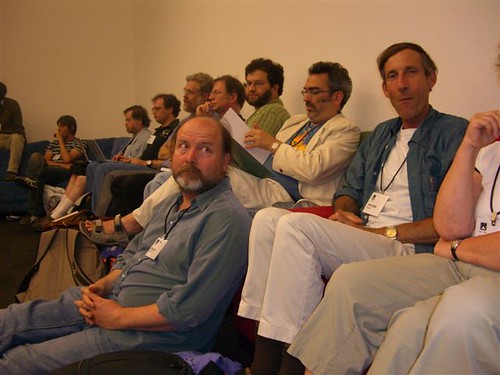
(Note - picture is from Ester Dyson's flick page) ---- The first big surprise of the meeting to me and many others happened at this. I was in the back of the room sitting on some couches (along with all the other wise people who knew this evening would go on for a while - also on the couches were Ester Dyson, Roger Brent, Oliver Morton, George Church, and a few others). On about the 10th or so person, a woman stood up and said "I am Martha Stewart ..." Yes, Martha Stewart was at the meeting. It created a bit of a buzz, maybe out of celebrity shock. Although given the number of geeks at the meeting, the fact that Freeman Dyson was there as were a variety of other geek heroes, the celebrity alone of Martha Stewart being there was probably not the main reason people kept saying "Is that for real." Maybe it was also because she was not someone one would have expected. I for one was a bit intrigued because I have been going through two of her cookbooks like I once read Science Fiction novels - I love her recipes.
- Another good introduction was when Freeman Dyson said he was not as smart as his kids. Then later George Dyson, his son, said his three words "Not that smart" which got a good laugh too.
- A final good introduction was by someone I could not see who said "DNA Hacking and Carpentry" which led someone to say "Jesus is here?"
- After this was all over - we got presented with 4 pre-selected talks - the only explicit scheduling of talks for the meeting. These talks were by:
- Drew Endy from MIT talking about Biohacking,
- Felice Frankel talking about "Envisioning Science" - a critical aspect of all of science which gets neglected much of the time.
- Saul Griifth, talking about global energy budgets for the planet,
- and Charles Simonyi talking about his recent space tourism flight. It was in his talk that everyone found out one of the reasons Martha Stewart was there - she was somehow with him as during his talk he turned to Martha to discuss menus for part of the 11 day trip. The other presentations were certainly interesting but Simonyi's was the feature of the night without a doubt. He had recently gone to the International Space Station with a Russian Crew, which only cost him 20-30 million dollars.
- Then came the signing up for talks thing --- people went up to the front and filled in discussion slots on the big bullet board. And thus the "un" meeting finally got a potential schedule. More on this later. After this was filled in, there was a little reception downstairs and eventually people went back on buses to the hotel to go to sleep. Which I must do now.
Friday, August 03, 2007
Train to Scifoo
Here are some pictures from my train ride to Scifoo. I took the train from Davis to Santa Clara ... and am awaiting the bus from our hotel to Googleplex. Will post more later when I have the chance. I know this is a little off base for my normal blog, but I thought it might be a bit fun to show the journey from the farmland to the big city.
 |
| New Album 8/3/07 2:22 PM |
Thursday, August 02, 2007
SciFoo, SciFoolery, Nature, O'Reilly, Google, and More
Well, I am off tomorrow to SciFoo camp. I went last year and wrote a bit about it in what was then my first attempts at blogging. Quick summary - SciFoo is a gathering of people with various connections to science, engineering and technology development. It is organized by the O'Reilly publishers and the Nature Publishing Group and it is, as last year, at Googleplex, the headquarters of a company some people may have heard of.
I confess, normally I pretty much hate going to meetings. I miss my kids. I hate hotels. And many meetings pretty much suck. But last years Scifoo -- it was hands down the most intriguing, interesting, and worthwhile meeting I have ever been to. Needless to say I was pretty happy to get invited back --- and have been eagerly awaiting this for months. Scifoo was great for two main reasons: (1) the people who were there (ranging from relatively unknown but absurdly brilliant graduate students to miscellaneous Nobel laureates and Macarthur winners) and (2) the fact that it is an un-meeting (there are no sessions planned and no real schedule --- just open slots in different sized rooms anyone can sign up for).
I will be blogging from Googleplex as much as I can and will try to let people know about the exciting things I find out there. And unlike last year, when I drove from Davis and picked up someone one the way, I have decided to try and make my trip more carbon neutral by taking the train to Santa Clara which turns out to be only a few miles from the hotel where most people are staying. Plus the train ride will give me time to maybe prepare a presentation which would be better than last year when I made one in about 15 minutes for a session on microbial diversity.
Here are some other bloggy things on scifoo:
I confess, normally I pretty much hate going to meetings. I miss my kids. I hate hotels. And many meetings pretty much suck. But last years Scifoo -- it was hands down the most intriguing, interesting, and worthwhile meeting I have ever been to. Needless to say I was pretty happy to get invited back --- and have been eagerly awaiting this for months. Scifoo was great for two main reasons: (1) the people who were there (ranging from relatively unknown but absurdly brilliant graduate students to miscellaneous Nobel laureates and Macarthur winners) and (2) the fact that it is an un-meeting (there are no sessions planned and no real schedule --- just open slots in different sized rooms anyone can sign up for).
I will be blogging from Googleplex as much as I can and will try to let people know about the exciting things I find out there. And unlike last year, when I drove from Davis and picked up someone one the way, I have decided to try and make my trip more carbon neutral by taking the train to Santa Clara which turns out to be only a few miles from the hotel where most people are staying. Plus the train ride will give me time to maybe prepare a presentation which would be better than last year when I made one in about 15 minutes for a session on microbial diversity.
Here are some other bloggy things on scifoo:
Wednesday, August 16, 2006
SciFoo Camp Day 3
For Day 3 of FooCamp, I drove over to the Googleplex so missed out on the sociology of the bus. It is always interesting as a meeting progresses through the days to see people who did not know each other previously become more and more comfortable with each other. I supose that happened here too, but Jason and I wanted to be able to scoot on out of there once the festivities ended.
We had another high-quality google meal for breakfast, although it seemed that the nutritionist may have not been given full control since the majority of items at the meal were fried or soaked in sugar or oil (i.e., bacon, french toast, etc). But the food was still good and if one did not like it one could always grab some organic snack inside.
On a side note, I kept cracking up every time I had one of these "Organic FoodBars." This was funny for two reasons. First, the name of the bar reminds me of something from the movie Repo Man where in the background of scenes, various food items are labelled as "Beer" or "Food." But the other reason these bars were funny is that everyone kept talking about foobar, which is another one of the O'Reilly folks meetings they are planning and a play on words.
Anyway, this was the day I saw the presentation on HowToons.Com (see earlier posting). I did go to a few other good sessions, but I confess I also spent a decent amount of time in the camping area of the googleplex chatting with other people. I made so many good connections at the meeting it seemed like that was certainly as much in the spirit of the whole thing as going to all the sessions would have been. Eventually had a final scifoo wrap up session where the powers that be asked us for critiques and suggestions for improvement.
In my glee to report on the great aspects of this scifoo, I may have given the impression that all was perfect. This was not the case and there were areas in need of much improvement. I and others brought some such issues up in the discussion here. One thing that was really somewhat unusual and ironic that was less than ideal was how they presented the information from the registration to other scifooers. When we registered on Day 1 we filled out a slip of paper listing five key words or phrases to describe oneself. I figured, this would get converted to electronic format and posted on some web site somewhere or used in some type of RFID tags to meet like minded folks. I mean, we were at Google, for heaven's sake. But no, instead what they did was simply print out our pictures onto the forms (they were about 4 inches by 8 inches) and then post all the forms on a board. Generally, the whole thing was useless, as people wrote in tiny print and not always very legibly, since they had no idea they would be posted in this way. There were other things in need of work but most of them were minor and unnlike in many other contexts where people point out problems with something at scifoo the audience actually proposed solutions to the problems too. That was a nice touch from my point of view, as it is easy to complain and generally hard to find solutions.
Then, just like that, it was over.
We had another high-quality google meal for breakfast, although it seemed that the nutritionist may have not been given full control since the majority of items at the meal were fried or soaked in sugar or oil (i.e., bacon, french toast, etc). But the food was still good and if one did not like it one could always grab some organic snack inside.
On a side note, I kept cracking up every time I had one of these "Organic FoodBars." This was funny for two reasons. First, the name of the bar reminds me of something from the movie Repo Man where in the background of scenes, various food items are labelled as "Beer" or "Food." But the other reason these bars were funny is that everyone kept talking about foobar, which is another one of the O'Reilly folks meetings they are planning and a play on words.
Anyway, this was the day I saw the presentation on HowToons.Com (see earlier posting). I did go to a few other good sessions, but I confess I also spent a decent amount of time in the camping area of the googleplex chatting with other people. I made so many good connections at the meeting it seemed like that was certainly as much in the spirit of the whole thing as going to all the sessions would have been. Eventually had a final scifoo wrap up session where the powers that be asked us for critiques and suggestions for improvement.
In my glee to report on the great aspects of this scifoo, I may have given the impression that all was perfect. This was not the case and there were areas in need of much improvement. I and others brought some such issues up in the discussion here. One thing that was really somewhat unusual and ironic that was less than ideal was how they presented the information from the registration to other scifooers. When we registered on Day 1 we filled out a slip of paper listing five key words or phrases to describe oneself. I figured, this would get converted to electronic format and posted on some web site somewhere or used in some type of RFID tags to meet like minded folks. I mean, we were at Google, for heaven's sake. But no, instead what they did was simply print out our pictures onto the forms (they were about 4 inches by 8 inches) and then post all the forms on a board. Generally, the whole thing was useless, as people wrote in tiny print and not always very legibly, since they had no idea they would be posted in this way. There were other things in need of work but most of them were minor and unnlike in many other contexts where people point out problems with something at scifoo the audience actually proposed solutions to the problems too. That was a nice touch from my point of view, as it is easy to complain and generally hard to find solutions.
Then, just like that, it was over.
Tuesday, August 15, 2006
SciFoo Camp Impressions Day2
You know a meeting is good when you simply have no time to check email let alone write in a blog. That was the case at scifoo and is why I am writing now a few days after the fact.
Day 2 was much more epic than the first since of course it was a full day of fooing. I managed to get up pretty early despite the late night (well, I cheated a little compared to others - I was up late but had only half a glass of very bad "single" malt). Many people looked a little rough around the edges in the morning in the hotel lobby... Nothing too surprising there as those who flew in, especially from overseas, met the wrath and illogic of modern airline security. The people from the UK in particular had some pretty good stories about being told they were not even allowed to buy books IN THE AIRPORT to bring on the plane. You might think then they would at least shut down the book sales, but of course no, that would cost them money.
So with TSA delays and jet lag and possibly some drinking I am not sure how they made it out early in the AM. We then all piled into a google provided bus and headed over to googleplex again. The conversations were lively along the way, although some of them had nothing to do with scifoo.
Then we got to googleplex for breakfast. As with food the night before, the food was mostly top notch although never pretentious or wasteful. Although I must say there were some unusual things mixed in (like some pretty heart attack inducing pieces of breakfast cake). I am sure the google nutritionist we met the night before was not overhwlemingly in favor of those items. Yes, google does in fact have some type of nutritionist. I never talked to her in detail to find out what that meant, but I did talk to a few scifoo folks about my theories that she was really a spy (she just seemed to pay way too much attention to all of the actual sessions to simply be the nutritionist; plus she always seemed to be talking on her two way radio). Maybe she had something to do with my theories about the addiction of the word google (see my previous post about this issue). Nutritionist - addiction --- seems like there must be a connection there.
Anyway, then the sessions began. Here's how it was set up. Outside, there was a coutryard with a paved patio section and a giant tent with tables for eating. Inside the main door was a giant room with camping stuff laid out all over the place (in homage to previous foo camps where people really camped). You had to walk through this open air camping section to get to the large grid showing the sessions being offered (people were still filling out session offerings throughout the day). Some sessions were downstairs near the camping room, and others were upstairs and a short 2 minute walk away. In addition, we were near a large cafeteria which including these giant bins with snack food (most of it on the healthy side of snack food which was fine with me) and a large fridge with a diversity of drinks.
I spent much of the day going to sessions relating to "open access" or "citizen science" but triedto force myself out of my box as much as possible. Among the most memorable sessions I went to were one on biology inspired robots (they had a robot gecko that could climb using millions of tiny hairlike projections like geckoes really use). See this Berkeley news release for some examples. Overall, the day was great. I got to catch up with some colleagues, and hang out with my brother who had been unable to come the night before. I also went to some great sessions on exploration (including of the earth's oceans and of Mars).
Not much was disappointing, although I was still somewhat dismayed to see how scientists support open source software, and open access to data, but then do not always support open access to publications. When asked why, they give the lamest explanations, like, "well, that is just the way it is done." Perhaps most tellingly, the technology and engineering and physical sciences folks seem to get the Open Access to publications movement more so than the biologists and other life science folks. Maybe that is due to the existence of the physics archives and things like that. Or maybe biologists do not like to speak up when there were multiple folks from Nature there, and they did not want to jeopardize their chances of getting a Nature paper. I think the real explanation is that many of them are, how should I put this politely, afraid of change (note I wanted to say chicken shit there but then decided to be polite).
Anyway, overall the day was great. I even did a presentation jointly with Tom Knight from MIT, where he discussed genome engineering and small genomes and I discussed how one studies mcirobes in their natural environments. I only wish I had thought of this more in advance and had done fewer slides and simply drawn on the board or just talked since we did not leave a ton of time for free discussion. Nevertheless, there were lots of people there and lots of really good questions were asked. Tom even inspired me to consider working on the group of organisms her works on (mycoplasmas, spiroplasmas and their relatives which are these really interested bacteria that do not have cell walls and tend to have really small genomes).
What I noticed happening was that as the day progressed, people spent less time sort of wandering around aimlessly between or during sessions and more time talking to other scifoo folks in the camping area of the main room. In addition, the google herders, in their black shirts, were frequently out in this area also having discussions (in addition to being positioned carefully at all intersections where we might wander off into nofoo land and possibly bump into some magical new google initiative we were not supposed to see). Message to google - you should be careful of the folks with the wandering insect like robots since they did not attract the attention of the intersection guards. In general, the google herders who were there were all very helpful and generally engaging but never obtrusive (they reminded me of stories Ihave heard about the staff on survivor who are always there but try to mostly stay out of the way).
And eventually, the main sessions came to an end and we wandered back outside for dinner in the open air or under the tent. By then everyone seemed to at least have someone they felt comfortable talking to and everything was much less awkward than the night before. Not to say that all was perfect - there were of course the awkward moments and some highly strange people. But unlike many conferences I have been to, since this was a pretty select crowd, even the highly strange people were generally quite interesting once you got past their veneer.
So eventually people piled in to the buses and went back to the hotel. Of course, the night could not end there. But this time, instead of going to the lame bars, we decided to have a party in the hotel lounge. A few of us went out and bought some stuff to drink at a nearby store and we then had a quite pleasant evening talking about Mars, evolution, Nature, and scifoo in the hotel lounge. The only drab moment was when the receptionist came in and said something to the effect of "guests are beginning to complain about the noise" that we shut the doors and talked a little more quietly. I even came up with a good term to use in a new paper I am working on thanks to some of the Mars exploration folks who were there. Eventually, I went to sleep. And thus Day 2 did end.
Day 2 was much more epic than the first since of course it was a full day of fooing. I managed to get up pretty early despite the late night (well, I cheated a little compared to others - I was up late but had only half a glass of very bad "single" malt). Many people looked a little rough around the edges in the morning in the hotel lobby... Nothing too surprising there as those who flew in, especially from overseas, met the wrath and illogic of modern airline security. The people from the UK in particular had some pretty good stories about being told they were not even allowed to buy books IN THE AIRPORT to bring on the plane. You might think then they would at least shut down the book sales, but of course no, that would cost them money.
So with TSA delays and jet lag and possibly some drinking I am not sure how they made it out early in the AM. We then all piled into a google provided bus and headed over to googleplex again. The conversations were lively along the way, although some of them had nothing to do with scifoo.
Then we got to googleplex for breakfast. As with food the night before, the food was mostly top notch although never pretentious or wasteful. Although I must say there were some unusual things mixed in (like some pretty heart attack inducing pieces of breakfast cake). I am sure the google nutritionist we met the night before was not overhwlemingly in favor of those items. Yes, google does in fact have some type of nutritionist. I never talked to her in detail to find out what that meant, but I did talk to a few scifoo folks about my theories that she was really a spy (she just seemed to pay way too much attention to all of the actual sessions to simply be the nutritionist; plus she always seemed to be talking on her two way radio). Maybe she had something to do with my theories about the addiction of the word google (see my previous post about this issue). Nutritionist - addiction --- seems like there must be a connection there.
Anyway, then the sessions began. Here's how it was set up. Outside, there was a coutryard with a paved patio section and a giant tent with tables for eating. Inside the main door was a giant room with camping stuff laid out all over the place (in homage to previous foo camps where people really camped). You had to walk through this open air camping section to get to the large grid showing the sessions being offered (people were still filling out session offerings throughout the day). Some sessions were downstairs near the camping room, and others were upstairs and a short 2 minute walk away. In addition, we were near a large cafeteria which including these giant bins with snack food (most of it on the healthy side of snack food which was fine with me) and a large fridge with a diversity of drinks.
I spent much of the day going to sessions relating to "open access" or "citizen science" but triedto force myself out of my box as much as possible. Among the most memorable sessions I went to were one on biology inspired robots (they had a robot gecko that could climb using millions of tiny hairlike projections like geckoes really use). See this Berkeley news release for some examples. Overall, the day was great. I got to catch up with some colleagues, and hang out with my brother who had been unable to come the night before. I also went to some great sessions on exploration (including of the earth's oceans and of Mars).
Not much was disappointing, although I was still somewhat dismayed to see how scientists support open source software, and open access to data, but then do not always support open access to publications. When asked why, they give the lamest explanations, like, "well, that is just the way it is done." Perhaps most tellingly, the technology and engineering and physical sciences folks seem to get the Open Access to publications movement more so than the biologists and other life science folks. Maybe that is due to the existence of the physics archives and things like that. Or maybe biologists do not like to speak up when there were multiple folks from Nature there, and they did not want to jeopardize their chances of getting a Nature paper. I think the real explanation is that many of them are, how should I put this politely, afraid of change (note I wanted to say chicken shit there but then decided to be polite).
Anyway, overall the day was great. I even did a presentation jointly with Tom Knight from MIT, where he discussed genome engineering and small genomes and I discussed how one studies mcirobes in their natural environments. I only wish I had thought of this more in advance and had done fewer slides and simply drawn on the board or just talked since we did not leave a ton of time for free discussion. Nevertheless, there were lots of people there and lots of really good questions were asked. Tom even inspired me to consider working on the group of organisms her works on (mycoplasmas, spiroplasmas and their relatives which are these really interested bacteria that do not have cell walls and tend to have really small genomes).
What I noticed happening was that as the day progressed, people spent less time sort of wandering around aimlessly between or during sessions and more time talking to other scifoo folks in the camping area of the main room. In addition, the google herders, in their black shirts, were frequently out in this area also having discussions (in addition to being positioned carefully at all intersections where we might wander off into nofoo land and possibly bump into some magical new google initiative we were not supposed to see). Message to google - you should be careful of the folks with the wandering insect like robots since they did not attract the attention of the intersection guards. In general, the google herders who were there were all very helpful and generally engaging but never obtrusive (they reminded me of stories Ihave heard about the staff on survivor who are always there but try to mostly stay out of the way).
And eventually, the main sessions came to an end and we wandered back outside for dinner in the open air or under the tent. By then everyone seemed to at least have someone they felt comfortable talking to and everything was much less awkward than the night before. Not to say that all was perfect - there were of course the awkward moments and some highly strange people. But unlike many conferences I have been to, since this was a pretty select crowd, even the highly strange people were generally quite interesting once you got past their veneer.
So eventually people piled in to the buses and went back to the hotel. Of course, the night could not end there. But this time, instead of going to the lame bars, we decided to have a party in the hotel lounge. A few of us went out and bought some stuff to drink at a nearby store and we then had a quite pleasant evening talking about Mars, evolution, Nature, and scifoo in the hotel lounge. The only drab moment was when the receptionist came in and said something to the effect of "guests are beginning to complain about the noise" that we shut the doors and talked a little more quietly. I even came up with a good term to use in a new paper I am working on thanks to some of the Mars exploration folks who were there. Eventually, I went to sleep. And thus Day 2 did end.
Monday, August 14, 2006
SciFoo Camp Highlight1 - HowToons and Science Education Reform
I am going to post some blogs on some of the more interesting things I saw at foo camp.
I think by far and away the thing that made the biggest impression on me at scifoo camp was HowToons. From their description:
That is why I was so excited about Howtoons. This is one of the most creative and elegant ways to reach out to kids I have ever seen. What they have done is create hands on modules to teach various principles of the world (some engineering, some science, some math). These modules are based on having kids create experiments out of various household goods they have lying around (e.g., 2 liter soda bottles play a big role). The modules are just stunningly cool (I would want to do them as an adult). For example, they have one where the kids make their own safety goggles out of soda bottles, or make ice cream with explanations about why it works. But that is not the best part. The best part is that the instructions for the modules are done in comic books, with beautiful artwork, and entertaining side stories, and are things kids would actually want to read. If you have kids, or do are involved in any way in K-12 science, math or engineering instruction, you really have to check out Howtoons.
They are coming out with a new book soon that enbeds all of their best modules. You can make preorders on Amazon.
Some other cool education related activities were discussed at scifoo. One of the others that stuck with me was a presenation about using the online world SecondLife for education. I will try and write more about that in a later posting.
I think by far and away the thing that made the biggest impression on me at scifoo camp was HowToons. From their description:
Howtoons are cartoons showing kids of all ages "How To" build things. Each illustrated episode is a stand-alone fun adventure accessible to all. Our Howtoons are designed to encourage children to be active participants in discovering the world through Play-that-Matters -- fun, creative, and inventive -- and to rely a lot less on mass-consumable entertainmentIn this day and age, science, math and engineering is becoming more and more important for the world. And yet despite much lip service, we seem to be doing a pretty poor job of reaching out to kids and to people not currently interested in these areas. I have been involved in this area for some time and have seen a bunch of different approaches:
- When I was an undergraduate at Harvard I and another student (Alison Lingane) pushed Harvard to create an undergraduate major in Environmental Studies that covered science, policy, economics, etc but did not take any "pro" or "anti" environment position. The secret goal behind this was to bring science to students who might end up becoming lawyers, congresspeople, senators, etc. Harvard created such a major a few years later called Environmental Science and Public Policy.
- When I was a graduate student at Stanford, I served on the committee that was charged with redesigning Stanford's science, math, and engineering requirements for non science majors. (A little aside - although this was over 10 years ago now, the web site I created is still up here - it slipped through the cracks of the Stanford delete mafia). In the end, we came up with a plan to create full year integrated courses that covered a particular are and had science, math, and engineering embedded within the course. None other than Condoleeza Rice was in charge of the committee and I thought the idea for the new courses was so great that I helped design and then teach one of them (a course on heart disease). I was really proud of this course (and won Stanford's biggest teaching award to boot). But in the end, I think college may be too late to reach students and get them to really appreciate science, math and engineering.
That is why I was so excited about Howtoons. This is one of the most creative and elegant ways to reach out to kids I have ever seen. What they have done is create hands on modules to teach various principles of the world (some engineering, some science, some math). These modules are based on having kids create experiments out of various household goods they have lying around (e.g., 2 liter soda bottles play a big role). The modules are just stunningly cool (I would want to do them as an adult). For example, they have one where the kids make their own safety goggles out of soda bottles, or make ice cream with explanations about why it works. But that is not the best part. The best part is that the instructions for the modules are done in comic books, with beautiful artwork, and entertaining side stories, and are things kids would actually want to read. If you have kids, or do are involved in any way in K-12 science, math or engineering instruction, you really have to check out Howtoons.
They are coming out with a new book soon that enbeds all of their best modules. You can make preorders on Amazon.
Some other cool education related activities were discussed at scifoo. One of the others that stuck with me was a presenation about using the online world SecondLife for education. I will try and write more about that in a later posting.
My 18 month old daughter is in love with google
So I just got back from a 2 day trip to Googleplex for scifoo camp (more on that in other posts). And my wife told me that she mentioned to our 18 month old daughter Analia that I was at Google, as if that would mean anything to her.
And now she cannot stop saying the word. She says it and giggles. If she hears me say it, she starts repeating it over and over again and thinks it is the funniest thing in the world. Here is a video of her saying it.
She loves goofy words, and asks me to repeat them whenever I say them (e.g., I said the word booty the other day and now she says that a lot too - I guess I have to be more careful around her now).
But for some reason google is the best word in her book. Maybe this is part of their secret to success. They have discovered a word that is secretly addictive. I mean, we know that different words can stimulate different parts of the brain. And these guys were at Stanford after all, where there is some pretty good language and neurobiology research. Maybe the key to this whole thing is the word.
Imagine if they had named the system "searchies." That would give me the heebiejeebies every time I used it. Or how about "smeagol." Not too appealing either. I may have to enter my daughter in a reeducation camp of some type. Fortunately, I live in Davis, CA, aka the People's Republic of Davis, so I am sure there are reeducation camps here.
And now she cannot stop saying the word. She says it and giggles. If she hears me say it, she starts repeating it over and over again and thinks it is the funniest thing in the world. Here is a video of her saying it.
She loves goofy words, and asks me to repeat them whenever I say them (e.g., I said the word booty the other day and now she says that a lot too - I guess I have to be more careful around her now).
But for some reason google is the best word in her book. Maybe this is part of their secret to success. They have discovered a word that is secretly addictive. I mean, we know that different words can stimulate different parts of the brain. And these guys were at Stanford after all, where there is some pretty good language and neurobiology research. Maybe the key to this whole thing is the word.
Imagine if they had named the system "searchies." That would give me the heebiejeebies every time I used it. Or how about "smeagol." Not too appealing either. I may have to enter my daughter in a reeducation camp of some type. Fortunately, I live in Davis, CA, aka the People's Republic of Davis, so I am sure there are reeducation camps here.
Sunday, August 13, 2006
SciFoo Camp impressions Day 1
So here I am back in Davis after an exhausting and pretty exhilarating 2 days.
Friday, I drove from Davis to Sunnyvale the location of the hotel all scifoo camplers were staying at. I stopped on the way in Walnut Creek, to pick up Jason Stajich another one of the scifoo participants (a new Berkeley post doc who works on things related to what I do and thus who I already knew). We saw little traffic in the drive from Walnut Creek to Sunnyvale (it was Friday PM but the traffic was in the other direction most of the way).
We then dumped our stuff (well, I had to change rooms first. My "non smoking room" smelled like someone hung up the sheets in a smoking lounge at the airport for a month) and hopped on the bus to Googleplex. We had no idea what to expect.
Got to Googleplex and we herded off the bus into a reception area where we picked up some typical conference goodies (name badges, the obligatory logo bag). But already things smelled a little different when they gave us some type of puzzle box for our personal entertainment. Then they proceeded to have use write down some keywords describing our work and they took our pictures (these were later merged together and put up on a bulletin board so you could see if they was anyone else there you just had to talk to). I confess, I never looked at the board. I thought it would be almost against the spirit of the whole thing to seek out people I had some commonality with. I wanted to get to know people I would otherwise probably never encounter.
Then we got the first glimpse of the Google wonderful obsession with decent food. I have been to conferences with really good food and really bad food. This was the first conference/meeting/workshop that I had been to where the food was abundant and potentially healthy (as in, there were always somewhat healthy options) and yet never overbearing. Not only was the official lunch and breakfast and dinner food quite good, but they had these collections of drinks and munchies freely available throughout the day. This included a diverse selection of organic and/or vegan snack items which made me quite happy as I have been drifting more and more towards organic foods and even a litle bit towards vegan foods for some time.
There was a giant tent outside (maybe this was in homage to the foo "camps", although I think it might have been a permanent fixture there). And we mingled. As at most meetings where I knew very few people, it was a little hard to feel comfortable at first. Do you simply go up and introduce yourself to people "Hi, I'm Jonathan, and I work on evolution" or do you just find the one person you know and stick to them, or do you sit down at a table and mix anonymity with sociality? I chose the latter option and began to get to know some of the scifooers (not sure wat the offical term is for participants in these things).
Eventually, after mingling for a few hours, we were herded inside to a large room and we got the "introduction" to the meeting. The introduction was minimalist but and then we spent about an hour or so, going around the room giving a few words about what we work on. This was not the most useful thing in the world but at least it was not too tedious. This was because we were instructed to say only three words (I was way at the end, after some pretty good humorous lines were used so I just said "intelligently designed evolution"). Some people went over their limit, but it did not drag out too long. There were some pretty good little ditties in this session -- only later did I realize that some people knew what to expect in advance and probably had been thinking about this for some time.
That evening we had a few mini presenations but the key to the evening was the unveilling and the signing up on the giant scheduling board. Basically, there were slots for rooms and times. Some rooms were big and some were small. And people signed up for topics in the rooms. It was quite chaoitic op by the board while this was going on - people trying to decide things like "Do I sign up for a big room, or is that too arrogant" or "Should I do more than one presentation". I did not initially sing up for anything ( I confess, I had not really come prepared to lead a discussion - having not really understood what scifoo camp was going to be about).
The other key to the evening was the adoption of Chatham House rules. This I guess is some British thing whereby nobody is allowed to attribute anything to an individual without their permission. So if someone there said they thought someone you knew was a rube (someone told me this), you could post it in your blog (as I just did) but could not say who said it, without permission. This supposedly would make people speak more freely. I think this was not necessary for this group of people as a did not sense that people were holding back on saying anything negative for fear of attribution (I did see some serious sucking up going on in various venues but when you have the founders of google walking going to sessions, as well as some of the biggest names in various fields it is hard to avoid some fawning).
Eventually, evening number one at Google came to a close. I STILL did not know what to really expect for these open sessions, but I was getting to know people and having a pretty good time (except for the missing reading bedtime stories to my 1.5 year old daughter). We took the bus back to the hotel and it seemed to early to crash so a bunch of us went around the corner from theo hotel to what must be one of the lamest bars in the South Bay (when we walked in one of the patrons complained that we did not have enough women with us like he was going to somehow magically hook up if only there were more women there). But a group of use did hang out there for a couple of hours (the single malt we ordered tasted more like gasoline thant anything else but hey - gas is expesnive these days so maybe they did the switch with good intentions) before wandering back to the hotel (we peeked in the other bar - it was even more suspect than the first).
Friday, I drove from Davis to Sunnyvale the location of the hotel all scifoo camplers were staying at. I stopped on the way in Walnut Creek, to pick up Jason Stajich another one of the scifoo participants (a new Berkeley post doc who works on things related to what I do and thus who I already knew). We saw little traffic in the drive from Walnut Creek to Sunnyvale (it was Friday PM but the traffic was in the other direction most of the way).
We then dumped our stuff (well, I had to change rooms first. My "non smoking room" smelled like someone hung up the sheets in a smoking lounge at the airport for a month) and hopped on the bus to Googleplex. We had no idea what to expect.
Got to Googleplex and we herded off the bus into a reception area where we picked up some typical conference goodies (name badges, the obligatory logo bag). But already things smelled a little different when they gave us some type of puzzle box for our personal entertainment. Then they proceeded to have use write down some keywords describing our work and they took our pictures (these were later merged together and put up on a bulletin board so you could see if they was anyone else there you just had to talk to). I confess, I never looked at the board. I thought it would be almost against the spirit of the whole thing to seek out people I had some commonality with. I wanted to get to know people I would otherwise probably never encounter.
Then we got the first glimpse of the Google wonderful obsession with decent food. I have been to conferences with really good food and really bad food. This was the first conference/meeting/workshop that I had been to where the food was abundant and potentially healthy (as in, there were always somewhat healthy options) and yet never overbearing. Not only was the official lunch and breakfast and dinner food quite good, but they had these collections of drinks and munchies freely available throughout the day. This included a diverse selection of organic and/or vegan snack items which made me quite happy as I have been drifting more and more towards organic foods and even a litle bit towards vegan foods for some time.
There was a giant tent outside (maybe this was in homage to the foo "camps", although I think it might have been a permanent fixture there). And we mingled. As at most meetings where I knew very few people, it was a little hard to feel comfortable at first. Do you simply go up and introduce yourself to people "Hi, I'm Jonathan, and I work on evolution" or do you just find the one person you know and stick to them, or do you sit down at a table and mix anonymity with sociality? I chose the latter option and began to get to know some of the scifooers (not sure wat the offical term is for participants in these things).
Eventually, after mingling for a few hours, we were herded inside to a large room and we got the "introduction" to the meeting. The introduction was minimalist but and then we spent about an hour or so, going around the room giving a few words about what we work on. This was not the most useful thing in the world but at least it was not too tedious. This was because we were instructed to say only three words (I was way at the end, after some pretty good humorous lines were used so I just said "intelligently designed evolution"). Some people went over their limit, but it did not drag out too long. There were some pretty good little ditties in this session -- only later did I realize that some people knew what to expect in advance and probably had been thinking about this for some time.
That evening we had a few mini presenations but the key to the evening was the unveilling and the signing up on the giant scheduling board. Basically, there were slots for rooms and times. Some rooms were big and some were small. And people signed up for topics in the rooms. It was quite chaoitic op by the board while this was going on - people trying to decide things like "Do I sign up for a big room, or is that too arrogant" or "Should I do more than one presentation". I did not initially sing up for anything ( I confess, I had not really come prepared to lead a discussion - having not really understood what scifoo camp was going to be about).
The other key to the evening was the adoption of Chatham House rules. This I guess is some British thing whereby nobody is allowed to attribute anything to an individual without their permission. So if someone there said they thought someone you knew was a rube (someone told me this), you could post it in your blog (as I just did) but could not say who said it, without permission. This supposedly would make people speak more freely. I think this was not necessary for this group of people as a did not sense that people were holding back on saying anything negative for fear of attribution (I did see some serious sucking up going on in various venues but when you have the founders of google walking going to sessions, as well as some of the biggest names in various fields it is hard to avoid some fawning).
Eventually, evening number one at Google came to a close. I STILL did not know what to really expect for these open sessions, but I was getting to know people and having a pretty good time (except for the missing reading bedtime stories to my 1.5 year old daughter). We took the bus back to the hotel and it seemed to early to crash so a bunch of us went around the corner from theo hotel to what must be one of the lamest bars in the South Bay (when we walked in one of the patrons complained that we did not have enough women with us like he was going to somehow magically hook up if only there were more women there). But a group of use did hang out there for a couple of hours (the single malt we ordered tasted more like gasoline thant anything else but hey - gas is expesnive these days so maybe they did the switch with good intentions) before wandering back to the hotel (we peeked in the other bar - it was even more suspect than the first).
Subscribe to:
Posts (Atom)
Most recent post
A ton to be thankful for -- here is one part of that - all the acknowledgement sections from my scholarly papers
So - it is another Thanksgiving Day and in addition to thinking about family, and football, and Alice's Restaurant, I also think a lot a...

-
Wow. Just wow. And not in a good way. Just got an email invitation to a meeting. The meeting is " THE FIRST ANNUAL WINTER Q-BIO ...
-
 There is a spreading surge of PDF sharing going on in relation to a tribute to Aaron Swartz who died a few days ago. For more on Aaron ...
 -
 Well, I have tried to hold off giving out awards here since I kind of botched my last attempt at this. But here goes. Yesterday, researcher...

