Monday, November 23, 2015

Pubmed to trial new collaboration status tool to block interaction with ex-collaborators


Bethesda, MD. November 23, 2015.

Pubmed is to ease de-collaboration (when one stops working with a collaborator) woes by tweaking its 'Collaboration Status' function – allowing ex-collaborators to disappear from view without users removing them as a colleague.

The literature network will trial the new collaborator tool in the United States, with plans to roll out the changes worldwide after receiving feedback.

David Lippmann, product manager for Pubmed, said in a statement: “Starting today, we are testing tools to help researchers manage how they interact with their former collaborators on Pubmed after their collaboration has ended. When researchers change their collaboration status to indicate they are no longer in a collaboration, they will be prompted to try these tools.

“The work is part of our ongoing effort to develop resources for scholars who may be going through difficult moments in their lives. We hope these tools will help people end collaborations on Pubmed with greater ease, comfort and sense of control.”

The tools will allow users to limit the papers, data sets or status updates that an ex-collaborator will see. Without having to de-collaborate or block a former research partner, Pubmed will also make sure their name and ORCID ID do not appear in the site's paper feed.

Their name will not be suggested either when users tag researchers in papers.

Users will also be able to edit who can see past papers with a former collaborator and untag from papers written with that person.

Today in SPAMMY conference invitations #2

Dear Dr. Jonathan A Eisen,

Greetings!

The purpose of this letter is to invite
 you to be as a Speaker for the upcoming 6th

International Conference & Expo on Proteomics during March 29-31, 2016 Atlanta, USA. 

The aim to deliver a global platform to share knowledge and expertise with the scientific 

community on the advancements in the field of Proteomics. The conference anticipates 
leading worldwide researchers, scientists, academic scientists, industry researchers, scholars, 
decision makers and other professionals from across the globe. 

The theme of the conference is Revealing The Novel Innovation of Life Science, To Meet 

EmergingChallenges. 

Benefits:

1.      Personal interaction with the Organizing Committee Members, Keynote speakers and other 
eminent personalities for our future course of work.
2.      Opportunity to conduct workshop/symposium with your team and colleagues based on your 
research expertise.

Some confirmed speakers for World Proteomics 2016:

Steven Pelech, President of Kinexus Bioinformatics Corp, Canada.
Krishna Dronamraju, President of Foundation for Genetic Research, USA.
Desmond Fitzgerald, Vice-President for Health Affairs, UCD, Ireland.
Laszlo Takacs, CEO of Biosystems International Kft, Hungary.
Cheorl-Ho Kim, Director, Sungkyunkwan University, Republic of Korea.
Sixue Chen, Director of Proteomics, University of Florida, USA.
Jochen Schwenk, KTH - Royal Institute of Technology, Sweden.
S.K. Jain, Head of Biochemistry, Hamdard University, India.
Raju Ravikumar, Professor, NIMHANS University, India.
Kian Kani, University of Southern California, USA
Ahmed Aldarmahi, King Saud bin Abdulaziz University for Health Sciences, Saudi Arabia.

For more details please visit http://www.proteomicsconference.com/america/

In closing, we would be pleased and honored if you would consent to be speaker at the World 

Proteomics 2016 Conference. 

I look forward to receiving your reply

Please feel free to contact us for further details on the conference.

Respectfully,
Mark Henry Jane
5716 Corsa Ave, Suite110
Westlake, Los Angeles
CA-91362-7354, USA

Today in SPAMMY confereonce invitations

Dear Dr. Eisen,
On behalf of the Conference Chairs and Committees, it is my great pleasure to invite you to deliver an invited talk at the EMN Meeting on Membranes, which will be held in Novotel World Trade Centre Hotel, Dubai-United Arab Emirates, on April 05-08th, 2016.
Updated information about the EMN Meeting on Membranes can be found at http://emnmeeting.org/membranes/
The main purpose of EMN Membranes Meeting is to describe and discuss the newadvancement in Membranes Technology with its well-recognized and promising applications. We hope to bring together leading scientists, researchers, scholars and engineers from academia, R&D laboratories and industry around the world to exchange, share and learn the most interesting work done recently.
The workshops emphasis on promising aspects of Membrane usage are as follows: Bio absorbable Nano fiber Membranes, Membranes for Energy Conversion such as Fuel Cell, Gas Separation, Membrane Assembly and Translocation, Osmosis and Nano filtration Membranes, Membranes for Computing, Proton Exchange Membranes, Power Generation by Pressure Retarded Osmosis, Membranes for Environmental Protection and Membranes for Process Intensification and General in this broad field.
I do hope you can make time in your busy schedule to act as an invited speaker share your ideas on this topic. Your experience and comments will add an important dimension to what’s potentially a very important discussion for the field.
Please directly reply this email with your contact information, a tentative title of your invited presentation and which workshop is more appropriate for you or you can recommend other workshop for your talk if you could accept our invitation.
We are looking forward to hear from you and it will certainly be our pleasure and honor to see you in Dubai soon. Thanks!

Best Regards,
Mr. Muhammad Umar Farooq

Tuesday, November 10, 2015

Thanks, no plans to help you get your impact factor on

Got this in the intertubes this morning. Sorry - not planning to submit there.

Dear Jonathan A Eisen,

Hope you are doing well.

We, Bio Accent open access publishers came newly into publishing sector to provide a platform to the researchers, practitioners, students and professionals from both academia as well as industry to meet and share cutting-edge development in the field of Microbiology.

We have found your profile from your institute; it seems you are a very good expert in Microbiology. We don’t want to miss your appreciable work so, we are inviting you for manuscript submission in BAOJ Microbiology.

We request you to let us know if you have any kind of research work to publish with us and please let me know your tentative date of manuscript submission.

We are expecting huge support from your side, so it will help us to get indexed & impact factor soon.

Awaiting your positive response.

Sincerely
Laura

Sunday, November 08, 2015

BigDat 2016 where men (and only men) will teach you about big data #YAOMM

Just got an email invitation to the following

2nd INTERNATIONAL WINTER SCHOOL ON BIG DATA

BigDat 2016

Bilbao, Spain

February 8-12, 2016

Organized by:
DeustoTech, University of Deusto
Rovira i VirgiliUniversity


I confess, I was intrigued enough to look because it was in Bilbao, and, well, my kids are completely obsessed with soccer and we are thinking of a trip to Barcelona, so why not a trip to Bilbao too.  And then, well, I got sick to my stomach.  I looked at the list of speakers and instructors and did a bunch of Googling to make inferences about their gender.  And, well, everyone associated with the School appears to be male.  That is 24 or 24 slots (4 keynote speaker slots and 20 professor slots.  See below for the rundown.  People I identified as male are highlighted in yellow. Sad and disappointing.  Needless to say I will not be going.

-----------------------------

Keynote Speakers
  1. Nektarios Benekos (European Organization for Nuclear Research)
  2. Chih-Jen Lin (National Taiwan University)
  3. Jeffrey Ullman (Stanford University)
  4. Alexandre Vaniachine (Argonne National Laboratory)
Professors and Courses
  1. Nektarios Benekos (European Organization for Nuclear Research)
  2. Hendrik Blockeel (KU Leuven)
  3. Edward Y. Chang (HTC Health, Taipei)
  4. Nello Cristianini (University of Bristol)
  5. Ernesto Damiani (University of Milan)
  6. Francisco Herrera (University of Granada),
  7. Chih-Jen Lin (National Taiwan University),
  8. George Karypis (University of Minnesota)
  9. Geoff McLachlan (University of Queensland)
  10. Wladek Minor (University of Virginia),
  11. Raymond Ng (University of British Columbia)
  12. Sankar K. Pal (Indian Statistical Institute)
  13. Erhard Rahm (University of Leipzig)
  14. Hanan Samet (University of Maryland)
  15. Jaideep Srivastava (Qatar ComputingResearch Institute)
  16. Jeffrey Ullman (Stanford University)
  17. Alexandre Vaniachine (Argonne National Laboratory)
  18. Xiaowei Xu (University of Arkansas, Little Rock)
  19. Fuli Yu (Baylor College of Medicine)
  20. Mohammed J. Zaki (Rensselaer Polytechnic Institute)

Wednesday, November 04, 2015

Improving Ability to Identify Possible Conflicts of Interest of Scholars 1: Adding a Disclosure Field to ORCID

Real and perceived conflicts of interest are a critically important topic in scholarly activities that I believe has not received enough attention from the scientific community.  Right now, disclosures of possible conflicts of interest are handled incredibly very unevenly and poorly by academia and industry and government.  Even when people do the right thing and make detailed disclosures, such information is hard to find and ephemeral.  There are many things that the community could do to improve the ability to find such information.

One simple step that I believe could be useful would be to link disclosures to universal scholar ID systems.  Although there are multiple UID systems for scholars, right now the UID of choice appears to be ORCID. ORCID currently allows scholars to compile information about their education, employment, funding and scholarly works.

I therefore propose that ORCID add a new category: DISCLOSURES.  What would be included here? Well, I don't know exactly but would include things like board membership, stock in companies, funding not listed elsewhere, any other significant relationship with a group, and more.  Sure this could get messy.  But I think we need to do more to make it easier to share and find information that could be a actual or potential conflict of interest.

Something like this:


If anyone knows of other tools for doing this I would love to hear about them.

Tuesday, November 03, 2015

Does #AAAS care about #Ebola anymore? Nope. And probably never did. #ClosedAccess

In October I wrote a blog post criticizing AAAS (and ASM) for trying to give themselves a pat on the back for making a few papers about Ebola freely available: The Tree of Life: No #AAAS and ASM you do not deserve good PR for freeing up a few papers on Ebola.  The whole thing was a publicity stunt.  And AAAS in particular tried to play up how they were doing this for the benefit of humanity.

So today I decided to check back and look into whether AAAS was making new papers on Ebola freely available. So I searched for the word Ebola in the title or Abstract 

The most recent seemed interesting:


Surely AAAS must still care enough about Ebola to make new papers freely available right? Nope. $20 to rent for a day


How about #2:


Seems useful and worth reading if one works on Ebola.  Free right?  Nope: $20/day


How about #3:

Seems peripherally relevant to Ebola but I would not mind if more Ebola workers read this.  Free right?  Nope.  Guess how much? $20/day


And so on.  A few in the first 10 were, at least for now freely available.  But overall it seems, AAAS and Science have decided Ebola is no longer important.  So much for helping the world.

Monday, November 02, 2015

YASEBI - Yet another SPAMMY editorial board invitation

Got this SPAMMY invite in the emails. Given that I work neither on Immunology or Immunotherapy this seems, well, SPAMMY.

Dear Dr. Jonathan Eisen,

The Journal of Immunology & Immunotherapy welcomes you!

Henry Publishing Group introduces you the Journal of Immunology & Immunotherapy. The journal is newly launched with an open access initiative to serve the scientific community globally. We welcome eminent scientific personalities, who are expertise in this field as editors to form the editorial board. 

Based on your expertise and contributions in this field, we request you to associate with us as an editor.  We would be happy if you could serve as an editor and help us for the growth and development of the journal.

Kindly go through the URL for journal online,

We are awaiting for your response regarding your opinion towards the position. If you are interested, please mail us your acceptance along with an updated CV, summary of research expertise and biography at immunology@henrypublishinggroup.org

Please let us know if you have any queries regarding this. I look forward to hear from you soon.

Hope to associate with you a long lasting and scientific relationship with you

With kind regards
Andy Lauer
Unit 3,
830 Manukau Rd,
Rayal Oak,
Auckland - 1061,
New Zealand      

Sunday, November 01, 2015

Today in SPAMMY Journal Editorial Board Invitations

Got this today.  Seems pretty dubious:

ARC Journals of Immunology and Vaccines (AJIV) – Editorial Board Invitation
Dear Dr. Eisen JA,
We introduce ourselves as ARC Publications PVT LTD (Academician’s Research Center) is a premier international, open access, publisher with Hyderabad, India as its head quarters diffusing across the globe covering European, Western and Asian nations. Our primary objective is to publish quality research that undergoes a thorough scrutiny process while giving creative freedom to the researcher. 
This is to bring to your kind notice that we are in the process of recruiting eminent people as Editorial Board Members for our ARC Journals of Immunology and Vaccines (AJIV). It is an Open Access, Academic, Peer-reviewed, quality journal that publishes unbiased original research in the field of Immunology and Vaccination.  We cordially invite you to take the role as Editorial Board Member to be part of our Journal.   
We would request you to submit a manuscript or a two page Editorial article to encourage our journal as we would like to release our first issue with our Journal Editorial Board Member’s articles. We request you to invite your colleagues/ Expertises/ Students to publish your the scientific/ research work with us.
Kindly send us your Resume, Bio data and Photograph for our Editorial office purpose. Your Resumes and Manuscripts could be submitted at editor_ajiv@arcjournals.org.
Thank You.
AJIV - Editorial Office
ARC Publications PVT LTD

Saturday, October 31, 2015

Removing my name from the author list of #closedaccess "Unified Microbiome Initiative" paper in Science

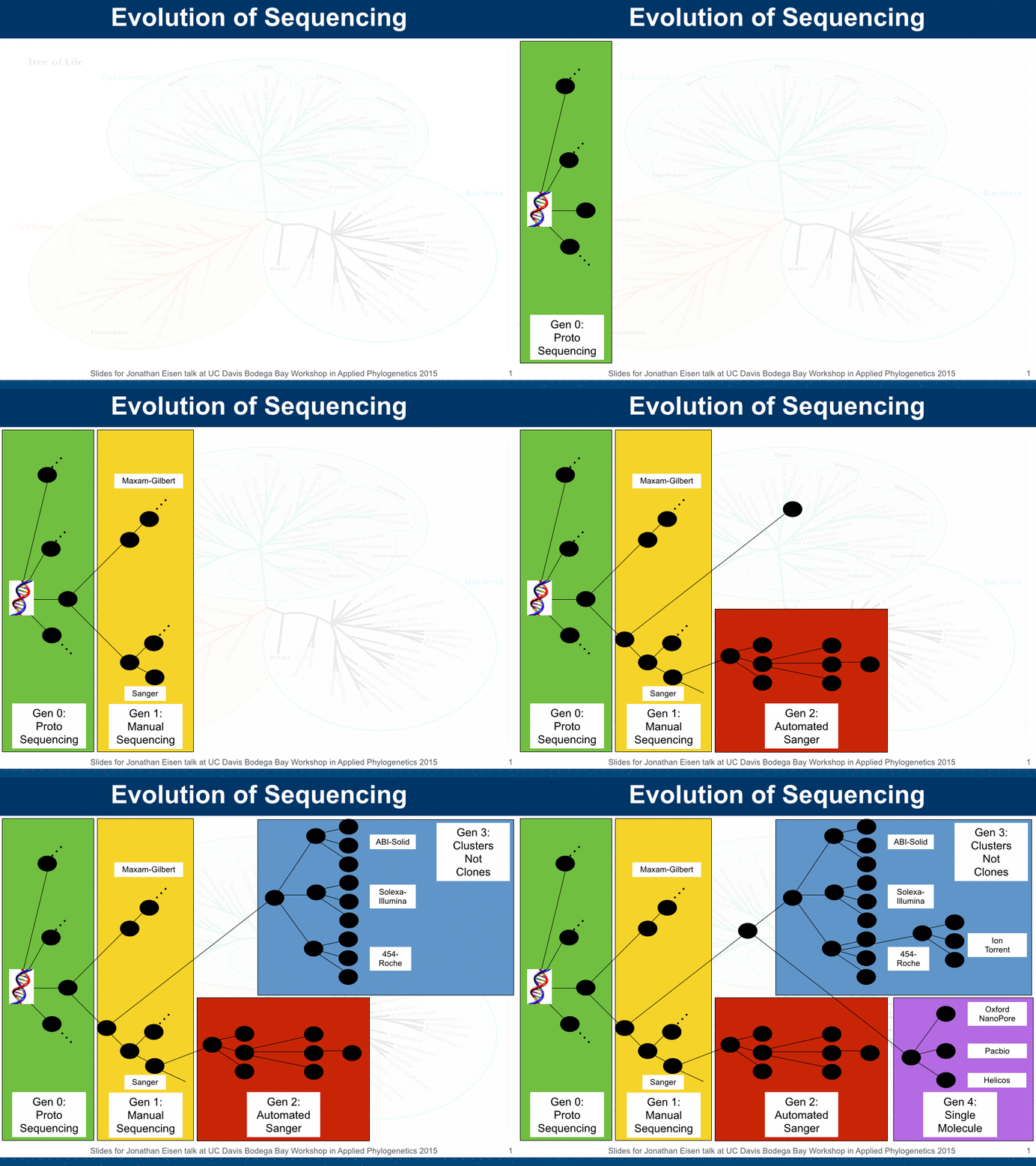
Evolution of DNA sequencing talk 2015 version

Crossposted from microBEnet

Every year for the last few years I have given a talk on the "Evolution of DNA Sequencing" at the "Workshop in Applied Phylogenetics" at Bodega Bay Marine Lab. I just did the talk and thought I would post the slides here. I note - I also added an evolutionary tree of sequencing methods which I include here as a separate animated gif too.

 
I note I posted a request to Twitter the day before the talk pointing to last years slides and I got lots of helpful suggestions from people about what to add or change. I included links to Tweets in the talk and thanked those people on the slides. But I would like to thank everyone here too. Published originally on March 10, 2015.  Updated  10/20/15 with information below and republished. Finally posted the video of the talk (recorded using Camtasia) to Youtube.  It is imperfect (there are a few things I said that came out wrong .. it was late at night).  But since it may be helpful to people I am posting it.


Thursday, October 22, 2015

The story behind the paper by @JeremyJBarr on phage using mucus to hunt prey

This is a guest post by Jeremy Barr about a new paper of his. Also see his previous post from 2013: Story behind the paper: from Jeremy Barr on "Bacteriophage and mucus. Two unlikely entities, or an exceptional symbiosis? "

---------------------------------------------------------

The story behind the paper “Subdiffusive motion of bacteriophage in mucosal surfaces increases the frequency of bacterial encounters”

Here’s the story behind our recent publication on the subdiffusive motion of bacteriophage in mucus published in PNAS – a manuscript that builds on our Bacteriophage Adherence to Mucus (BAM) model of phage-derived immunity. You can also find a recent write up on the work by San Diego State University (SDSU) News Center here.

Inception

In early 2013, I attended my first Keystone Symposia conference on “Emerging Topics in Immune System Plasticity” in Santa Fe, New Mexico. Apart from the excellent snow conditions, I was beginning to question my decision to attend an immunity conference as an experimental microbiologist, but one of the last presentations at the conference, given by Christopher Hunter from UPenn, stuck with me. The Hunter lab was investigating the ability of CD8+ T cells to control the parasite Toxoplasma gondii in the brains of mice. Using a powerful microscopy system, they were able to watch T cell movement in real time while they were searching the brain for the sparsely distributed parasites. They found the T cells moved in a specific pattern, characterized by many short-distance movements interspersed with occasional longer-distance flight to a new area. This search strategy is known as a Lévy flight, and it allowed the T cells to more effectively search an area of the brain for hiding Toxoplasma than if they searched by directed or random motion (see paper here). Once I saw this talk, the idea behind our paper was planted. I knew that by adhering to mucus, bacteriophage could also use this strategy to hunt bacteria, but it wasn’t until a couple of years later that I was able to test this hypothesis.

The makings of a microfluidic mucus layer.

During this time, I had been reading a number of papers that were reconstituting organ-level functions on microfluidic devices, making simulated lung or gut environments.
Recognizing the potential of these systems, I began working with Samuel Kassegne and his Masters student Nicholas Sam-Soon in the Department of Mechanical Engineering at San Diego State University (SDSU) to develop our own microfluidic ‘chip’ aimed to simulate a mucus layer with fluid flow and secretion dynamics. I had no idea how difficult this endeavor would be. Our first chip was as close to a complete failure as one could get. The device leaked, it was dirty, and I had the bright idea that we could simple poke a syringe into the chip to set up fluid flow.

But we persevered. We continually solved problem after problem, with every solution leading to new problems, be it leaks, growths, or cracks in the chip. Two years and a Masters thesis later, the system was finally working at a useful throughput for us to experimentally test. We could now run up to nine chips simultaneously and immediately set out to recapitulate our prior results – that mucus-adherent phage protected mucosal epithelium from bacterial infections.

What we found from these experiments was quite surprising. Firstly, I should explain that the model system we were using was phage T4, a strictly lytic phage that infects and kills Escherichia coli that we previously showed was capable of adhering to mucus, and a T4∆hoc phage that is equally capable of killing E. coli but lacks the capsid proteins required to adhere to mucus. When we infected the chips with E. coli bacterium and the non-mucus adherent T4∆hoc phage, we found that these phage-treated chips were no better at reducing bacterial abundance in the mucus layer compared to control chips where no phage had been added at all. Meanwhile, the mucus-adherent T4 phage was capable of reducing bacterial colonization in the mucus by over 4000-fold. We next investigated whether differences in phage accumulation or persistence in the mucus could explain this stark difference, but we found no effect. The question remained, why were the mucus-adherent phage better suited at finding and reducing bacteria in mucus than the same phage that could not stick?


Weekly math meetings to the rescue

For the last four and a half years I have been extremely fortunate to have the opportunity to work as both a post-doc and now an adjunct faculty in Forest Rohwer’s lab at SDSU. During that time, one of Forest’s many punishments for me was compulsory, weekly Bio-Math meetings, which are still being run here at SDSU. These meetings were something that I initially rebelled against – what good could math do me? But as I unwillingly persisted, I came to realize the value in using math to describe biological systems. This is especially true for phages that play the game of life at a speed and scale that is at times incomprehensible.

Over time, I came to have my own weekly math meetings with a group of SDSU mathematicians, statisticians, and physicists. I owe a big thanks to Peter Salamon, Arlette Baljon, Jim Nulton, and Ben Felts, who all took countless hours out of their days to meet with me and discuss the complexities of diffusion. During these meetings we analyzed hundreds of thousands of data points detailing phage diffusivity in mucus, and eventually we answered the question as to why mucus-adherent phage were better at reducing bacterial numbers – the phage were employing a search strategy to hunt bacteria in mucus. But this search strategy was not the same as the Lévy flights I had seen the T cells use at the conference talk years earlier. This was something different, something that no predator had been shown to utilize before. Our phage were using a type of motion know as subdiffusion.

Phage are like ticks in a grass field

We found that phage that adhere weakly to mucus, through reversible binding interactions to one or more mucin strand, exhibit subdiffusive motion, not normal diffusion, in mucosal surfaces. The question now was what that means for the phages. What benefit could subdiffusive motion provide?

Subdiffusion is a very abstract concept that is difficult to explain without mathematical formula, and we spent many hours discussing the possible biological implications. Subdiffusive particles move slower and slower over time, remaining in their original positions longer, and in certain models the chance of finding a nearby target is significantly increased. Using similar logic, we hypothesized that mucus-adherent phage moved slower in specific regions of the mucus layer, remained nearby sites of productive bacterial infections, and concentrated in regions of the mucus that overlapped the niche of their bacterial host – all resulting in a greater chance for the phage to encounter a bacterium. Now we just had to prove it.

One of the beautiful things about phage biology is the detailed and expansive literature published over the last 100 years. Going back through these papers, we found a classical phage experiment that was first published in 1932 by Martin Schlesinger. This experiment measured the adsorption rate of a specific phage to its bacterial host. Using this assay, we showed that phage adsorption rate was increased in mucin solutions at low, but not high, bacterial concentrations. The logic here is that when bacterial hosts are abundant, the chance of a random phage-host encounter is high, and any improvement in the search strategy employed doesn’t provide a noticeable benefit. But when bacterial abundance is low and chance phage-host encounters are comparatively low, performing a more efficient search can greatly improve the chances of a successful infection.

The implications here become apparent when we consider that phages are typically quite specific and that mucosal surfaces harbor a large diversity of bacterial hosts – dynamics that reduce the chance of any successful phage-host encounter. From the perspective of the phage subdiffusing within a mucus layer, the world is a three-dimensional web, and like ticks in a grass field, the phage are holding onto the mucus network, awaiting a bacterial host.

The publication process

I presented this work at another Keystone Symposia on “Gut Microbiota Modulation of Host Physiology” earlier this year. During one of the conference dinners, an editor for Science happened to join the table where I was seated. We started speaking and they suggested that I submit the work for review at Science. At the time, I was reading Steven Pinker’s The Sense of Style and wanted to write the paper in ‘Classic Style’ to simply explain phage subdiffusion and appeal to a broader audience. I was very fortunate to be able to work once again with Merry Youle. We wrote a very stylized paper for Science, but after a two-week internal review we were told that although the work would likely be of great interest to the field, it was not broad enough for their general readership. So we quickly edited the paper and sent it to PNAS for review.

Our reviewers from PNAS were very helpful and suggested a number of experiments that strengthened the work, but they all hated the writing style and asked us to cut out many of the phage anthropomorphisms we had used (e.g., phage hunting bacteria). We spent another three months collecting and analyzing additional data and rewriting the paper, now with a more serious tone (e.g., search strategies instead of hunting). Overall, I felt our resubmitted paper was much stronger scientifically, even though it lost some readability. But the paper was still not accepted, and we had to go through a third revision. The final reviewer insisted on us including in vivo experiments (not something we could easily do for this paper, but we’re working on it) and continued to argue that the use of ‘search strategy’ obfuscated phage subdiffusion in mucus. Although we disagreed with this final point, the thought of going through another review was enough for us to concede, and we removed the use of this term from the paper. The rest of the editorial process was handled extremely well and we were in press at PNAS just three weeks later.

Most recent post

A ton to be thankful for -- here is one part of that - all the acknowledgement sections from my scholarly papers

So - it is another Thanksgiving Day and in addition to thinking about family, and football, and Alice's Restaurant, I also think a lot a...